Last month Bidsketch had the biggest increase in revenue it’s ever had.
Before that, the biggest increase in revenue came when FreshBooks emailed a million people and mentioned Bidsketch as a new integration for sales proposals.
I got so many new sales notifications that day, I thought someone had hacked my server. It was nuts.
Last month’s increase in revenue was double that one.
Conversions and traffic didn’t increase, though. Nope, the reason I saw this kind of growth was because I redesigned my plans and increased pricing for new signups.
It was a long process and took a lot of work but it’s one of the best things I’ve done since launching Bidsketch. It was more effective and profitable than our best marketing wins, like giving away proposal templates or contract templates to attract new leads.
Not only was it a profitable move, but I learned how to use surveys, experiments, and usage data, to help me decide how to price my product.
Note: To help me out with these changes I read The Strategy and Tactics of Pricing and enlisted the help of Chris Hopf. Most of the best things mentioned here I learned from Chris. He’s a huge reason why things turned out so well. Thanks Chris!
The problem with my old plans…
When I first launched Bidsketch I experimented by raising my prices for new signups until I found the most profitable price point.
Unfortunately, those pricing experiments took place with weak messaging and badly designed plans. So what I really found, was the highest price points my crappy marketing site was capable of.
This is what I had before the change:
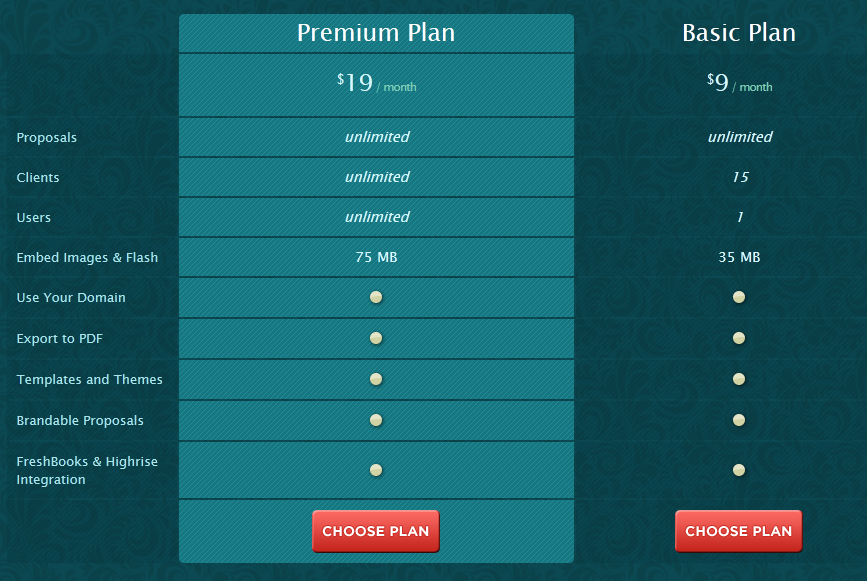
There are several problems with the way these plans are structured.
Problem #1: Plan names. Premium and Basic doesn’t mean anything to a potential customer, other than saying that one plan is cheap and the other expensive. Actually, looking at both price points, it’s more like cheap and cheap.
Problem #2: Both plans include every feature.
Problem #3: Plan limits. The Premium plan had unlimited proposals, clients, and users. Most everything is unlimited and the few limits placed on the Basic plan don’t incentivize upgrades (except for the user limit).
Problem #4: Complete lack of customer segmentation. Basically, these plans weren’t designed to ensure customers that received more value from using proposal software were appropriately charged.
So before thinking about price, I had to restructure my plans to eliminate these problems. This meant that I first needed to identify my customer segments properly.
Customer segments…
To segment customers, I needed to understand exactly which people were getting value out of Bidsketch, put them into related groups, and find out the differences between each of those groups.
I started off by sending several surveys and having conversations with customers.
One of the most helpful surveys was Survey.io. This survey asks a key question:
How would you feel if you could no longer use Bidsketch?
It’s a multiple choice question with five options and it helps you identify exactly who considers your product a “must have” product.
Once I had a couple hundred responses I created a targeted list of everyone that considered Bidsketch a “must have” product.
I researched every one of these companies by looking up their usage data (to cross-reference with survey results), and checking them out online.
Some of the questions I was trying to answer at this point:
- What industry do they belong to?
- How many users do they have?
- How often do they use Bidsketch?
- What features do they use the most?
The next step was to have phone calls with most of the founders/CEOs on the list.
Some key questions I asked in my phone calls:
- How many employees do you have and how many people use Bidsketch?
- How much time does Bidsketch save you on each proposal?
- How important is feature X to you/your team?
- Describe your typical/ideal proposal workflow.
The point of all of this research was to discover specific attributes that would better help me segment customers. I was also attempting to find out which key features were most important to each of these segments.
I found that I had three main segments:
- Freelancers — A one-person business that creates one to two proposals a month.
- Studio — Small business with multiple employees but only one person creates proposals.
- Agency — Small business with multiple employees and multiple people create proposals.
Plan design…
After all of that research, it became clear which specific features each of these segments valued most and which metrics I should target.
For example, looking at usage data and feedback from phone calls I saw that freelancers didn’t care about being able to use their own domain as much as a studio. This meant that I could potentially hold back that feature on the low-end plan.
To help me figure out which features to use, I created a list of the top features and ordered them by importance. Then, I removed core features or the ones that every segment would expect a product like mine to have.
- Analytics
Templates- Custom domain
- Team management
Proposal notifications- Integrations
- …
Out of this list came the features that I could experiment with when designing my new plans.
I briefly considered charging per user to focus on one key metric. But looking at the data I saw that there were only two major breaks and it had nothing to do with my main segments. So I decided against pursuing that strategy.
By this point, I had enough information that pricing became much easier.
Pricing is always hard. But knowing which segments you’re pricing a product for, and how much value they get out of your product, gives you a great starting point.
I ran so many experiments that I really don’t remember what the specific pricing points were, but I do remember starting with this:
- Low end – $9/month
- Middle tier – $19/month
- High end – $49/month
My experiments were very easy. All I did was change pricing for new customers in the backend and updated the marketing site to reflect the new pricing tiers.
Removing features consisted of removing the features within the pricing grid on the marketing site. In reality, every plan still received every feature but they didn’t know it until after they signed up and started using the product.
The end result of all that testing was this:
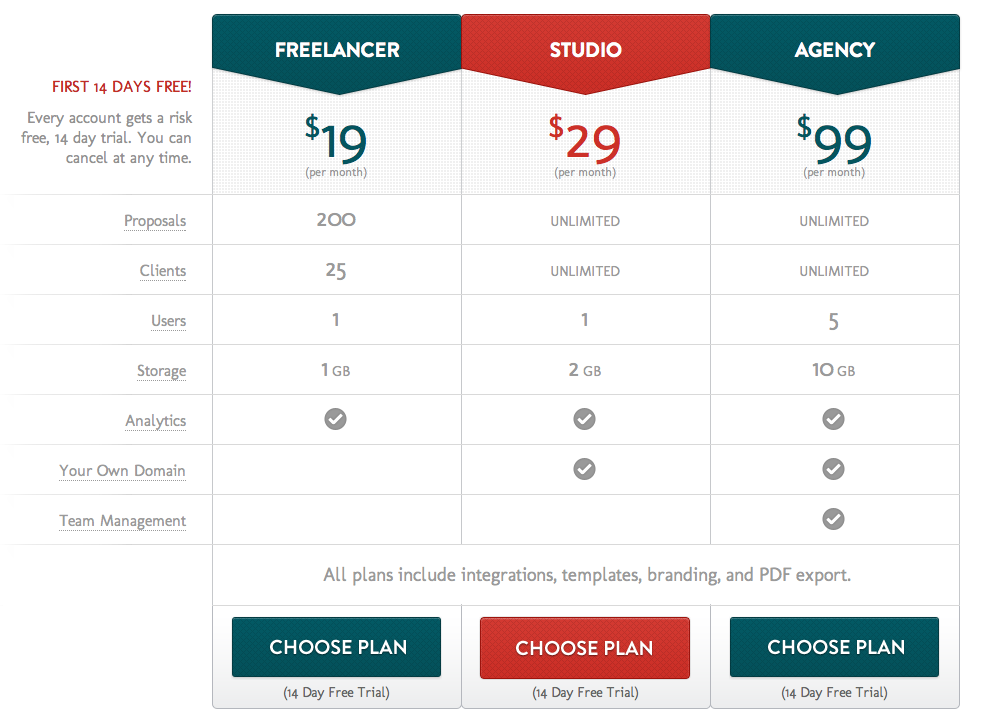
Results after the first couple of months:
- Biggest revenue increase I’ve ever had in a single month
- Average revenue per customer more than doubled
- Very minor drop in visitor to trial conversions
- Trial to paid conversions stayed the same
- Churn stayed the same
- Trippled our growth rate
I’m sure I can further refine and simplify my pricing but it’s a decent start considering what I had when I started.
While the increase in revenue has been great, the more valuable part of this exercise has been that I’ve gained a deeper understanding of my customer segments, which key things those segments value, and how to price according to perceived value.
Most importantly, by focusing on my customers, I’ve learned how not to let my own perceptions get in the way of charging enough money.
Enough money for what? Enough money to deliver an even better product to my customers.