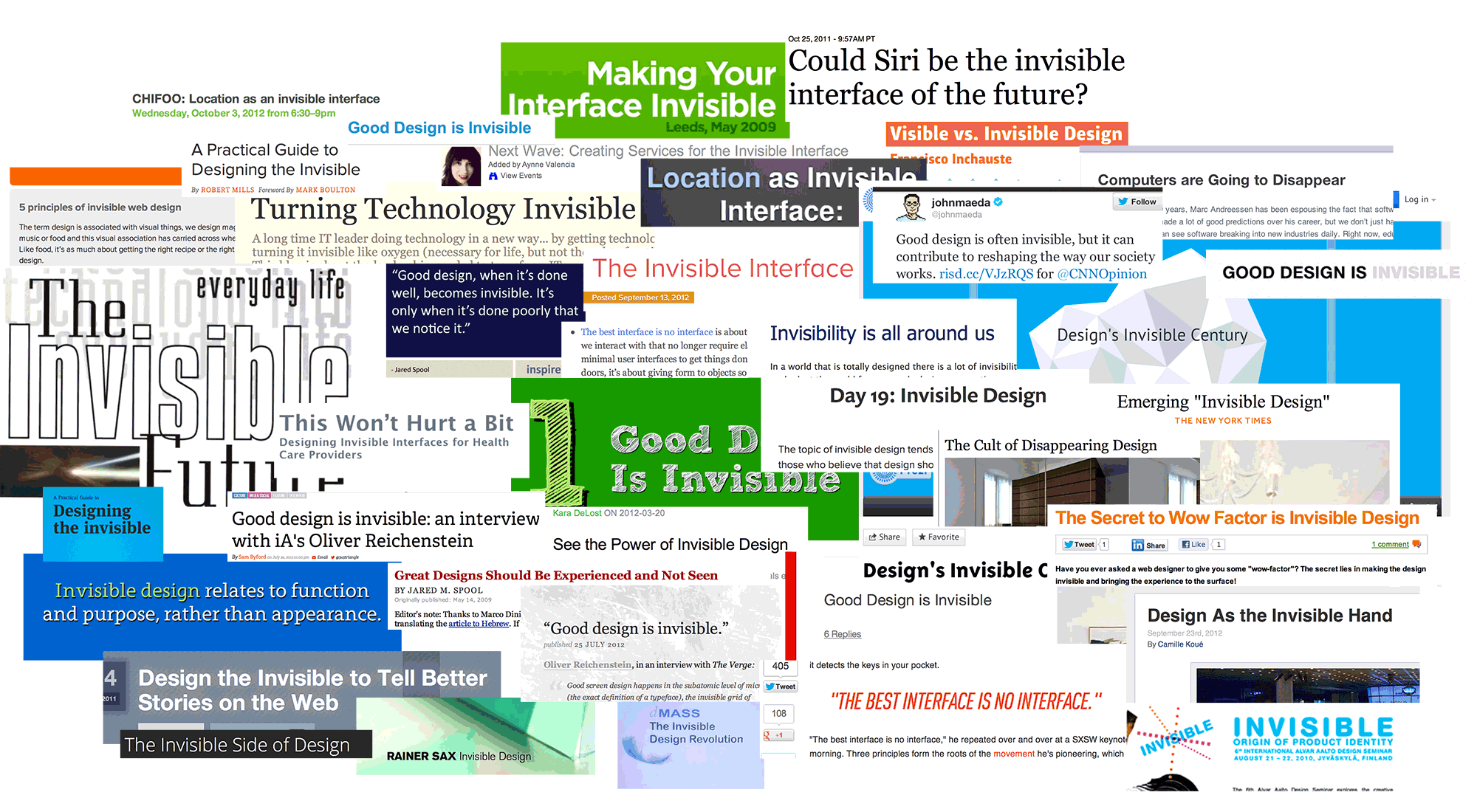
‘The best design is invisible’ is the interaction design phrase of the moment. The images above are from my ever-expanding collection of quotes about how design and technology will ‘disappear’, become ‘invisible’ or how the ‘best interface is no interface’.
The Verge has recently given both Oliver Reichenstein and Golden Krishna a platform to talk about this. This has spawned manifestos, films, talks, books, #NoUI hashtags and some debates about what it might mean. I’ll call this cluster of things ‘invisible design’.
I agree with some of the reasons driving this movement; that design’s current infatuation with touchscreens is really problematic. I’ve spent the last eight years rallying against glowing rectangles, studying our obsession with screens and the ways in which this has become a cultural phenomenon. In response I have been researching and inventing interfaces for taking interaction out from under the glass.
But I also take issue with much of the thinking for a few reasons that I’ll outline below.
1. Invisible design propagates the myth of immateriality
We already have plenty of thinking that celebrates the invisibility and seamlessness of technology. We are overloaded with childish mythologies like ‘the cloud’; a soft, fuzzy metaphor for enormous infrastructural projects of undersea cables and power-hungry data farms. This mythology can be harmful and is often just plain wrong. Networks go down, hard disks fail, sensors fail to sense, processors overheat and batteries die.
Computing systems are suffused through and through with the constraints of their materiality. – Jean-François Blanchette
Invisible design propagates the myth that technology will ‘disappear’ or ‘just get out of the way’ rather than addressing the qualities of interface technologies that can make them difficult or delightful.
Intentionally hiding the phenomena and materiality of interfaces, smoothing over the natural edges, seams and transitions that constitute all technical systems, entails a loss of understanding and agency for both designers and users of computing. Lack of understanding leads to uncertainty and folk-theories that hinder our ability to use technical systems, and clouds the critique of technological developments.
As systems increasingly record our personal activity and data, invisibility is exactly the wrong model.
By removing our knowledge of the glue that holds the systems that make up the infrastructure together, it becomes much more difficult, if not impossible, to begin to understand how we are constructed as subjects, what types of systems are brought into place (legal, technical, social, etc.) and where the possibilities for transformation exist. – Matt Ratto (2007)
In other words, as both users and designers of interface technology, we are disenfranchised by the concepts of invisibility and disappearance.
2. Invisible design falls into the natural/intuitive trap
The movement tells us to ‘embrace natural processes’ and talks about the ‘incredibly intuitive’ Mercedes car interface. This language is a trap (we should ban the use of natural and intuitive btw) that doesn’t give us any insight into how complex products might actually become simple or familiar.
Invisible design leads us towards the horrors of Reality Clippy. Does my refrigerator light really go off? Why was my car unlocked this morning? How did my phone go silent all of a sudden? Without highly legible systems for managing and understanding all of this ‘smartness’ we are going to get very lost and highly frustrated. The tricky business of push notifications and the Facebook privacy train wreck is just the tip of the iceberg.
The example of the Nest thermostat invisibly ‘learning’ your habits to control your home temperature is a good one. But the Nest has a highly visible interface that reassures you as to its status, tells you when it is learning, and a large dial for adjusting temperature. Beautiful, legible microinteractions. A Nest without these visual and direct manipulation interfaces would be useless, uncanny and frustrating. Nest wants UI.
The discussion around invisible design often talks about using sensors and tangible interfaces instead of visual interfaces. But these systems are not inherently simpler or more familiar. They have their own material qualities with edges and ‘grain’ that need to be understood and learnt. Their literal invisibility can cause confusion, even fear, and they often increase unpredictability and failure.
Revealing the invisible seams of RFID interfaces in the Touch Project.
In our work with interface technologies such as RFID and computer vision, we’ve discovered that it takes a lot of work to make sense of the technologies as design materials. So it’s not useful to say that UI is ‘disappearing’ into sensing, algorithms and tangible interfaces, when we don’t fully understand them as UI yet.
3. Invisible design ignores interface culture
Interfaces are the dominant cultural form of our time. So much of contemporary culture takes place through interfaces and inside UI. Interfaces are part of cultural expression and participation, skeuomorphism is evidence that interfaces are more than chrome around content, and more than tools to solve problems. To declare interfaces ‘invisible’ is to deny them a cultural form or medium. Could we say ‘the best TV is no TV’, the ‘best typography is no typography’ or ‘the best buildings are no architecture’?
Much of our work at BERG is not just about solving problems, but about cultural invention:
We’re not interested in this idea of the invisible technology in a modernist sense. Tech won’t be visible but only if it’s embedded into the culture that it exists within. By foregrounding the culture, you background the technology. It’s the difference between grinding your way through menus on an old Nokia, trying to do something very simple, and inhabiting the bright bouncy bubbly universe of iOS. The technology is there, of course, but it’s effectively invisible as the culture is foregrounded.” – Jack Schulze (in Domus 965 / January 2013)
We should be able to simultaneously celebrate the fantastic explosion of diversity in UI, and develop healthy critique around the use of interfaces like touch screens. But by calling for UI to disappear altogether so that things can be more efficient, we remain in the same utilitarian and rational mindset that produces inert technological visions like this, rather than seeing interfaces as part of the cultural landscape.
4. Invisible design ignores design and technology history
The movement ignores at least thirty years of thinking in design and technology. A few examples:
Much of the recent invisible design discussions repeat the thinking in Jared Spool’s ‘Great Designs Should Be Experienced and Not Seen’ and Donald Norman’s ‘Invisible Computer’. But a better reference point would be Don Norman’s earlier book, The Design of Everyday Things, where he instead talks about the ‘problems caused by inadequate attention to visibility’ and supporting or managing our mental models of systems. We need a lot more thinking about our mental models of algorithms in particular.
Adam Greenfield has investigated the social and ethical issues around the development of ubiquitous computing systems, and is particularly concerned by its disappearance:
“Ubiquitous systems must contain provisions for immediate and transparent querying of their ownership, use, and capabilities. Everyware must, in other words, be self-disclosing. Whether such disclosures are made graphically, or otherwise, they ensure that you are empowered to make informed decisions as to the level of exposure you wish to entertain.” – Adam Greenfield (2006)
Some designers have talked about the actual qualities they want from ubiquitous computing interfaces, such as polite, pertinent and pretty:
“The vast quantities of information that personal informatics generate need not only to be clear and understandable to create legibility and literacy in this new world, but I’d argue in this first wave also seductive, in order to encourage play, trial and adoption” Matt Jones & Tom Coates (2008)
Matthew Chalmers has, more than anyone else, revealed the history of seamlessness. Seamlessness is ‘the deliberate “making invisible” of the variety of technical systems, artifacts, individuals and organizations that make up an information infrastructure. This work actively disguises the moments of transition and boundary crossing between these various parts in order to present a solid and seemingly coherent interface to users.’ (Ratto 2007). Although Mark Weiser is often thought of as an advocate of seamless systems, Chalmers found that:
Weiser describes seamlessness as a misleading or misguided concept. In his invited talks to UIST94 and USENIX95 he suggested that making things seamless amounts to making everything the same, reducing components, tools and systems to their ‘lowest common denominator’. He advocated seamful systems (with “beautiful seams”) as a goal. Around Xerox PARC, where many researchers worked on document tools, Weiser used an example of seamful integration of a paint tool and a text editor (Weiser, personal communication). He complained that seamless integration of such tools often meant that the user was forced to use only one of them. One tool would be chosen as primary and the others reduced and simplified to conform to it, or they would be crudely patched together with ugly seams. Seamfully integrated tools would maintain the unique characteristics of each tool, through transformations that retained their individual characteristics. This would let the user brush some characters with the paint tool in some artful way, then use the text editor to ‘search and replace’ some of the brushstroked characters, and then paint over the result with colour washes. Interaction would be seamless as the features of each tool were “literally visible, effectively invisible”. Seamful integration is hard, but the quality of interaction can be improved if we let each tool ‘be itself’. – Matthew Chalmers (2003)
Matt Ratto investigates the darker side of this drive towards invisibility, revealing that seamlessness encourages:
“a particular kind of passivity and lack of engagement between people and their actions and between people and their social and material environment” and that we must “critique the clean, orderly, and homogenous future that is at the heart of these modernist visions” – Matt Ratto (2007)
And Anne Galloway suggests that it is in the seams where the design work can be done:
“Although seamlessness may remain a powerful and effective metaphor to guide particular projects, when it comes to actually getting the work done—and the challenges of having to do it with people who can be very different from each other—then I suggest it is in everyone’s best interests to recognise the importance of seams and scars in marking places where interventions can be made, or where potential can be found and acted upon.” – Anne Galloway (2007)
In interaction design we need to look at the long history of Durrell Bishop’s work, one of the strongest advocates for self-evident design, whether it is physical or virtual, through his teaching and design practice. Durrell’s ‘Platform 12’ in the RCA Design Products course attempts to see design as:
“a celebration of a model for how things work, where once again we can treat function as beauty, instead of merely treating design as form and image.”
Durrell’s work on the Marble Answering Machine (1992) is a brilliant piece of self-evident design, and remains a touchstone for all interaction design work.
Designers also need to look at the first four chapters of ‘Where the action is’ by Paul Dourish which give a coherent account of the relationships between human abilities and computer interfaces over the last 50-60 years. Dourish shows how interfaces are not becoming invisible, but how they are increasingly social and tangible.
And finally, from a design perspective, there is a long tradition of making complex products legible and understandable. Industrial designer Konstantin Grcic talks about the relationship between the technologies and the use of an object:
“A machine is beautiful when it’s legible, when its form describes how it works. It isn’t simply a matter of covering the technical components with an outer skin, but finding the correct balance between the architecture of the machine… and an expressive approach that is born out of the idea of interaction with those using the object.” – Konstantin Grcic (2007)
And perhaps more famously, Dieter Rams has always talked of honesty and understanding in his product design practice. Making a product understandable is one of his Ten Principles of “Good Design”.

This drive for understanding needs to go further than physical form (as it has done at Apple) and start to inform the design of systems and UI.
Towards legible, evident interaction
We must abandon invisibility as a goal for interfaces; it’s misleading, unhelpful and ultimately dishonest. It unleashes so much potential for unusable, harmful and frustrating interfaces, and systems that gradually erode users’ and designers’ agency. Invisibility might seem an attractive concept at first glance, but it ignores the real, thorny, difficult issues of designing and using complex interfaces and systems.

We might be better off instead taking our language from typography, and for instance talk about legibility and readability without denying that typography can call attention to itself in beautiful and spectacular ways. Our goal should be to ‘place as much control as possible in the hands of the end-user by making interfaces evident’.
Of course the interfaces we design may become normalised in use, effectively invisible over time, but that will only happen if we design them to be legible, readable, understandable and to foreground culture over technology. To build trust and confidence in an interface in the first place, enough that it can comfortably recede into the background.