by Dave Arnold
Because I lost a bet I went raw vegan for a week. No meat, fish, egg or dairy, and nothing that had ever been raised above 118 degrees F.
The Bet:
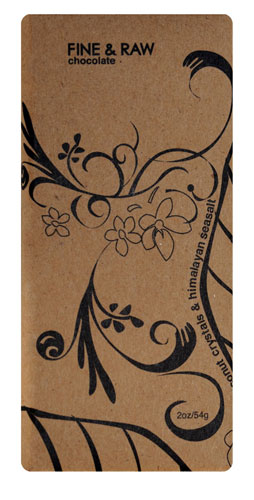
A while back on the radio I was trash-talking raw chocolate –chocolate whose component ingredients have never been heated above 118 F. I contended that good raw chocolate was an impossibility because many of the characteristic flavors of chocolate develop during roasting, a process perforce over 118 F. I was so confident, I boasted I would eat raw-vegan for a whole week if someone could produce a raw chocolate even resembling real chocolate. I got hosed. My ex-intern Grace brought me a bar of Fine & Raw Chocolate. It wasn’t my favorite chocolate, and the texture wasn’t right (too soft), but it was clearly chocolate.
What I Thought Would Happen:
Any constraint you place on yourself is an opportunity to grow and learn. Learning to prepare raw vegan food, I figured, would make me a better overall cook. Problem is: raw vegan food is really hard to do well. I read ten different raw vegan cookbooks and very quickly realized that most recipes take a loooong time to make –like days — and have enough steps to make my sous-vide/rotovap/liquid-nitrogen and centrifuged concoctions seem simple. A typical recipe calls for sprouting wheat (a several day process) then soaking those sprouts in water for an additional day. That water takes on a fermented taste and forms a basic raw ingredient called rejuvelac. The rejuvelac is then blended (in a vita-prep, mind you, not your crappy home blender) with raw cashews that you’ve soaked for 12 hours. The resulting mixture is then allowed to strain and set up for another 24 hours in your fridge. What you are left with is cashew cheese. It tastes pretty good, but it should not be called cheese –it should have its own name. Yummy cashew paste? Recipes like this aren’t technically difficult, but the time management was a pain – I usually allot about 15 to 30 minutes to produce dinner.
Though I had grand visions of the miraculous dishes I would create, only two came to pass.
Stuff I thought I would be great but didn’t try:
The rotovap: The rotary evaporator lets me do distillations well below 118 F. I can take a raw vegan wine (wine was my savior on the week long raw stint), and turn it into a raw brandy to make honest-to-god raw cocktails. I had a small amount of raw brandy lying around from an old experiment, so I took a swig, but because my rotovap is packed up right now, I couldn’t make any more. Drat. For more on rotary evaporation, see here.
The centrifuge: The centrifuge lets you clarify juice without ever heating it –another great plus for raw vegan cocktails. I’m sure most raw foodists are used to consuming mass quantities of blended stuff, but give me a pure clear beverage any day. The centrifuge also excels at making nut milks (see here). Although we use hot water for our nut milks, you wouldn’t have to. The yield is high — a huge plus when using expensive ingredients like raw organic nuts. Raw foodies…. go buy a centrifuge!
Stuff I did try that I liked:
“Earl Grey” White Tea: I knew giving up caffeine cold-turkey would be problematic. I typically begin my day with two double espressos, and without them I am an ornery mess with a headache. You can’t have coffee on a raw diet even if you cold-brew because coffee is roasted. Ditto with most teas, which are fired at temperatures well in excess of the raw magic numbers — with one exception. Silver needle white tea is the least processed tea, sun- dried and then lightly fired at extremely low temperatures (like 110 F). I bought some at Harney & Sons.
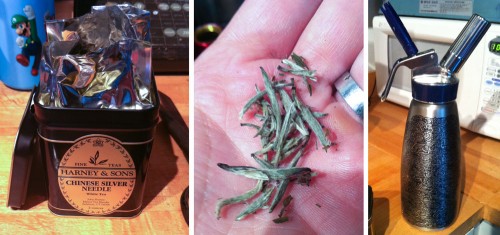
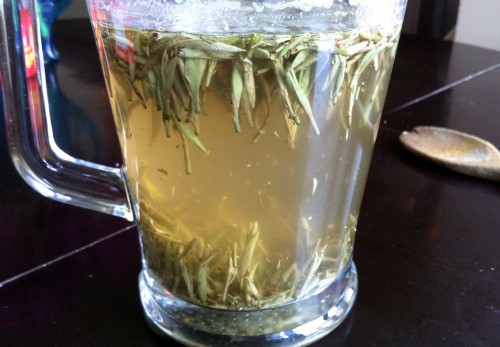
White tea is so delicate that even using conventional brewing temperatures, the beverage is light and not very robust. Cold brewing does almost nothing. Maybe the leaves are difficult to hydrate because they are less mechanically damaged than most tea leaves? I turned to N2O infusion, a technique I developed last year, to solve this problem. It works like this: pressurized nitrous oxide (N2O) forces liquids into porous foods –in this case tea leaves– inside a whipped cream maker. That pressurized infused liquid picks up flavor quick. After a short amount of time you suddenly release the pressure in the whipped cream maker. The nitrous then bubbles violently and carries the flavor back out of the food again. More on the technique here. I didn’t measure the amount of tea I used per quart of water (I was too rattled by my lack of caffeine), but I can tell you that I used two N2O chargers per quart of water and let it infuse for 2 minutes under pressure. After I vented the the pressure I allowed the tea leaves to stay in the liquid for 1 hour, after which I drained the leaves and pressed out the liquid. I got a pretty delicious tea.
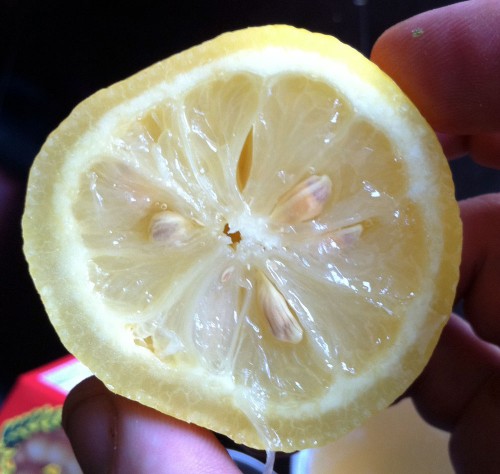
I then added some raw honey and some funky lemon. What is a funky lemon? Some lemons in my fridge accidentally froze. I pulled them out, allowed them to thaw on my counter, and forgot about them for two days. I was going to throw them out, but when I gave them a sniff they reminded me of bergamot, the characteristic citrus flavor of Earl Grey tea. To see if I could replicate this result I froze some lemons on purpose and allowed them to thaw for a day and a half. Yep, bergamot. What is happening: the freeze-thaw cycle damages the tissue in the lemon, allowing part of the juice an oil to “degrade” into stale juice, but the stale/fresh combo is somehow pleasant. I did some preliminary research, and one of the four major aroma compounds in bergamot –(Z)-limonene oxide, is also a breakdown compound of air-aged lemon oil. I need to do more experiments; I have had interesting results with frozen and thawed fruits (apples, pears, persimmons, quince) for years but have never studied them in depth.
N2O infused silver needle white tea+raw honey+funky lemon=Raw Earl Grey=Dave not a complete monster.
Rapid infusion in general: Many raw food recipes for vegetables call for an extended soaking time in a flavorful liquid, like vinegar or sauerkraut juice, followed by a low temperature dehydration step. The soaking does two things: 1. adds flavor; 2. removes some liquid from the vegetables through osmosis, making them less crisp and giving them more of a “cooked” texture, which is further accentuated by the low temp dehydration. Mushrooms respond particularly well to this treatment, though many vegetables benefit –onions, peppers, zucchini, etc. Flash infusion, either with a vacuum machine or with N2O infusion (if you don’t have a vacuum), or even Vacu-Vin flash infusion (see here) really accelerates the process. I was able to prepare mushrooms in 1.5 hours instead of the 5 the recipe called for. Win.
Stuff I tried that I hated:
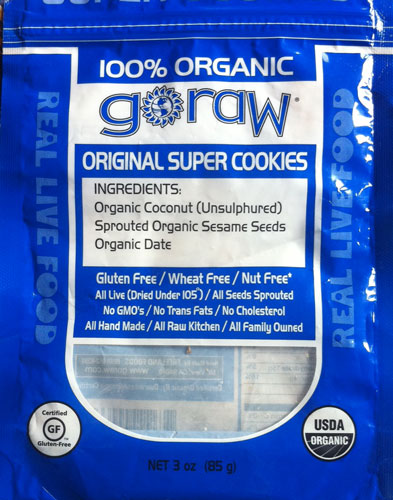
Flax crackers: Man did these suck. I soaked and blended flax seeds, sauerkraut juice (I didn’t have rejuvelac), and some other junk I can’t remember into a smooth paste and dehydrated them at 110 F for 24 hours. Flax seeds are the go-to cracker-and-crust-making ingredient for raw foodists because the seeds grind to form a gummy paste that sets up stiff enough to dehydrate into a cracker. They were crispy enough when dry, but they were beyond bad when used as the base for raw vegan nachos. They lost their texture and took on an unappetizing bleach-y aroma when wet. Now I know why all the commercial raw cracker manufactures over-flavor their wares with spices — gotta cover up the nasty flavor. I bought one brand of raw vegan cracker that I truly enjoyed and would eat anytime — Go Raw Flax Snax. Their stuff is all-sprouted. Maybe that is why it’s better?
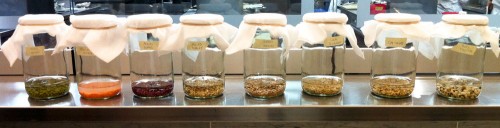
Sprouts: I really dislike raw sprouts. Nastassia and I sprouted 8 different seeds. I hated them all. They all tasted vaguely of poison. I fed some to a health-loving chef-friend, and he said they were OK. I made him taste twice to be sure he didn’t detect the poison flavor I was noting. He didn’t. Please never bring an alfalfa sprout into my house, as they are a magic combo of probable contamination, poor texture, and bad taste. Crap on raw sprouts.
So what did I eat most of the time?
Unless you are
-rich and can buy many prepared foods and go to nice raw restaurants all the time, or
-have enough time to go through the raw-food time-consuming recipe rigamarole, or
-someone for whom food is merely fuel
you are in for a shock when you go raw vegan. Most mornings I pounded all sorts of fresh fruit, which gave me a sugar high but sent me crashing hard mid-day. I ate a lot of avocados. A lot. Avocados are the Jesus-fruit for raw foodists –they taste great and are high in fat. My go-to meal was avocado/tomato (not in season, greenhouse grown, Campari tomatoes)/raw sauerkraut (another life-saver)/chopped onion/extra-virgin olive oil salad. Because I own a vita-prep, I was able to make a corn soup and cauliflower soup from the Charlie Trotter/Roxanne Klein Raw cookbook. Both were quick and ok, but left me wishing I had a big hunk o bread. I eventually became so distraught at the food I was eating that I took the whole family out to Pure Food and Wine, Sarma Melngailis’ raw restaurant in New York. It was the one good meal I had that week.
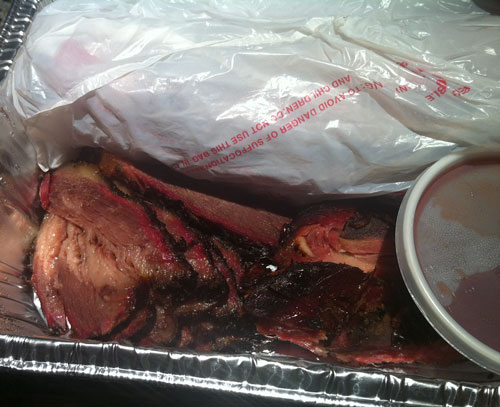
My first post-raw-vegan meal was a plate of barbecue brisket and ribs from Black’s Barbecue in Lockhart, outside of Austin, Texas.  A healthy meat-detox after that week of veggie-binging.
Raw Veganism, My Take:
Adherents of raw vegan-ism believe that food that hasn’t been cooked and is minimally processed contains active enzymes that are vital to our health and well-being. Typically, cooked food is seen as a form of poison to be avoided. Typical claimed benefits of this diet are an increase in energy, facility of weight loss, and the appearance of a healthy glow. Here are some specific claims, my responses, and some gripes:
- Enzymes and the 118 F (or 106F, or whatever) rule: Almost all raw literature sites a temperature in this range as one at which enzymes are broken down. This notion is simply not true. Some enzymes are denatured at those temperatures but many are not. Even enzymes that will denature at 118 F typically take a while to do so. Take beer as an example. To make beer you need malted barley –barley that has started to sprout, activating the enzymes (alpha and beta amylases), that break starches into sugars. Malted barley is invariably kiln dried well above 118F to develop flavor and preserve its enzymes. When it comes time to actually use those enzymes to make sugar, in a process called mashing, the temperature is usually between 140 and 158 degrees F. Down at 118 F they just aren’t active enough.
- It is a good idea to eat all sorts of active enzymes: First, your body makes all of its own enzymes. Secondly, even if you lacked enzymes, they, like all proteins, need to be broken down into short polypeptides to be absorbed through your small intestine.You can’t increase the enzyme count in your cells by eating enzymes because they aren’t absorbed into your bloodstream. All the influence an eaten enzyme can have, therefore, happens in your mouth, stomach, and intestines. Some eaten enzymes are destroyed by the acid in your stomach and the native protease enzymes in your stomach and small intestine. Those that make it through might have some beneficial effect, but I haven’t seen any (real) studies that show why. Your intestines are teeming with living bacteria that produce loads and loads of enzymes that help break things down in your gut. The way I see it, obsessing over the few extra enzymes you get from raw food is like dumping water in the ocean to raise the tide.
- Raw food is better, and everyone would eat that way if they knew enough or had enough willpower: I couldn’t disagree more. I don’t feel raw food is healthier in any way to cooked food. I think you should eat what tastes good and is well prepared in moderate quantities. Eating 3 pints of fresh blueberries because it is all you can find at the corner fruit stand that looks remotely appealing and you can’t sate your hunger ain’t healthier than having a piece of delicious baguette. Even if eating raw was not an imposition I would not do it. I don’t see a valid health advantage, plus I am guided solely by taste.
- Raw food helps you lose weight: I feel this is true. You don’t digest raw food well. I don’t know how to put it politely. I’ll just say my body didn’t alter the raw food I ate very much; plus it made me an intestinal transit-time race car driver.
- Raw food gives you energy: Not in my experience. My energy took a steep nose dive during my week of raw food. Even though I am 40 and non-athletic with two small kids, I am a pretty high energy guy. Many people think I take meth-amphetamines because I get so wound up. Raw food left me feeling like I had lead in my legs all the time. I was told by a raw food friend that I have to do the diet longer than a week to see the benefits. I suspect that after a couple of weeks your body goes into a starvation euphoria where you think you have a lot of energy.
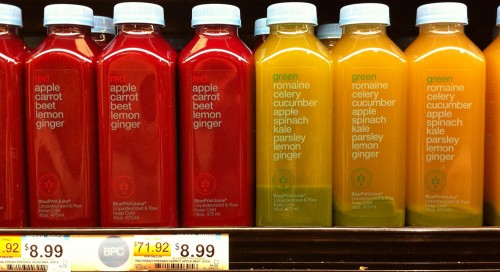
- Raw Food is more Natural: Not so fast. Most raw food recipes are highly processed, using dehydrators, high speed blenders, and expensive juicers. That’s not a negative thing, but it isn’t “natural” either. Furthermore, the raw diet isn’t natural for anyone that doesn’t live in a tropical or semi-tropical climate where good things that can be eaten raw grow year round. The raw diet, as it is now practiced, is elitist. It requires many expensive or difficult to source ingredients that usually can’t be sourced locally year round by most people. Elitist diets aren’t bad, but they aren’t “more natural” than normal diets. How can they be natural if they rely on modern transportation and farming techniques to make them possible? As an aside, prepared raw food is preposterously expensive. Almost everything I bought cost eight bucks. A tube of cashew “cheese?” Eight bucks. A tiny bag of raw chips? Eight bucks. Miniature raw chocolate bar? Eight bucks. And so on.
- The Raw Glow: I am loath to put any credence into this claim but I will relate this incident 5 days into my raw diet. I am a glow-in-the-dark translucently white guy who prefers the troglodyte life and avoids the sun like the plague it is. I was walking through the farmers market perusing the raw-food possibilities when a woman handed me a flier for a white water rafting company saying, “take this, you look out-doorsy.” Holy crap. The raw-food glow.