Transience is celebrated in dozens of lesser-known practices too, such as moon viewing. You can’t help but admire a country that sets aside a special evening in September for contemplating the full moon. Or that holds lavish festivals to give thanks for the work done by inanimate objects, including everything from old kitchen knives to calligraphy brushes and even used sewing needles.
Transience forms the Japanese sense of beauty.
And there are the growing ranks of Moss Girls. Inspired in part by Hisako Fujii’s best-selling book, Mosses, My Dear Friends, moss-viewing has become increasingly trendy, especially with young women, who go on guided tours to Japan’s lush moss-carpeted forests. This goes way beyond just stopping to smell the roses: Moss Girls get down on hands and knees with a loupe to contemplate the lovely growths.
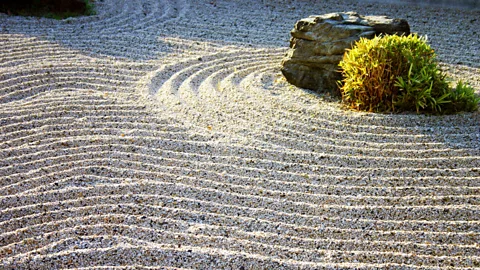
And while to the less mindful among us moss may seem insignificantly small, no Zen garden is complete without its moss-covered rock or stone lanterns. It’s the living embodiment of wabi-sabi – the spirit of humble, rustic impermanence that defines Japanese aesthetics.
But there’s more to Japanese mindfulness than gazing at bugs and blooms. Countless practical applications govern virtually every aspect of daily life, all designed to help you ‘be in the now’. At school, days begin and end with a short ceremony, where greetings are exchanged and the day’s events are announced. Before and after each class, students and teacher stand, bow and thank each other. And before starting the lesson, students are asked to close their eyes to focus their concentration.

 Angeles Marin Cabello
Similarly, construction workers engage in collective stretches to limber up for the day’s work. In the office, a colleague will tell you 'Otsukaresama', (literally ‘you’re tired’), as a way of saying thanks for the work you’ve done. At meetings, hand someone your meishi (business card) and they'll examine it carefully and make a comment, never dreaming of just sticking it in their pocket.
These practices are a way of what Kabat-Zinn calls ‘purposefully paying attention to things we ordinarily never give a moment’s thought to’. They help keep you conscious of where you are and what you are doing throughout the day, rather than stumbling from one hour to the next on autopilot, focused only on going-home time.
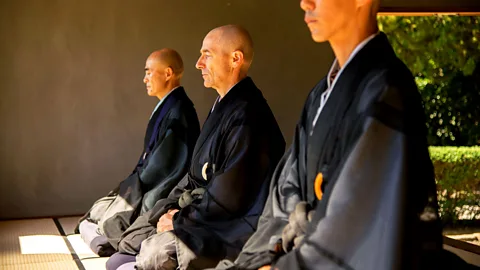
Like so much of Japanese culture, the roots of all these customs lie in Zen. “Mindfulness has been part of the Buddhist tradition for centuries,” said Takafumi Kawakami, priest at Kyoto’s Shunko-in temple. In the Kamakura Era (1185-1333), Zen became popular among the samurai class and had a formative influence on the arts, including tea ceremony, flower-arranging and landscape gardening. In the Edo Era (1603-1868), a time of peace, Zen found its way into the education of common people.
 Shinshoji Zen Museum and Gardens
For its practitioners, Zen is an attitude that permeates every action: bathing, cooking, cleaning, working. “Every activity and behaviour in daily life is a practice [of Zen],” said Eriko Kuwagaki of Shinshoji Temple in Fukuyama, Hiroshima Prefecture.
A delightful old Zen story, collected in Paul Reps’ 1957 anthology of Zen texts, Zen Flesh, Zen Bones, illustrates this point. After studying to be a Zen teacher for many years, Teno went to visit Nan-in, an old Zen master. It was raining heavily and, as is customary, Teno left his clogs and umbrella in the entrance before entering Nan-in’s house.
Every activity and behaviour in daily life is a practice [of Zen].
After greeting each other, Nan-in asked Teno: “Did you leave your umbrella to the left or right of your clogs?” Unable to answer, Teno realised he was still a long way from attaining Zen, and went away to study for six more years.
Most of us might not want to take things quite so far. Nevertheless, Nan-in’s question remains relevant, as more and more researchers are discovering that present-moment awareness not only boosts stress resilience and well-being, but also lowers levels of anxiety and depression.