
 Getty Images
Your face can be your fortune or your downfall - and it's not just a question of beauty. Others may be unconsciously judging your features in ways you don't realise, says David Robson.
Imagine you grew up with a non-identical twin. You have the same upbringing, the same IQ, the same education, the same interests. Both of you are equally gregarious, equally adventurous, equally interesting. You both work out at the same gym, and eat the same food.
Spiritually and mentally, you are doppelgangers. There’s just one small difference: your faces. Maybe one of you has the kind of wide-eyed, childlike features of a bush baby. Maybe the other has stronger cheekbones and a more rugged (some might say Neanderthal) brow.
Over the years, how do you think your lives would play out? Would you follow the same routes in life, or would the subtle differences in your appearance help send you on alternative paths?
 Getty Images
Within a split-second, others judge whether you are competent and trustworthy; whether you are a leader or a follower
Sadly, the answer is the latter. Within a split-second of laying eyes on you, others will have decided whether you are competent and trustworthy; whether you are a leader or a follower. And those prejudices might shape key events in your life, determining everything from your friendships to your bank balance.
“Although we like to think we make decisions in a rational way, we are often swayed by superficial cues,” says Christopher Olivola at Carnegie Mellon University. “And appearances are a particularly superficial, yet very strong cue.”
In the past, this “face-ism” (as Olivola and his colleagues call it) was considered an unfortunate fact of life. But the more they come to understand its pervasive influence, the more they are beginning to wonder if it should be treated like any other prejudice. If so, it could be time to take action.
Armed robbery is one of the only professions where beauty is never a virtue
Given our obsession with celebrity culture, physical beauty may appear the greatest source of face-ism. Beginning as early as the 1990s, economist Daniel Hamermesh has found that more attractive people can earn 10 to 12% more – for professionals as diverse as American football players, lawyers, and even his fellow economists. “Which is a scary thought,” he says today. In fact, one of the only exceptions, he found, was armed robbers. “If he can scare you into giving you the money, he doesn’t need to use violence.” Indeed, as BBC Future has explored before, good looks aren’t always a golden ticket for the law-abiding, either. A woman considered to be more beautiful, for instance, may find it harder to get a top job if the interviewers thought it undermined her credibility.
In any case, our preoccupation with beauty may have caused us to neglect the many other forms of facial prejudice, as Olivola’s colleague Alexander Todorov at Princeton University found 10 years ago. He asked participants to look at photos of US politicians running for Congress and Senate for just one second and then to judge how “competent” they looked on a numerical scale. Even when he took into account other factors, such as age and attractiveness, the participants’ snap judgements predicted who would win a seat with nearly 70% accuracy.
 Getty Images
More recent studies have shown similar results, all examining how facial appearance feeds success, irrespective of your sex appeal. The more dominant you look, the more likely you are to be hired as a CEO – and the higher your pay packet, for example. In the military, meanwhile, scientists have asked people to judge faces of cadets for perceived dominance. Those with the higher ratings were more likely to climb the ranks later in life.
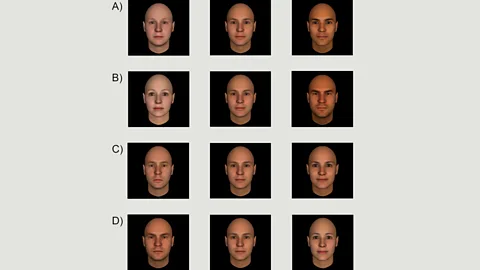
Admittedly, this centres on completely subjective reports. How do we know what makes an honest, competent or dominant face? One possibility is that we are simply responding to facial expressions – an open smile, or an angry frown. There’s no doubt that it does make a difference. Even so, the evidence suggests we are also reading other, more permanent cues. For instance, Olivola and Todorov have used carefully designed computer generated pictures with neutral expressions to control for all other factors. By asking subjects to rate them, and comparing the ratings of many different photos, the team has then been able to create a kind of digital photo-fit that best captures the subtle characteristics that signal each trait. The resulting pictures suggest that we are reacting to slight differences across the whole face – everything from the shape of the eye-brows to the underlying bone structure. See the faces below to judge whether you look particularly competent, dominant, extrovert or trustworthy.
 Christopher Olivola, Friederike Funk, Alexander Todorov
You might like to think that you would never be so shallow – but the fact is that whenever you meet someone, you spontaneously appraise them. In fact, Todorov has shown that 40 milliseconds are all it takes to form a rapid impression of someone’s personality – that’s about a tenth as long as a single blink of the eye. What’s more, it appears to be a life-long habit: even three- and four-year-olds decide who looks “mean” or “nice” based solely on appearances.
It’s hard to understand why we might have evolved a sign on our face saying ‘don’t trust me'
Those fleeting judgements may not be so worrying, if they were mostly accurate. And indeed, they do contain a small kernel of truth. Jean-Francois Bonnefon at CNRS in France and colleagues recently asked participants to play an economic game – in which they were given a few euros and could decide whether or not to invest it in another player, who could then choose whether to keep (the dishonest option) or share their profits (the honest option). Based solely on a single photo, the participants turned out to be able to predict what route their competitor would take, slightly better than that of pure chance. It raises some interesting evolutionary questions, he says. “It’s hard to understand why we might have a sign on our face saying ‘don’t trust me'." As BBC Future has explored before, your face can also reveal secrets the levels of your hormones or the health of your immune system.
Practically speaking, though, our accuracy is so poor it probably does more harm than good. “People put too much weight on appearances and neglect what they already know,” says Olivola. In games measuring trust and honesty, for instance, participants are willing to trust someone with an innocent-looking face, even when there is already tangible evidence that their partner has cheated beforehand.
 Getty Images
It’s not hard to see how these kinds of rapid first impressions could begin to lead you and your imaginary twin down very different trajectories. Whether you are entering a party, meeting your in-laws, attending a job interview or applying for a bank loan – your looks could be deciding your fate. It’s a particular thorny issue in today’s hyper-connected world, says Olivola. “Nowadays, with online profiles, we can form impressions before we talk to someone, before we even meet them.” Suppose you are hiring a new assistant. You may have every intention of reviewing a CV objectively, but once a photo has planted a seed of bias in your mind, it may be too late. “It can change the way we interpret the subsequent information,” he says. Bonnefon agrees. “It’s probably impossible to train people not to make the impressions – it’s an automatic behaviour.”
Given these concerns, Olivola and Todorov recently wrote a paper arguing that psychologists should begin to investigate ways to combat face-ism. “If a decision is important, I would try to structure the information so that faces come at the end of the decision process,” says Todorov. “When we interview graduate students for admission, I know whether I would like to work with them before I meet them. The most important information is in their past performance and their letters of reference.” Olivola even suggests you could interview candidates behind a screen, although he agrees it may not be a realistic solution. Many professional orchestras, however, have found that blind auditions can reduce the influence of other prejudices – one study found they significantly improve the selection chances of female musicians, for example.
Do we want to spend government money protecting bad looking people when other groups merit more attention?
As Hamermesh argues in his book Beauty Pays, prejudice based on appearances could be a legal issue – if you can prove that you are not earning as much as your more-attractive colleague. Creating and implementing new laws costs money, however, and he’s not sure that this warrants the resources when there are more pressing matters at hand. “The question is, do we want to spend government money protecting bad looking people when – it’s my personal view – other groups merit more attention?” he says. Certainly, no one is claiming that face-ism should eclipse our efforts to fight other kinds of prejudices – like sexism or racism. (Although it’s possible it may in fact inflate those other biases, when they overlap.)
Whether or not we would want these issues to enter the courts, we should at least take the time to acknowledge our superficiality. Unlike most kinds of prejudices, we are both the victims and the villains of face-ism: everyone will have judged someone else unfairly, based on their appearance, and we’ve all been judged in return. And that’s an ugly truth that’s worth facing.