
 Getty Images
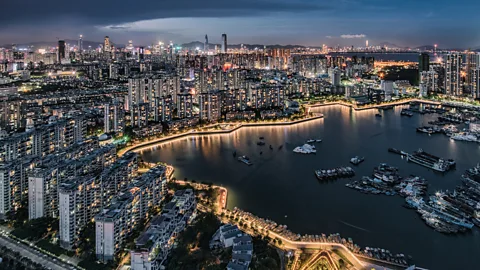
In just 40 years, Shenzhen has transformed from a fishing village to a booming innovation hub, with skyrocketing economic and population growth.
Getty Images
 Getty Images
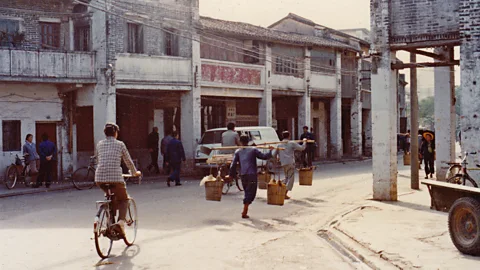
Forty years ago, Shenzhen was an isolated fishing village just north of Hong Kong, the point from which vast numbers of mainlanders risked their lives to illegally emigrate by swimming across the border to their prosperous southern neighbour.
Then, in 1980, it became one of China’s first Special Economic Zones – small, controlled areas where the Chinese communist government first tested out market reforms before rolling out new policies nationwide. It was a move that would turn this town of fewer than 30,000 people into one of China’s most dynamic cities, with a booming economy and population to match.
Following the death of Mao Zedong, Chinese paramount leader Deng Xiaoping ushered in an era of economic reforms, overseas investment and greater openness in diplomatic affairs with the rest of the world. Shenzhen benefited from its adjacency to Hong Kong – at the time a successful, booming market economy run by the British.
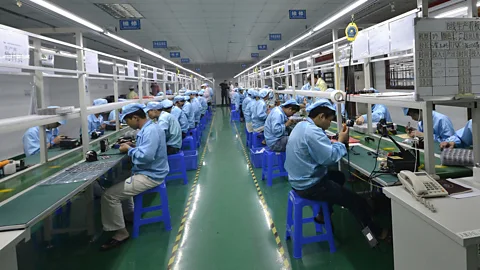
Tax incentives and freedom to trade without the approval of the Chinese government helped Shenzhen to lure Hong Kong manufacturers and investors to open factories there. The much cheaper labour and land earned the region the nickname "the factory of the world", but it quickly earned another – "the playground of Hong Kong’s rich". The huge gap in wealth and living costs between the two cities allowed rich transplants to lead luxurious lifestyles.
 Google
 Getty Images
Through the 1980s and 1990s, Shenzhen was considered to be a cheap and rather soulless manufacturing base. Mainly occupied by factories, and oriented as a low-tech and intensive-labour manufacturing centre, the population predominantly consisted of migrant factory workers from rural parts of China.
Fast-forward to 2017 and Shenzhen is now a national hub of innovation, technology, artificial intelligence, start-ups and bio-tech which avidly competes with its more famous neighbour.
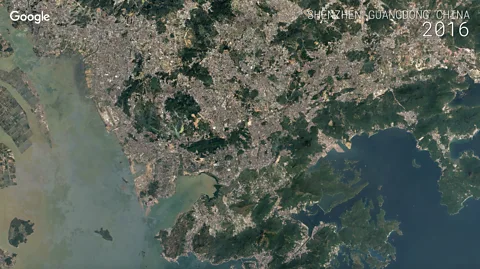
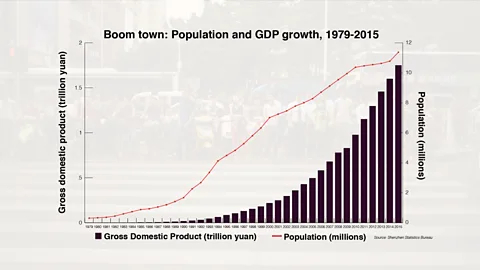
According to China’s official household registry, the population has risen from 314,000 in 1979 to about 11.37 million in 2016, and the city's GDP has grown from less than 200 million yuan ($29.25m) in 1979 to 1.75 trillion yuan ($256bn) in 2016.
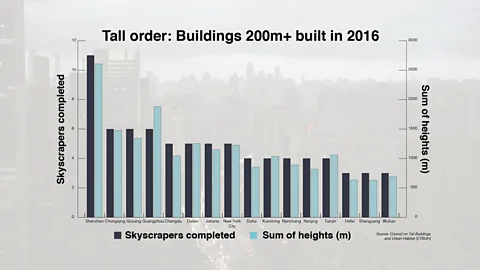
The growth can be seen in the city’s skyline – last year Shenzhen completed 11 skyscrapers taller than 200m, more than Australia and the US combined.
 Trevor Sochocki
 Getty Images
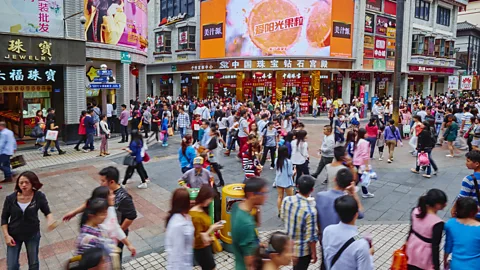
Thanks to a newer, more efficient transport system and urban planning, traffic is not as much of a problem as in Beijing and Shanghai. And due to the major influx of Chinese migrants into the city over the past 37 years, Shenzhen's residents are said to be more welcoming and hospitable to visitors from around the world.
But there are still downsides to living in China’s most successful metropolis. In Shenzhen, as with all Chinese cities, media outlets operate under tight Communist Party control and internet access and freedom is curtailed: popular sites like Google, Facebook and YouTube are not accessible.
Foreigners also still face a significant language barrier, which can be a big problem for anyone who gets sick, since even the best hospitals make few concessions to language skills and overall services can be mediocre. Foreigners needing medical attention are better off running to a hospital in Hong Kong, where communication will be easier.
 Trevor Sochocki
 Getty Images
The city’s manufacturing and trading industries draw a lot of foreign business travellers looking to source electronic components, garments, or to find local manufactures. Numerous trade fairs and exhibitions throughout the year add to the draw.
But increasingly, foreigners come to the city for more than just manufacturing. The fastest-growing industries to attract foreign investment are real estate, IT, and culture and entertainment, according to 2015 government figures.
More than 53 million people visited Shenzhen in 2015 (the most recent year available), and of those, foreigners made up 12.18 million.
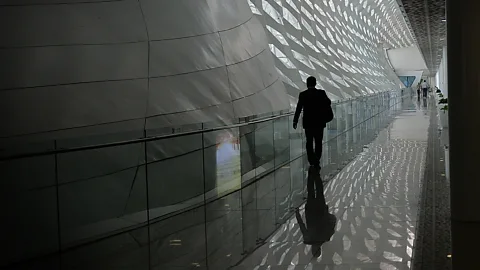
The city has five land border crossings for travellers commuting from Hong Kong, and flights arrive to the newly-built Shenzhen International Airport from every corner of China and 21 international destinations including Germany, the US and Japan. High-speed trains link Shenzhen to major cities in the region including Macau, Guangzhou and Hong Kong.
There is a long list of luxury and business hotels and serviced apartments catering to business travellers, most of them located in the Futian Central Business District area near the Shenzhen Convention and Exhibition Center.
For those living in Shenzhen, however, the influx of wealth and business has also made it harder to live there. Average new home prices have more than doubled since 2014 to more than 50,000 yuan per sq m ($7,486 per sq m) – the fastest growth in residential property prices worldwide, while the influx of workers is driving up rental prices. It means many working families cannot afford their own home in the city, no matter how hard they work.
 Getty Images
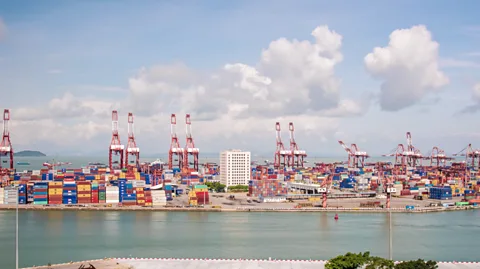
Shenzhen is home to the world's fifth-busiest port
 Getty Images
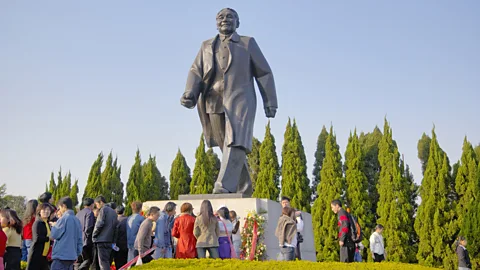
Shenzhen is surrounded by mountains and the sea, which provides an opportunity to escape the hustle and bustle for even just a few hours. A short jog from the central business district is Lotus Mountain (Lianhua Shan in Chinese), where a giant statue of former leader Deng Xiaoping, depicted striding boldly into the future.
Huaqiangbei, the city’s electronics district, is a commercial area home to thousands of electronics stores. There, shoppers can find a cornucopia of both finished products and components, with everything from computer parts to robot babysitters.
For those with more time to explore the city, Dafen Village in Buji District hosts hundreds of artists selling both replica oil paintings and their own original works.
The influx of Chinese migrants to the city has brought with it authentic regional cuisine from all over China, from Dim Sum and Cantonese-style seafood to spicy Sichuan and Hunan foods.
While rising costs in the city put a middle-class consumer lifestyle out of reach for many, those who have made their fortunes can afford to send their children to top schools in China and abroad, which has brought about more of a focus on the arts.
A growing number of venues cater to this class: OCT Loft Creative Industry Park is a hub of art museums and cultural venues, where old factories have been converted into creative cafes, pubs and shops. Design Society, an international collaboration with Britain's Victoria and Albert Museum, is due to open in Shekou at the end of this year.
Shenzhen’s culture and arts scene still has a long way to go to catch up with Beijing and Shanghai. But as the city continues to transform from a manufacturing-based zone into a more diverse metropolis, and with a younger generation of educated creatives who feel their roots are in Shenzhen, the city is starting to shed its industrial reputation as “the factory of the world”.