
Apple’s Eddy Cue has just announced that Apple Music will change its plan and pay royalties to artists even during its three-month free trial for users, following Taylor Swift’s public complaint about the policy. She had planned to withhold her hit album ‘1989’ from the service in protest.
We’ve learned that Apple made this decision to change its policy today. It will be paying an undisclosed royalty rate on a per stream basis to artist for the whole time that users are on the free trial.
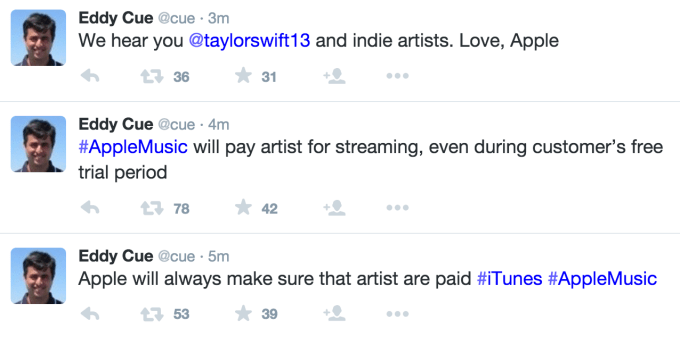
Apple had planned to offer users a three-month free trial of its upcoming streaming Apple Music service that launches June 30th. However, it had negotiated deals with the major labels to not pay rights holders royalties during these trials and instead pay a tiny bit more in royalty rates afterwards.
Now in the wake of intense negative PR stemming from Swift’s blog post that bashed the policy, including my post earlier today where I wrote “Apple is acting greedy” and should pay up, the tech giant has recanted.
The move should help it improve the public perception of Apple Music and potentially pull in some artists that were boycotting the old payout structure. Those include artists managed by Beggars Group, which put out its own letter to Apple last week denouncing the royalty-free trial.
Techcrunch event
San Francisco, CA | October 13-15, 2026
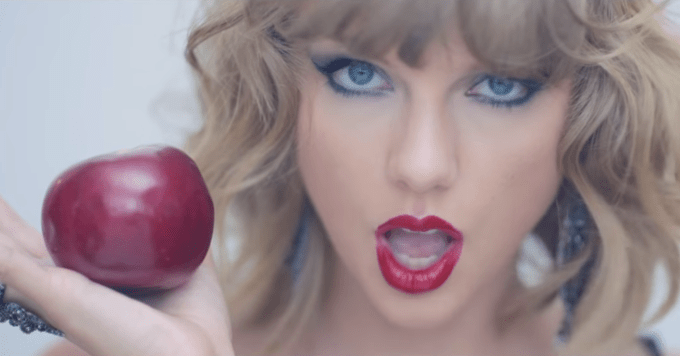
It’s unclear what Swift and Beggars Group will do now that their demands have been met, though Swift did just tweet her thanks for everyone who supported her conviction, saying “I am elated and relieved. Thank you for your words of support today. They listened to us.”
Swift previously pulled ‘1989’ from Spotify citing philosophical disagreements with its “free” ad-supported tier. Spotify also offers short free trials and extremely cheap $0.99 three-month trials. But a source with knowledge of Spotify’s deal structure tells me it already pays artists royalties during all its trial periods. It’s quite possible that both will pay artists at a lower rate during free trials than during normal subscriptions.
While it might be nice to think of Swift as a champion for all musicians here, Bloomberg Businessweek did recently report that she was in talks for exclusives with Apple Music. Those seem to have never come to fruition, so it’s a little suspicious that she’s now swinging so far the other way.
This morning I argued for why Apple should invest in the future of Apple Music by being more generous with artists and paying royalties during its trials. Apparently Apple agrees on some level. Check out that article for more on why this change of heart is a smart move for Apple.
Essentially:
- Apple has a huge opportunity to own streaming music, which could be very lucrative long-term. It just needs to invest now to grow a user base
- Apple has plenty of cash to subsidize the royalties of the free trial, so there’s little reason to be stingy as long as it can avoid regulatory scrutin
- The higher royalty rate it negotiated to pay to offset the free trial period, 71.5% or 73% compared to 70% that other services pay, doesn’t actually earn rights holders more money unless users subscribe for at least three years. It was a largely hollow concession
- These royalties are a user acquisition cost as Apple competes with Spotify, Google, and other streaming services. Artists shouldn’t have to pay for those, even if they benefit long-term from more people signing up for expensive subscriptions
- Apple Music isn’t well differentiated from competitors yet (though BeatsOne Radio and Connect have potential to give artists promotion and secondary monetization streams at scale). Winning favor with artists who withhold their best music from Spotify like Taylor Swift could give Apple Music an edge in the market
- If Apple Music satisfies its customers, Apple should have no problem recouping the upfront subsidy to royalties, and it can take on this financial risk much easier than musicians can
- Again, Apple has so much money that it’s worth the better product and good PR to just pay up
Josh Constine is a Venture Partner at ~$3 billion AUM early-stage VC fund SignalFire where he invests in pre-seed startups with a focus on consumer. He teaches startup pitch writing and fundraising strategy as a recurring lecturer at the Stanford Graduate School Of Business, and with accelerators like Z Fellows, Inception Studios, and Stanford ASES. Previously, Constine was Editor-At-Large for TechCrunch where he wrote 4000 articles and was ranked the #1 most cited tech journalist in the world from 2016-2020 by Techmeme. Constine has led 300+ on-stage interviews and keynotes in 18 countries with luminaries including Mark Zuckerberg and the CEOs of Shopify, DoorDash, Snapchat, Instagram, and more. Constine graduated from Stanford University with a Master’s degree he designed in Cybersociology, and wrote his thesis in 2008 on why remixable memes would be the future of marketing. He has been quoted in the NYT and WSJ, is regularly featured on CNN for his thoughts on AI and Silicon Valley, and advises startups on PR, fundraising, and organic growth.