News that a major company or extremely well-funded competitor has launched a new product with a similar or identical name is certainly the kind of thing that keeps startup founders up at night. Just ask Paper.
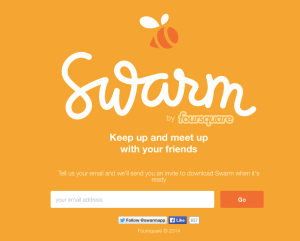 Well, the former has just happened to location-sharing UK startup Swarmly, after location-sharing app Foursquare announced yesterday that it would launch a new app called Swarm.
Foursquare as a whole pre-exists the UK startup by some years. It’s offered a “swarm” feature from very early on, a “badge” that users could earn when checking into a place alongside 50 others, or more for a “super swarm.”
But the similarity in name and general purpose are unfortunate to say the least.
To be clear, Foursquare’s new — and, as yet, unreleased — app is not completely identical in feature set to Swarmly.
Swarmly, for iOS and Android, lets you share your location with friends and anonymously, as well as locate social “hotspots” — or swarms of people nearby — in realtime, powered by its aggregated, anonymized location-based data.
Meanwhile, Swarm essentially splits out the old Foursquare’s check-in functionality — leaving the main Foursquare app to focus on location-based search and discovery, taking on Yelp directly — as well as adding a Facebook “nearby friends”-type feature that makes sharing your location more general and less specific.
Techcrunch event
Boston, MA | June 23, 2026
Foursquare itself isn’t particularly perturbed by the similarities they do share.
“Swarm, the Swarm brand, and the Swarm functionality are all the product of five years’ learning, hard work, and development,” a spokesperson tells TechCrunch. “The brand is taken from the original Foursquare badge set, and the app was developed coming from that.”
It’s, unsurprisingly, a different tune from the David to Foursquare’s Goliath.
“[It] certainly makes things a bit more complicated when it comes to discoverability if we have to compete with a similar app with an almost identical name from a well established company,” Swarmly CEO and co-founder Marco De Nichilo tells TechCrunch.
There’s also a certain irony since Swarmly is, in part, powered by Foursquare’s API in order to surface venue location data (although it has plenty of in-house tech, too). That suggests, if it wasn’t already extremely likely, that Foursquare would have been aware of Swarmly’s existence.
“It does seem somewhat.. odd,” adds De Nichilo. “They are definitely aware of our app [since] we use their venue API, and [they have] started moving in that direction with an incredibly similar name at the same time. It seems a little too coincidental especially given their previous stance regarding always-on location sharing.”
Swarmly has alway had a focus on “always-on” location sharing because of its dual functionality, where aggregating realtime location data is as important, if not more so, than individually sharing your location with friends. That’s a feature we previously described as something akin to Waze’s crowdsourced traffic data but for people.
Foursquare’s Swarm app will also allow for background, “always-on”, location sharing, hence De Nichilo’s feeling that the company has moved in on a space Swarmly was already occupying, along with others such as Highlight, Circle and the now-defunct Latitude from Google.
In a further twist, along with a ton of games in the iOS store stuffed with keywords related or similar to ‘swarm’ (such as Angry Wasp!), another startup carries the exact same name. Swarm, backed by Icon Venture Partners and a number of prominent seed investors, is a mobile tool for bricks ‘n’ mortar retailers.
Steve O’Hear was best known as a technology journalist at TechCrunch, where he focused on European startups, companies and products.
He first joined TechCrunch in November 2009 as a contributing editor for TechCrunch Europe, where he worked alongside longtime TC veteran Mike Butcher to help build TechCrunch’s coverage in Europe.
In June 2011, Steve took a break from journalism to co-found the London and Prague-based startup Beepl. In his role as CEO, he helped the company raise its first VC round; in November 2012, Beepl was acquired by Brand Embassy.
Steve left TC in 2021, joining a startup before launching his own thriving public relations shop soon after. Steve passed away in 2024 after a brief illness.
Ingrid was a writer and editor for TechCrunch, from February 2012 through May 2025, based out of London.
Before TechCrunch, Ingrid worked at paidContent.org, where she was a staff writer, and has in the past also written freelance regularly for other publications such as the Financial Times. Ingrid covers mobile, digital media, advertising and the spaces where these intersect.
When it comes to work, she feels most comfortable speaking in English but can also speak Russian, Spanish and French (in descending order of competence).