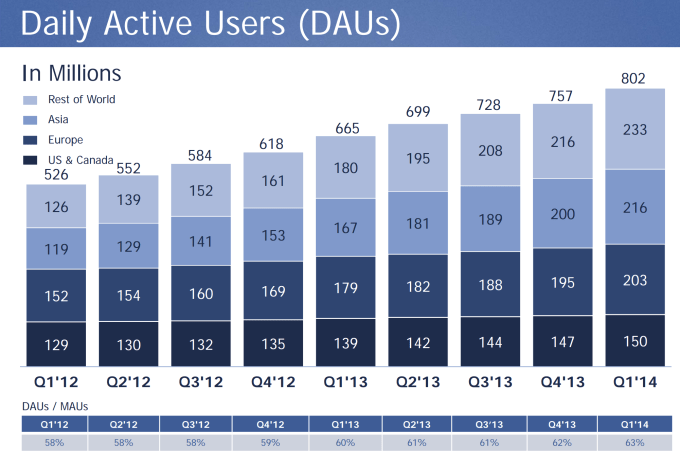
Facebook’s is getting more and more mobile, now with 1.01 billion users on small screens. It’s Q1 2014 earnings show it beat expectations, earning $2.5 billion in revenue with an $0.34 EPS. It now has 1.28 billion total monthly users, 802 million daily users, and 609 million daily mobile users. Facebook continued its march to become a mobile ad company with 59% of ad revenue coming from portable devices. Wall Street had expected $2.36 billion in revenue and earnings of 24 cents per share.
Compared to Q4 2103, Facebook’s total user count is up 4% from 1.23 billion total monthly users, total daily user count is up 5.9% from 757 million, and daily mobile user count is up 9.5% from 556 million. Mobile ads made up 53% of ad revenue in Q4, the first time they peaked over 50%, and now account for 57% of ad revenue. Wall Street seems to like what it sees as $FB is up 3.6% in after-hours trading as of 2:45pm PST.
Total ad revenue hit $2.27 billion, up 82% from a year ago. Payments revenue including games and apps reached $237 million this quarter, down slightly from $241 million during the holiday Q4. GAAP costs and expenses reached $1.43 billion, up 32% YOY, driven by headcount and infrastructure expenses. Capital expenditures reached $363 million in Q1 2014.
One other news item is that Facebook CFO David Ebersman is stepping down June 1st and will be replaced by the company’s vice president of corporate finance and business David Wehner. Ebersman plans to return to the healthcare industry after he transitions out in September.
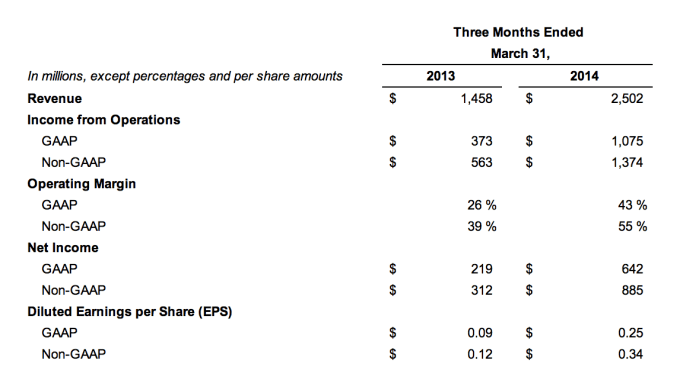
For a sign of how far Facebook has come on mobile year-over-year, monthly mobile users are up 34% to 1.01 billion now, daily mobile users is up 43%, and mobile as a share of total ad revenue is up from just 30%. It also now has 341 million monthly mobile-only users, up from 296 million in Q4 and 189 million a year ago. Many worried Facebook wouldn’t figure out how to monetize mobile as its users shifted there in mass, dragging down its IPO. But the company has proved the pessimists wrong by turning mobile app install ads into a cash cow.
This is the first earnings report after Facebook spent $16 billion in cash and stock (plus extra for bonuses) to buy international messaging app WhatsApp, and virtual reality hardware maker Oculus for around $2 billion in cash and stock. Expect the earnings call to include thoughts on why those were smart buys.
Techcrunch event
San Francisco, CA | October 13-15, 2026
Another big focus of the day will be on whether Facebook shares any data on teen usage. The company reported a slight drop in engagement amongst young teens in the US during its Q3 2013 earnings and its share price plummeted. Last quarter, it punted on the issue, saying “in terms of teens we don’t have any new data to report” which combined with high performance in mobile ads to boost the share price 13% the next day.
We’ll be covering the earnings call live at 2pm PST, so stay tuned to our Facebook earnings page.
Below you can see charts tracking Facebook’s financial and user growth, including this quarter:

Josh Constine is a Venture Partner at ~$3 billion AUM early-stage VC fund SignalFire where he invests in pre-seed startups with a focus on consumer. He teaches startup pitch writing and fundraising strategy as a recurring lecturer at the Stanford Graduate School Of Business, and with accelerators like Z Fellows, Inception Studios, and Stanford ASES. Previously, Constine was Editor-At-Large for TechCrunch where he wrote 4000 articles and was ranked the #1 most cited tech journalist in the world from 2016-2020 by Techmeme. Constine has led 300+ on-stage interviews and keynotes in 18 countries with luminaries including Mark Zuckerberg and the CEOs of Shopify, DoorDash, Snapchat, Instagram, and more. Constine graduated from Stanford University with a Master’s degree he designed in Cybersociology, and wrote his thesis in 2008 on why remixable memes would be the future of marketing. He has been quoted in the NYT and WSJ, is regularly featured on CNN for his thoughts on AI and Silicon Valley, and advises startups on PR, fundraising, and organic growth.