Ticketmaster screws artists and venues by charging big service fees that scare away customers. Chicago-based FanFueled thinks it’s time event ticketing and marketing platforms stop gauging and start adding value. That’s why it’s just raised a $1 million seed round led by Listen LLC and angel William Lohse to provide ticketing at 1/3 to a 1/4 of Ticketmaster’s service fees. It also plans to one-up Eventbrite with its referral system that lets event promoters track social sharing of ticket links and reward those driving the most sales.
At one point, a stable, scalable ticketing system was worth paying for, but that technology is more widely available now. Ticketmaster’s exorbitant service fees, around $17 on top of an $100 ticket, are ridiculous. FanFueled charges just a $3 fee on the same ticket, and also offers a peer to peer marketing system.
Unfortunately, the government foolishly approved Ticketmaster’s merger with Live Nation last year, facilitating exclusive ticketing agreements with the giant venues and artists the megacorporation owns and manages. This protects it from disruption. However, discontent amongst smaller bands and concert halls is brewing, and eventually Ticketmaster’s exclusivity agreements will require renewal. If it can think long-term, FanFueled has a chance to take a chunk of the massive ticketing market, warranting the seed round bet.
In the meantime, FanFueled is competing with EventBrite, which recently closed a $50 million Series E round and provides do it yourself ticketing at a reasonable 5.5% + $1 fee. Other competitors also taking a shot at the ticketing throne include Ticket ABC which simplifies refunds, and Ticketfly which provides deep analytics.
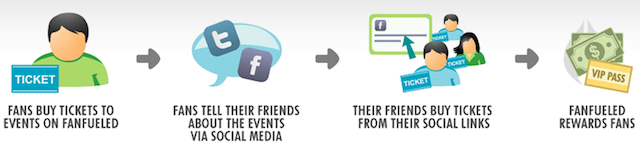
FanFueled’s strategy for beating these companies revolves around its referral rewards system. Fans share a tracked ticketing link, and promoters can reward those who inspire the most sales with merchandise, backstage passes, tweets from the band, or whatever they want. FanFueled even tracks downstream sales multiple degrees of separation from the original sharer. Artists and venues can profit from incentivizing valuable word-of-mouth referrers with rewards that cost them little or nothing.
FanFueled now has 10 full-time employees, and has handled ticketing for some bigger regional music festivals. It has had success with its rewards model, with 20% of customers sharing ticketing links.
Founder and CEO Anderson Bells rages “The whole ticketing business model is to exploit fan passion. It’s a broken model that discounts tickets at the last minute and penalizes the biggest fans that buy tickets first. Why not harness that passion rather than exploit it. With FanFueled, the sooner people buy their ticket, the more rewards they earn. We’re saving clients marketing costs while enhancing their relationship with the fan.”
Techcrunch event
Boston, MA | June 23, 2026
It will be serious uphill battle, and subsequent funding rounds may be necessary to give FanFueled time to gain momentum. But I think smaller players in the music scene are rooting for a ticketing revolution, in pricing but also in adaptation to social. Ticketmaster and Live Nation’s monopoly are not rock’n’roll. FanFueled might be.
Josh Constine is a Venture Partner at ~$3 billion AUM early-stage VC fund SignalFire where he invests in pre-seed startups with a focus on consumer. He teaches startup pitch writing and fundraising strategy as a recurring lecturer at the Stanford Graduate School Of Business, and with accelerators like Z Fellows, Inception Studios, and Stanford ASES. Previously, Constine was Editor-At-Large for TechCrunch where he wrote 4000 articles and was ranked the #1 most cited tech journalist in the world from 2016-2020 by Techmeme. Constine has led 300+ on-stage interviews and keynotes in 18 countries with luminaries including Mark Zuckerberg and the CEOs of Shopify, DoorDash, Snapchat, Instagram, and more. Constine graduated from Stanford University with a Master’s degree he designed in Cybersociology, and wrote his thesis in 2008 on why remixable memes would be the future of marketing. He has been quoted in the NYT and WSJ, is regularly featured on CNN for his thoughts on AI and Silicon Valley, and advises startups on PR, fundraising, and organic growth.