The beauty of Mathematics
25th July 2013
There are certain things in mathematics I have always found fascinating, particularly the ways in which seemingly unrelated concepts fit together.
The e constant
For example, take the constant e, discovered in the 17th century by Jacob Bernoulli when he was studying compound interests:

Say you have $1 at a bank and the bank gives you 100% interest. After one year, you’ll have $2.
But if the bank pays the interest more often - say 10%, 10 times a year - you’ll end up with $(1.1^10) ~ $2.59. The more often the bank pays the interest, the closer the value will be to e = 2.71828…
Differentiation
To see where this goes, let’s now look at differentiation.
 is the slope (
 ) of function f at the point x. In other words, just a way of describing how quickly a function grows at any given point:

Let’s now ask the following question: Is there a function f such that  for each x?
In other words: “Is there a function that describes its own growth?”
It turns out there is exactly one such function, and it is:
 .
.
Complex numbers
Now if the previous is not mysterious enough, let’s look at complex numbers.
Complex numbers were discovered in the 16th century when mathematicians realized that in order to solve cubic equations (equations such as  ), they inevitably had to work with the concept of
  , which they named i (the imaginary unit).
The concept perplexed mathematicians for a while. Even Gauss expressed his concern on “the true metaphysics of the square root of −1" at the age of 20. He later came to accept it.
It was only later realized that any complex number  can be seen as a vector in a 2D plane.

Addition of complex numbers then works the same way vector addition works.
What’s more curious though, is multiplication of complex numbers. It is defined in a straightforward, algebraic, way:

Surprisingly enough, the resulting vector has the length which is the product of the lengths of the input vectors, and its angle with the x axis is the sum of angles of the input vectors.
Multiplying by i rotates a vector by 90 degrees counter-clockwise. Think about this for a while. Suddenly, complex numbers have to do with a circle.
And indeed, Euler later realized (via summation of infinite series) that:

Yes, the e constant again. Richard Feynman called the equation “one of the most remarkable, almost astounding, formulas in all of mathematics.“
And of course, by substituting π for x, we get the famous:

Fractals
Now we are getting to the seventies of 20th century.
Take a complex number c in the complex 2D plane and the following series:

Now we plot all the complex numbers c for which this series does not diverge, that is all points c for which z always stays within a finite distance from 0 (as opposed to growing to infinity).
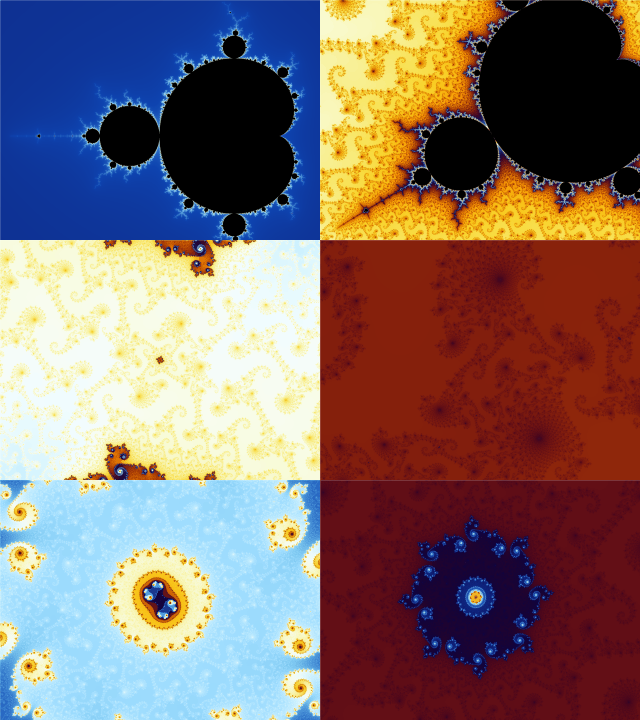
What we obtain is the Mandelbrot set:

The Mandelbrot set is connected, has finite area and infinite perimeter. Around the perimeter, the series  has chaotic properties. That is, the behavior of the series changes drastically from non-divergent to divergent for a very small change of c as we cross the perimeter (in popular terms, this is called the butterfly effect).
The perimeter is a single continuous line that doesn’t get simpler no matter how much we zoom in (therefore the Mandelbrot set is an example of a fractal):
Conclusion
All this leaves me with the following question: is mathematics made or discovered?
We’ve built everything on a few trivial axioms, starting with addition and multiplication of natural numbers (essentially counting on our fingers) and this is what follows out of it.
Not only do these concepts almost miraculously fit together, but they even tend to be useful for describing the reality around us and come in very handy in physics and engineering.