Holiday shoppers are notoriously impatient, and in 2025, they’re increasingly impatient when it comes to slow websites. Keywords like “website downtime tracking” and “ecommerce site reliability” are often trending because businesses are realizing that slow is the new down. This holiday season, the goal is to safeguard your website against business-critical slowdowns without adding “manual […]
You can think about a website the same way you think about your car. Every time something breaks, a professional—an engineer or a mechanic—usually charges a high amount for the fix (isn’t it annoying when you can’t tell if it’s a big or small fix?). Alternatively, you can learn some basics, get a few inexpensive […]
An API, application programming interface, is a collection of tools, protocols, and subroutines that can be used when building software programs or applications. APIs makes software development easier by providing reusable components and a set of clearly defined communication protocols. Recently APIs have come to mean web services, but there are also APIs for software […]
Last updated: February 28, 2024 Page load time and response time are key metrics to monitor, and they can give you an in-depth understanding of how your website is performing. However, the difference between page load time and response time isn’t immediately obvious, and neither are the benefits of tracking them independently.
Powerful transaction monitoring now complements the availability and real user monitoring (RUM) capabilities in SolarWinds Observability SaaS to provide richer Digital Experience Monitoring. With synthetic transaction and website availability monitoring, you can automate the testing of complicated website flows to identify broken links, latency, and availability issues before your users do and ensure a flawless […]
Tracking your website’s exit and bounce rates will give you insight into how your audience engages with your website and the user experience they receive. This information will enable you to make data-driven decisions on performance-related improvements, ensuring your website functions at its optimal capacity. In this article, we explain exactly what exit rates and […]
These days, systems and applications evolve at a rapid pace. This makes analyzing the internal performance of applications complex. Observability emerges as a path to efficient and effective operational insights. Imagine a team of doctors monitoring a patient’s vitals—heart rate, temperature, blood pressure. These readings, combined with observation of symptoms, paint a picture of the […]
Last updated: February 29, 2024 Average size of a webpage matters because it correlates with how fast users get to your content. People today have grown to expect good performance from the web. If your website takes more than 2.5 seconds to load, your users will probably never return to you again. Further, the more […]

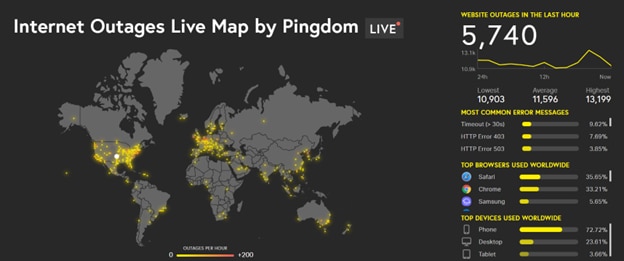
Sometimes when you try to visit a web page, you’re met with an HTTP error message. It’s a message from the web server that something went wrong. In some cases it could be a mistake you made, but often it’s the site’s fault. Now, you might wonder, which are the most common HTTP errors that people encounter when they surf the Web? That is the question we’ll answer in this article.
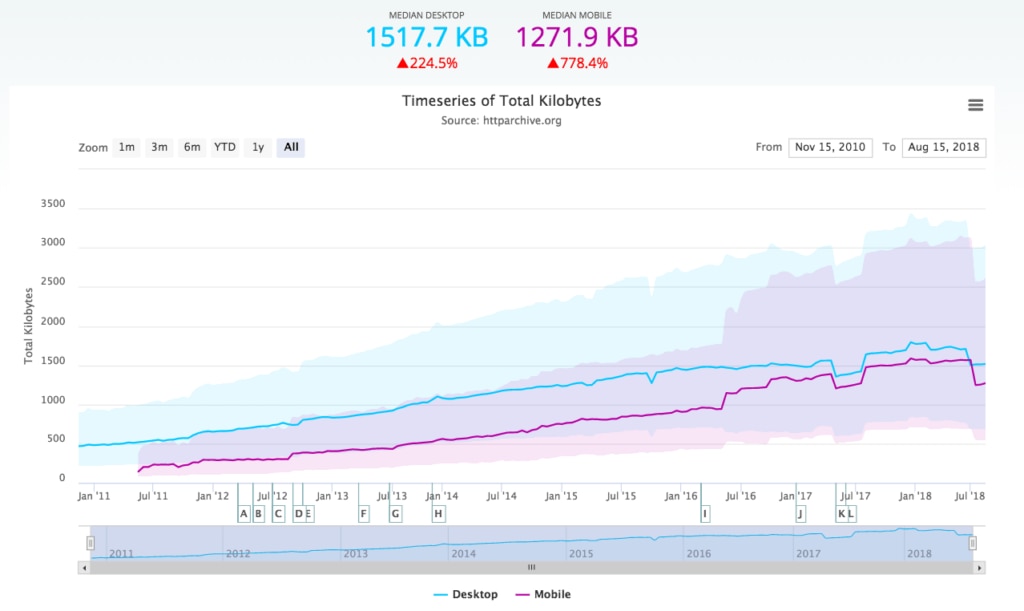
Last updated: February 26, 2024 The size of the web is slowly growing. Over the past decade, the average webpage weight grew by 356%, from about 484 KB to 2.205 MB. Considering 800 KB was the average size of a website in 2012, that’s an enormous difference. While it’s true that the global average internet […]
Last updated: February 28, 2024 Websites have become larger and more complex over the past few years, and users expect them to load instantaneously, even on mobile devices. The smallest performance drops can have big effects; just a 100ms decrease in page load time can drop conversions by 7%. With competitors just a click away, organizations […]
In the last decade, businesses have made massive investments in the digital economy with the goal of increasing operational efficiency and improving their customer or end-user experience. However, it isn’t rare for businesses to incur losses due to poor page load speed, failed transactions, or website errors. This is why businesses need to track end-user […]
 At the scale that Facebook operates, a lot of traditional approaches to serving web content break down or simply aren’t practical. The challenge for Facebook’s engineers has been to keep the site up and running smoothly in spite of handling over two billion active users. This article takes a look at some of the software and techniques they use to accomplish that.
Code names can be about secrecy, but when it comes to software development, it’s usually not so much about secrecy as it is about the convenience of having a name for a specific version of the software. It can be very practical to have a unique identifier for a project to get everyone on the […]
Modern software applications involve multiple layers of code and services, working together to meet increasingly demanding user requirements. To achieve this, systems became distributed, providing improved scalability, fault tolerance, and complexity. However, this innovation brought new challenges to basic troubleshooting and performance monitoring to maintain the health of systems. It’s for these reasons that observability […]
At SolarWinds, we’re constantly thinking ahead to develop observability solutions that evolve with you and that abstract application and IT complexity so that you can deliver an exceptional digital experience for your business. And today, we’re excited to announce – SolarWinds Observability SaaS is here! SolarWinds Observability SaaS includes application, infrastructure, database, network, log, and digital […]
Just before Halloween 2021, Roblox engineers experienced a horror story: a service outage that also took down critical monitoring systems. It seemed like the issue was a hardware problem, but it wasn’t. Users were frustrated, and the clock was ticking. After three full days of downtime, service was finally restored on Halloween day.
Since Russia’s invasion of Ukraine on February 24, 2022, denial-of-service (DoS) attacks impacting availability have been rising. The attacks aren’t only affecting Russia and Ukraine either. Public and private organizations in multiple industries have been impacted, and several nations—including the U.S. and U.K.—have issued warnings about cyberthreats from Russia.
Introduction In today’s fast-paced business environment, tech startups are on the rise. Several small- and medium-scale businesses are competing with established companies to showcase their unique digital services. Heroku is a favorite among these businesses and their development teams, as its PaaS provides a ready-to-serve platform for application setup. Developers can deploy the platform easily […]
The partnership between Nobl9 and SolarWinds® Pingdom® is the bridge between business and technology everyone’s been waiting for. What Is Nobl9? Nobl9 is a software reliability platform that works with DevOps practitioners, reliability engineers, and now SolarWinds to make you feel more confident in the dependability of your products. By using service-level objectives (SLOs), Nobl9 […]