WhatsApp Outage Map
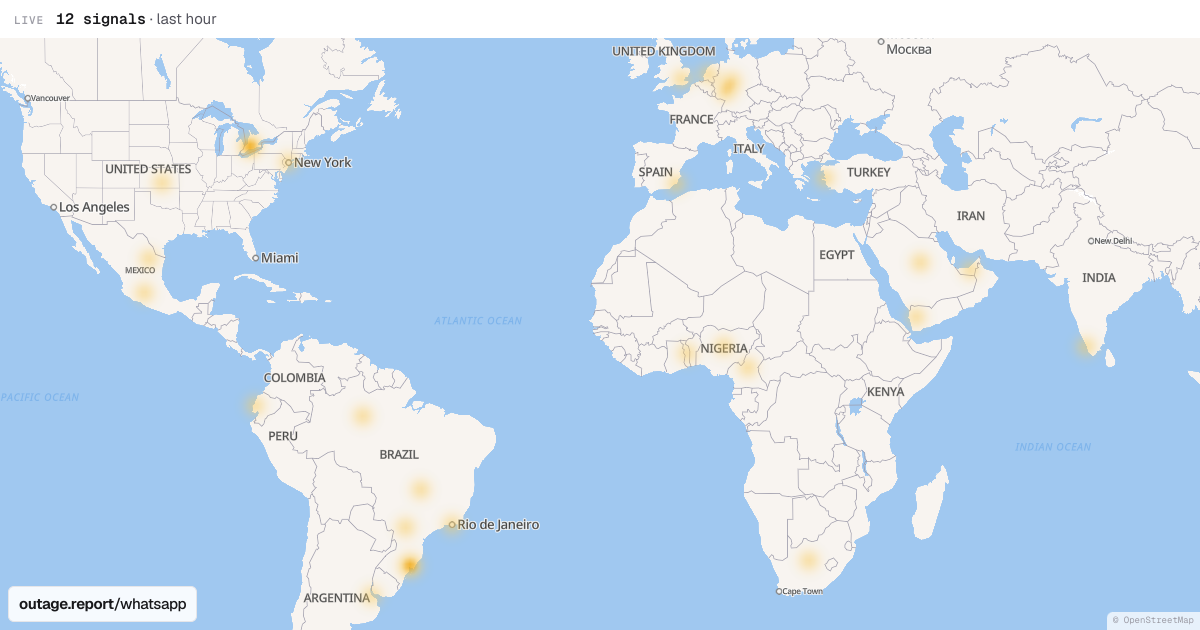
The map is generated based on the locations of users who submitted reports on the site
What’s typical for WhatsApp
Typical report volume
<1report per day
30-day baseline — the chart’s typical band
WhatsApp reliability
Total downtime (12 mo)
7h 8m
Based on 6 recorded incidents over the last 12 months.
Outage history
-
# Aug 3, 2026 Disruption 3h 57m
20:01 UTC Not working 46% 123 reports peak ~7 / 5min 🇧🇷 🇲🇽 🇩🇪
-
# Jun 23, 2026 Disruption 21m
21:44 UTC App 60% 27 reports peak ~9 / 5min 🇨🇭
-
# Jun 12, 2026 Disruption 1h 47m
13:47 UTC App 29% 110 reports peak ~2/min 🇨🇭 🇧🇩 🇭🇳
-
22:03 UTC Service disruption 10 reports
-
# Nov 4, 2025 48m
14:26 UTC Service disruption 43 reports
-
08:41 UTC Service disruption 5 reports
-
# Feb 28, 2025 Major outage 1h 29m
15:39–17:08 UTC · 1h 29m
Major outage: reports spiked, lasting 1h 29m — 1,340 reports in total.
-
# Dec 11, 2024 Major outage 3h 21m
17:55–21:15 UTC · 3h 21m
Major outage: reports spiked, lasting 3h 21m — 2,814 reports in total.
Comments
What's happening for you? Share what you're seeing
A
Anonymous26d
Can't upload pictures
A
Anonymous26d
Aucun média ne peut être envoyé. Depuis le Togo. Afrique de l'ouest
A
Anonymous26d
No funciona en Toda la Argentina 🇦🇷
A
Anonymous26d
Ponete las pilas Zukaritas
A
Anonymous26d
I can't send print screen
A
Anonymous26d
WhatsApp not working, I can't send photos or videos
A
Anonymous26d
WhatsApp not working, I can't send photos or videos
A
Anonymous26d
No media being sent. From Netherlands
About WhatsApp
WhatsApp is a widely used messaging application for smartphones and other mobile devices. WhatsApp allows users to send text messages, voice messages, images, videos, and other media to their contacts, as well as make voice and video calls over the internet
Frequently asked questions
Is WhatsApp down right now?
WhatsApp appears to be working normally — report volume is within the typical range for this time of day. The last reported incident was about 26 days ago.
Why is WhatsApp not working for me?
We're not detecting a broad WhatsApp outage right now, so a problem is most likely local to you — your internet connection, device, or the app. Try restarting the app, then your router. If many people report the same issue, this page will update to show it.
When was the last WhatsApp outage?
The last recorded WhatsApp incident was about 26 days ago.
How do I report a WhatsApp problem?
Use the “Report a problem” button on this page and choose what's not working. Reports are anonymous and update the live status and outage map in real time.
How does Outage.Report know if WhatsApp is down?
We aggregate anonymous user reports and monitor public social-media posts, comparing live volume against WhatsApp's normal baseline for the time of day and region to detect anomalies — often before they're officially confirmed.
People also check
Status of related services right now