General Computing
Build, Deploy or Embed Your Code
Julia makes it possible to build complete applications. Write web UIs with Dash.jl and Genie.jl or native UIs with Gtk4.jl. Pull data from a variety of databases. Build shared libraries and executables with PackageCompiler. Deploy on a webserver with HTTP.jl or embedded devices. Powerful shell integration make it easy to managing other processes.
Julia has foreign function interfaces for C, Fortran, C++, Python, R, Java, Mathematica, Matlab, and many other languages. Julia can also be embedded in other programs through its embedding API. Julia's PackageCompiler makes it possible to build binaries from Julia programs that can be integrated into larger projects. Python programs can call Julia using juliacall. R programs can do the same with R's JuliaCall, which is demonstrated by calling MixedModels.jl from R. Mathematica supports calling Julia through its External Evaluation System.
Parallel Computing
Machine Learning
Scientific Computing
Rich Ecosystem for Scientific Computing
Julia is designed from the ground up to be very good at numerical and scientific computing. This can be seen in the abundance of scientific tooling written in Julia, such as the state-of-the-art differential equations ecosystem (DifferentialEquations.jl), optimization tools (JuMP.jl and Optimization.jl), iterative linear solvers (Krylov.jl, LinearSolve.jl), Fast Fourier transforms (AbstractFFTs.jl), and much more. General purpose simulation frameworks are available for Scientific Machine Learning, Quantum computing and much more.
Julia also offers a number of domain-specific ecosystems, such as in biology (BioJulia), operations research (JuMP Dev), image processing (JuliaImages), quantum physics (QuantumBFS), nonlinear dynamics (JuliaDynamics), quantitative economics (QuantEcon), astronomy (JuliaAstro) and ecology (EcoJulia). With a set of highly enthusiastic developers and maintainers, the scientific ecosystem in Julia continues to grow rapidly.
Data Science
Interact with your Data
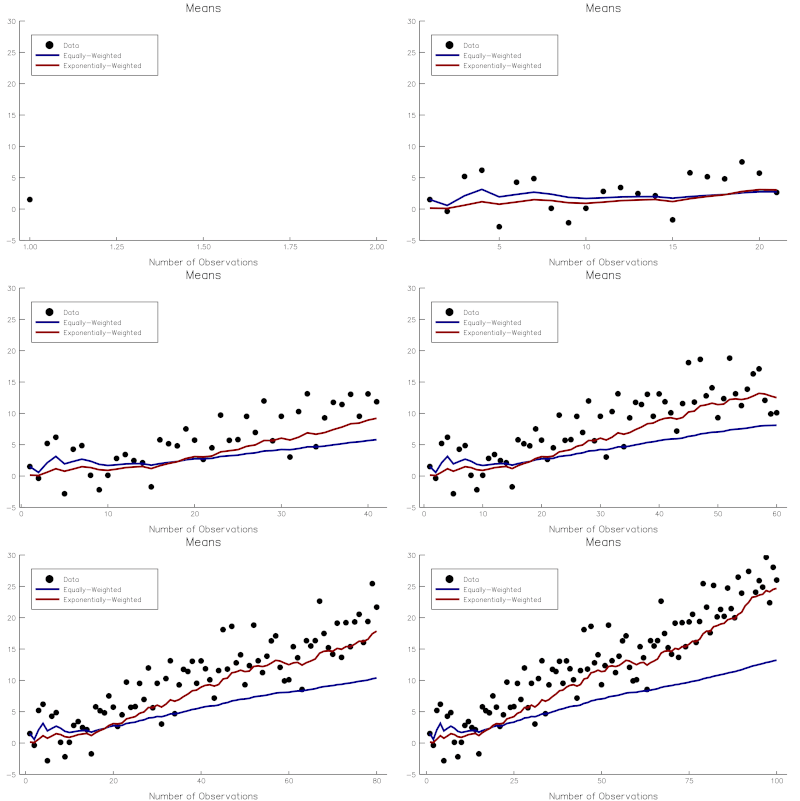
The Julia data ecosystem provides DataFrames.jl to work with datasets, and perform common data manipulations. CSV.jl is a fast multi-threaded package to read CSV files and integration with the Arrow ecosystem is in the works with Arrow.jl. Online computations on streaming data can be performed with OnlineStats.jl. The Queryverse provides query, file IO and visualization functionality. In addition to working with tabular data, the JuliaGraphs packages make it easy to work with combinatorial data.
Julia can work with almost all databases using JDBC.jl and ODBC.jl drivers. In addition, it also integrates with the Spark ecosystem through Spark.jl.
Visualization
Data Visualization and Plotting
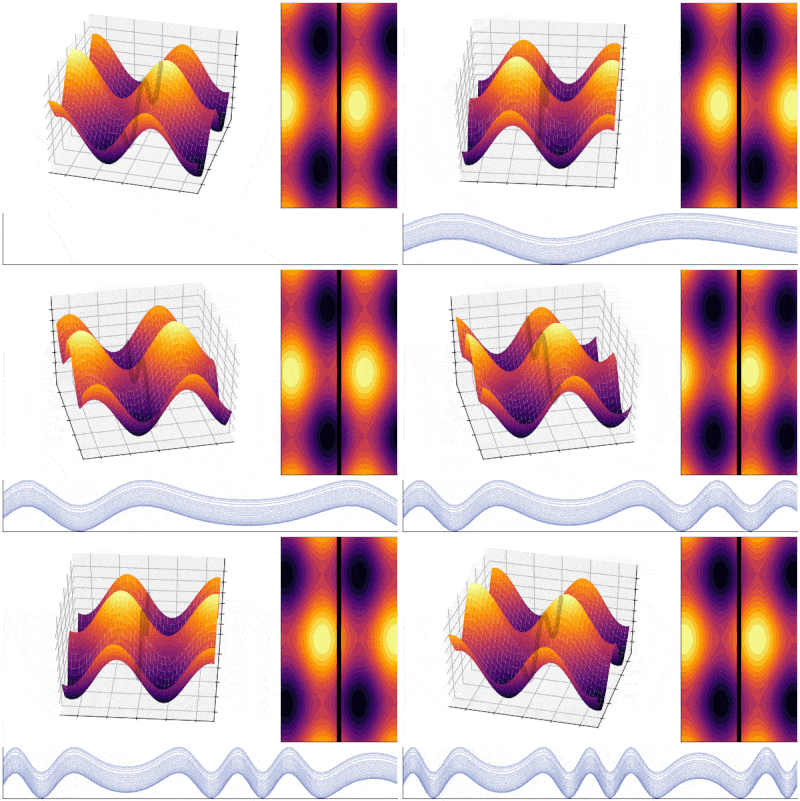
Data visualization has a complicated history. Plotting software makes trade-offs between features and simplicity, speed and beauty, and a static and dynamic interface. Some packages make a display and never change it, while others make updates in real-time.
Plots.jl is a visualization interface and toolset. It provides a common API across various backends, like GR.jl, PyPlot.jl, and PlotlyJS.jl. Makie.jl is a sophisticated package for complex graphics and animations. Users who are used to "grammar of graphics" plotting APIs should take a look at Gadfly.jl. VegaLite.jl provides the Vega-Lite grammar of interactive graphics interface as a Julia package. For those who do not wish to leave the comfort of the terminal, there is also UnicodePlots.jl.