Part of the Art, Money, and the Renaissance blog series
Sometime in the year 1490, Lorenzo de’ Medici, the de facto ruler of Florence, took notice of a young man working in a trade guild workshop. This, in itself, was not remarkable. Lorenzo was an architect, poet and banker, as well as a politician: he was what is now called a renaissance man. His interests extended to painting and sculpture — nearly all of the civilized arts — and as a connoisseur, he had a knack for spotting talent. What is remarkable, however, is that the precocious young man he befriended was really a child; a boy of 15, and his name was Michelangelo di Lodovico Buonarroti Simoni. Lorenzo offered Michelangelo’s father a position at the palace and proposed that the apprentice join Lorenzo’s family, to be raised as a son and educated with the Medici children.
From 1490 to 1492, Michelangelo attended the Humanist academy the Medicis had founded. More importantly, his newfound status now allowed him to consort with poets, scholars, artists, scientists, and philosophers. During his residency in the Medici household, the young Michelangelo kept a journal that he filled with poetry, and he was known to avow that these were the most important years of his life. Lorenzo had created a salon, a scene which formed the epicenter of a new Italian culture, and there is little doubt that this was fueled by money; the Medici were masters of an international banking network, and Florence’s emergent middle class, organized around a system of art and craft guilds, sponsored competitions that rewarded artists for their work.
Money sluiced through the streets and piazzas of Renaissance Florence, and yet the sheer hydraulic force of capital did not determine every outcome. Money was a means, but not an end. What mattered most was social interaction in the context of a networked culture driven by ideals, and Burning Man may be regarded in a similar light. One way to fathom this phenomenon is to follow the money. In 2016, Black Rock City will distribute 1.2 million dollars to artists in the form of honoraria. In so doing, it is like the Wool Guild, the Arte della lana, the premier trade guild of Florence. Along with banking, it was one of the two great pillars that supported the Florentine economy, and a significant portion of this wealth was lavished on civic art that was available to every citizen.
There isn’t any doubt this institution’s funds derived from the manufacture and sale of high-end luxury goods. Florence’s wealthiest families spent up to forty percent of their income on apparel worn at social gatherings and popular public events. They did this out of family pride and to secure prestige among their peers. That pride, however, overlapped with public spirit — it led to the production of creative work that cradled widespread social interaction; it sustained and enlarged the identity of an entire people, and it is fair to say that without this flow of money there would have been no Renaissance, no quickening of knowledge, no spread of humanist ideals.
In the case of Burning Man, such quasi-governmental patronage does not exhaust resources that are devoted to art. As with competitions sponsored by the Wool Guild, Black Rock City’s honoraria are awarded by a small committee, but this curatorship, as practiced by a few, is counter-balanced by a radically populist patronage. Each year many artist groups will subsidize their projects through community fundraising events and crowd-sourced campaigns on the Internet. Some critics say that Burning Man should shoulder all of these expenses, but we have found that self-initiated efforts create constituencies, loyal networks that support these artists on and off the playa.
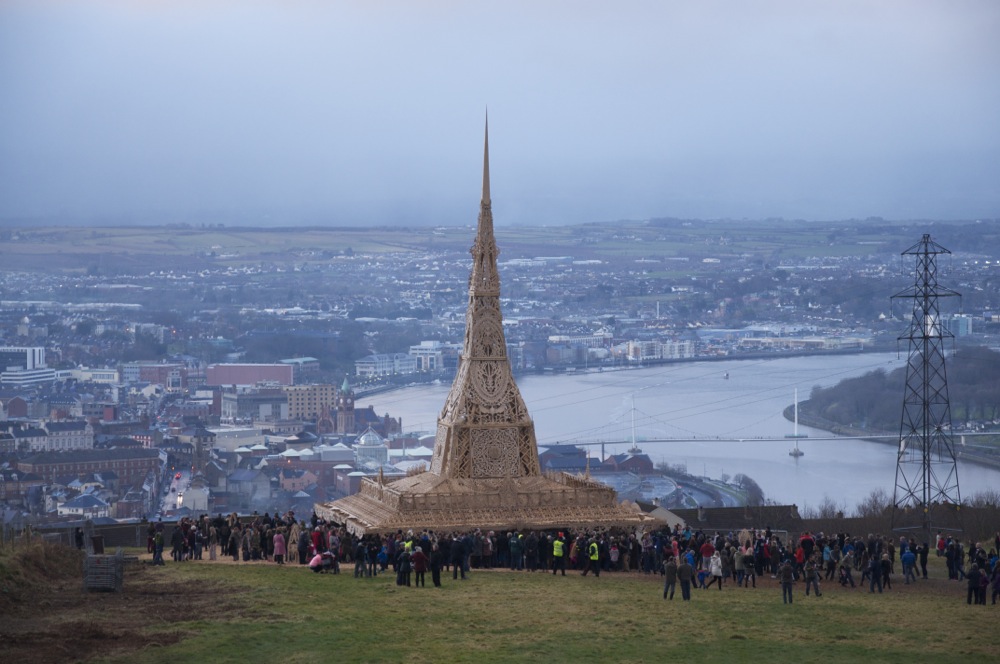
This has produced a flow of art that’s issued out of Black Rock City in the form of privately commissioned work, civic installations, and exhibitions subsidized by festivals. Now this surge of money in support of art is going global. One example is the work of the Temple Crew as led by David Best, with help from the Artichoke Trust, the Burning Man Project, a robust crowd-sourcing campaign, and contributions by a host of public institutions. David’s 21-person crew joined with 98 local volunteers to create a temple in the heart of Derry, an Irish city long-torn by violent struggles between and Protestants and Catholics. According to Artichoke’s website, “Up to 60,000 visitors wrote personal messages…filling the inside with pictures of loved ones, handwritten messages, and symbols of peace”. This was a culture-bearing effort that embodied all of Burning Man’s Ten Principles.
Private philanthropy also plays a role in the elaboration of Black Rock City’s culture. As stated in this year’s art theme text, “Over many years, private donors, with a remarkable lack of fanfare, have quietly funded some of the most beloved artworks that have honored our city”. When Lorenzo de’ Medici adopted the young Michelangelo into his family, he did much more than hire on a hand to serve his needs. Private patronage is personal; it is immediate and intimate, and what is true of Florence and our temporary city is also true of every celebrated art scene ever known. One example is the relationship of a famous heiress, Peggy Guggenheim, and Jackson Pollock, a struggling painter. Peggy paid the painter’s daily bills, bought his work when no one else would, and organized his first art show. At a soirée held in her home, she even let him pee in her fireplace (though not on the carpet).
Some critics label wealthy Burners as outsiders, but Burning Man has always attracted outliers, adventurers from every walk of life. Amid the ranks of moneyed patrons, many people understand that the essential value of a work of art cannot be charted on a balance sheet. Instead of clutching at a fetishized commodity, they contribute to the ongoing life of art as it moves through society. Moreover, this behavior isn’t limited to rarified salons, such as the scene created by Lorenzo in the Medici Palace. Examine industrial districts inhabited by modern-day bohemians. Here, amid graffitied walls and dumpster treasure troves, one is likely to detect the presence of a trustifarian — a benefactor with a trust fund — who discretely funnels money into artist’s pockets.
‘Burn Wall Street’ by Otto Van Danger and crew. Funded by Burning Man and a substantial contribution by a private patron. Photo by Andrew Wegst.
These varied streams of income moving through our city irrigate a fertile social field. Burning Man is an enormous art school, and in this it very much resembles the Republic of Florence and its system of guilds. We ask participants applying for an honorarium to describe their involvement in our community, and these accounts reveal a now familiar pattern. They speak of experience gained from creating art at events within our regional communities. And just as frequently, they describe an informal and spontaneous apprenticeship system. People volunteer to work with more established artists on the playa, and almost inevitably there occurs a seminal moment in these narratives when these applicants declare that they are now prepared to graduate and step out on their own, hastening to add that they have gathered a qualified group of collaborators around them.
This churning scene of interaction is fed by one last flood of money, since more than half of the art that appears in Black Rock City is self-funded by participants who don’t receive a subsidy. Expand this category to include Theme Camps, art cars and thousands of impromptu performances, and it is clear that in a society devoted to the giving of gifts, anyone at any time can be both artist and philanthropist. The flowering of Florence in the 15th century produced a new society that valued initiative and creative expression, even as it stressed communal effort and civic engagement. Most of all, this was a movement animated by ideals that citizens of Florence had retrieved from the past. And if we examine our own ideals, as described by the Ten Principles, it is apparent they express this same dynamic balance between individual action and collective identity.
Many people think of Black Rock City as a moneyless utopia. By forswearing money during one week in the desert, they feel they’ve found redemption in a fallen world. This ignores the obvious fact that in coming to the desert and preparing to participate, they have spent at least as much in the marketplace as the Burning Man organization spends in creating our city. As evidenced by Florence, civilization isn’t possible without widespread commercial activity. We retreat into the desert every year to contemplate those things in life that are beyond all price, that kind of immediate experience that has an unconditional value: this is why we have suspended commerce in our city. But if Burning Man is to be more than a refuge, and if we believe that it is destined to do work in the world, we should invest our efforts in creating a society that conditions how money behaves.
If there is a moral here, it is that money isn’t moral. It is not inherently good, it is not irretrievably bad; it is like water as it tumbles in its pell-mell progress through our world. But money can be canalized by culture; it can be made to serve non-monetary values in a way that’s self-sustaining. This is well illustrated by the history of Florence. Over a span of three generations, a city no larger than our own, with a population comparable to that of Black Rock City, produced a staggering number of geniuses: Giotto, Ghiberti, Brunelleschi, Michelangelo, Leonardo da Vinci — this alone was enough to influence the course of Western civilization for five hundred years. It can be claimed that this was adventitious, the result of historic circumstances that can never be replicated, but it may be that Florence simply got things right. We often say our city is a Petri dish, an experiment devoted to creating culture and community. Perhaps it is now time to take this audacious experiment one step further and begin to imagine a greater and more civilized world.