Over a year ago, I wrote here about ice. It has 16 known forms with different crystal geometries. The most common form on Earth, hexagonal ice I, is a surprisingly subtle blend of order and randomness:

Liquid water is even more complicated. It’s mainly a bunch of molecules like this jostling around:
The two hydrogens are tightly attached to the oxygen. But accidents do happen. On average, for every 555 million molecules of water, one is split into a negatively charged OH⁻ and a positively charged H⁺. And this actually matters a lot, in chemistry. It’s the reason we say water has pH 7.
Why? By definition, pH 7 means that for every liter of water, there’s 10-7 moles of H⁺. That’s where the 7 comes from. But there’s 55.5 moles of water in every liter, at least when the water is cold so its density is almost 1 kilogram/liter. So, do the math and you see one that for 555 million molecules of water, there’s only one H⁺.
Acids have a lot more. For example, lemon juice has one H⁺ per 8800 water molecules.
But let’s think about this H⁺ thing. What is it, really? It’s a hydrogen atom missing its electron: a proton, all by itself!
But what happens when you’ve got a lone proton in water? It doesn’t just sit there. It quickly attaches to a water molecule, forming H₃O⁺. This is called a hydronium ion, and it looks like this:
But hydronium is still positively charged, so it will attract electrons in other water molecules! Different things can happen. Here you see a hydronium ion water molecule surrounded by three water molecules in a symmetrical way:
This is called an Eigen cation, with chemical formula H₉O₄⁺. I believe it’s named after the Nobel-prize-winning chemist Manfred Eigen—not his grandfather Günther, the mathematician of ‘eigenvector’ fame.
And here you see a hydronium ion at lower right, attracted to water molecule at left:
The is a Zundel cation, with chemical formula H₅O₂⁺. It’s named after Georg Zundel, the German expert on hydrogen bonds. The H⁺ in the middle looks more tightly connected to the water at right than the water at left. But it should be completely symmetrical—at least, that’s the theory of how a Zundel cation works.
But the Eigen and Zundel cations are still positively charged, so they attract more water molecules, making bigger and bigger structures. Nowadays chemists are studying these using computer simulations, and comparing the results to experiments. In 2010, Evgenii Stoyanov, Irina Stoyanova and Christopher Reed used infrared spectroscopy to argue that a lone proton often attaches itself to 6 water molecules, forming H⁺(H₂O)₆, or H₁₃O₆⁺, like this:
As you can see, this forms when each hydrogen in a Zundel cation attracts an extra water molecule.
Even this larger structure attracts more water molecules:
But the positive charge, they claim, stays roughly within the dotted line.
Wait. Didn’t I say the lone proton was right in the middle? Isn’t that what the picture shows—the H in the middle?
Well, the picture is a bit misleading! First, everything is wiggling around a lot. And second, quantum mechanics says we don’t know the position of that proton precisely! Instead, it’s a ‘probability cloud’ smeared over a large region, ending roughly at the dashed line. (You can’t say precisely where a cloud ends.)
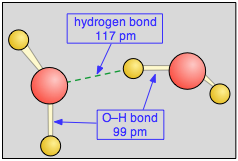
It seems that something about these subtleties makes the distance between the two oxygen nuclei at the center is surprisingly large. In an ordinary water molecule, the distance between the hydrogen and oxygen is a bit less than 100 pm—that’s 100 picometers, or 100 × 10-12 meters, or one angstrom (Å) in chemist’s units:
In ordinary ice, there are also weaker bonds called hydrogen bonds that attach neighboring water molecules. These bonds are a bit longer, as shown in this picture by Stephen Lower, who also drew that great picture of ice:
But the distance between the two central oxygens in H₁₃O₆⁺ is about 2.57 angstroms, or twice 1.28:
Stoyanov, Stoyanova and Reed put the exclamation mark here. I guess the big distance came as a big surprise!
I should emphasize that this work is new and still controversial. There’s some evidence, which I don’t understand, that 20 is a ‘magic number’: a lone proton is happiest when accompanied by 20 water molecules, forming H⁺(H₂O)₂₀. One possibility is that the proton is surrounded by a symmetrical cage of 20 water molecules shaped like a dodecahedron! But in 2005, a team of scientists did computer simulations and arrived at a different geometry, like this:

This is not symmetrical: there’s a Zundel cation highlighted at right, together with 20 water molecules.
Of course, in reality a number of different structures may predominate, in a rapidly changing and random way. Computer simulations should eventually let us figure this out. We’ve known the relevant laws of nature for over 80 years. But running them on a computer is not easy! Kieron Taylor did his PhD work on simulating water, and he wrote:
It’s a most vexatious substance to simulate in useful time scales. Including the proton exchange or even flexible multipoles requires immense computation.
It would be very interesting if the computational complexity of water were higher, in some precise sense, than many other liquids. It’s weird in other ways. It takes a lot of energy to heat water, it expands when it freezes, and its molecules have a large ‘dipole moment’—meaning the electric charge is distributed in a very lopsided way, thanks to the ‘Mickey Mouse’ way the two H’s are attached to the O.
I’ve been talking about the fate of the H⁺ when a water molecule splits into H⁺ and OH⁻. I should add that in heavy water, H⁺ could be something other than a lone proton. It could be a deuteron: a proton and a neutron stuck together. Or it could be a triton: a proton and two neutrons. For this reason, while most chemists call H⁺ simply a ‘proton’, the pedantically precise ones call it a hydron, which covers all the possibilities!
But what about the OH⁻? This is called a hydroxide ion:
But this, too, attracts other water molecules. First it grabs one and forms a bihydroxide ion, which is a chain like this:
H—O—H—O—H
with chemical formula H₃O₂⁻. And then the bihydroxide ion attracts other water molecules, perhaps like this:
Again, this is a guess—and certainly a simplified picture of a dynamic, quantum-mechanical system. Here’s a nice picture of the chemist J. D. Bernal with a model of liquid water molecules:

References and digressions
For more, see:
• Evgenii S. Stoyanov, Irina V. Stoyanova, Christopher A. Reed, The unique nature of H⁺ in water, Chemical Science 2 (2011), 462–472.
Abstract: The H⁺(aq) ion in ionized strong aqueous acids is an unexpectedly unique H₁₃O₆⁺ entity, unlike those in gas phase H⁺(H₂O)n clusters or typical crystalline acid hydrates. IR spectroscopy indicates that the core structure has neither H₉O₄⁺ Eigen-like nor typical H₅O₂⁺ Zundel-like character. Rather, extensive delocalization of the positive charge leads to a H₁₃O₆⁺ ion having an unexpectedly long central OO separation of 2.57 Å and four conjugated OO separations of 2.7 Å. These dimensions are in conflict with the shorter OO separations found in structures calculated by theory. Ultrafast dynamic properties of the five H atoms involved in these H-bonds lead to a substantial collapse of normal IR vibrations and the appearance of a continuous broad absorption (cba) across the entire IR spectrum. This cba is distinguishable from the broad IR bands associated with typical low-barrier H-bonds. The solvation shell outside of the H₁₃O₆⁺ ion defines the boundary of positive charge delocalization. At low acid concentrations, the H₁₃O₆⁺ ion is a constituent part of an ion pair that has contact with the first hydration shell of the conjugate base anion. At higher concentrations, or with weaker acids, one or two H₂O molecules of H₁₃O₆⁺ cation are shared with the hydration shell of the anion. Even the strongest acids show evidence of ion pairing.
Unfortunately this paper is not free, and my university doesn’t even subscribe to this journal. But I just discovered that Evgenii Stoyanov and Irina Stoyanova are here at U. C. Riverside! So, I may ask them some questions.
This picture:
came from here:
• Srinivasan S. Iyengar, Matt K. Petersen, Tyler J. F. Day, Christian J. Burnham, Virginia E. Teige and Gregory A. Voth, The properties of ion-water clusters. I. The protonated 21-water cluster, J. Chem. Phys. 123 (2005), 084309.
Abstract. The ab initio atom-centered density-matrix propagation approach and the multistate empirical valence bond method have been employed to study the structure, dynamics, and rovibrational spectrum of a hydrated proton in the “magic” 21 water cluster. In addition to the conclusion that the hydrated proton tends to reside on the surface of the cluster, with the lone pair on the protonated oxygen pointing “outwards,” it is also found that dynamical effects play an important role in determining the vibrational properties of such clusters. This result is used to analyze and complement recent experimental and theoretical studies.
This paper is free online! We live in a semi-barbaric age where science is probing the finest details of matter, space and time—but many of the discoveries, paid for by taxes levied on the hard-working poor, are snatched, hidden, and sold by profiteers. Luckily, a revolution is afoot…
There are other things in ‘pure water’ beside what I’ve mentioned. For example, there are some lone electrons! Since these are light, quantum mechanics says their probability cloud spreads out to be quite big. This picture by Michael Tauber shows what you should imagine:

He says:
Schematic representation of molecules in the first and second coordination shells around the solvated electron. First shell molecules are shown hydrogen bonded to the electron. Hydrogen bonds between molecules of 1st and 2nd shells are disrupted.
This entry was posted on Friday, November 29th, 2013 at 6:49 pm and is filed under chemistry. You can follow any responses to this entry through the RSS 2.0 feed. You can leave a response, or trackback from your own site.