[bibtex key=EvansHamkinsPerlmutter2017:APositionInInfiniteChessWithGameValueOmega^4]
Abstract. We present a position in infinite chess exhibiting an ordinal game value of $\omega^4$, thereby improving on the previously largest-known values of $\omega^3$ and $\omega^3\cdot 4$.
This is a joint work with Cory Evans and Norman Perlmutter, continuing the research program of my previous article with Evans, Transfinite game values in infinite chess, namely, the research program of finding positions in infinite chess with large transfinite ordinal game values. In the previous article, Cory and I presented a position with game value $\omega^3$. In the current paper, with Norman Perlmutter now having joined us accompanied by some outstanding ideas, we present a new position having game value $\omega^4$, breaking the previous record.
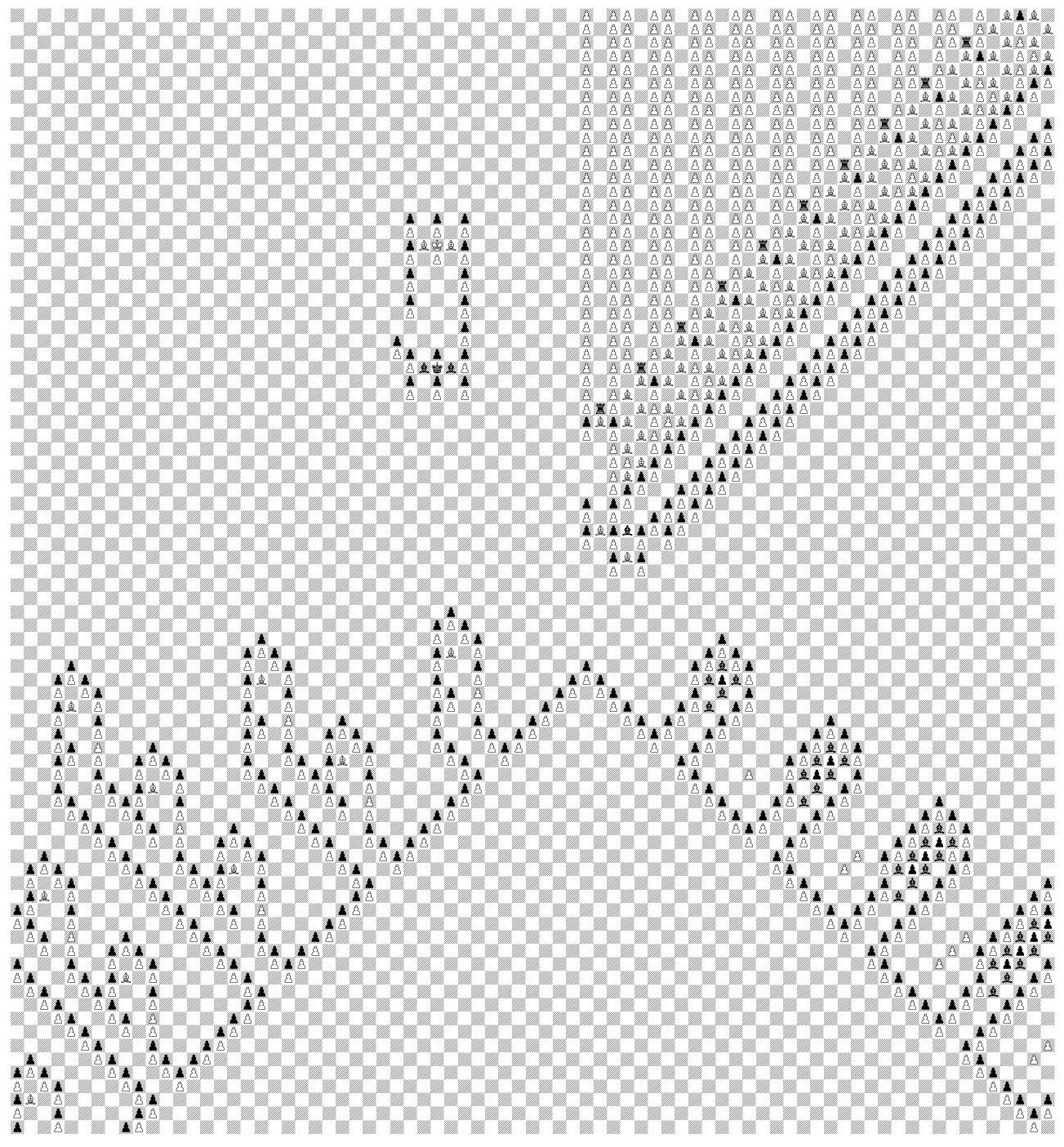
A position in infinite chess with value $\omega^4$
In the new position, above, the kings sit facing each other in the throne room, an uneasy détente, while white makes steady progress in the rook towers. Meanwhile, at every step black, doomed, mounts increasingly desperate bouts of long forced play using the bishop cannon battery, with bishops flying with force out of the cannons, and then each making a long series of forced-reply moves in the terminal gateways. Ultimately, white wins with value omega^4, which exceeds the previously largest known values of omega^3.
In the throne room, if either black or white places a bishop on the corresponding diagonal entryway, then checkmate is very close. A key feature is that for white to place a white-square white bishop on the diagonal marked in red, it is immediate checkmate, whereas if black places a black-square black bishop on the blue diagonal, then checkmate comes three moves later. The bishop cannon battery arrangement works because black threatens to release a bishop into the free region, and if white does not reply to those threats, then black will be three steps ahead, but otherwise, only two.
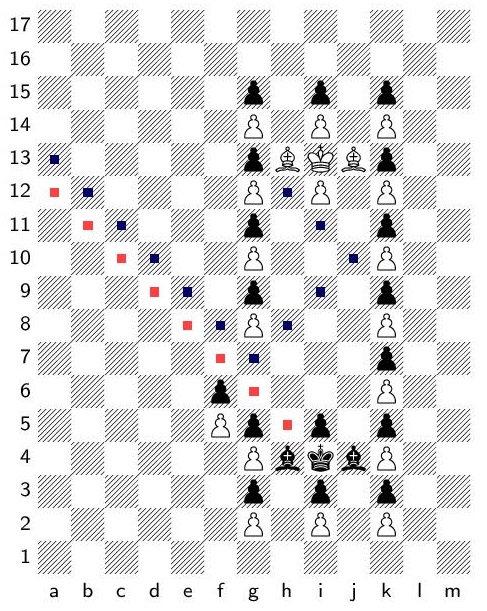
The throne room
The rook towers are similar to the corresponding part of the previous $\omega^3$ position, and this is where white undertakes most of his main line progress towards checkmate. Black will move the key bishop out as far as he likes on the first move, past $n$ rook towers, and the resulting position will have value $\omega^3\cdot n$. These towers are each activated in turn, leading to a long series of play for white, interrupted at every opportunity by black causing a dramatic spectacle of forced-reply moves down in the bishop cannon battery.
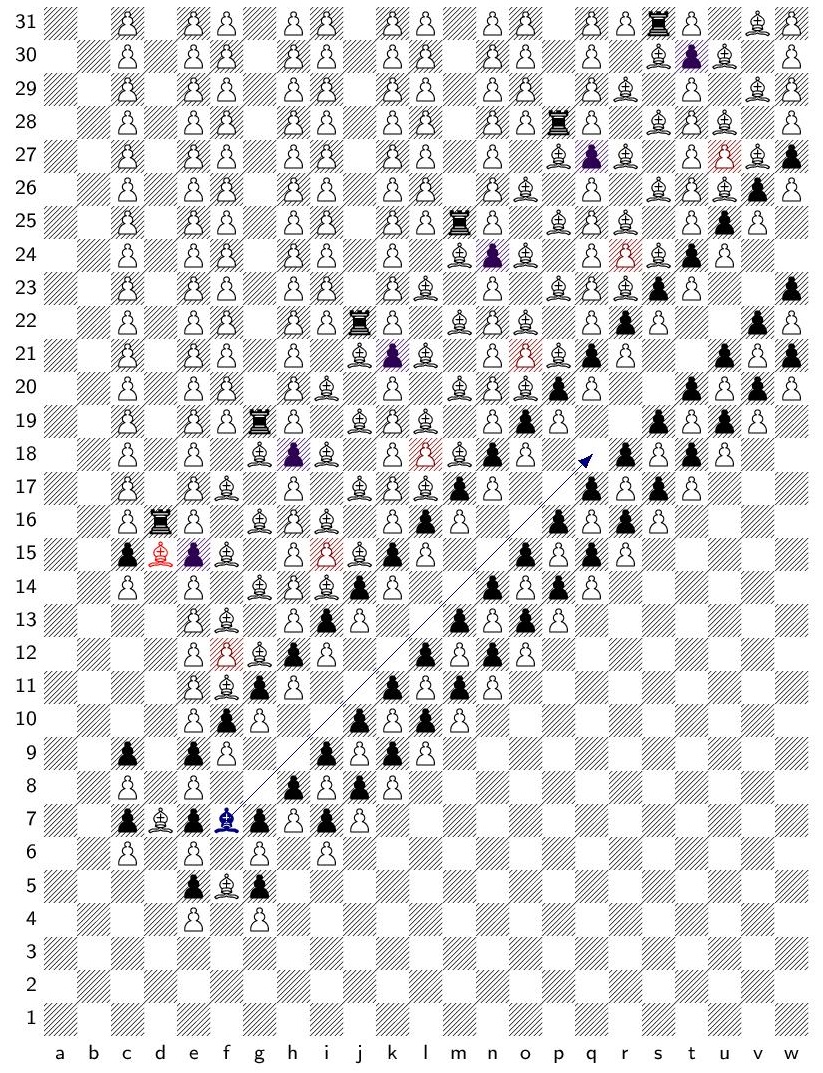
The rook towers
At every opportunity, black mounts a long distraction down in the bishop cannon battery. Shown here is one bishop cannon. The cannonballs fire out of the cannon with force, in the sense that when each green bishop fires out, then white must reply by moving the guard pawns into place.
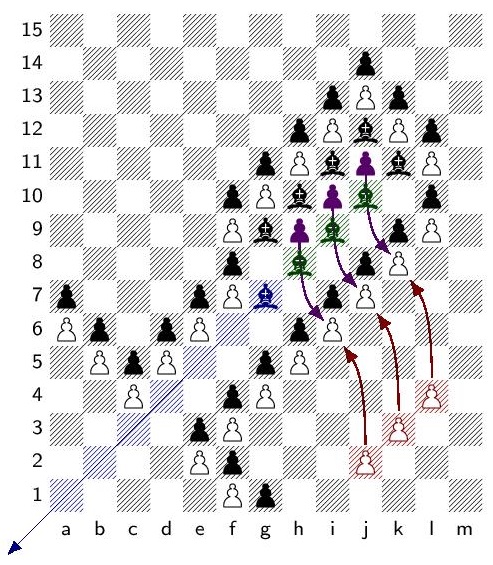
Bishop cannon
Upon firing, each bishop will position itself so as to attack the entrance diagonal of a long bishop gateway terminal wing. This wing is arranged so that black can make a series of forced-reply threats successively, by moving to the attack squares (marked with the blue squares). Black is threatening to exit through the gateway doorway (in brown), but white can answer the threat by moving the white bishop guards (red) into position. Thus, each bishop coming out of a cannon (with force) can position itself at a gateway terminal of length $g$, making $g$ forced-reply moves in succession. Since black can initiate firing with an arbitrarily large cannon, this means that at any moment, black can cause a forced-reply delay with game value $\omega^2$. Since the rook tower also has value $\omega^2$ by itself, the overall position has value $\omega^4=\omega^2\cdot\omega^2$.
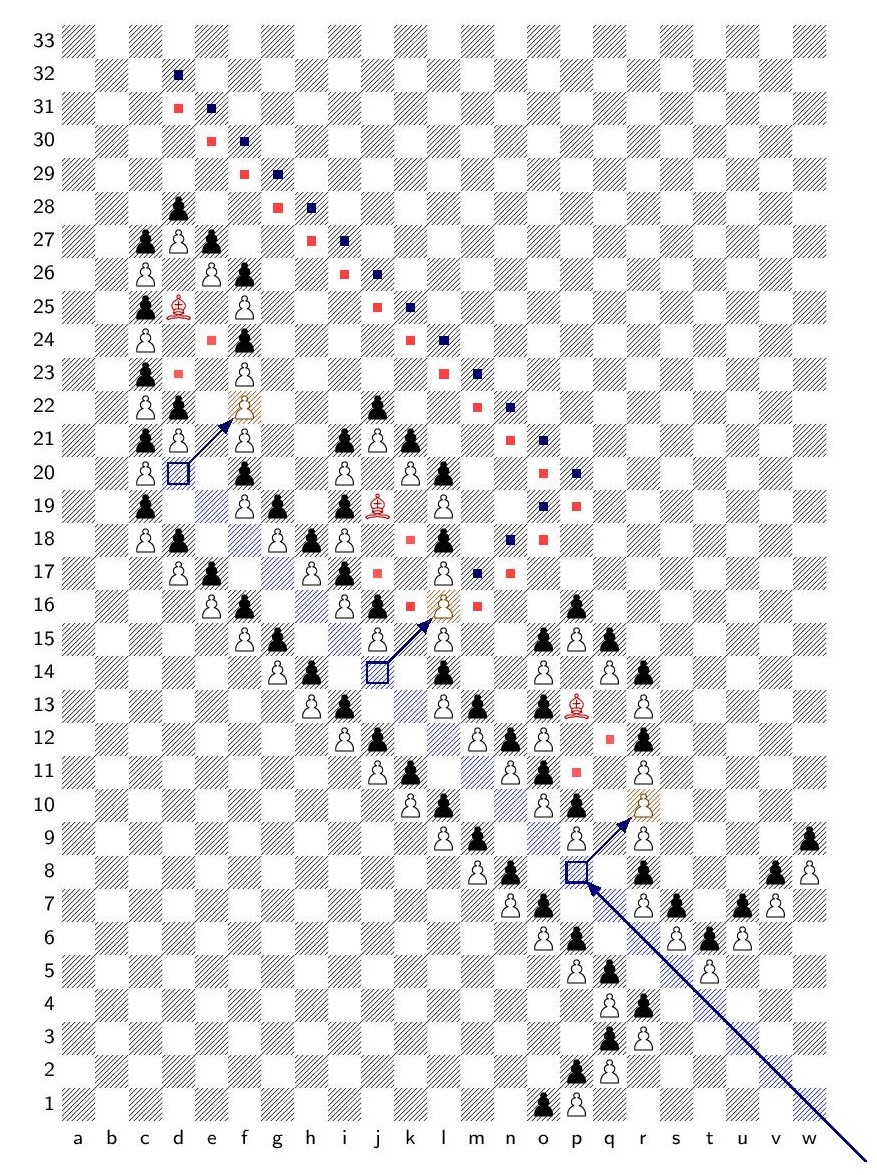
Bishop gateway terminal wing
With future developments in mind, we found that one can make a more compact arrangement of the bishop cannon battery, freeing up a quarter board for perhaps another arrangement that might lead to a higher ordinal values.
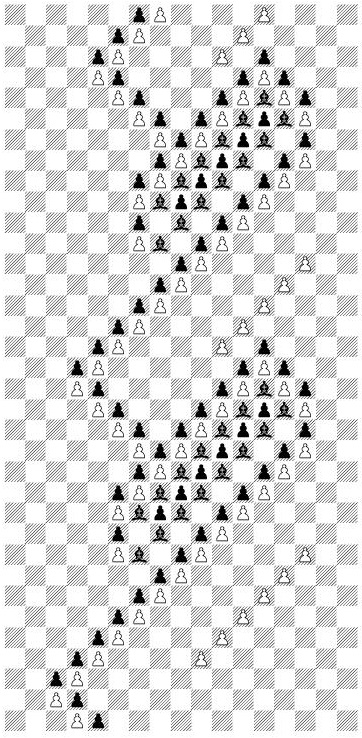
Alternative compact version of bishop cannon battery
Read more about it in the article, which is available at the arxiv (pdf).
See also:
- Tranfinite game values in infinite chess
- The mate-in-$n$ problem of infinite chess is decidable
- Johan Wästlund’s MathOverflow question: Checkmate in $\omega$ moves?
- Richard Stanley’s MathOverflow question: Decidability of chess on an infinite board