Fabien Sanglard's Website
September 20th, 2013
Decyphering the Business Card Raytracer
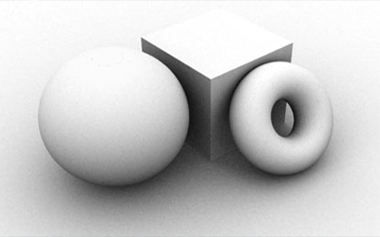 I recently came across Paul Heckbert's business card raytracer.
For those that have never heard of it: It is a very famous challenge in the Computer Graphics field that
started on May 4th, 1984 via a post on
I recently came across Paul Heckbert's business card raytracer.
For those that have never heard of it: It is a very famous challenge in the Computer Graphics field that
started on May 4th, 1984 via a post on comp.graphics by Paul Heckbert ( More about this in his article "A Minimal Ray Tracer" from the book Graphics Gems IV).
The goal was to produce the source code for a raytracer...that would fit on the back of a business card.
Andrew Kensler's version is mesmerizing and one of the greatest hack that I have seen. Since I am curious, I decided to deconstruct it: Here is what I understood.
Edit :Andrew Kensler himself commented on Hacker News and adressed/elaborated on my observations: Thanks you so much Andrew :) !
The Business Card Code
  #include <stdlib.h>   // card > aek.ppm
  #include <stdio.h>
  #include <math.h>
  typedef int i;typedef float f;struct v{
  f x,y,z;v operator+(v r){return v(x+r.x
  ,y+r.y,z+r.z);}v operator*(f r){return
  v(x*r,y*r,z*r);}f operator%(v r){return
  x*r.x+y*r.y+z*r.z;}v(){}v operator^(v r
  ){return v(y*r.z-z*r.y,z*r.x-x*r.z,x*r.
  y-y*r.x);}v(f a,f b,f c){x=a;y=b;z=c;}v
  operator!(){return*this*(1/sqrt(*this%*
  this));}};i G[]={247570,280596,280600,
  249748,18578,18577,231184,16,16};f R(){
  return(f)rand()/RAND_MAX;}i T(v o,v d,f
  &t,v&n){t=1e9;i m=0;f p=-o.z/d.z;if(.01
  <p)t=p,n=v(0,0,1),m=1;for(i k=19;k--;)
  for(i j=9;j--;)if(G[j]&1<<k){v p=o+v(-k
  ,0,-j-4);f b=p%d,c=p%p-1,q=b*b-c;if(q>0
  ){f s=-b-sqrt(q);if(s<t&&s>.01)t=s,n=!(
  p+d*t),m=2;}}return m;}v S(v o,v d){f t
  ;v n;i m=T(o,d,t,n);if(!m)return v(.7,
  .6,1)*pow(1-d.z,4);v h=o+d*t,l=!(v(9+R(
  ),9+R(),16)+h*-1),r=d+n*(n%d*-2);f b=l%
  n;if(b<0||T(h,l,t,n))b=0;f p=pow(l%r*(b
  >0),99);if(m&1){h=h*.2;return((i)(ceil(
  h.x)+ceil(h.y))&1?v(3,1,1):v(3,3,3))*(b
  *.2+.1);}return v(p,p,p)+S(h,r)*.5;}i
  main(){printf("P6 512 512 255 ");v g=!v
  (-6,-16,0),a=!(v(0,0,1)^g)*.002,b=!(g^a
  )*.002,c=(a+b)*-256+g;for(i y=512;y--;)
  for(i x=512;x--;){v p(13,13,13);for(i r
  =64;r--;){v t=a*(R()-.5)*99+b*(R()-.5)*
  99;p=S(v(17,16,8)+t,!(t*-1+(a*(R()+x)+b
  *(y+R())+c)*16))*3.5+p;}printf("%c%c%c"
  ,(i)p.x,(i)p.y,(i)p.z);}}
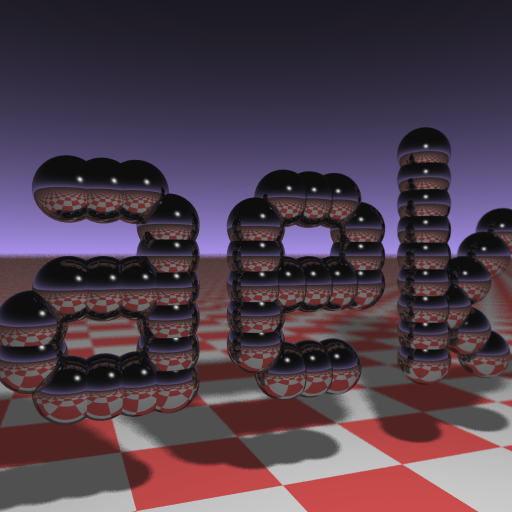
The code looks confusing but it compiles and run flawlessly! On my MacBook Air, it takes 27 seconds to generate the image on the right. If you want to run it yourself, save the code in a file named
card.cpp, open a Terminal window and type:
    c++ -O3 -o card card.cpp
    ./card > card.ppm
Business Card Raycaster features
The list of features is impressive :
- The world is made of spheres which are carefully organized.
- There is a floor and it is textured.
- There is a sky and it has a nice gradient.
- Shadows are soft shadows.
- OMG, Depth of View blur: Are you kidding me ?
All that fitting on the back of a business card ! Let's see how it works !
Vector class
    #include <stdlib.h>   // card > aek.ppm
    #include <stdio.h>
    #include <math.h>
    typedef int i;typedef float f;struct v{
    f x,y,z;v operator+(v r){return v(x+r.x
    ,y+r.y,z+r.z);}v operator*(f r){return
    v(x*r,y*r,z*r);}f operator%(v r){return
    x*r.x+y*r.y+z*r.z;}v(){}v operator^(v r
    ){return v(y*r.z-z*r.y,z*r.x-x*r.z,x*r.
    y-y*r.x);}v(f a,f b,f c){x=a;y=b;z=c;}v
    operator!(){return*this*(1/sqrt(*this%*
    this));}};i G[]={247570,280596,280600,
    249748,18578,18577,231184,16,16};f R(){
    return(f)rand()/RAND_MAX;}i T(v o,v d,f
    &t,v&n){t=1e9;i m=0;f p=-o.z/d.z;if(.01
    <p)t=p,n=v(0,0,1),m=1;for(i k=19;k--;)
    for(i j=9;j--;)if(G[j]&1<<k){v p=o+v(-k
    ,0,-j-4);f b=p%d,c=p%p-1,q=b*b-c;if(q>0
    ){f s=-b-sqrt(q);if(s<t&&s>.01)t=s,n=!(
    p+d*t),m=2;}}return m;}v S(v o,v d){f t
    ;v n;i m=T(o,d,t,n);if(!m)return v(.7,
    .6,1)*pow(1-d.z,4);v h=o+d*t,l=!(v(9+R(
    ),9+R(),16)+h*-1),r=d+n*(n%d*-2);f b=l%
    n;if(b<0||T(h,l,t,n))b=0;f p=pow(l%r*(b
    >0),99);if(m&1){h=h*.2;return((i)(ceil(
    h.x)+ceil(h.y))&1?v(3,1,1):v(3,3,3))*(b
    *.2+.1);}return v(p,p,p)+S(h,r)*.5;}i
    main(){printf("P6 512 512 255 ");v g=!v
    (-6,-16,0),a=!(v(0,0,1)^g)*.002,b=!(g^a
    )*.002,c=(a+b)*-256+g;for(i y=512;y--;)
    for(i x=512;x--;){v p(13,13,13);for(i r
    =64;r--;){v t=a*(R()-.5)*99+b*(R()-.5)*
    99;p=S(v(17,16,8)+t,!(t*-1+(a*(R()+x)+b
    *(y+R())+c)*16))*3.5+p;}printf("%c%c%c"
    ,(i)p.x,(i)p.y,(i)p.z);}}
|
The main trick that helps reducing the code size dramatically it to use two define :
The other big space saver is the 'v' C++ class which is used for vector but also pixel processing. Here is the code formated, highlighted and commented: #include <stdlib.h> #include <stdio.h> #include <math.h> typedef int i; typedef float f; struct v{ f x,y,z; v operator+(v r){return v(x+r.x,y+r.y,z+r.z);} v operator*(f r){return v(x*r,y*r,z*r);} f operator%(v r){return x*r.x+y*r.y+z*r.z;} v(){} v operator^(v r){return v(y*r.z-z*r.y,z*r.x-x*r.z,x*r.y-y*r.x);} v(f a,f b,f c){x=a;y=b;z=c;} v operator!(){return *this*(1 /sqrt(*this%*this));} }; |
Random() and World database
    #include <stdlib.h>   // card > aek.ppm
    #include <stdio.h>
    #include <math.h>
    typedef int i;typedef float f;struct v{
    f x,y,z;v operator+(v r){return v(x+r.x
    ,y+r.y,z+r.z);}v operator*(f r){return
    v(x*r,y*r,z*r);}f operator%(v r){return
    x*r.x+y*r.y+z*r.z;}v(){}v operator^(v r
    ){return v(y*r.z-z*r.y,z*r.x-x*r.z,x*r.
    y-y*r.x);}v(f a,f b,f c){x=a;y=b;z=c;}v
    operator!(){return*this*(1/sqrt(*this%*
    this));}};i G[]={247570,280596,280600,
    249748,18578,18577,231184,16,16};f R(){
    return(f)rand()/RAND_MAX;}i T(v o,v d,f
    &t,v&n){t=1e9;i m=0;f p=-o.z/d.z;if(.01
    <p)t=p,n=v(0,0,1),m=1;for(i k=19;k--;)
    for(i j=9;j--;)if(G[j]&1<<k){v p=o+v(-k
    ,0,-j-4);f b=p%d,c=p%p-1,q=b*b-c;if(q>0
    ){f s=-b-sqrt(q);if(s<t&&s>.01)t=s,n=!(
    p+d*t),m=2;}}return m;}v S(v o,v d){f t
    ;v n;i m=T(o,d,t,n);if(!m)return v(.7,
    .6,1)*pow(1-d.z,4);v h=o+d*t,l=!(v(9+R(
    ),9+R(),16)+h*-1),r=d+n*(n%d*-2);f b=l%
    n;if(b<0||T(h,l,t,n))b=0;f p=pow(l%r*(b
    >0),99);if(m&1){h=h*.2;return((i)(ceil(
    h.x)+ceil(h.y))&1?v(3,1,1):v(3,3,3))*(b
    *.2+.1);}return v(p,p,p)+S(h,r)*.5;}i
    main(){printf("P6 512 512 255 ");v g=!v
    (-6,-16,0),a=!(v(0,0,1)^g)*.002,b=!(g^a
    )*.002,c=(a+b)*-256+g;for(i y=512;y--;)
    for(i x=512;x--;){v p(13,13,13);for(i r
    =64;r--;){v t=a*(R()-.5)*99+b*(R()-.5)*
    99;p=S(v(17,16,8)+t,!(t*-1+(a*(R()+x)+b
    *(y+R())+c)*16))*3.5+p;}printf("%c%c%c"
    ,(i)p.x,(i)p.y,(i)p.z);}}
|
The next section also saves a lot of code by defining a R function that
return a random value within [0.0f-1.0f]. It is very useful for the stochastic sampling resulting
in blur and soft-shadows.
The Here is the code formated, highlighted and commented :
   i G[]={247570,280596,280600,249748,18578,18577,231184,16,16};


   f R(){return(f)rand()/RAND_MAX;}
|
Main method
The main method uses a simple image file format known as PPM. It is text based with a ridiculously simple header:
P6 [WIDTH] [HEIGHT] [MAX_VALUE] followed by the RGB values for each pixels.
For each 512x512 pixels in the image, the program samples (S) the color of 64 rays, accumulates the result and write it to the output (stdout).
It applies a bit of random delta on each ray origin and ray direction in order to produce a nice Depth of View effect.
    #include <stdlib.h>   // card > aek.ppm
    #include <stdio.h>
    #include <math.h>
    typedef int i;typedef float f;struct v{
    f x,y,z;v operator+(v r){return v(x+r.x
    ,y+r.y,z+r.z);}v operator*(f r){return
    v(x*r,y*r,z*r);}f operator%(v r){return
    x*r.x+y*r.y+z*r.z;}v(){}v operator^(v r
    ){return v(y*r.z-z*r.y,z*r.x-x*r.z,x*r.
    y-y*r.x);}v(f a,f b,f c){x=a;y=b;z=c;}v
    operator!(){return*this*(1/sqrt(*this%*
    this));}};i G[]={247570,280596,280600,
    249748,18578,18577,231184,16,16};f R(){
    return(f)rand()/RAND_MAX;}i T(v o,v d,f
    &t,v&n){t=1e9;i m=0;f p=-o.z/d.z;if(.01
    <p)t=p,n=v(0,0,1),m=1;for(i k=19;k--;)
    for(i j=9;j--;)if(G[j]&1<<k){v p=o+v(-k
    ,0,-j-4);f b=p%d,c=p%p-1,q=b*b-c;if(q>0
    ){f s=-b-sqrt(q);if(s<t&&s>.01)t=s,n=!(
    p+d*t),m=2;}}return m;}v S(v o,v d){f t
    ;v n;i m=T(o,d,t,n);if(!m)return v(.7,
    .6,1)*pow(1-d.z,4);v h=o+d*t,l=!(v(9+R(
    ),9+R(),16)+h*-1),r=d+n*(n%d*-2);f b=l%
    n;if(b<0||T(h,l,t,n))b=0;f p=pow(l%r*(b
    >0),99);if(m&1){h=h*.2;return((i)(ceil(
    h.x)+ceil(h.y))&1?v(3,1,1):v(3,3,3))*(b
    *.2+.1);}return v(p,p,p)+S(h,r)*.5;}i
    main(){printf("P6 512 512 255 ");v g=!v
    (-6,-16,0),a=!(v(0,0,1)^g)*.002,b=!(g^a
    )*.002,c=(a+b)*-256+g;for(i y=512;y--;)
    for(i x=512;x--;){v p(13,13,13);for(i r
    =64;r--;){v t=a*(R()-.5)*99+b*(R()-.5)*
    99;p=S(v(17,16,8)+t,!(t*-1+(a*(R()+x)+b
    *(y+R())+c)*16))*3.5+p;}printf("%c%c%c"
    ,(i)p.x,(i)p.y,(i)p.z);}}
|
  i main(){

     printf("P6 512 512 255 ");


     v g=!v(-6,-16,0),
       a=!(v(0,0,1)^g)*.002,
       b=!(g^a)*.002,
       c=(a+b)*-256+g;

     for(i y=512;y--;)
     for(i x=512;x--;){


        v p(13,13,13);     // Default pixel color is almost pitch black


        for(i r=64;r--;){


            v t=a*(R()-.5)*99+b*(R()-.5)*99;


            p=S(v(17,16,8)+t,
                !(t*-1+(a*(R()+x)+b*(y+R())+c)*16)

                )*3.5+p;
        }

        printf("%c%c%c",(i)p.x,(i)p.y,(i)p.z);

     }
  }
|
Sampler
The Sampler (S) is a function that returns a pixel color for a given Point Origin (o) and Vector Direction (d). It is recursive if it hits a sphere. If no sphere is hit by the ray (and a ray always ends up missing) then the function either returns a sky color gradient or a floor color based on a checkerboard texture.
Remark the calls to R when computing the light direction: This is how the soft-shadows are generated.
    #include <stdlib.h>   // card > aek.ppm
    #include <stdio.h>
    #include <math.h>
    typedef int i;typedef float f;struct v{
    f x,y,z;v operator+(v r){return v(x+r.x
    ,y+r.y,z+r.z);}v operator*(f r){return
    v(x*r,y*r,z*r);}f operator%(v r){return
    x*r.x+y*r.y+z*r.z;}v(){}v operator^(v r
    ){return v(y*r.z-z*r.y,z*r.x-x*r.z,x*r.
    y-y*r.x);}v(f a,f b,f c){x=a;y=b;z=c;}v
    operator!(){return*this*(1/sqrt(*this%*
    this));}};i G[]={247570,280596,280600,
    249748,18578,18577,231184,16,16};f R(){
    return(f)rand()/RAND_MAX;}i T(v o,v d,f
    &t,v&n){t=1e9;i m=0;f p=-o.z/d.z;if(.01
    <p)t=p,n=v(0,0,1),m=1;for(i k=19;k--;)
    for(i j=9;j--;)if(G[j]&1<<k){v p=o+v(-k
    ,0,-j-4);f b=p%d,c=p%p-1,q=b*b-c;if(q>0
    ){f s=-b-sqrt(q);if(s<t&&s>.01)t=s,n=!(
    p+d*t),m=2;}}return m;}v S(v o,v d){f t
    ;v n;i m=T(o,d,t,n);if(!m)return v(.7,
    .6,1)*pow(1-d.z,4);v h=o+d*t,l=!(v(9+R(
    ),9+R(),16)+h*-1),r=d+n*(n%d*-2);f b=l%
    n;if(b<0||T(h,l,t,n))b=0;f p=pow(l%r*(b
    >0),99);if(m&1){h=h*.2;return((i)(ceil(
    h.x)+ceil(h.y))&1?v(3,1,1):v(3,3,3))*(b
    *.2+.1);}return v(p,p,p)+S(h,r)*.5;}i
    main(){printf("P6 512 512 255 ");v g=!v
    (-6,-16,0),a=!(v(0,0,1)^g)*.002,b=!(g^a
    )*.002,c=(a+b)*-256+g;for(i y=512;y--;)
    for(i x=512;x--;){v p(13,13,13);for(i r
    =64;r--;){v t=a*(R()-.5)*99+b*(R()-.5)*
    99;p=S(v(17,16,8)+t,!(t*-1+(a*(R()+x)+b
    *(y+R())+c)*16))*3.5+p;}printf("%c%c%c"
    ,(i)p.x,(i)p.y,(i)p.z);}}
|
   v S(v o,v d){
      f t;
      v n;


      i m=T(o,d,t,n);

      if(!m)

      return v(.7,.6,1)*pow(1-d.z,4);


      v h=o+d*t,
      l=!(v(9+R(),9+R(),16)+h*-1),
      r=d+n*(n%d*-2);


      f b=l%n;


      if(b<0||T(h,l,t,n))
         b=0;


      f p=pow(l%r*(b>0),99);

      if(m&1){
         h=h*.2;
         return((i)(ceil(h.x)+ceil(h.y))&1?v(3,1,1):v(3,3,3))*(b*.2+.1);
      }


      return v(p,p,p)+S(h,r)*.5;
  }
|
Tracer
The Tracer is in charge of casting a Ray (Origin o ,Direction d). It return an integer that is a code for the intersection test with the spheres in the world (0=miss toward sky,1=miss toward floor, 2=sphere hit). If a sphere is hit, it updates the references t (the parametric value to compute the distance of intersection) and n (the half-vector where the ray bounce).
    #include <stdlib.h>   // card > aek.ppm
    #include <stdio.h>
    #include <math.h>
    typedef int i;typedef float f;struct v{
    f x,y,z;v operator+(v r){return v(x+r.x
    ,y+r.y,z+r.z);}v operator*(f r){return
    v(x*r,y*r,z*r);}f operator%(v r){return
    x*r.x+y*r.y+z*r.z;}v(){}v operator^(v r
    ){return v(y*r.z-z*r.y,z*r.x-x*r.z,x*r.
    y-y*r.x);}v(f a,f b,f c){x=a;y=b;z=c;}v
    operator!(){return*this*(1/sqrt(*this%*
    this));}};i G[]={247570,280596,280600,
    249748,18578,18577,231184,16,16};f R(){
    return(f)rand()/RAND_MAX;}i T(v o,v d,f
    &t,v&n){t=1e9;i m=0;f p=-o.z/d.z;if(.01
    <p)t=p,n=v(0,0,1),m=1;for(i k=19;k--;)
    for(i j=9;j--;)if(G[j]&1<<k){v p=o+v(-k
    ,0,-j-4);f b=p%d,c=p%p-1,q=b*b-c;if(q>0
    ){f s=-b-sqrt(q);if(s<t&&s>.01)t=s,n=!(
    p+d*t),m=2;}}return m;}v S(v o,v d){f t
    ;v n;i m=T(o,d,t,n);if(!m)return v(.7,
    .6,1)*pow(1-d.z,4);v h=o+d*t,l=!(v(9+R(
    ),9+R(),16)+h*-1),r=d+n*(n%d*-2);f b=l%
    n;if(b<0||T(h,l,t,n))b=0;f p=pow(l%r*(b
    >0),99);if(m&1){h=h*.2;return((i)(ceil(
    h.x)+ceil(h.y))&1?v(3,1,1):v(3,3,3))*(b
    *.2+.1);}return v(p,p,p)+S(h,r)*.5;}i
    main(){printf("P6 512 512 255 ");v g=!v
    (-6,-16,0),a=!(v(0,0,1)^g)*.002,b=!(g^a
    )*.002,c=(a+b)*-256+g;for(i y=512;y--;)
    for(i x=512;x--;){v p(13,13,13);for(i r
    =64;r--;){v t=a*(R()-.5)*99+b*(R()-.5)*
    99;p=S(v(17,16,8)+t,!(t*-1+(a*(R()+x)+b
    *(y+R())+c)*16))*3.5+p;}printf("%c%c%c"
    ,(i)p.x,(i)p.y,(i)p.z);}}
|
   i T(v o,v d,f& t,v& n){
     t=1e9;
     i m=0;
     f p=-o.z/d.z;
      if(.01<p)›
       t=p,n=v(0,0,1),m=1;


     for(i k=19;k--;)
     for(i j=9;j--;)

     if(G[j]&1<<k){


        v p=o+v(-k,0,-j-4);
        f b=p%d,c=p%p-1,q=b*b-c;


        if(q>0){

           f s=-b-sqrt(q);

           if(s<t && s>.01)


             t=s,
             n=!(p+d*t),
             m=2;
         }
     }
     return m;
  }
|
The Leet Number
Many readers have tried to shorten the code further with more or less success. The original author stopped with the current version for
a very interesting reason:
  $ wc card.cpp
  35      95    1337 card.cpp
The total size of the code is 1337 bytes: The Leet number. Beat that !
Script kiddie
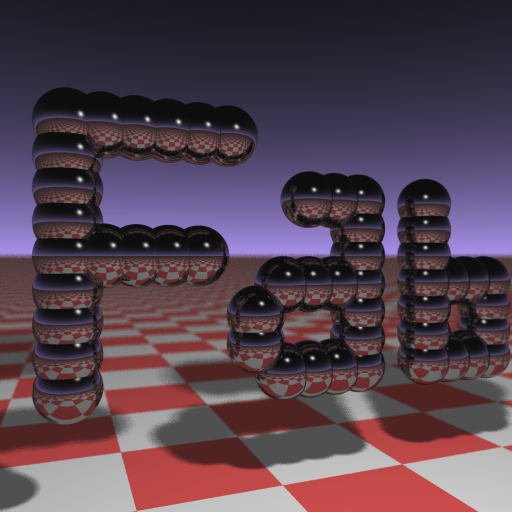
And now that the business card is fully understood, we can generate our own :
   #include <stdlib.h>   // card > aek.ppm
   #include <stdio.h>
   #include <math.h>
   typedef int i;typedef float f;struct v{
   f x,y,z;v operator+(v r){return v(x+r.x
   ,y+r.y,z+r.z);}v operator*(f r){ return
   v(x*r,y*r,z*r);}f operator%(v r){return
   x*r.x+y*r.y+z*r.z;}v(){}v operator^(v r
   ){return v(y*r.z-z*r.y,z*r.x-x*r.z,x*r.
   y-y*r.x);}v(f a,f b,f c){x=a;y=b;z=c;}v
   operator!(){return*this*(1/sqrt(*this%*
   this));}};i G[]={133022, 133266,133266,
   133022, 254096, 131216, 131984, 131072,
   258048,};f R(){return(f)rand()/RAND_MAX
   ;}i T(v o,v d,f&t,v&n){t=1e9;i m=0;f p=
   -o.z/d.z; if(.01<p)t=p, n=v(0,0,1),m=1;
   for(i k=19;k--;)for(i j=9;j--;)if(G[j]&
   1<<k){v p=o+v(-k,0,-j-4);f b=p%d,c=p%p-
   1,q=b*b-c;if(q>0){f s=-b-sqrt(q);if(s<t
   &&s>.01)t=s,n=!(p+d*t),m=2;}}return m;}
   v S(v o,v d){f t;v n;i m=T(o,d,t,n);if(
   !m)return v(.7,.6,1)*pow(1-d.z,4);v h=o
   +d*t,l=!(v(9+R(),9+R(),16)+h*-1),r=d+n*
   (n%d*-2);f b=l%n;if(b<0||T(h,l,t,n))b=0
   ;f p=pow(l%r*(b>0),99);if(m&1){h=h*.2;
   return((i)(ceil(h.x)+ceil(h.y))&1?v(3,1
   ,1):v(3,3,3))*(b*.2+.1);}return v(p,p,p
   )+S(h,r)*.5;}i main(){printf("P6 512  "
   "512 255 ");v g=!v(-6,-16,0),a=!(v(0,0,
   1)^g)*.002,b=!(g^a)*.002,c=(a+b)*-256+g
   ;for(i y=512;y--;)for(i x=512;x--;){v p
   (9,9,9);for(i r=64;r--;){v t=a*(R()-.5)
   *99+b*(R()-.5)*99;p=S(v(17,16,8)+t,!(t*
   -1+(a*(R()+x)+b*(y+R())+c)*16))*3.5+p;}
   printf("%c%c%c",(i)p.x,(i)p.y,(i)p.z);}}
Recommended readings
Since I have spent as lot of time reading about raytracing, here are a few really good resources:
- scratchapixel.com : Great raytracer lessons written by professionals that have worked on Toy Story, Avatar, Lord of the Rings, Harry Potter, Pirates of the Caribbean and many other movies.
- An Introduction to Ray Tracing : An old book but a Classic.
- Physically Based Rendering : Heavy on maths but really good and well explained.
@