 The California legislature just passed Assembly Bill 100 (AB100), which according to the inset calls for “100% clean energy by 2045”. The brief review presented in this post shows that AB100, which targets electricity, not energy, will cut California’s greenhouse gas emissions by only about 16% even in the unlikely event its target is met. Its main impact will be to add to the regulatory overload from which California’s electricity providers already suffer. The fact that the bill was passed at all indicates that California legislators, as well as being unable to tell the difference between megawatts and megawatt-hours, are also unable to tell the difference between electricity and energy.
AB100 (Senate version SB100) is California’s latest attempt to convert its dream of a 100% clean, renewable and sustainable energy future into reality. Media outlets were near-unanimous in concluding that it finally commits California to 100% renewable energy:
Los Angeles Times: The bill …. would require California to obtain 100% of its power from clean sources by 2045
Forbes: California has approved a measure requiring all energy used in the sunshine state to be from renewable sources by 2045
ZME Science: Last week, California’s legislators passed Senate Bill 100, a bill to power the state exclusively on clean energy
Even Senator Kevin de León, who introduced the bill, claims on his website that AB100 will power the state on “100% clean, renewable energy”. California Senate President pro Tempore Kevin de León (D-Los Angeles) on Tuesday introduced Senate Bill 100, The California Clean Energy Act of 2017, which puts the state on the path to 100 percent clean, renewable energy by 2045. If the politician responsible for drafting AB100 believes this we can assume that the 42 other California legislators who voted for it don’t understand the difference between electricity and energy either.
Here is what AB100 actually says. The text from which the following extracts are taken is here:
SECTION 1.
(a) This act shall be known as The 100 Percent Clean Energy Act of 2018.
(b) The Legislature finds and declares that the Public Utilities Commission, State Energy Resources Conservation and Development Commission, and State Air Resources Board should plan for 100 percent of total retail sales of electricity in California to come from eligible renewable energy resources and zero-carbon resources by December 31, 2045.
Let’s dissect this wording point by point.
First, calling it the “100 Percent Clean Energy Act of 2018” is misleading. The bill doesn’t call for 100% clean energy. It calls for 100% clean electricity.
Second, “(agencies) should plan…….” Meeting the 100% target isn’t mandatory. And plans are cheap.
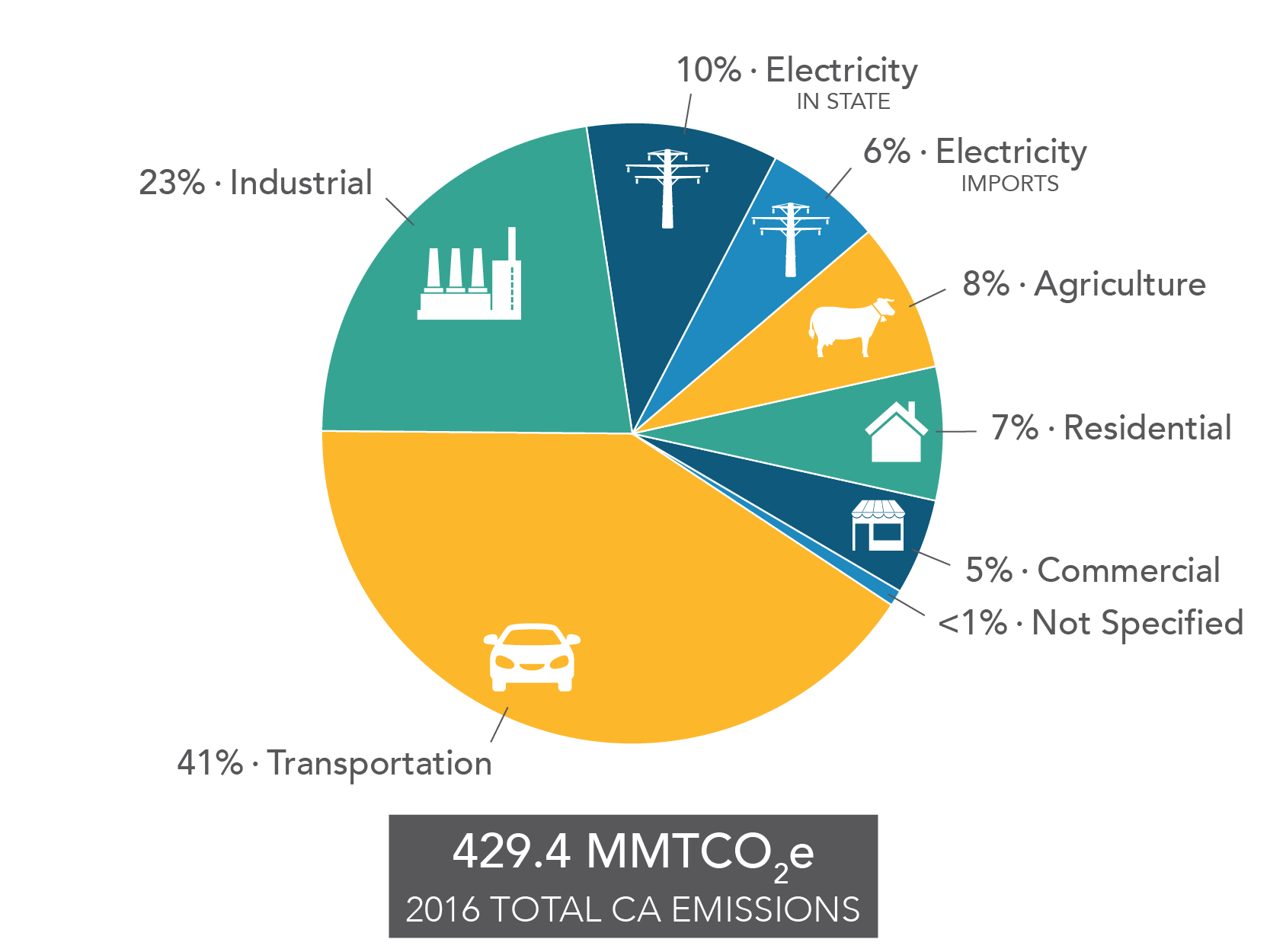
Third, “… for 100% of total retail sales of electricity…..” I have assumed that “total retail sales” include all of the electricity sold by providers to all sectors of the California economy – residential, commercial, industrial, agricultural etc., which according to the California Energy Commission amounted to 285.7 TWh in 2016. But according to the pie slice chart shown below (data from the California Air Resources Board) California’s electricity sector, with imports included, generated only 16% of the state’s greenhouse gas emissions in 2016. So AB100 targets only 16% of California’s emissions:
Next comes the question of what “eligible renewable energy resources” are. According to Section 25741 of the California Public Resources Code eligible resources are biomass, solar thermal, photovoltaic, wind, geothermal, fuel cells using renewable fuels, small hydroelectric generation of 30 megawatts or less, digester gas, municipal solid waste conversion, landfill gas, ocean wave, ocean thermal, or tidal current, and any additions or enhancements to the facility using that technology. The only explicit change AB100 makes is to add hydro plants larger than 30MW by deleting a few words from the original draft:
An existing
smallhydroelectric generation facilityof 30 megawatts or lessshall be eligible only if a retail seller or local publicly owned electric utility procured the electricity from the facility as of December 31, 2005.
But at the same time it applies restrictions which pretty much guarantee that no new plus-30MW hydro plants will be built:
A new hydroelectric facility ….. is not an eligible renewable energy resource if it will cause an adverse impact on instream beneficial uses or cause a change in the volume or timing of streamflow.
Since it’s not possible to operate a conventional hydro dam efficiently without changing the volume and timing of streamflow this limits the options to run-of-river projects. But there are few potential ROR sites left in California, and probably none when permitting problems are taken into account.
Another change AB100 makes is to add “zero carbon resources” to “eligible resources”. Zero-carbon resources were not mentioned in the original draft and are not defined in the current bill. It’s been surmised that they are a veiled reference to nuclear plants, but this is doubtful. California’s last remaining nuclear plant (Diablo Canyon) remains scheduled for shutdown and the legislature wants the shutdown to proceed. Bill SB1090, which confirmed that Diablo Canyon will be replaced by “a portfolio of greenhouse-gas-free resources”, recently passed the Senate by a vote of 67-1.
AB100 applies other restrictions too. (Note that the following clause adds “state agencies” to “end-use customers”. I have no data on the electricity consumption of California’s state agencies but assume it isn’t very much, and presumably it would be included in retail sales anyway).
It is the policy of the state that eligible renewable energy resources and zero-carbon resources supply 100 percent of all retail sales of electricity to California end-use customers and 100 percent of electricity procured to serve all state agencies by December 31, 2045. The achievement of this policy for California shall not increase carbon emissions elsewhere in the western grid and shall not allow resource shuffling.
What is “resource shuffling”? It’s what happens when a California utility sells its interest in, say, an out-of-state coal plant to an out-of-state utility (Los Angeles Department of Water & Power’s sale of its interest in the Navajo Generating Station to the Salt River Project is an example) and “replaces” it with wind and/or solar. This allows California to claim an emissions reduction even though there is no change in regional emissions. A good article on resource shuffling is available here for those who may want more information. One of the points it makes is that resource shuffling is difficult to regulate.
California also faces the practical problem of how to replace over 200 TWh/year (assuming no significant EV consumption) of baseload and load-following generation with wind, solar and other “eligible renewables” by 2045. This could require up to 100GW of new renewable capacity along with maybe 20 terawatt-hours of energy storage to handle intermittency. But renewable energy development in California is slowing down, and the legislature apparently still believes it can solve the storage problem with a few gigawatts (hours unspecified) of battery storage. In short, the chances that AB100’s target can be met are slim.
That concludes my brief analysis of AB100. Commenters are encouraged to point out any misinterpretations or omissions.
The question of what preceded AB100 is also worth brief discussion before wrapping the post up. California began its quest for a carbon-free energy future with Assembly Bill 32, the presumptuously-titled California Global Warming Solutions Act of 2006, and since then probably more than 100 bills or modifications of bills relating to energy and/or electricity have been introduced (eleven were introduced in the 2017-18 legislative session alone). Keeping track of all the new rules and regulations these bills have spawned must be a nightmare for California’s electricity providers, and AB100 will do little other than add to the regulatory overload. One wonders when the implosion is going to occur.
And there are indications that California’s greens are no longer having things all their own way. The 43-32 vote in favor of AB100 was hardly an overwhelming endorsement (many legislators were concerned about cost and feasibility) and the greens have suffered two more defeats in the last few days. AB893, which would have ordered California utilities to procure another 2,500 megawatts of wind and solar over the next four years and 1,750 megawatts of geothermal over the coming decade, failed to come to a vote before the legislative session ended and AB813, which would have expanded California’s grid to accommodate more renewable energy, never made it out of committee. Gov. Jerry Brown has threatened not to sign AB100 unless AB813 was passed, although most think he will sign it anyway. We’ll have to wait and see.
Update: Gov. Brown signed off on the bill today (Monday 10 September, h/t Mark Miller). According to the Mercury News the bill was opposed by major utilities, such as Pacific Gas and Electric and Southern California Edison, oil interests such as the Western States Petroleum Association, and the California Farm Bureau Federation and California Chamber of Commerce, who said that it would bring higher electricity prices. But Brown disagreed. “It will not be easy. It will not be immediate. But it must be done,” he said.