I’ve been wearing contact lenses in the US for a year now, and my purchasing strategy is wear what doc recommends. Despite knowing optometrists (eye doctors)1 often have conflicting incentives to recommend a brand that sponsors them, or simply make a recommendation of incomplete data (perhaps they don’t stock all the brands). When it comes to comparing things in a relatively niche domain with infrequent purchases, the internet doesn’t do a very good job. Personally, I’d started to wear Hubble lenses recently - $1/day lenses from an up and coming well marketed internet startup - over the Acuvue Oasys before some googling made me realize I was making a stupid decision. I decided to take matters into my own hands and ended up comparing 100 different contact lenses. Disclaimer, I’m not a certified eye doctor.
TLDR
If you’re looking for normal daily lenses, of the 21 options I looked at out there, 14 of which I obtained pricing information from across 5 online sellers, the best tradeoff in terms of quality and price is the Cooper Vision Clariti 1-day, with a cost of $1.04ppd (less than Hubble’s $1.1ppd, with shipping) and a oxygen permeability (dk rating) of 60 (more than Hubble’s 18). In addition, Hubble makes contacts in a sketchy Taiwan factory plagued with multiple FDA issues, whereas Cooper Vision makes them in UK, US and Puerto Rico.
There are a total of 7 daily contact lenses on the pareto frontier of price and quality (by dk) that you should choose between if you’re looking for a different price/quality trade-off than I was.
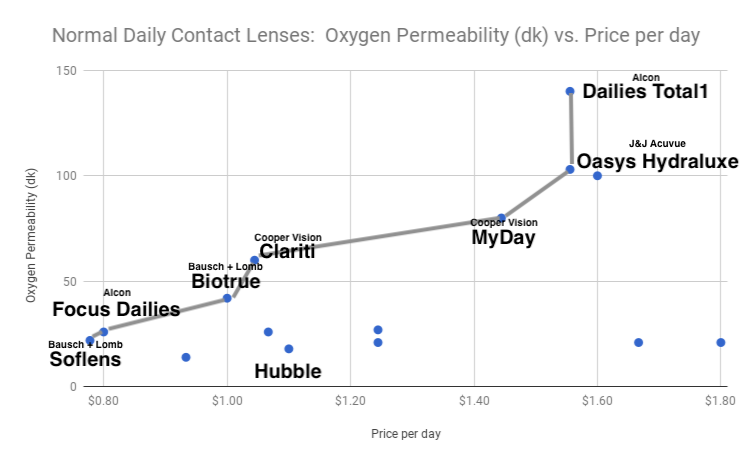
The pareto frontier of the best normal daily contact lenses by price and quality, measured by oxygen permeability.
Sources
From the article about Hubble, I noticed ODSpecs. It seemed like the most comprehensive and complete dataset on contact lenses I could find online. It had price ranges that were mined from different lens sellers and optometry-specific numbers (and not just wishy washy descriptions). It didn’t have some key things though: a price per day comparison, structured data on the different types of lenses and a sense of what was cheap and expensive.
Parameters
These are the elements of the contact lens that largely determine the price per wear - our key metric.
Oxygen permeability
The most important parameter, it seemed, to gauge the quality of a contact lens was its oxygen permeability (wiki) - the ability of the lens to let oxygen into the eye by diffusion. It is expressed on a “per thickness” (/t) level, thus the measure Dk/t (but in short, dk). The first FDA approved contact lens in 1971 has a dk of 9. Let’s call this the baseline for all our comparisons. There are other technical parameters of comparison like: material, thickness, base curve, and power range, and more. I didn’t really use these as a comparison metric because I either didn’t understand what was better than the other (material, base curve), they weren’t listed (thickness), or they weren’t very relevant to me (power range, cause I have low power). The dk rating of a lense also depends on the material of the lens, but I won’t go into details on material because the scientific names are likely irrelevant to a customer.
The higher the dk rating of a lens, the higher the price.
Duration of Wear
There are broadly four classes of contact lens durations:
- Daily Disposables (1 Day)
- Biweeklies (15 days)
- Monthlies (30 days)
- Tri-monthlies (90 days)
- Yearlies (365 days)
The lower the duration of the lens wear, the higher the price. Dailies cost more than Monthlies, and are more convenient, typically. A increasing number of lens’ wearers wear daily lenses.2
Within duration, there’s a concept of replaceability: daily wear **and **extended wear. Extended wear lenses are lenses you can wear to sleep. I didn’t really consider this parameter here, because I rolled with the assumption that extended wear lenses are still unsafe.
Types
There are broadly five classes of lenses that alter the price greatly:
- Normal
- Spherical lenses for myopia (nearsightedness) or hyperopia (farsightedness)
There are special lenses for myopia and hyperopia, but because the price difference is not much from normal lenses, I’ve clubbed them into the same category. - Toric lenses for astigmatism
These lenses are usually branded with “Toric” or “Astigmatism” in the name. Astigmatism is a type of eye impairment due to irregular curvature of the cornea, and toric are the kind of lenses to treat it. - Multifocal lenses for presbyopia
These lenses are also branded with “Multifocal” or “Presbyopia” in the name. Presbyopia is an eye impairment which doesn’t allow your eyes to focus, and is a natural part of aging. Multifocal lens are meant to treat it. - Colored
Lenses with pigments for style.
Toric and Multifocals are around the same price, both being 50-80% more expensive than their normal variants, regardless of duration. Colored lenses are about always 2x more expensive.
Manufacturers
The contact lens market (in the US at least) is dominated by 4 major players:
-
Alcon (3 brands)
Subsidiary of the Swiss pharmaceutical giant Novartis.
Brands include: Air Optix, Dailies, Freshlook. -
Bausch + Lomb (5 brands)
US subsidiary of the Canadian pharma giant Valeant.3
Brands include: Biotrue, Optima, PureVision, Soflens, Ultra -
Cooper Vision (9 brands)
Subsidiary of the California based Cooper Companies, the smallest of the four manufacturers.
Brands include: Avaira, Biofinity, Biomedics/Clariti, Clearsight, Frequency, Hydrasoft, MyDay, Preference, Proclear, Vertex -
Johnson & Johnson (1 brand: Acuvue, 5 sub-brands)
The biggest of the four manufacturers.
Subbrands: Define, Oasys, Moist, TruEye, Vita
There are other ~30 other companies listed on ODSpecs’ Misc page, but prices aren’t collected for these lenses.
Sellers
There are likely many more sellers of lenses, but the popular online stores that I found were:
- 1800Contacts
- Walmart
- DiscountContactLens.com
- Lens.com
- LensDirect.com
These are also the prices that ODSpecs compares. Note, you should definitely compare between websites because I’ve personally observed range variations of above 60% across websites. The Johnson & Johnson Acuvue was $27 on lens.com and $45 on 1800Contacts. Some sellers are better for some brands than others but by and large Lens.com has the cheapest stuff. 8 of the 15 daily brands I manually compares across the 5 sites were cheapest on lens.com.
Comparing different Lens Classes
A full comparison of all comparisons are in this Google Sheet here. All the comparisons below are in terms of price per daily wear. In total, I compared 96 different kinds of lenses, and 97 if you consider Hubble.
| Average | Dailies | Biweekly | Monthly | 3 Months | Yearly |
| Normal | $1.48 |
$0.66 |
$0.49 |
$0.47 |
$0.13 |
| Multifocal | $2.10 |
$1.08 |
$0.96 |
- | - |
| Toric | $2.06 |
$1.13 |
$0.85 |
$0.71 |
$0.34 |
| Colors | $1.30 |
$0.75 |
- | - |
| Ranges | Dailies | Biweekly | Monthly | 3 Months | Yearly |
| Normal | $0.80 - $2.00 | $0.44 - $0.90 | $0.24 - $0.83 | $0.36 - $0.61 | $0.12 - 0.14 |
| Multifocal | $1.50 - $3.00 | $0.87 - $1.33 | $0.48 - $1.67 | - | - |
| Toric | $1.50 - $3.00 | $0.59 - $1.33 | $0.35 - $1.56 | $0.50 - $0.89 | $0.24 - $0.43 |
| Colors | $3.80 - $5.50 | $0.88 - $1.67 | $0.48 - $0.95 | - | - |
| Counts | Dailies | Biweekly | Monthly | 3 Months | Yearly | Total (type) |
| Normal | 21 |
8 |
11 |
3 |
1 |
44 |
| Multifocal | 7 |
2 |
8 |
0 |
0 |
17 |
| Toric | 7 |
7 |
11 |
3 |
1 |
29 |
| Colors | 1 |
3 |
2 |
0 |
0 |
6 |
| Total (duration) | 36 |
20 |
32 |
6 |
2 |
96 |
What is the best normal daily lens?
Back to the original question I was trying to solve: What is the best normal daily lens?
There are 21 models I looked at. Broadly, in this category, based on the oxygen permeability dk level, there are two classes:
- affordable (dk between 25 and 50): 12 brands
- luxury (dk between 50 and 150): 5 brands
I set hubble’s $1.1/day cost as my baseline (+$0.1 for shipping), and wanted to buy lenses cheaper than that. I had personally checked across 5 different sellers to cross-check the ODSpecs pricing data. Both our data agreed that there were 5 daily lenses cheaper than it by price per daily wear (ppd). Here are my prices alongside the OD prices with the dk rating4 5 6:
| Brand | My price | My Seller | OD price | OD seller | Dk |
| Bausch + Lomb Soflens | $0.78ppd | lens.com | $0.73ppd | lens.com | 22 |
| Alcon Focus Dailies | $0.80ppd | lens.com | $0.98ppd | lens.com | 26 |
| Cooper Vision Clearsight (same as Biomedics) | $0.93ppd | lens.com | $0.95ppd | lens.com | 14 |
| Bausch + Lomb Biotrue | $1.00ppd | walmart | $0.91ppd | lens.com | 42 |
| Cooper Vision Clariti | $1.04ppd | lensdirect | $1.11ppd | walmart | 60 |
| Alcon Dailies AquaComfort Plus | $1.07ppd | lens.com | $0.80ppd | lens.com | 26 |
| Hubble | $1.10ppd | 18 | |||
| Cooper Vision Proclear | $1.24ppd | lens.com | $1.04ppd | lens.com | 27 |
| J&J Acuvue Moist | $1.24ppd | DCL | $1.24ppd | walmart | 21 |
| Cooper Vision MyDay | $1.44ppd | walmart | $1.60ppd | walmart | 80 |
| J&J Acuvue Oasys Hydraluxe | $1.56ppd | lens.com | $1.56ppd | 1800 | 103 |
| Alcon Dailes Total1 | $1.56ppd | 1800 | $1.31ppd | lens.com | 140 |
| J&J Acuvue TruEye | $1.60ppd | DCL | $1.69ppd | 1800 | 100 |
| J&J Acuvue Define | $1.67ppd | walmart | $1.67ppd | walmart | 21 |
The pareto frontier of the best normal daily contact lenses by price and quality, measured by oxygen permeability.
Based off of this data, the pareto frontier7 of normal daily lenses by price and dk rating has seven brands:
- Basuch + Lomb Soflens
- Alcon Focus Dailies
- Bausch + Lomb Biotrue
- Cooper Vision Clariti (with a “luxury” dk of 60!)
- Cooper Vision MyDay
- J&J Acuvue Oasys Hydraluxe
- Alcon Dailies Total1
Of these, the first four are cheaper than Hubble.
Given my personal balance of price and quality, my personal choice are the Cooper Vision Clariti 1 day lenses from lensdirect.com, with a price of $46 for a 90-pack and a dk of 60. Here’s a link, and a screenshot:

My pick for the best tradeoff between price and quality of normal daily contact lenses,
with a price of $1.04ppd and an oxygen permeability of 60 dk.
This article is not sponsored.