To enable scaling – and to minimise costs – software vendors have to exploit efficiencies at the expense of quality:
- They strip back the service to the absolute minimum. They typically cut out the quantitative and qualitative analysis that supports good testing.
- They rely on cookie-cutter testing. Instead of creating a bespoke testing strategy for each client, they replicate the same test across multiple websites, regardless of whether it’s the right test to run.
- They load account managers with 10–20 clients – meaning the service is focused on doing the minimum necessary to limit churn.
In short, to keep up with the growth of the platform, they inevitably have to sacrifice the quality of the managed service in the interest of making it scale.
Let’s look at each of these three points in turn.
#1 Stripped-back service
At its core, conversion optimization is simple:
Find out why people aren’t converting, then fix it.
The problem is that the first part – finding out why they aren’t converting – is actually pretty hard.
Earlier this year, I shared our take on Maslow’s hierarchy of needs – our “hierarchy of testing”:
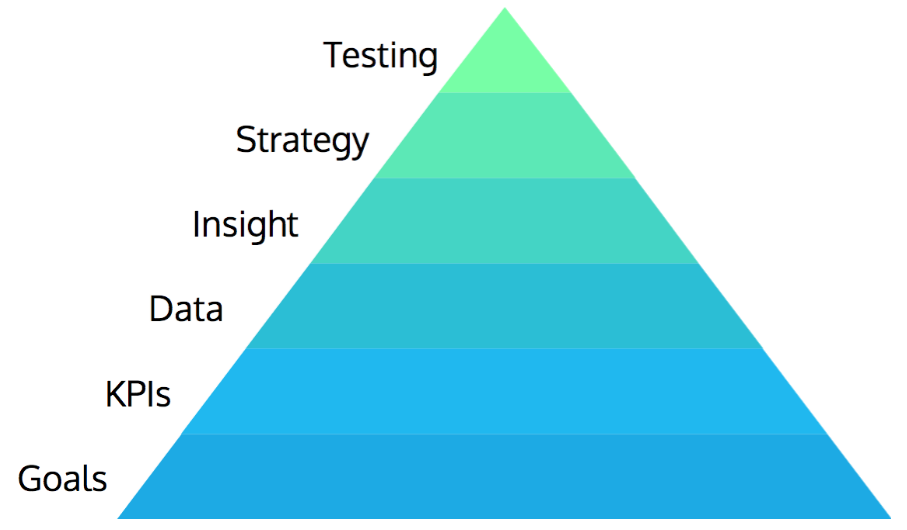
The principle is the same as Maslow’s – the layers at the bottom of the pyramid are fundamental.
Starting at the top, there’s no point testing without a strategy. You can’t have a strategy without insight and data to support it. And you can’t get that without defining the goals and KPIs for the project.
In other words, you start at the bottom and work your way up. You don’t jump straight in with testing and hope to get good results.
In particular, the layers in the middle – data and insight – are essential for success. They link the testing program’s goals to the tests. Without them, you’re just guessing.
But all of this comes at a cost – and it’s typically the first cost that managed services cut. Instead of using a similar model to the pyramid above, they jump straight to the top and start testing, without the data and insight to show where and what they should be testing.
Ask them where they get their ideas from, and they’ll probably say heuristics – a nicer way of saying “best practice”.
#2 Cookie-cutter testing
Creating tests that aren’t based on data and insight is just the start.
To maximise efficiency (again, at the expense of quality), managed services will typically use similar tests across multiple clients. After all, why build a unique test for one client when you can roll it out across 10 websites with only minimal changes?
Break down the fees that managed services charge, and it’s easy to see why they have to do this.
Let’s assume Vendor X is charging £3k to deliver 2 tests per month. If we allow £1k/day as a standard managed service rate, then that gives 24 hours – or 12 hours per test.
At Conversion.com, we know that even just to build an effective test can take longer than 12 hours – and that’s before you add in time for strategy, design, QA and project management.
The cookie-cutter approach is problematic for two core reasons:
- They start with the solution, and then find a problem for it to fix. It’s clear that this is going to deliver average results at best. (Imagine if a doctor or mechanic took a similar approach.)
- It limits the type of tests to those that can be easily applied across multiple websites. In other words, the concepts aren’t integrated into the website experience, but are just pasted on the UI. That’s why these tests typically add popups, modify the calls-to-action and tweak page elements.
#3 Account manager loading
This focus on efficiencies means that account managers are able to work across at least 10–20 clients. Even assuming that account managers are working at 80% utilisation, that means that clients are getting between 1.5 and 3 hours of their time each week.
Is that a problem?
At Conversion.com, our consultants manage 3–5 clients in total. We feel that limit is essential to deliver an effective strategy for optimization.
Ultimately, it reflects our belief that conversion optimization can and should be integral to how a company operates and markets itself – and that takes time.
Conversion optimization should let you answer questions about your commercial, product and marketing strategy:
- How should we price our product to maximise lifetime value?
- How do we identify different user segments that let us personalize the experience?
- Which marketing messages are most impactful – both on our website and in our online and offline advertising?
Not “Which colour button might work best?”
Conversion optimization isn’t a series of tactical cookie-cutter tests that can be churned out for your website, while 19 other clients compete for your AM’s attention.