I am very happy that I can finally introduce our general AI project that we have been working on here at Keen Software House. Just to be clear, this is not an AI for video games (although it could be used in games).One of my life-long dreams has always been to create a human-level artificial intelligence. After the success of Space Engineers, I was finally in a position to go full-throttle on this. In 1/2014 we started a new team dedicated solely for this purpose. Today, the AI team has 15 computer scientists and engineers and our plan is to grow to at least 30 people. We are also considering opening offices across Europe (to reach the talent who can’t move to Prague).
If you are interested, we are hiring: http://www.keenswh.com/jobs.html
In this blog post I will talk about:
- Why we believe that AI is the most important project to undertake
- What this AI project is about
- How our approach differ from others
- What have we achieved so far
- What are our short-term and long-term goals
- Video talk
- How our R&D team works
- What’s next
Why is AI so important?
We believe that general AI is the technology with the greatest potential to help people. If we solve the intelligence, replicate it, clone it, scale it up, make it smarter and faster than us – then the AI can keep inventing things for us. AI can become our “final invention” – in a good sense 🙂
Imagine that we get to build a computer that has the cognitive capability of a smart human. We ask it to optimize its hardware and software and come up with a more advanced version. And then we repeat this process, over and over. The progress won’t be linear; it will be exponential, leading to a recursively self-improving AI.
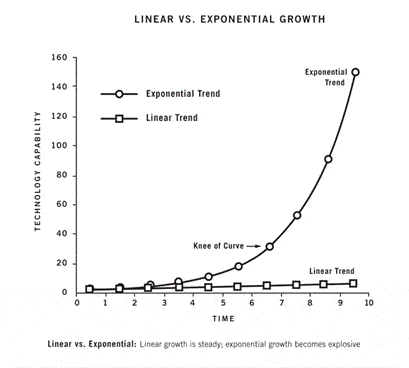
Then in a very short period of time you will have a computer whose cognitive capabilities may be a million times larger than ours. We can’t even imagine the type of problems this machine would be able to understand and solve. But we know that if we control it safely, it can solve everything that humanity ever wanted: just faster, better and more efficiently.
And because we are speaking in terms of exponential growth, one dollar invested in an AI company can soon represent a value millions of times larger. That’s a return-on-investment that can’t be achieved in any other business. Of course we’re not doing this just for the money: AI will open doors to unimaginable worlds.
Let’s dream for a second and see where AI can be useful:
- Upgrade our bodies; fix death and diseases
- Upgrade our intelligence
- Travel to outer space, harvest asteroids, gather clean energy
- Discover natural laws that are too complex for the human mind to comprehend
- Invent and build things for people
- And many more – AI scientists, AI programmers, AI astronauts, AI [insert anything]
General AI could be the best thing in human history. Admittedly there are some risks too, and they need to be addressed carefully when the time comes.
Our long-term mission is to build artificial brains, be useful to humanity, and understand the universe.
What is our AI project about?
We are trying to build an artificial brain that can perceive, learn and adapt to the environment while generating behavior that maximizes reward. The AI brain could be integrated into any type of a robot body or software application. It would receive data from sensors and it would output commands to motors/actuators. Motivation will come in the form of a positive or negative reward signal.
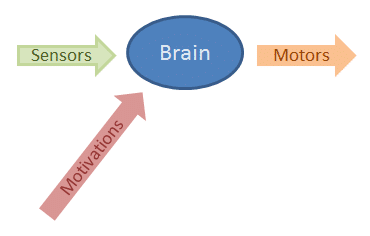
The brain will learn time-based patterns in incoming and outgoing data, and also from the brain’s internal activity; it will seek causalities, correlations and associations; it will make predictions (e.g. what’s going to happen in next 10 milliseconds, 100 milliseconds, etc.) – and then it will use all these mechanisms to build a model of the world, its own body and mind; this all will be processed on multiple levels of abstraction and hierarchy. After this the brain will generate behavior patterns that are directed to maximize its chances to receive positive reward in the future. The brain will learn the associations between its current situation, its latest actions and the outcome/reward.
The brain will develop and learn in the same way that children do. It will start with zero knowledge of the world (except a few innate reflexes), then it will start interacting with the world (randomly or through innate reflexes) and by observing the causalities (time-based patterns), it will start creating a model of the world – layer by layer, with multiple levels of hierarchy and abstraction.
How does our approach differ from machine learning or specialized/narrow AI?
Our approach is very similar to traditional ML techniques (looking for patterns) except we add behavior and motivation on top of it. We want to build a brain, not just process data.
Behaviors are executed by a sequence of muscle commands, which in fact are just another type of pattern (played in the opposite direction to sensory signals). Nevertheless, we take a lot of inspiration from ML and narrow AI approaches.
Some of our AI modules will become very specialized (e.g. image recognition, audio processing) because we don’t have the millions of years that evolution had to fine-tune a solution for a general principle. Instead, we have engineering skills and we already know how the end-result should look (the human mind).
Current state and plans
Our AI project is still in the early stages of development. Our long-term goal is human-level intelligence (10+ years), but we are already looking for short-term goals (1-3 years).
Already accomplished:
- Brain Simulator – a visual editor for designing the architecture of artificial brains; developer selects from various AI modules (e.g. image recognition, working memory, prediction, motion behavior generator, etc.) and links them together so that the signals travel between the right modules; currently implemented in Windows and CUDA, but we plan to make it multi-platform very soon;
- AI that learns to play Pong
- Unstructured input (screen pixels and reward signal)
- AI has to extract useful features from the image, causalities, correlations, select goals that lead to increasing positive reward
- This was just a testing milestone but it’s nice to know that similar problem got solved by a company called Deep Mind which got acquired by Google for $400milhttp://www.technologyreview.com/news/524026/is-google-cornering-the-market-on-deep-learning/
Upcoming milestones:
- AI that plays a game with a more complex environment; multiple sub-goals needed to achieve the end-goal; delayed reward; this all requires long-term hierarchical goal following
- AI that learns to play variety of games without forgetting any of them and being able to generalize rules across the games
- Muscle control sequences, bipedal robot balancing
AI playing Pong (visualization of attention module, taken action and current state to goal state similarity measurement)
Brain Simulator: this video shows a simple test of Self-organizing Map (Kohonen map) with the MNIST hand-written digits data set.
Short-term goals: 3-12 months
- Release the Brain Simulator with all example apps (e.g. Pong); most likely for free
- Release a platform where AI researchers can share their AI modules and brains (e.g. if someone makes a better version of an AI module and uploads it to this storage, others can benefit from it)
- Hire at least 15 colleagues for the AI team; open offices across Europe
- Promote our AI project and explain its benefits to the general population
- Find use cases for short-term commercial utilizations without sacrificing our long-term mission. We already have some B2B ideas (marketing, predictions, and desktop work automation). We need real feedback and we need to help real people
- Spin off our AI project to a new sister company – the reason is that Keen Software House is a game development company and this situation may be confusing to potential partners of our AI business
- Work with the community and let our game fans join this adventure
- Players will design AI brains (via Brain Simulator) and then import them to Space Engineers or Medieval Engineers where the AI will come to life
- Enable third-party AI module/brain developers to cooperate with our game fans on testing and training of their creations (players’ collective force will help training the developer’s AI brain)
We study and are inspired by the work of other teams and we want to cooperate wherever possible.
Business model
At the beginning, our AI brains are going to be inferior to existing specialized AI solutions (nobody would pay for an AI that can only play a Pong game…).
But in time, the universalness of our approach will show its fruits and business customers will start using our AI brains in their robots and software applications. Brain Simulator will be used to design and test AI brains for specific applications; developers will have freedom in choosing our or third-party AI modules.
Brain Simulator will become a platform for a new ecosystem, joining AI module/brain developers with business customers.
AI company’s income shall come from licensing (royalties). Receiving a share from every product where our AI brain is integrated is a huge business opportunity worth billions of dollars.
Third-party AI module/brain developers will make money too – their work will get sub-licensed and they will get their share on royalties.
$10mil USD funding
I have an enormous belief in our AI project and that’s why I am funding it with $10mil of my own money. More money will come if needed.
We plan to raise additional funding via equity crowd-funding and venture capital, but this is not an urgent thing.
However, the idea of equity crowd-funding is neat because it’s a way how we can give people a chance to participate in the future profits that the AI economy will bring. Becoming a co-owner in an AI company and receiving dividends is one of the ways to have an income in an era where automation replaces all human jobs.
None of this will negatively impact our game development. Our game dev teams have more money than that they can spend in years and they are doing a fantastic job even after I had to split my time between games and AI; currently I focus a little bit more on AI, but this is going to change from time to time. There are still things that I want to accomplish in gaming and I know for sure that in 6 months I will be back, preparing some very specific new ideas… I love making games and not even robots can stop me from creating them 🙂
Just a reminder of what’s under development in our games:
- Game AI and animals for Medieval Engineers; soon after that we will focus on AI for Space Engineers
- Planets for Space Engineers – a very huge project!
- Multi-player for Medieval Engineers: https://www.youtube.com/watch?v=XZblf25glAI
- Campaigns and scenarios for ME and SE
- Redoing networking layer for ME and SE
- SE on Xbox One
- Many more!
As you can see, we try to do everything we can to secure a solid game development process while not ignoring the long-term goals that we have in general AI.
I have a gut-feeling that the general AI will come to our games too. And because it will not be constrained by short-term narrow AI concepts, it could be a major game changer for the whole video-game industry.
Presentation at the Czech Technical University in Prague
You can learn more in our first public talk which was held a few weeks ago at Czech Technical University in Prague.
Artificial general intelligence research project at Keen Software House (3/2015)
Artificial general intelligence research project at Keen Software House (3/2015)
We switch between free periods (when everyone works on a topic of his choice) and milestone periods (that are focused and lead to a measurable goals). It’s usually 1 month free period and 2 months for a milestone period.
We hold two team meetings each week. First one is for brainstorming where anyone can speak up about his ideas, findings and questions. The second one is an update meeting where everyone shows what he has done since the last meeting and what is he going to do next.
We try to replicate the “agile development” which is so successful in our game development teams and so we aim for rapid iterations: come up with an idea/hypothesis, implement it fast, test it fast and see if it’s worth further investigation.
The motivation of all our colleagues is crystal clear: we are working on the most exciting scientific challenge and if we do it right, the fruits of our work will change everything.
In my humble opinion, there’s no better work in Prague for a programmer/researcher than what we do in our AI and game teams.
We plan to keep informing you about our AI project: business model, short-term commercialization ideas, AI ethics, AI safety, technological singularity, our milestones, etc.
We will have a new web site dedicated entirely to AI project/company very soon.