Balkinization
an unanticipated consequence of
Jack M. Balkin
Balkinization Symposiums: A Continuing List
E-mail:
Jack Balkin:
jackbalkin at yahoo.com
Bruce Ackerman
bruce.ackerman at yale.edu
Ian Ayres
ian.ayres at yale.edu
Corey Brettschneider
corey_brettschneider at brown.edu
Mary Dudziak
mary.l.dudziak at emory.edu
Joey Fishkin
joey.fishkin at gmail.com
Heather Gerken heather.gerken at yale.edu
Abbe Gluck abbe.gluck at yale.edu
Mark Graber
mgraber at law.umaryland.edu
Stephen Griffin
sgriffin at tulane.edu
Jonathan Hafetz
jonathan.hafetz at shu.edu
Jeremy Kessler
jkessler at law.columbia.edu
Andrew Koppelman
akoppelman at law.northwestern.edu
Marty Lederman
msl46 at law.georgetown.edu
Sanford Levinson
slevinson at law.utexas.edu
David Luban
david.luban at gmail.com
Gerard Magliocca
gmaglioc at iupui.edu
Jason Mazzone
mazzonej at illinois.edu
Linda McClain
lmcclain at bu.edu
John Mikhail
mikhail at law.georgetown.edu
Frank Pasquale
pasquale.frank at gmail.com
Nate Persily
npersily at gmail.com
Michael Stokes Paulsen
michaelstokespaulsen at gmail.com
Deborah Pearlstein
dpearlst at yu.edu
Rick Pildes
rick.pildes at nyu.edu
David Pozen
dpozen at law.columbia.edu
Richard Primus
raprimus at umich.edu
K. Sabeel Rahman
sabeel.rahman at brooklaw.edu
Alice Ristroph
alice.ristroph at shu.edu
Neil Siegel
siegel at law.duke.edu
David Super
david.super at law.georgetown.edu
Brian Tamanaha
btamanaha at wulaw.wustl.edu
Nelson Tebbe
nelson.tebbe at brooklaw.edu
Mark Tushnet
mtushnet at law.harvard.edu
Adam Winkler
winkler at ucla.edu
Compendium of posts on Hobby Lobby and related cases
The Anti-Torture Memos (arranged by topic)
Recent Posts
Friday, November 05, 2010
Constitutional Dictator (and Maximum Leader) Ben Bernanke Issues New Stimulus Plan Without Congressional Approval
JB
So here's what happened. On Tuesday the voters gave the Republicans control of the House of Representatives and several Senate seats because they opposed bank bailouts and Obama's stimulus plan. As a result, Barack Obama understands that he won't be able to pass a new stimulus bill to improve the economy. The newly elected Republicans simply won't stand for it, and many Democrats are just too scared of what the public would say.
Indeed, if President Obama had showed up at the press conference immediately following the elections and announced that regardless of the results of the elections, he was proposing a new 600 billion dollar stimulus plan, and that he expected Congress to pass it immediately, reporters would have thought he was delusional.
Now imagine that President Obama said: "And if Congress doesn't act immediately to pass my 600 billion dollar stimulus package, I'll simply enact it myself without Congress." Reporters would have thought he was doubly delusional. And a dictator to boot!
Now imagine that President Obama also said: "And, you know what, I'm going to structure my new 600 billion dollar stimulus by giving the banks windfall profits. That's right, the very same banks that got those lovely bailouts before!" The Republicans' heads would explode!
So what exactly did Fed Chairman Ben Bernanke do on that very same Wednesday? He ordered the Fed to purchase 600 billion dollars of United States bonds. Who owns those bonds? Well, um, banks, investment banks, brokerage houses and other financial institutions; you know, many of the same players who got those lovely bailouts that the voters hated so much. And by purchasing 600 billion dollars in bonds in a relatively short period of time, he is effectively driving up their price, thereby giving a windfall to their owners. (Even better: many of the owners are in foreign countries-- so it's effectively a bailout for foreign banks too! I'm sure the voters will love that.)
And he can do all this without asking Congress's permission. Why? Because he's Ben Freaking Bernanke, the chairman of the Federal Reserve, that's who. He doesn't have to pay attention to any polls or popular outrage about bank bailouts or Republican opposition to a second stimulus. He don't need no stinking stimulus package! He's more powerful than the President of the United States! He's our maximum leader.
In fact, just to show what a powerful person he is, Bernanke does this under the nose of the Republicans right after the elections! And the Republicans don't put two and two together. They don't see that he's doing what they would never let Obama get away with. They don't make a peep. In fact, I'll bet that a few of them even congratulated him on taking bold action to
save the economy.
But it gets better. Bernanke knows that there's a fair chance that his 600 billion dollar stimulus will have relatively little effect, because those same banks and financial institutions, freshly armed with that lovely windfall, might not loan all of the funds they receive in return for their bonds. They might just pocket the profits. (And then award very large bonuses!) Nevertheless, Bernanke reasons that this 600 dollar stimulus is the best he can do under the circumstances, because Congress is full of ignorant knuckleheads who won't try another stimulus package that actually has a decent chance of boosting the economy. And if what he's trying doesn't work, maybe he'll spend some more money until it does work! Take that Congress!
Oh, and I forgot to mention: Everybody understands that President Obama's and the Democrats' political fortunes depend on whether or not the economy improves as soon as possible. Now you might think that, politically isolated as they are from everyday politics, the technocratic and apolitical professionals at the Fed would try to improve the economy as soon as possible, regardless of who benefits politically. Right? Wrong. Bernanke and his friends at the Fed waited until after the election was over, and the Democrats got creamed. Nice timing, Ben. Nice.
In our recent essay on constitutional dictatorship Sandy Levinson and I offer Bernanke as an example of a distinctive and important feature of American government, what we call distributed dictatorship. Bernanke and the Fed do not control every part of American policy. They cannot order troops to go to war, for example. But in their specific area of expertise and authority-- the use of the Fed's resources for economic policy-- he and the Fed are effectively accountable to no one. And that is why Bernanke did what Obama and Congress could not do-- ordered a second 600 billion dollar stimulus package for banks and other bondholders--even if it might not turn out to be as effective.
So, to sum up: Last Tuesday, the people made clear: no more big bailouts to banks, no second stimulus, no runaway federal spending. President Obama told the press he was chastened by the shellacking and promised he would do better next time.
But Ben Bernanke didn't promise anything!
Books by Balkinization Bloggers


Linda C. McClain and Aziza Ahmed, The Routledge Companion to Gender and COVID-19 (Routledge, 2024)

David Pozen, The Constitution of the War on Drugs (Oxford University Press, 2024)

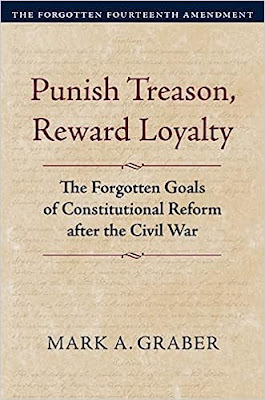


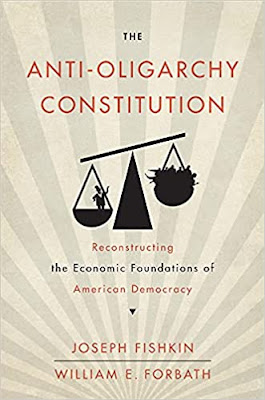
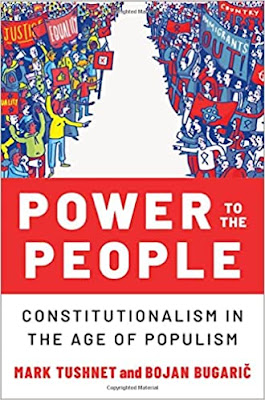


Jack M. Balkin, The Cycles of Constitutional Time (Oxford University Press, 2020)


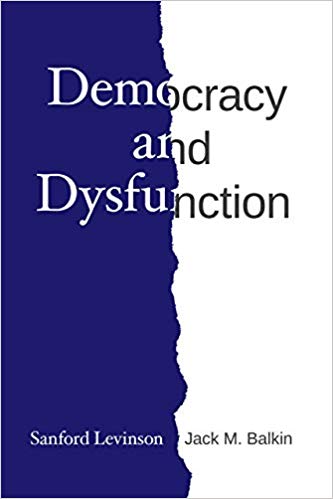
Sanford Levinson and Jack M. Balkin, Democracy and Dysfunction (University of Chicago Press, 2019)


Brian Z. Tamanaha, A Realistic Theory of Law (Cambridge University Press 2017)


Balkinization Symposium on We the People, Volume 3: The Civil Rights Revolution

Joseph Fishkin, Bottlenecks: A New Theory of Equal Opportunity (Oxford University Press, 2014)

Mark A. Graber, A New Introduction to American Constitutionalism (Oxford University Press, 2013)


Stephen M. Griffin, Long Wars and the Constitution (Harvard University Press, 2013)


Balkinization Symposium on Ordered Liberty: Rights, Responsibilities, and Virtues

Andrew Koppelman, Defending American Religious Neutrality (Harvard University Press, 2013)

Brian Z. Tamanaha, Failing Law Schools (University of Chicago Press, 2012)


Mary Dudziak, War Time: An Idea, Its History, Its Consequences (Oxford University Press, 2012)

Jack M. Balkin, Living Originalism (Harvard University Press, 2011)


Richard W. Garnett and Andrew Koppelman, First Amendment Stories, (Foundation Press 2011)


Bruce Ackerman, The Decline and Fall of the American Republic (Harvard University Press, 2010)
Balkinization Symposium on The Decline and Fall of the American Republic


Mark Tushnet, Why the Constitution Matters (Yale University Press 2010)

.jpg)


Jack M. Balkin and Reva B. Siegel, The Constitution in 2020 (Oxford University Press 2009)


David Luban, Legal Ethics and Human Dignity (Cambridge Univ. Press 2007)

Ian Ayres, Super Crunchers: Why Thinking-By-Numbers is the New Way to be Smart (Bantam 2007)



Brian Tamanaha, Law as a Means to an End (Cambridge University Press 2006)

Sanford Levinson, Our Undemocratic Constitution (Oxford University Press 2006)

Mark Graber, Dred Scott and the Problem of Constitutional Evil (Cambridge University Press 2006)

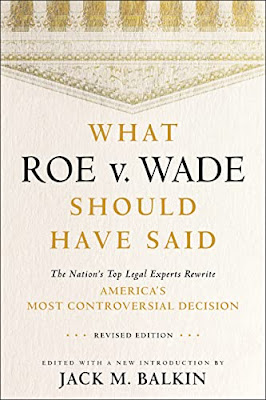
Jack M. Balkin, ed., What Roe v. Wade Should Have Said (N.Y.U. Press 2005)

Sanford Levinson, ed., Torture: A Collection (Oxford University Press 2004)
Balkin.com homepage
Bibliography
Conlaw.net
Cultural Software
Writings
Opeds
The Information Society Project
BrownvBoard.com
Useful Links
Syllabi and Exams