Ten years ago today a US Appeals court took on the case that would decide the …
“The worst thing that could come of this is I could fall down the steps of the FTC building, hit my head and kill myself,” quipped Microsoft Chairman William H. Gates in 1992, as the Federal Trade Commission launched an investigation of his company. But nobody joked on the third day of April, 2000, as Judge Thomas Penfield Jackson delivered his decision on what had morphed into the biggest software antitrust case in history: The United States of America vs. Microsoft.
“The court concludes that Microsoft maintained its monopoly power by anticompetitive means and attempted to monopolize the Web browser market,” Jackson declared.
Ten years ago, on September 26, 2000, that trial took a crucial turn towards the settlement that would allow Microsoft to retain its vast control over the personal computer operating system market. Let’s revisit the essentials of that case, and follow the aftermath—a legacy of endless negotiation and struggle with the entity that, to this day, is the OS on 91.32 percent of the world’s PCs.
Drastic reduction
To Judge Jackson, Microsoft’s behavior was a clear and present violation of the Sherman Antitrust Act. Early on, he warned, Microsoft came to see “middleware”—specifically the Netscape Navigator Web browser and Sun’s Java technology—as a “Trojan horse,” that could enable competing operating systems to prevail over the Intel-empowered PC market.
“When Netscape refused to abandon its efforts to develop Navigator into a substantial platform for applications development,” Jackson continued, “Microsoft focused its efforts on minimizing the extent to which developers would avail themselves of interfaces exposed by that nascent platform.” Microsoft did this primarily via by tethering its own Internet Explorer to every Windows PC system and simultaneously making it more difficult to install or pre-install Navigator.
This “increased the likelihood that preinstallation of Navigator onto Windows would cause user confusion and system degradation,” leading to more support costs and lower sales for computer manufacturers, the court concluded. Thus these companies felt “compelled by Microsoft’s actions to reduce drastically their distribution and promotion of Navigator.”
Three weeks later, the Department of Justice and the Attorneys General of 17 states asked that same judge to cut Microsoft in half. Company one would make and sell Microsoft’s operating system. Company two would produce and distribute applications. This is what Jackson ordered on June 7, 2000.
Here was a 1911 Standard Oil and 1984 AT&T break-up moment, noted The New York Times. “If the recommendation were enacted by the court and upheld on appeal, it would be one of the few times in the 110-year history of the Sherman Antitrust Act that the government had succeeded in breaking up a major multinational corporation.”
But it never happened. Instead, on September 26, 2000, the Supreme Court refused to hear the case, which was then routed to the United States Court of Appeals for the District of Columbia. Regular Ars readers are quite familiar with this venue, which recently rebuked the Federal Communications Commission’s attempt to sanction Comcast for P2P throttling.
There, Jackson’s conclusions met a similar fate. “I am not in the camp that says just because a district court lists something under ‘findings of fact,’ it’s gospel,” declared the court’s Harry Edwards during oral arguments. “It has to be a fact, in fact.”
Beyond the pale

Not a great sign, reporters noted, and it all went downhill from there. The DC court noted with disdain that Jackson—a decidedly off-the-cuff kind of guy—had consented to behind-the-scenes interviews with top newspapers and magazines, including The New York York Times and The Wall Street Journal. During these discussions, the judge compared top Microsoft executives to drug dealers and Gates himself to Napoleon.
“Beyond the pale,” one justice complained. “It’s not what we do,” another protested. The breakup order was also not to be done. On June 28 the appeals court put the kibosh on that plan, skewered Jackson for not holding a hearing on the remedy for Microsoft’s behavior, and took him off the case.
“Although we find no evidence of actual bias, we hold that the actions of the trial judge seriously tainted the proceedings before the District Court and called into question the integrity of the judicial process,” the DC court ruled. More fundamentally, the court found erroneous Jackson’s conclusion that Microsoft’s liability for its monopoly on the operating system market could be understood as “a presumptive indicator of attempted monopolization of an entirely different market”—that is, web browsers.
The court branded the Department of Justice’s effort to demonstrate a “dangerous probability of achieving monopoly power in the putative browser market” a “failure.”
You could read this decision in various ways. It obviously threw a lot of what Jackson had decided to the wind. But, as journalist John Heilemann noted, a “judicial panel that was obviously the most conservative in the nation,” had agreed that Microsoft enjoyed monopoly power over PC operating system market.
The court had “unanimously handed the government a victory that no one had predicted on most of the case’s central legal issues,” Heilemann wrote. “What it had handed Microsoft was a stay of execution.”
But when the hangman’s noose finally arrived, critics dismissed it as a rather light and silky affair that suspended the software giant only a few millimeters off the ground. The Final Judgment that the Bush administration’s DoJ and Microsoft worked out in November of 2002 prohibited the company from retaliating against non-Microsoft software vendors or computer manufacturers or that included non-Microsoft middleware in their Windows PC offerings.
The deal also required Microsoft to properly disclose to software makers and computer manufacturers the Application Programming Interfaces that the company used for its middleware products.
This agreement, warned Sun Microsystems, “does little or nothing to eliminate the unlawful monopoly maintained by Microsoft over PC operating systems. Nor does it redress the harm that Microsoft’s illegal acts have caused to competition in that market.”
While the judgment “apparently recognizes the threat to competition posed by Microsoft’s exclusionary behavior in adjacent and downstream markets, the remedies it proposes to redress this threat are plagued with so many loopholes and ambiguities that there can be no assurance that Microsoft’s anticompetitive conduct will stop.”
It’s off to Europe we go
Was this an ominous defeat for free and fair competition on the software market? Was it the vindication of a company whose only real sin was success? Ten years later, it’s hard to come to categorical conclusions about the matter, because the Microsoft antitrust case has never really ended. Like the “Jarndyce versus Jarndyce” legal affair in Charles Dickens’ novel Bleak House, it just keeps plodding along.
As Microsoft antitrust fervor cooled down in the United States, it boiled to the brim in Europe. In March of 2004 the European Union hit the company with a €497 million fine, concluding that Microsoft had abused its monopoly position against RealNetwork’s RealAudio player. Europe also told Microsoft to release a version of Windows XP without Windows Media Player (the “Windows XP N” as it came to be called), and to provide more technical documentation for its Windows Server protocols.
Two years later the EU ruled that Microsoft had not complied with that last requirement, opening the door for more fines. The organization’s European Commission insisted that licensing Windows Server source code wasn’t enough. A clear explanation of the protocols had to be released as well. It wasn’t until October of 2007 that the EU reached an acceptable compromise with Microsoft on the Windows Server question.
But no sooner did the dust settle on that dispute, then the Union announced a brand-new probe of the company’s interoperability standards for its Office 2007 suite. Its Commission also promised to investigate a complaint from Norwegian browser maker Opera. The developer accused Microsoft of illegally tying Internet Explorer to Windows and not adhering to “fundamental and open” standards for how Web browsers render pages. The complaint asked the EC to require Microsoft to offer versions of Windows sans Internet Explorer.

Ballots
By January of 2009, the EU was calling the inclusion of IE in Windows a violation of the organization’s antitrust laws. “Microsoft’s tying of Internet Explorer to the Windows operating system harms competition between web browsers, undermines product innovation and ultimately reduces consumer choice,” the organization charged.
“The 800-pound gorilla here, of course, is Firefox, with its worldwide market share hovering in the 20 percent range,” we noted at the time. But “if Microsoft unbundles Windows and Internet Explorer, how do you get on the Internet to get another browser?”
In early June of that year, Microsoft announced its solution to that problem. It would ship to Europe a special version of Windows 7 without Internet Explorer 8. “The E versions of Windows 7 will include all the features and functionality of Windows 7 in the rest of the world, other than browsing with Internet Explorer,” Microsoft explained. “Computer manufacturers will be able to add any browser they want to their Windows 7 machines, including Internet Explorer, so European consumers who purchase new PCs will be able to access the Internet without any problem.”
But even this did not satisfy the EU, which a day later announced that it would continue to pursue its antitrust investigation. “In terms of potential remedies if the Commission were to find that Microsoft had committed an abuse, the Commission has suggested that consumers should be offered a choice of browser, not that Windows should be supplied without a browser at all,” the Union opined.
As of this year, the solution is a browser ballot.
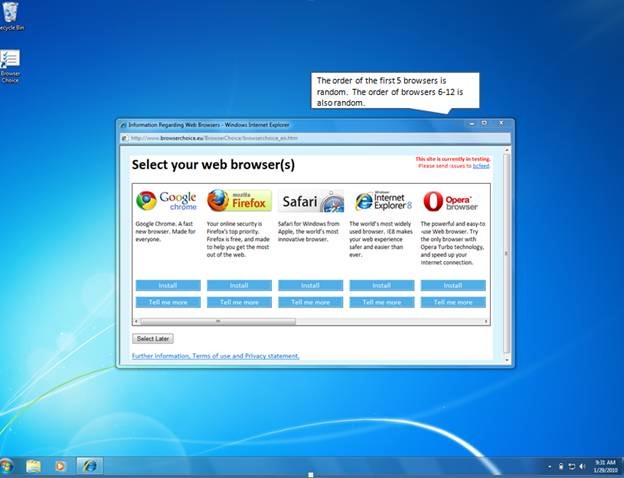
The browser ballot
“The ballot itself will be distributed to EU customers running Windows XP, Windows Vista, and Windows 7, via Windows Update,” we noted in February. “Installing the update will, on Windows 7, unpin the IE icon from the taskbar, and then offer a selection of browsers. The five leading browsers—Safari, Chrome, Firefox, Opera, and Internet Explorer—will be visible on the main selection screen, along with a further seven accessible by scrolling to the right.”
Back in the USA
Meanwhile, in the United States, the Department of Justice grappled with a different question: how long should the government continue to oversee and enforce its Final Judgment?
The Bush administration’s DoJ clearly wanted out of the job, and announced as much in October of 2007. But that was a little more than a year before a presidential election, which brought in the Obama team. The new regime was more sympathetic to the attorneys general of a handful of states and the District of Columbia, who argued that without continued enforcement of the Final Judgment, Microsoft would revert back to its old ways.
“When the remedial regime imposed by the Court expires in large part in November 2007, the principal constraint on Microsoft’s ability to abuse its market power will be gone,” they wrote to the DoJ in late August 2007. “There is no way of knowing whether Microsoft will continue to refrain from engaging in the anticompetitive conduct enjoined by the Final Judgment once it has expired and plaintiffs are no longer able to enforce it.”
And despite the Final Judgment, Microsoft has not adequately documented its protocols, they charged in October, and no major PC maker distributes a browser other than Microsoft’s Internet Explorer.
“Many new middleware technologies are just now appearing that may, in the near future, pose a competitive threat to Microsoft’s operating system monopoly. These technologies substantially depend upon the browser. Because Microsoft still retains control of the OEM channel for browser distribution, in part because its illegal conduct with respect to IE has not yet been fully remedied, it is critical that [various sections] of the Modified Final Judgment be continued until these technologies mature.”
Responsive to these appeals, Obama’s DoJ hit the ground running in January with an extension on the Final Judgment, citing server protocol documentation that had only been partially released long after a 2003 deadline. The Justice Department then asked the judge in charge of the case, Colleen Kollar-Kotelly, for additional oversight through 2011.
Protecting icons
Where does everything stand now? In April of 2009, Microsoft, the DoJ, and the states of New York, Ohio, Illinois, Kentucky, Louisiana, Maryland, Michigan, North Carolina, and Wisconsin agreed to a Second Modified Final Judgment. The agreement put Microsoft on a revised schedule for releasing all its relevant protocols and documentation that continues through April of 2011.
And the deal places new parameters around Microsoft’s dealings with PC makers, or Original Equipment Manufacturers, to use the legal acronym. Microsoft cannot prevent OEMs from:
- Installing, and displaying icons, shortcuts, or menu entries for any Non-Microsoft Middleware or any product or service (including but not limited to IAP [Internet Access Provider] products or services) that distributes, uses, promotes, or supports any Non-Microsoft Middleware, on the desktop or Start menu, or anywhere else in a Windows Operating System Product where a list of icons, shortcuts, or menu entries for applications are generally displayed, except that Microsoft may restrict an OEM from displaying icons, shortcuts and menu entries for any product in any list of such icons, shortcuts, or menu entries specified in the Windows documentation as being limited to products that provide particular types of functionality, provided that the restrictions are non-discriminatory with respect to non-Microsoft and Microsoft products.
- Distributing or promoting Non-Microsoft Middleware by installing and displaying on the desktop shortcuts of any size or shape so long as such shortcuts do not impair the functionality of the user interface.
- Launching automatically, at the conclusion of the initial boot sequence or subsequent boot sequences, or upon connections to or disconnections from the Internet, any Non-Microsoft Middleware if a Microsoft Middleware Product that provides similar functionality would otherwise be launched automatically at that time, provided that any such Non-Microsoft Middleware displays on the desktop no user interface or a user interface of similar size and shape to the user interface displayed by the corresponding Microsoft Middleware Product.
- Offering users the option of launching other Operating Systems from the Basic Input/Output System or a non-Microsoft boot-loader or similar program that launches prior to the start of the Windows Operating System Product.
- Presenting in the initial boot sequence its own IAP offer provided that the OEM complies with reasonable technical specifications established by Microsoft, including a requirement that the end user be returned to the initial boot sequence upon the conclusion of any such offer.

It is a statement that, almost eight years after the first Final Judgment of 2002, the US government still thinks it must warn Microsoft not to stop PC makers from including shortcuts to non-Microsoft products on a Windows PC desktop. But that, apparently, is where we remain.
Hindsight
Was all this struggle worth it? It’s worth reading the 47 comments that various individuals, companies, and public interest groups sent to the DC Circuit Court as Microsoft and the government pondered the details of their 2002 Final Judgment. Many predicted the long, torturous history that a non-breakup remedy would set in motion.
The proposed deal “permits Microsoft to continue to fortify and expand its monopoly,” warned the Computer and Communications Industry Association, and “provides an imprimatur for Microsoft to continue and expand a whole range of additional, related anticompetitive practices.”
As a consequence,” the proposal “is an instrument of monopolization, not a remedy for it. The Court should not add judicial endorsement to DOJ’s agreement to give up the case.”
“We are disappointed of course to see a move away from a structural remedy,” wrote Ralph Nader and James Love, “which we believe would require less dependence upon future enforcement efforts and good faith by Microsoft, and which would jump start a more competitive market for applications.”
But not everybody thinks this trip was worth taking. We asked our resident Microsoft expert, Peter Bright, for an assessment. Bright views the European half of this story with skepticism.
“‘Competition,’ has no intrinsic value,” he noted, “and being anti-competitive is not ipso facto anti-consumer. The fines that the EU collected do nothing to advance competition within the EU. They function simply as a money transfer from Microsoft and its shareholders to the EU and its taxpayers.”
As for the “EU-appeasing Windows XP N,” it was “soundly rejected by the market, which should surprise absolutely no one,” Bright added, “and though the Browser Ballot looked initially as if it was having some influence on browser share, this does not appear to have yielded any long-term impact. Any meaningful consideration of the interests of the consumer was absent, on both sides of the Atlantic.”
The end result of all this litigation, Bright concludes, “has been to make Microsoft even more dysfunctional. Fear of lawsuits is leading the company to make its software inferior. For example, a threatened lawsuit from Adobe over the inclusion of Save As PDF functionality in Office 2007 led Microsoft to drop the feature, though it was later offered as a downloadable add-on. This move did not benefit consumers in any way; in truth, it’s not clear it even benefited Adobe. But that is how the company is run now.”
New gatekeepers
Meanwhile, as so often happens in these lengthy antitrust dramas, the technology world moves on. Firefox, Chrome, Safari, and Opera now serve almost 40 percent of all Internet browser users. The focus has shifted to application and developer access rules for mobile operating systems like iOS. And the company that finds itself fixed between the world’s antitrust crosshairs these days is no longer Microsoft, but Google.
In fact, Microsoft evidently feels secure enough in its legal footing that it recently filed something close to an antitrust complaint against Google with the FCC.
“If a single search engine serves as the dominant gateway between consumers and content—there is a greater risk that economic forces will not exert sufficient discipline to prevent the dominant search engine from altering search results to favor its own interests or viewpoint,” Microsoft warned the Commission in June. “Also, because consumers will lack competitive options, it may be impossible for them as a practical matter to determine whether the results reflect hidden biases or whether there is other speech that is not being conveyed.”
“When a single entity achieves dominance and thereby becomes a gatekeeper,” the company’s commentary concluded, “there is an inherent risk that it may have both the incentive and ability to place its own interests above consumers’ interests in access to a broad and diverse range of content, services and viewpoints.”
Hmm—where have we heard that kind of complaint before?
Further reading
- Ken Auletta, World War 3.0: Microsoft and Its Enemies
- John Heilemann, Pride Before the Fall: The Trial of Bill Gates and the End of the Microsoft Era
- Joel Brinkley and Steve Lohr, USA vs. Microsoft: The Inside Story of the Landmark Case

Matt writes for Ars Technica about media/technology history, intellectual property, the FCC, or the Internet in general. He teaches United States history and politics at the University of California at Santa Cruz.