Deploying 10,000 tiny antennas makes no technical sense—but the law demands it.
Credit: Aurich Lawson / Thinkstock
Credit: Aurich Lawson / Thinkstock
Suppose I could offer you a choice of two technologies for watching TV online. Behind Door Number One sits a free-to-watch service that uses off-the-shelf technology and that buffers just enough of each show to put the live stream on the Internet. Behind Door Number Two lies a subscription service that requires custom-designed hardware and makes dozens of copies of each show. Which sounds easier to build—and to use? More importantly, which is more likely to be legal?
If you went with Door Number One, then you are a sane person, untainted by the depravity of modern copyright law. But you are also wrong. The company behind Door Number One, iCraveTV, was enjoined out of existence a decade ago. The company behind Door Number Two, Aereo, just survived its first round in court and is still going strong.
The difference between them—and the reason for Aereo’s willfully perverse design—originated in a critical 2008 DVR decision by the federal Second Circuit Court of Appeals in Cartoon Network v. CSC Holdings (which everyone just calls “Cablevision”). The tech at issue in Cablevision was a “DVR in the cloud,” and because of the way the Second Circuit answered the question of whether a DVR “performs” a copyrighted TV show when the user hits “play,” the decision opened a whole range of possibilities for entrepreneurs willing to mash up technologies in ways God never intended.
This is the story of Cablevision, the companies that followed in its wake, and how we got to the strange place where wasting resources on thousands of tiny antennas made you legal—but where using one antenna broke the law.
Backdrop
To understand what Cablevision decided and why it matters, we need to understand a bit about how copyright law treats broadcasting and streaming. For a very long time, copyright has covered more than just making copies. In 1856, for example, Congress gave playwrights an exclusive right to stage their plays in public. That “public performance right” has gradually expanded to cover almost everything that can be copyrighted and performed, from movies to musicals.
The meaning of a “public performance,” however, has been surprisingly hard to pin down. For more than a century, technologists have been coming up with unexpected ways of bringing media to people. Some cases were easy: the courts quickly decided that showing movies in theaters and broadcasting songs on the radio were public performances requiring permission of the rightsholder, while mere audition (in English, that’s “listening to the radio”) was not.
If the Internet is a copyright minefield, Cablevision had just right-clicked a new safe square for startups to stand on.
Cable TV, though, broke the mold. Back when the typical cable TV operator was an edgy upstart, the cable business model was retransmission without the express written consent of anyone. A cable network would put up an antenna somewhere with good TV reception, lay wires over the hills and far away to communities with terrible TV reception, and relay the signals to paying subscribers there.
In a pair of decisions, 1968’s Fortnightly v. United Artists and 1974’s Teleprompter v. CBS, the Supreme Court held that cable retransmission was not a “performance” for copyright purposes and so didn’t need copyright owners’ permission.
“Broadcasters perform. Viewers do not perform,” the court explained in Fortnightly. A cable network was just a way to help viewers receive distant TV broadcasts, like a gigantic pair of rabbit ears.
But the Supreme Court had meddled with the primal forces of nature, and Congress promptly swung into action, revising the law to override Fortnightly and Teleprompter. The 1976 Copyright Act added a “transmit clause” to its definitions to make clear that whether a work was performed “by means of any device or process” and whether the public received it “in the same place or in separate places and at the same time or at different times,” it would still infringe if transmitted without permission.
Meanwhile, Congress bought off the cable companies—who didn’t like this at all—with a complicated licensing scheme. In essence, copyright law was sucked into telecommunications law’s gravity well. In time, satellite TV broadcasters got the same deal: they were subject to copyright, but with their own crazy-intricate licensing system spelling out exactly what they could do and how much it would cost.
Harmony and order returned to the universe—until the Internet came along.
Son of cable
The Internet has never played nice with carefully crafted regulatory schemes. Since streaming became practical in the 1990s, a series of adventuresome dot-com entrepreneurs have been searching for a way to repeat the cable systems’ original legal coup, bringing live TV to Joe User—preferably without paying to do so. (It’s hard to make a living by streaming video when copyright owners can always turn around and grab back your profits by demanding higher licensing fees. Exhibit 1: Netflix. Exhibit B: Hulu.)
The first high-profile try was the aforementioned service behind Door Number One, the Canadian website iCraveTV. It hoisted an antenna in Toronto, picked up TV signals from Buffalo, New York then turned around and streamed those signals on the Internet (surrounded, of course, with ads). It tried to lock out Americans, but it didn’t try very hard (it asked users to enter a Canadian area code) and nearly half of its viewership came from the United States. When the movie studios sued in the United States, the court had little difficulty claiming jurisdiction over iCraveTV and its officers. An injunction was entered; goodbye, iCraveTV.
More recently, websites like FilmOn and ivi have tried to solve the copyright problem by fleeing back into telecommunications law. Both of them restream over-the-air TV on the Internet. ivi argued that it was a “cable system” and was therefore entitled to the Copyright Act’s special license for cable companies; FilmOn called itself a “carrier” with a similar goal.
Neither ended well. A federal court shut down ivi, giving a long history of the cable license and pointing out, rather inconveniently for ivi, that the company hadn’t even attempted to comply with any of the FCC’s extensive rules for cable licensing. The appeals court agreed—an Internet streaming server is not a “cable system.” (While the FCC is slowly considering whether to start treating pure TV-over-IP services like cable systems, it’s not there yet.)
FilmOn agreed to an injunction and to pay $1.6 million.
Hope for the rebroadcasters, however, came from an unlikely place: the cable industry.
Like a DVR… in the cloud!
In the half-century since Fortnightly, the cable companies have grown from scrappy underdogs into dominant media empires. Uneasy lies the head that wears the crown, however, and one of the technologies that makes cable executives sweat is the DVR. Recording TV and watching it at one’s leisure has the potential to wrest control of the viewing experience away from the wire and put it in the viewer’s hands. The cable response—straight out of a business-school textbook—has been to embrace the threat and get into the DVR business. Cable companies soon integrated DVRs into set-top boxes, offering subscribers one-stop recording (for a fee, of course).
The boffins at Cablevision, a New York-area cable company, had an even better idea. They proposed sucking the DVR out of the set-top box and moving it up into the cloud, placing the hard drive in a Cablevision head-end facility where the TV signals are modulated for cable transmission.
As you might expect, Cablevision’s announcement of its planned RS-DVR (short for “remote storage DVR”) drew the wrath of cable’s traditional frenemies: the TV networks who supply most cable content. The networks were largely powerless against traditional DVRs, thanks to the Supreme Court’s decision in the landmark Sony case. VCRs, the Court held, are legal to sell because customers could put them to “substantial noninfringing uses,” such as “time-shifting” live TV for later viewing. Nor is home playback covered by copyright: that’s a completely legal private performance unless you invite your neighbors over and charge admission.
The networks liked their odds against the RS-DVR. The essence of the Sony defense had been that the VCR left Sony’s control when it was sold. The RS-DVR, however, was sitting right there in a Cablevision head-end, on Cablevision property, where Cablevision techs could switch it off or reprogram it at any moment. And unlike a VCR, where the signal starts in the home and stays there, the RS-DVR transmits signals from the Cablevision head-end to the user’s home. To the networks, this seemed just like the question Congress settled when it overruled Fortnightly and Teleprompter: transmissions by cable companies to viewers are public performances, and permission is required.
The networks sued to prevent Cablevision from rolling out the RS-DVR service and won at the trial level.
But on appeal, Cablevision and the RS-DVR emerged triumphant. The Second Circuit seized on two facts to justify its holding that watching a show on the RS-DVR wasn’t a public performance. First, each time a user recorded a program, the RS-DVR made a separate copy of it for her, storing it on her own dedicated hard drive space. Second, each time she played back a program, it came from her own stored copy. This, the court concluded, meant that while Cablevision might “perform” the TV shows by streaming them, it didn’t perform them for “the public.” One person does not the public make, not if she has her own copy.
The TV networks argued in vain that all of Cablevision’s customers should be aggregated together as “the public,” since they were all receiving the broadcast the networks sent to Cablevision. But the court concluded that the individual copies in the RS-DVR broke the “chain of transmissions” that took a TV show from broadcaster to viewers. The transmission from NBC to Cablevision’s RS-DVR was a (public) performance; each transmission from an RS-DVR to its user was a separate (private) performance to an audience of one. The RS-DVR was legal.
For Cablevision’s customers, the consequences have been underwhelming. The RS-DVR rolled out last year in a trial in the Bronx with the oh-so-catchy name of “DVR Plus” and a $10.95/month price tag. (<crickets>) But for companies interested in building Internet businesses with a copyright angle, Cablevision was a godsend. If the Internet is a copyright minefield, Cablevision had just right-clicked a new safe square for startups to stand on.
Aereo—what an odd way to do things.
Thousands of tiny antennas
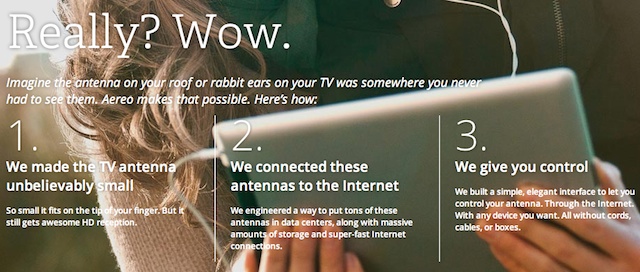
Now we’re ready to look behind Door Number Two and see what a difference Cablevision makes. Aereo is a New York startup backed by media baron Barry Diller, and its play is the same one cable companies made in their Wild West days: rebroadcasting live over-the-air TV without anyone’s permission. Quietly stepping over the arrow-strewn bodies of its predecessors, Aereo filled its Brooklyn data center with dime-sized antennas—80 on each circuit board, with 16 boards to a rack. When a user is logged in, Aereo designates one of the antennas as “hers” and starts recording the chosen channel to a unique copy on a hard drive, Cablevision-style. Then, just like with Cablevision’s RS-DVR, she can stream the stored video over the Internet.
Thousands of tiny antennas are a ridiculous way of capturing over-the-air TV. Storing a permanent copy rather than a buffer just large enough for streaming is a pessimization, not an optimization.
Two aspects of this business model stand out. The first is how precisely it hews to Cablevision. Each TV stream on Aereo, in Cablevision‘s words, “is made to a single subscriber using a single unique copy produced by that subscriber.” The only significant difference is that Aereo starts with TV signals that come in over the air rather than on a wire. (As a sign of how dependent Aereo is on Cablevision, the service is only offered in New York, where the Second Circuit’s decisions apply. Cross the river to New Jersey, which is part of the Third Circuit, and Aereo is unavailable in your area.)
Second, the striking thing about how Aereo works is just how gratuitously profligate it is with technology. Thousands of tiny antennas are a ridiculous way of capturing over-the-air TV. Storing a permanent copy rather than a buffer just large enough for streaming is a pessimization, not an optimization. And of course Aereo keeps as many separate copies of each program as there are viewers who want it. If copyright law made sense, copyright owners themselves would offer TV streaming on the Internet. But copyright law hasn’t made sense for years, and Aereo embraced the madness.
It worked. In July, a federal judge denied broadcasters’ request for an injunction to shut down Aereo. The broadcasters tried to get around Cablevision by arguing that the individual copies didn’t really count because—I am not making this up—the viewer could start streaming a show before it ended. It’s bizarre that buffering a TV show through a copy being recorded to a hard drive should let Aereo escape liability, but the argument that viewers should have to wait until the end of the show is just as strange. As the judge explained, the broadcasters’ view would mean that a user “who begins watching a recording of the Academy Awards, initially broadcast at 6:00 pm, one minute before the program ends at 11:00 pm” would be watching an infringing public performance, while a viewer “who begins watching a standard half-hour sit-com just a minute after its initial broadcast ends” would be watching a legal private performance from her own copy.
In a bizarre postscript to the Aereo lawsuit, the entrepreneur behind FilmOn, Alki David, announced a new service using the Aereo model, called BarryDriller.com. The subject of this off-color pun, Aereo’s backer Barry Diller, was unamused and promptly sued. The BarryDriller.com domain now redirects to David’s CBSYouSuck.com, a site that promotes David’s ongoing suit against CBS and CNET for distributing LimeWire.
The world’s longest video cable
It’s not just TV-on-the-Internet that got a jump-start from Cablevision. All kinds of other streaming-based business models suddenly seemed possible, too. The crucial question was where to get the copy you were streaming to a customer. Cablevision and Aereo got the copies when customers hit “record.” Cablevision had successfully argued that “the person who actually presses the button to make the recording supplies the necessary element of volition [to infringe], not the person who manufactures, maintains, or, if distinct from the operator, owns the machine.” (Similarly, in home taping with VCRs and DVRs, viewers make their own copies, which are often legal under fair use as time-shifting.)
A California startup called Zediva had another idea. It bought DVDs, taking advantage of the first sale doctrine to become the undisputed owner of copies of movies. It filled a Santa Clara data center with hundreds of DVD players. When a customer hit play on, say, Little Fockers, Zediva’s servers reserved a DVD player with the DeNiro/Stiller turkey in it, started the DVD playing, and streamed the video to the customer over the Internet. Zediva called it “a DVD with a very long cable attached.”
Having an individual file for each user is crucial; using deduplication would mean crossing out of Cablevision country.
Once again, the business model looked engineered to take advantage of Cablevision, and Zediva argued that its streams weren’t public performances because they went to individual viewers and no one else. And once again, it’s a business model that would not exist in a world with copyright policy that was not demonstrably insane. Rapidly spinning optical discs make sense as a distribution technology because they’re compact and durable. But they’re a hassle and a half for playback, because they scratch, skip, and make random access a pain. If you’re going to use the Internet for distribution, better to take the DVDs out of the picture and use them as coasters. But since Cablevision had opened up what seemed like a gap in copyright law, Zediva poured shiny lacquered discs into the breach.
Unfortunately for Zediva, it ran headlong into one of Cablevision‘s major limitations. Each Zediva stream went to a unique subscriber—but it didn’t come from a completely unique copy. After one user finished watching Little Fockers, the DVD and player would go back into the pool for others to use. This meant that the same DVD would be shown repeatedly to different users over time.
This mattered because of a case law that Cablevision had delicately tiptoed around. Long before DVRs and Internet streaming video, there were video stores. One, Maxwell’s Video Showcase, had tried to compete with movie theaters by also renting video booths for two to four people. You would pick your movie, get some popcorn, then sit on a luxurious upholstered bench and watch Raiders of the Lost Ark on a gigantic nineteen-inch screen. In a case called Columbia Pictures v. Redd Horne, the court held that Maxwell’s engaged in infringing public performances because “it shows each copy [of a film] repeatedly to different members of the public,” even if not simultaneously.
Other courts reached similar results in cases involving hotels and adult theaters, so Cablevision adopted a distinction between one copy and many. A million viewers and a million copies—OK. A million viewers but only one copy—not OK. This reasoning doomed Zediva, because of course the whole point of its business model was that it would reuse DVDs and stream them to different users in rapid succession.
Pause to note what a silly distinction this is. Making separate copies for each user is a massive waste of storage. Systems engineers would say that Cablevision should make only as many copies as it needs to meet demand. Making more does nothing to improve the experience for users; it does nothing to change the impact on copyright owners. All it does is drive up costs. But courts have to play the hands they’re dealt, and the Cablevision court was working with precedents that made the use of individual copies highly significant. If it is fair to say that Cablevision won on a technicality, then it is also fair to say that Zediva lost on one—and vice versa. These are precisely the kinds of technicalities that matter in modern copyright law.
Rock lockers
Cablevision is even spilling over into the simmering dispute over file lockers. It’s not entirely a coincidence that Amazon, Google, and Apple—big companies with a lot to lose if they get their copyright compliance wrong—all launched cloud-based music players in 2011. Their first line of legal defense is presumably the DMCA safe harbor for user-uploaded content, but there are traces of Cablevision in their policies.
The free versions of these music lockers require users to upload each and every song they want, no matter how many others have uploaded the same song. (Apple and Amazon’s paid versions, which will match files in the user’s collection, are licensed.) This might not be necessary for DMCA compliance, but from a Cablevision perspective, having an individual file for each user is crucial; using deduplication would mean crossing out of Cablevision country.
Or perhaps not. MP3tunes is (or maybe was) a music locker that deduplicates at a file-block level. Music companies sued, citing Cablevision. But a federal judge thought that this deduplication wasn’t a problem, explaining, “The record demonstrates that MP3tunes does not use a ‘master copy’ to store or play back songs stored in its lockers. Instead, MP3tunes uses a standard data compression algorithm that eliminates redundant digital data.” So either the judge didn’t think that individual copies were necessary, or he misunderstood what a “master copy” was.
The most ambitious music locker service doesn’t even describe itself as one. Instead, ReDigi calls itself “The World’s First Pre-Owned Digital Marketplace.” (The claim may be a bit overstated; similar ideas include the Digital Content Exchange and this patent application.) Why buy “Rumor Has It” from iTunes for $1.29 when someone else who already did is willing to sell it to you for 79 cents? ReDigi’s offline model is the used CD store—which of course is completely legal because of first sale.
But wait, you may be saying, at a used CD store the previous owner gives up the CD when the new owner gets one. Online, don’t they now both have a copy? Great question. ReDigi’s answer involves some DRM gymnastics. First, it uploads the track to its servers, giving the seller streaming access. When the owner “sells” the track, ReDigi changes the ownership bits on the file, locking the seller out and giving the buyer exclusive streaming access. (To keep the seller from simply uploading a copy and keeping the original, ReDigi deletes the track from the seller’s computer and uses DRM to make sure it’s never copied back.) In other words, ReDigi is a streaming music locker with a key that can be transferred from one user to another.
ReDigi is a complicated bank shot off of Cablevision. It strings together Cablevision‘s public performance rule—to justify streaming music originally uploaded by user A to user B—with a series of other arguments. Uploads are personal fair use by users, not infringing copies made by ReDigi. A change in the ownership bit is not an infringing “distribution” of anything to anyone. Downloads by the new owner are personal fair use. And so on.
There are serious questions about whether all of the pieces really hang together. (A skeptic would say that when the file changes “owners,” it fails the individual-copies test in the same way that Zediva did.) Still, the general picture should be familiar by now: a business using legal stepping stones to create a path from Step One (online streaming) to Step Three (profit).
A complex legacy
The post-Cablevision cases are almost comically formalistic about technical details. Instead of looking at the front-end user experience, they focus on the back-end hardware and software. Sooner or later, someone is going to argue to a court that it makes a difference for copyright purposes whether a video stream is decoded by the main CPU or by a dedicated graphics card—or some other distinction equally remote from anything the typical viewer thinks about when trying to catch up on last week’s episode of Breaking Bad.
This technological formalism has real costs and real benefits for all concerned. On the upside, Lawful Good technologists and investors need bright-line guidance. Imagine being a cloud computing vendor, watching the file locker litigation and worrying that one judge could scuttle your entire business model. Or worse, imagine being a cloud computing customer facing the risk that one judge could consign your files to Davy Jones’s locker.
Actually, there’s no need to imagine: this is precisely what happened to MegaUpload’s customers. Their data was eaten by the cloud of legal uncertainty that is criminal copyright infringement. Faced with the huge overhang of liability created by copyright doctrines that treat even evanescent “copies” in RAM as potential infringements, courts may be crafting exceptions, like Cablevision‘s public performance rule, to preserve some breathing room for innovation. Having clear rules can be helpful.
On the downside, the contortions required to fit through Cablevision’s hoops can be cringe-inducing, and not just for the technology companies blowing through their angel money to buy extra storage and bandwidth. One man’s “hoop” is another man’s “loophole,” and to copyright owners, Cablevision looks like a copyright-evasion cookbook: How To Succeed in Piracy Without Really Infringing. From their perspective, the post-Cablevision burst of innovation consists entirely of Frankenstein-style attempts to resurrect business models already condemned by the courts.
The road not taken
Perhaps we can think about the problem of copyright on the Internet another way. Instead of asking which back-end technologies are legal, it might make more sense to ask what it is legal for users to do with computers on the front end. This approach would let people spend less time worrying about the exact definitions of “reproduction” and “performance” and more time thinking about users’ rights, especially under fair use.
Cablevision itself illustrates what might have been. The whole point of the RS-DVR was that it was a perfect substitute for a home DVR. Reasoning by analogy, then, we might say that the two ought to either both be legal or both be illegal. And since home DVRs seem here to stay, it ought to be permissible for Cablevision to offer its customers exactly the same service they could have gotten by buying a gizmo. Call it “noninfringing personal fair use” and we can all go home.
The strangest thing about Cablevision is that the court didn’t even get a chance consider that argument. The parties agreed not to litigate the fair use issue. Yes, you read that right. It was a quid pro quo: Cablevision didn’t invoke users’ fair use rights and the cable networks didn’t try to hold Cablevision liable for users’ infringements. That turned a case about users’ uses into a case about Cablevision‘s technologies, changing a common sense debate over how far viewers can go in storing TV programs and watching them later into an abstruse legal disputation over the minutiae of primary ingest buffers and chains of transmission.
Another way of thinking about the decision is that the court wanted to provide a fair use ruling for viewers but wasn’t given the option, so it settled for much narrower rulings on the technologies involved.
Copyrighted content is the nuclear fuel of the Internet. It powers high-energy innovation, but can cause catastrophic legal meltdown if mishandled. Prolonged exposure has been scientifically proven to cause business-model mutations. Cablevision gave risk-tolerant entrepreneurs an inanimate carbon rod: enough to save the day for some of them, but hardly a long-term solution.
James Grimmelmann is a Professor at New York Law School.
Listing image: Aurich Lawson / Thinkstock