Under Obama, NASA finds itself in a familiar place: Big goals but inadequate funds.
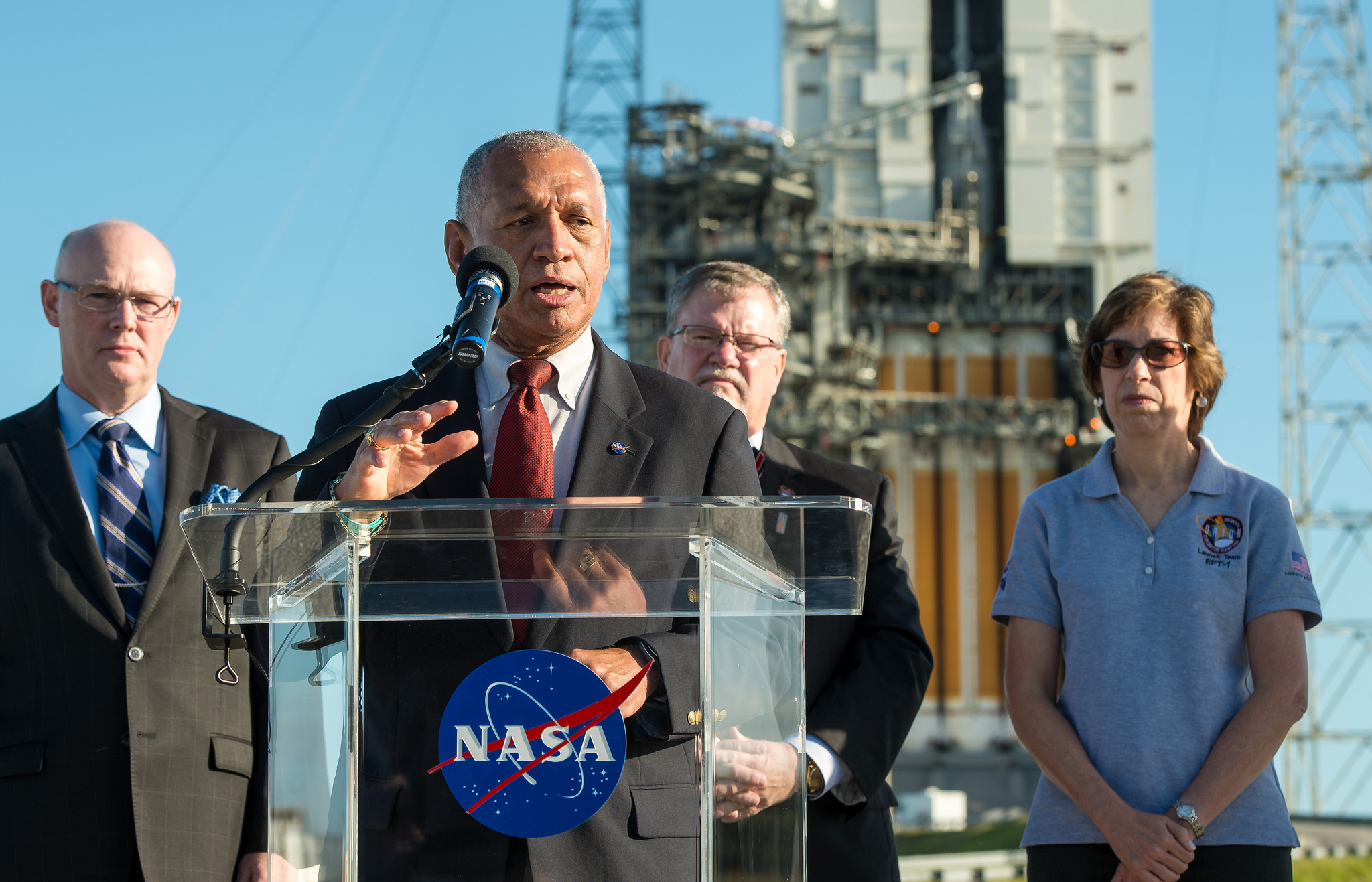
NASA Administrator Charles Bolden speaks to the media two days before Orion's uncrewed flight in December 2014. Credit: NASA
NASA Administrator Charles Bolden speaks to the media two days before Orion's uncrewed flight in December 2014. Credit: NASA
Charlie Bolden’s moment of triumph finally arrived on a warm December morning about 18 months ago. As he spoke of things to come, the Florida sunshine seemed to rejuvenate the decorated Marine and four-time astronaut. He’d survived five difficult years at NASA’s helm, taking knives from Congress, frustrating his former astronaut colleagues, and perhaps most painfully, watching helplessly as America became reliant on Russia for getting its own people into space.
But those difficulties were past. That morning at Kennedy Space Center, Bolden proudly said NASA was taking its first step on a “Journey to Mars.” As a buttress to these words, the mighty Delta IV rocket loomed behind Bolden with the shiny Orion spacecraft perched at its apex. In just two days, Orion would soar upward, completing a nearly flawless maiden flight. Bolden, 69, acknowledged that he may not live to see it, but his kids and grandkids would watch humans walk on Mars in the 2030s.
This moment captured the essence of Bolden’s leadership of NASA during the presidency of Barack Obama. Aspiration. Emotion. And, at times, a softening of reality. For while Bolden has spoken often about leading NASA to Mars, he rarely talks of the costs. NASA will spend $20 billion alone just to develop the Orion spacecraft. And Orion isn’t going to Mars. It’s a capsule to come back from the Moon.
Bolden hasn’t really leveled about two basic truths regarding Mars: it will cost a hell of a lot of money to do it NASA’s way, and it’s going to take a commitment like the nation hasn’t seen since the Apollo program. NASA presently has neither the money nor the commitment from Washington. Many who grasp the challenges of actually going to Mars, including those on the inside, realize this. “I can tell you that my colleagues, at least 90 percent if not more, don’t really think we have a good plan,” one veteran astronaut, who hopes to fly again and therefore sought anonymity, told Ars. Inside the astronaut office they joke about the Journey to Mars. “I think we’ve almost done negative work in the last seven years,” this flier said.
Not everyone feels that way about NASA’s human spaceflight program during Obama’s presidency, but there are few who offer unqualified praise for the president. He just never really showed much interest in space. While Obama did propose bold changes early on to NASA, seeking to more closely align the agency’s goals to funding levels, Congress objected and the president retreated almost immediately. He chose to invest his limited political capital in other areas, effectively ceding most power over NASA’s human spaceflight programs to a Congress largely driven by parochial interests. And when an agency needs a unified purpose and the means to achieve it, this is rarely a formula for success.
Obama’s policy
Barack Obama is pro-science. The Spock-like president has opened the White House lawn to science fairs and stargazing parties, and he made evidence-based policy decisions such as pushing for climate action. He has also occasionally given passing nods to space, such as when he invited astronaut Scott Kelly to his 2015 State of the Union speech.
Yet Obama campaigned to become president in 2008 on much more down-to-earth issues, like the end of US involvement in the Iraq and Afghanistan wars, healthcare, and education. Most pertinent to space buffs, to pay for his ambitious K-12 education plan, Obama proposed “delaying the NASA Constellation Program for five years.” This was George W. Bush’s plan to build a large rocket, the Orion space capsule, and return to the Moon as a waypoint to Mars. At $4 billion a year, it constituted nearly a fourth of NASA’s budget. When the space shuttle retired, its funding was to double.
How did our space policy get to where it is today? We look at the key players during the administration of President Barack Obama. NASA
One year into his presidency, Obama was as good as his word. After convening a blue-ribbon panel led by former Lockheed Martin Chairman Norm Augustine, Obama concluded NASA was on an unsustainable course. Constellation had run badly over budget and behind schedule as NASA attempted to exceed the ambitions of Apollo with a comparatively smaller budget. When Bolden released NASA’s new budget in February 2010, it ended funding for Constellation. Instead, NASA would spend five years investing in advanced technology before choosing what systems to build for deep space exploration. Also to replace the shuttle, NASA would rely on private companies like SpaceX to develop less costly transport to low-Earth orbit.
Congress hated the plan, which removed power and money from NASA’s principal human spaceflight centers in Florida, Texas, and Alabama. Already wary of the space shuttle’s looming retirement, senators from those states fought back. They wanted a big rocket, and they wanted it built by contractors who would lose contracts after the shuttle ended. So Boeing, which managed the shuttle orbiters, got a contract to build the Space Launch System (SLS) rocket’s core stage. ATK, which made solid rocket boosters for the shuttle, would continue making them for the SLS. Aerojet Rocketdyne, which made the shuttle’s main engines, would continue doing so for the SLS. NASA has sold this rocket design as sensible, because it relies on proven hardware. But the principal motivation in Congress seems to have been turf protection and taking care of large contractors.
President Obama caved pretty quickly. Six years ago this Friday, just two months after his budget release, he flew to Kennedy Space Center and delivered his first and only space policy speech. He agreed to keep the Orion spacecraft, speed up development of a heavy lift rocket, and send humans to Mars (at least on flybys) in the mid-2030s. And, in a rhetorical flourish that dismayed much of the space community, he removed the Moon as a possible destination. “We’ve been there before,” Obama said.
Not all were happy to see his original plan go. In some ways it anticipated the development of lower-cost reusable rockets by SpaceX and Blue Origin. NASA almost certainly could have bought launch capability for a much lower price off the shelf. “The president’s original plan was a well conceived plan,” said John Logsdon, a noted space historian and author. “If there was a long term commitment to space exploration, spending five years investing in advanced technology before deciding what systems to build was a good idea. In its wisdom the Senate rejected the plan.”
The Senate compromise, Logsdon said, offered a mixed blessing. Yes, it used old technologies, and NASA was forced to underinvest in long-term exploration technologies like new propulsion systems. But it did, at least, represent a semblance of a path forward. And as Congress wanted, it kept a large aerospace workforce engaged in rocket and spacecraft design. What is almost unprecedented in the history of NASA, Logsdon said, is that after this initial battle Obama largely left the House and the Senate with the power to direct NASA’s human space plans through their budget-writing processes. “I think space was just not a high enough priority to use up his limited political credit with Congress to fight for,” Logsdon said. “I think he viewed in 2009 and the first half of 2010 the opportunity for policy innovation, but the reaction out of Congress convinced him that space, rather than being an opportunity, could be a problem.”
As NASA worked through the policy implications of building a big rocket on a budget, it searched for a justification. It settled on the Journey to Mars. Almost everything NASA did became part of this. Even last summer, when the grand piano-sized New Horizons whizzed by Pluto and sent stunning images of the world back to Earth, Bolden said it represented “one more step” on the Journey to Mars.
Mars
Last fall, as I sat down at a table inside a Starbucks near the Johnson Space Center, Wayne Hale handed me a book. “I want you to have this,” he said. As the space shuttle’s senior manager in the mid-2000s, Hale helped put the program back on track after the Columbia accident. He has since retired but keeps busy consulting, serving on NASA’s Advisory Council and enjoying his grandchildren. Similar to Bolden, Hale would like his grandkids to see humans on Mars.
But Hale has concerns about the Journey to Mars, and the advisory council has prodded Bolden for more details on how NASA gets there from here. Hale believes he knows why Bolden has been so publicly vague. The book he brought, Mars Wars, offers an account of the rise and fall of George HW Bush’s Space Exploration Initiative. In 1989, on the 20th anniversary of the first Apollo Moon landing, Bush proposed to land humans on Mars by 2019. It’s complicated, but essentially this plan fell apart after a NASA study found it would cost as much as $540 billion to do so. The fallout from this effectively took talk of humans to Mars off the table for 15 years as NASA focused on low-Earth orbit.
When George W. Bush followed in his father’s steps and laid out the Constellation plan in 2004, calling for lunar exploration as a prelude to Mars landings, senior officials at NASA were given a copy of Mars Wars, Hale recalled. “We were all asked to read this book,” he explained. “The whole leadership was very sensitized by the mistakes that were made in 1989. Basically, one of the main lessons that we all came away with was the sticker price was too high. Congress took one look at that and said no way. I think this is now influencing the current administration.”

Wayne Hale, far right, observes the launch of STS-120 in 2007 as the space shuttle program manager.
Credit: NASA
Wayne Hale, far right, observes the launch of STS-120 in 2007 as the space shuttle program manager. Credit: NASA
Avoiding sticker shock seems a wise policy for the simple truth that most members of Congress do not really care about the Journey to Mars. Publicly they may say they support it, but their actions do not. To really achieve something of this scale, NASA needs to buy down risk on a multitude of technologies, including propulsion, deep space habitats, an entry, descent, and landing mechanism, and power generation on the surface itself. Consider electric propulsion: with a decade of research and development and a commitment to flying a nuclear reactor in space, NASA could cut travel time between Earth and Mars from six months to two or less. This would address a host of astronaut health concerns.
Back when it canceled Constellation, NASA proposed developing these Mars-enabling elements by creating a “Space Technology” program. As part of its budget request, it asked for $572 million in fiscal year 2011 and more than $1 billion in 2012 and years beyond. Congress has funded about half of this while taking money from space technology and putting it into the SLS rocket, based on legacy technology from the shuttle program. Countless panels have advised Congress that if it’s going to task NASA with grand ambitions, it needs to provide resources to fulfill them. Supporting a rocket, but nothing to fly on it or technologies to keep astronauts alive on a Mars journey, does not make for a sustainable program.
Gerst
William H Gerstenmaier isn’t a household name. But the soft-spoken engineer who was entranced by the Mercury, Gemini, and Apollo programs during his formative years in Ohio is probably the most important person in the world of human spaceflight. He oversees NASA’s space station, the development of Orion and the SLS rocket, and bears responsibility for mapping the agency’s human exploration future. Gerst, as he is known at NASA, has held a leadership position over human spaceflight at NASA for more than a decade. He has seen Constellation come and go and destinations change. Gerst has read Mars Wars, too.
In recent years he has also contended with the Obama administration’s preference for funding Earth science and other aspects of NASA’s budget instead of human spaceflight. Back in 2008, NASA spent about $11 billion on human spaceflight programs, or about 62 percent of its budget. By comparison, this year it will spend $9 billion, or 47 percent of the agency’s budget.
The brutal reality facing Gerst is this: during Constellation, NASA’s human spaceflight programs had an inadequate amount of money when the agency was supposed to go to the Moon. Now Gerst has less money but a far more technically challenging destination—Mars. Still, he has done his best to try to at least begin to put NASA onto a sensible path. He has plotted a series of missions in space near the Moon, dubbed the proving ground, where astronauts can learn to live in deep space.
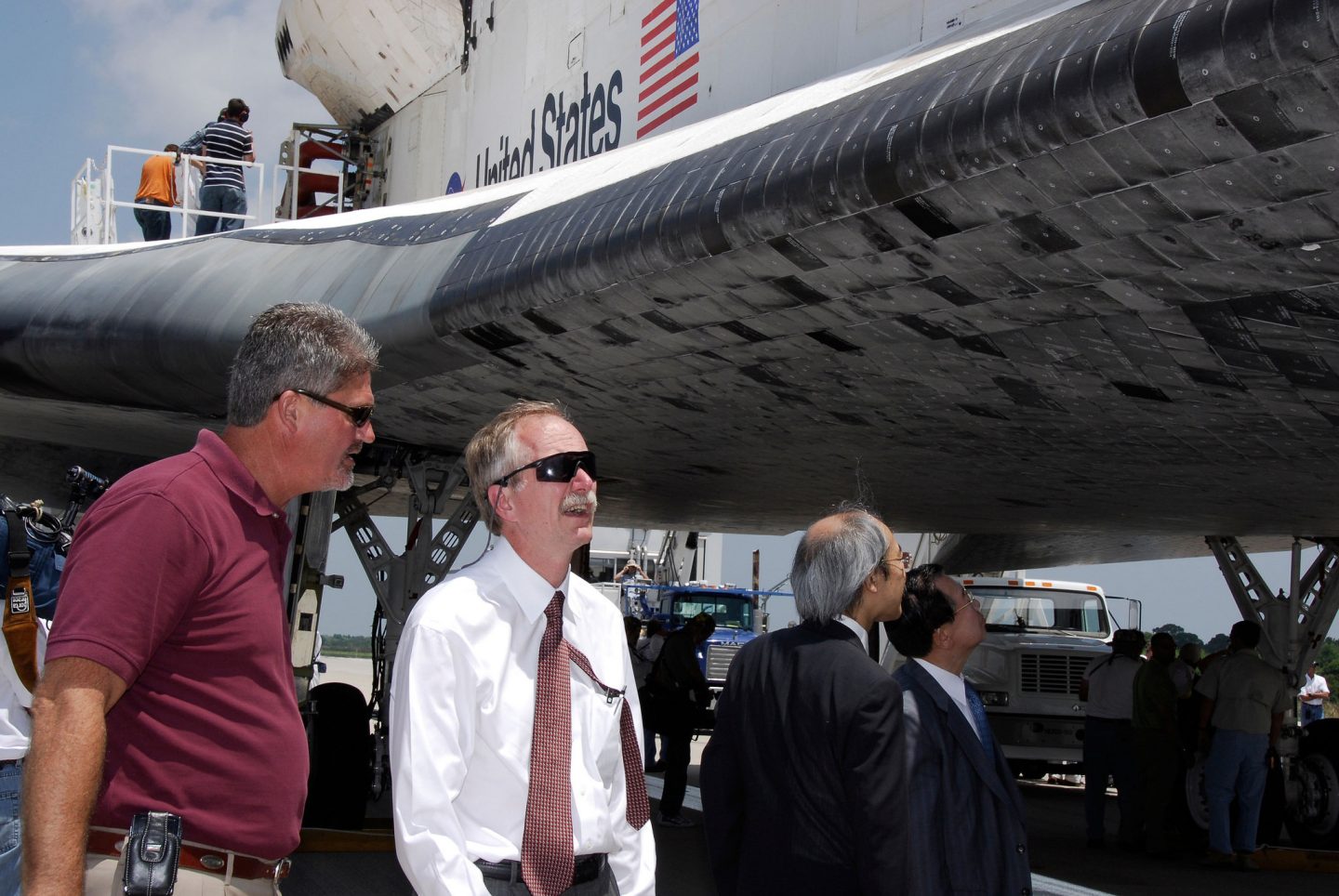
Bill Gerstenmaier, center, checks out space shuttle Discovery after a mission in 2008.
Credit: NASA
Bill Gerstenmaier, center, checks out space shuttle Discovery after a mission in 2008. Credit: NASA
Since the Moon has become taboo under Obama, there is no official talk of lunar landings. Quietly, however, Gerst has pushed forward development of technology that might enable NASA to use water derived from the lunar poles as propellant to fuel spacecraft bound for Mars. Sources familiar with his thinking say he knows NASA’s best bet for a meaningful human exploration program over the next two decades may well involve NASA astronauts operating on the Moon. This would be beneficial both because it would give astronauts something more to do than just fly around the Moon, and it would open up more opportunities for the growing commercial space sector, which is eager to explore the Moon and tap its resources.
Although Gerst isn’t allowed to openly talk about the Moon, when one listens to him speak you can hear this implicit message. At a meeting of the NASA Advisory Council this spring, Wayne Hale asked about those both inside and outside of NASA who would prefer NASA to at least use the Moon as a stepping stone on the way to Mars.
“We need to be careful that we’re not really destination driven,” Gerst replied. “It’s called a Journey to Mars, and I really stress the journey aspect. The fact that Mars is hard is good for us. It’s forcing us to look at new ways of doing business that we haven’t done before. It’s forcing us to look at new technology. It’s exactly the right thing that this agency ought to be doing. But I think it’s careful that we don’t stress so much on the destination.”
In his own careful way, then, Gerst has taken no actions to preclude a pivot back to the Moon by the next president. That’s an assessment John Logsdon, the historian, agreed with. “The hero in all of this is Bill Gerstenmaier,” Logsdon said. “He’s taken the cards he’s been dealt and begun to put the pieces together for a credible beginning to a Journey to Mars. There’s a plan here that’s flexible, too. It doesn’t take the Moon off the table.”
So what will happen when a new president comes into office? After speaking with more than a dozen insiders, both on and off the record, it seems possible to draw some tentative conclusions.
The Rocket
On the face of it, the Space Launch System rocket might seem the most contentious issue. A lot of aerospace engineers view the SLS as something akin to a Franken-rocket, pieced together from various parts. Instead of looking forward to an era of reusable rockets, the SLS uses technology from the 1960s and 1970s and will likely be expensive to fly. (Neither Bolden nor anyone with NASA will say how much it will cost to maintain the SLS rocket once it is built, whether it flies or not. These “fixed costs” for the space shuttle, an analogous launch vehicle, were estimated to be about $2.5 billion annually.)
Back in 2010, Lori Garver, who led Obama’s transition team on space issues, argued that NASA should not compete with a private sector which has shown the ability to design and build rockets for far less than NASA could do so. After becoming NASA’s deputy administrator, Garver helped draft the plan to end Constellation. She wasn’t thrilled with the Congressional response, and after leaving NASA in 2013, Garver has become openly critical of the SLS rocket.
For example: last November, at a forum on US spaceflight, she said, “NASA was a very symbol of capitalist ideals when we went to the Moon and beat the Russians. Now what we’re working with is more of a socialist plan for space exploration, which is just anathema to what this country should be doing. Don’t try to compete with the private sector. Incentivize them by driving technologies that will be necessary for us as we explore further.”
Critics have made a similar argument for the Orion space capsule. NASA has spent more than a decade and $10 billion building it—and the first flight with astronauts is probably still about seven years away. Meanwhile, both SpaceX and Boeing could probably modify their existing capsules, which will be flying humans into space as early as next year, to have the capability to make high velocity returns from the Moon like Orion. Should NASA continue to fund that program at more than $1 billion annually when it could just buy capsules from the private sector when it needs them?
None of this should take away from the first-rate technical work that has gone into building SLS and Orion. By all accounts they will be fine vehicles, built by dedicated engineers, that could form the core of a Mars exploration program. But, critics say if NASA is not going to be given enough money to fly the gold-plated vehicles on frequent and interesting missions, then what is the point of having them in the first place?
Nevertheless the SLS and Orion maintain broad support in Congress, both from Democrats and Republicans. Any White House seeking to end these programs would have to invest significant political capital to kill one or both. And for what end? Because it probably makes the best fiscal sense for the United States? A president picking battles with Congress would likely choose one more central to his or her ideological base.
Make no mistake, there would be a battle. A natural ally for Hillary Clinton, Texas Democratic Representative Eddie Bernice Johnson moved to allay any fears SLS or Orion employees might have. “To all those NASA and contract employees I would simply say, Congress supports SLS and Orion,” she said during a Congressional hearing this spring. “And we will continue to do so no matter what we say here to make the news or the record, we will do this in spite of a new president taking office.”
It boils down to this, explained one senior official in the private space industry who would love nothing more than to stick a knife into the SLS: “It’s going to be a hard program to kill.”
Destinations
The next president could always go nuclear on SLS and Orion, seeking to end both programs for financial reasons and confine NASA to low-Earth orbit, as NASA has been since the end of Apollo. But the end of SLS and Orion needn’t mean the end of exploration. Independent studies such as this one have shown that privately developed rockets could enable Moon landings within the next decade with NASA’s current budget and eventually open a pathway to Mars.
However, the most likely scenario is that the next president will move forward with the SLS, due to make its maiden flight in 2018, and Orion. In that case, probably the most interesting battle will come over the Journey to Mars and its implementation.
Although NASA has rarely come onto the radar during the 2016 presidential campaign, space analysts believe none of the candidates share Obama’s apathy toward the Moon. A number of key Republicans in the US House, including those over NASA’s budget authorizations and appropriations, favor a Moon-first approach. They see the Moon as a reservoir of resources as well as an important “high ground” in a geopolitical sense. For a Democrat in the White House, the Moon might offer a pragmatic area of compromise with Congress. For a Republican, it seems most likely that using the Moon as a stepping stone to Mars would be the default option.
A Moon-then-Mars program today might have political advantages over its predecessor, Constellation, which was largely a NASA-only program that eschewed international partnerships. Since that time, the European Space Agency and other government space agencies have come forward and expressed an interest to go the Moon, creating an opportunity for cooperation.
NASA also didn’t seek out lean deals with private space companies a decade ago, perhaps because many of those companies didn’t exist. For example, Constellation proposed using a massive $12 billion government-led Altair lander as a surface module. Today, companies such as Bigelow Aerospace, United Launch Alliance, and others have privately developed prototypes for far less expensive lunar habitats. This time around a new president may find compelling diplomatic and commercial reasons for a Moon-first strategy for Mars.
Nevertheless, support has undeniably been building for sending humans to Mars. Chris Carberry, co-founder of Explore Mars, pegged the beginning of that momentum to when NASA’s Curiosity rover landed on Mars in 2012. Since then there has been NASA’s drumbeat about a Journey to Mars, The Martian movie, and more. But Carberry recognizes that the next administration will probably take a look at the Moon as an interim destination. ”I’m not someone who is really opposed to going to the Moon,” he told Ars. “The main issue is how can we do that in a manner where we’re not going to get bogged down on the Moon for decades?”
Consensus
About a month ago, during one the innumerable hearings on space policy that takes place year-round in Washington DC and elsewhere, veteran space analyst Marcia Smith summed up the general feeling on NASA’s human exploration plans: “There is a consensus that there needs to be a consensus, but no consensus on what the consensus should be.”
It will take a strong president to provide some clarity. It is not enough to say we’re on a Journey to Mars without laying out at least the framework of a plan, a timeline, and providing the funding for technologies that will bring that about. That is the kind of program that might keep Congress happy, but it never really goes anywhere.
Sandy Magnus says the next president has a chance to show leadership by addressing difficult questions. After flying on the final space shuttle mission in 2011, Magnus left NASA and now serves as executive director of the American Institute of Aeronautics and Astronautics. She agrees that there has been a general coalescing around Mars, but there’s no concurrence on the smartest way to get there. And this is the “monster” issue that could be tackled by the next administration, Magnus told Ars.
“Certainly I think everyone agrees the road to Mars is going to be an international effort,” she said. “It’s a matter of how do you get there? There are people who want to hang out at the Moon. There are people who want to stay in cislunar space. There are people who want to go directly to Mars. So building a consensus is hard.”

Sandy Magnus talks with Stephen Colbert, prior to her appearance with the rest of the STS-135 crew in 2011, after the shuttle’s final mission.
Credit: NASA
Sandy Magnus talks with Stephen Colbert, prior to her appearance with the rest of the STS-135 crew in 2011, after the shuttle’s final mission. Credit: NASA
For example, at the international level, instead of NASA’s unilateral we’re-going-to-Mars dictum, the next administration should reach out to potential partners to develop a consensus on where those partners want to go and what element each partner could best contribute. If a broader exploration coalition means landings and establishing a commercial base on the Moon, the stability such international agreements bring might well be worth it.
The next administration should also leverage the growing strength and vibrancy of America’s commercial space industry. NASA has already done this by privatizing the delivery of cargo and crew to the space station during Obama’s presidency, one of the few ways he has really left his imprint on human spaceflight and stood up to Congress. The next president should continue to allow NASA to tap private industry even if the best commercial solutions come from companies outside the big aerospace lobbies.
Forging a plan that has Congressional buy-in, fits within the framework of international partnership, and finds cost-effective industry solutions will be a major challenge, space policy analysts say. It may not be glamorous work either, but ultimately only such a plan can bring the stability that NASA needs to sustain a program that will take decades to complete. Such a plan might, in fact, represent a true Journey to Mars.
Living in the moment
On that sunny December 2014 morning in Florida, I stood among 100 or so reporters and photographers fanned out in a large arc to hear Bolden talk about Orion and the Journey to Mars. As usual, after his remarks Bolden took a few questions. Stepping up to the microphone I related how a slew of independent assessments by organizations such as the National Research Council, and even the space agency’s own advisory council, had all found NASA’s Mars ambitions to be unrealistic. When, I asked, was Bolden going to tell the president and the US Congress that the agency’s goals exceeded the funding it received?
The retired Marine general didn’t hesitate. “Somebody’s got to stand out front and say, let’s go, and that’s generally the United States. The United States cannot step away from leadership that comes our way, because we’re the greatest nation in the world. That’s why I’m not concerned about the question you asked, because this nation always does step up when it’s necessary to do so.”
It will almost certainly cost hundreds of billions of dollars to put humans on Mars. Bolden, then, believes that despite the fight for every NASA nickel, every year, Washington will at some point miraculously double or triple NASA’s exploration budget to enable the Mars vision. This is known in space circles as yearning for another Kennedy moment, when a president decides some space objective is worth going for broke and gives the agency a blank check.
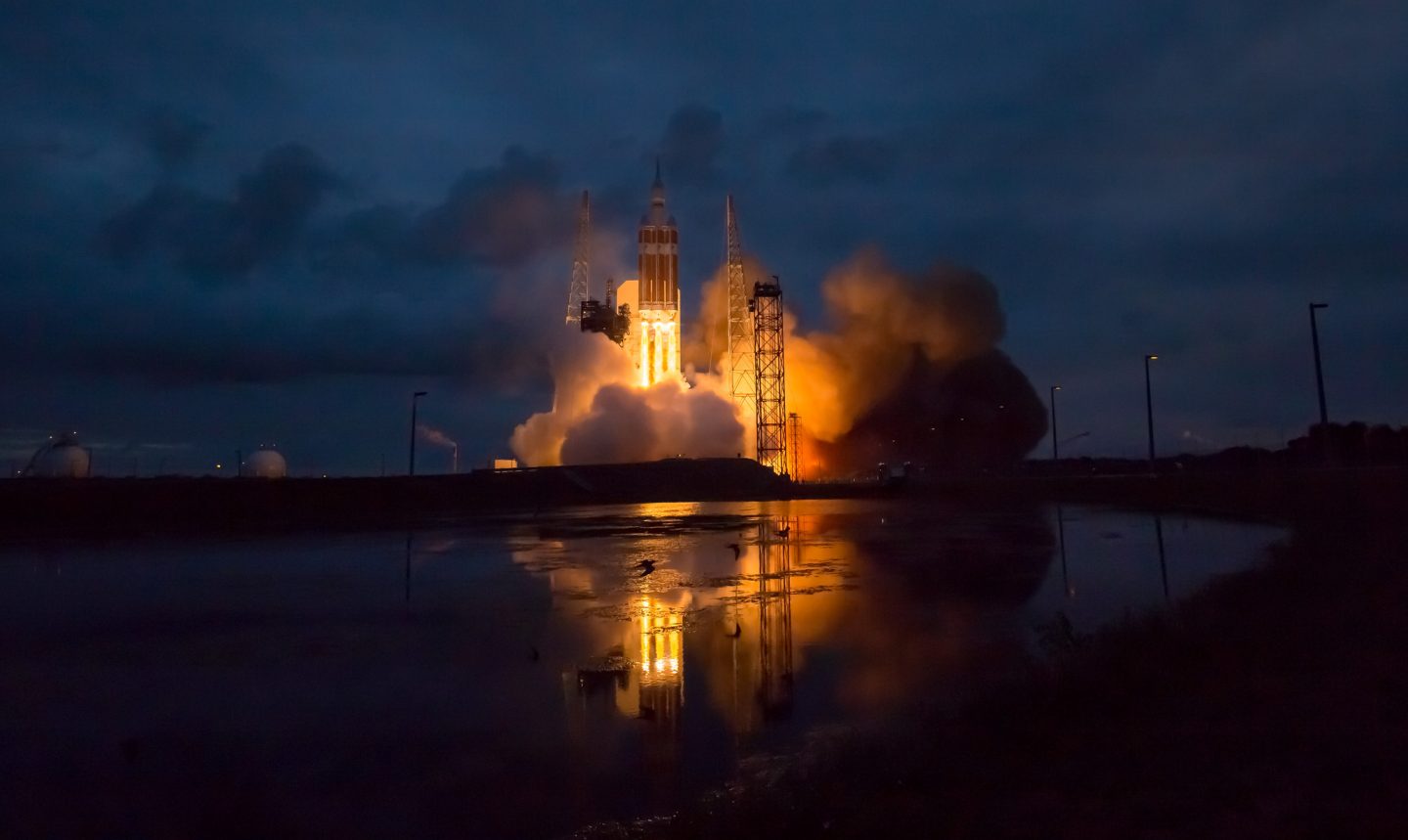
Orion launched into space on December 5, 2014, and completed a nearly flawless test mission.
Credit: NASA
Orion launched into space on December 5, 2014, and completed a nearly flawless test mission. Credit: NASA
Yet even as NASA’s share of the federal budget has fallen from 4.5 percent during the Apollo heydays to less than 0.5 percent today, scores of polls have found that only about 20 percent of Americans think NASA receives too little funding. The reality is that another Kennedy moment probably isn’t coming, and to gamble one’s space policy on that happening doesn’t seem a wise bet.
Two days after this exchange, Orion launched from Florida and created a beautiful arc of light as it ascended into the heavens. A few hours later, the sight of an American spacecraft parachuting into the azure blue Pacific Ocean proved to be a stirring image as well. Given an uncertain future, it was probably best to live in the moment.
Listing image: NASA

Eric Berger is the senior space editor at Ars Technica, covering everything from astronomy to private space to NASA policy, and author of two books: Liftoff, about the rise of SpaceX; and Reentry, on the development of the Falcon 9 rocket and Dragon. A certified meteorologist, Eric lives in Houston.