Other features are of narrower interest, but no less important. Enterprise support is greatly expanded, with VPN support, encrypted S/MIME e-mail, EAP-TLS Wi-Fi authentication, certificate management, and support for scanning and OCRing documents with the camera.
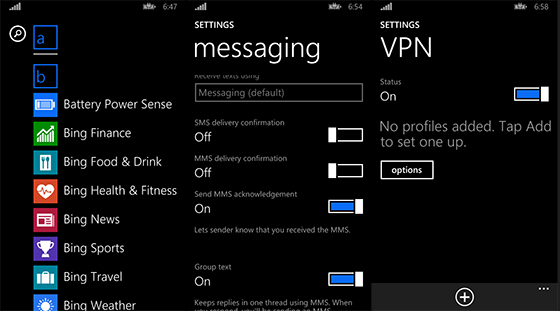
From left to right: the new battery sense app, the ability to set other apps as the default SMS/messaging client, and VPN support. Credit: The Verge
There are also lots of broader system updates: Internet Explorer gets bumped to version 11, including WebGL support and support for the rich YouTube HTML5 experience. A new Battery Sense feature will show which apps are using the most power and allow you to choose which apps get suspended when in battery saver mode. There will be built-in support for Bluetooth LE, mice, keyboards, Miracast, and Wi-Fi Direct.
There will be new ways of interacting with the phone. The keyboard will support swiping, so fingers can be dragged from key to key, and there is expected to be a new virtual assistant along the lines of Apple’s Siri, currently named (or perhaps codenamed) Cortana. Personally, I feel that Google Now is a better model to follow, as I’ve found it manages to be useful more often than not without me even having to ask it.
But more than all this is the behind-the-scenes alignment with “real” Windows. Windows Phone 7 apps were built with, more or less, a version of Silverlight, Microsoft’s cut-down .NET framework. Windows Phone 8 apps had a range of options. 7-style Silverlight apps could still be used, but using any new 8 features meant rebuilding with a sort of hybrid system: a derivative of 7’s Silverlight-based API, but running on top of the full-size .NET framework. In parallel, native C++ could be used, with access to Direct3D, and a very small subset of the WinRT API that’s used for Metro apps in Windows 8.
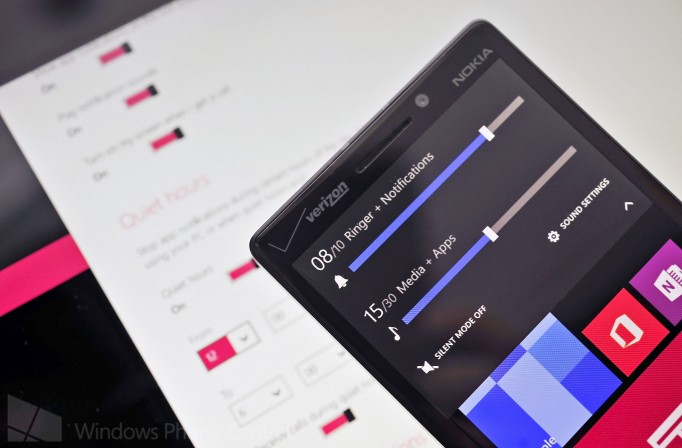
Separate volume sliders for notifications and media.
Separate volume sliders for notifications and media. Credit: Windows Phone Central
Windows Phone 8.1 shakes things up radically. It will continue to support the Silverlight-based applications developed for both Windows Phone 7 and Windows Phone 8. It will also provide a new version of Silverlight, dubbed Silverlight 8.1, to give those applications access to some—though not all—of 8.1’s new features.