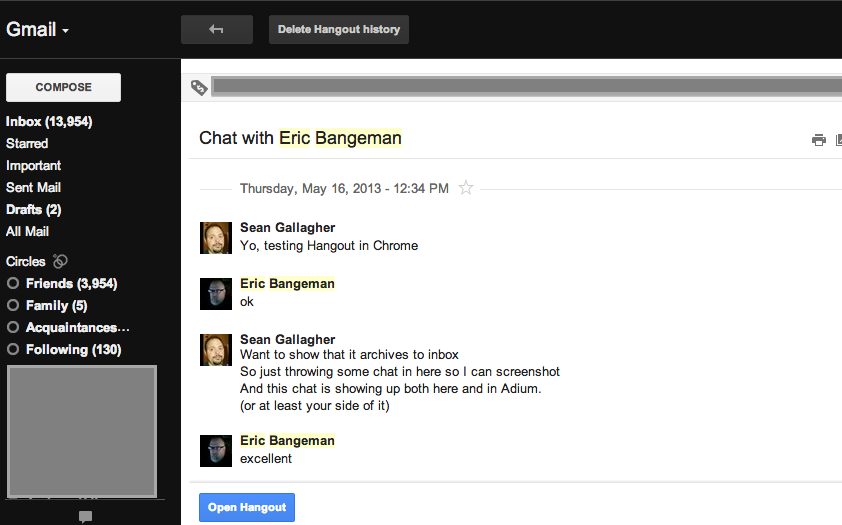
You can also launch a Hangout again with someone from within the Gmail archive or use the legacy Google Talk interface to start a hangout from any Web client.
Credit: Sean Gallagher
You can also launch a Hangout again with someone from within the Gmail archive or use the legacy Google Talk interface to start a hangout from any Web client. Credit: Sean Gallagher

For science, here I am hanging out with myself on video. Hangouts also allows video stills to be captured to an archive album, so you can “save your favorite moments”—or the text on that white board in your conference chat.
For science, here I am hanging out with myself on video. Hangouts also allows video stills to be captured to an archive album, so you can “save your favorite moments”—or the text on that white board in your conference chat.
Good news, bad news
There’s some bad news that comes with the new Hangout architecture, at least for others who want to have interoperability with Google chat users on the server side via XMPP. Google will not allow server-to-server connections. Chee Chew said that “we haven’t seen significant uptake” in federation with Google Talk via server-to-server connections. The majority of the uptake Google did see was from organizations or individuals looking to bombard Google Talk users with chat spam, Chew said. As a result, server-to-server XMPP has been left out of the consolidated Hangout environment.
That means that users of Jabber, OpenFire, and other open-source XMPP-based instant messaging servers won’t be able to tie into Hangouts through their own systems and will have to have separate Google credentials to chat with Google users. But it doesn’t mean that Google has euthanized XMPP completely, as some have reported.
The good news is that Hangouts will still support client-to-server connections via XMPP, though only for one-to-one text chat. That means that Web and client-side chat applications that have used XMPP to connect to Google Talk will still be able to see presence information about their contacts in Google+ and chat with them via text in Hangouts.
That news will come as relief to users of multi-service IM clients such as Adium, Pidgin, and Web-based and mobile tools like Imo and Xumi. It will also be a relief to Microsoft’s Office.com team, which just added integration between Microsoft’s Web e-mail client and Google Talk.
On the whole, Hangouts is a badly-needed update to Google’s chat infrastructure. It kills the somewhat pointless Google+ Messenger and builds successfully on the best of Google Talk while adding features that others had long ago added to their more platform-specific products. The archiving capabilities will be welcome among business users and consumers alike. Businesses that are users of Google Apps Vault, for example, and need to preserve communications for regulatory reasons or e-discovery will be especially happy about the integration with Gmail’s inbox.
The preservation of XMPP for clients also shows that Google is at least making an effort not to alienate people who have a need to use multiple IM providers. It’s also a recognition that not everyone yet lives in Larry Page’s perfect universe.