Allo isn’t built for a multi-device, connected world, but that’s probably on purpose.

The Google Logo for India Independence Day 2014. Credit: Google Doodles
The Google Logo for India Independence Day 2014. Credit: Google Doodles
Google’s new instant messaging client Allo doesn’t seem like a compelling product. Allo is missing many of the basic features you might expect in an instant messaging app: it only works with one device at a time, it doesn’t work on a desktop or laptop computer, it doesn’t support tablets very well, it doesn’t use a Google account, and it doesn’t support SMS. Allo has had a curiously incomplete product launch, and many Google users are left wondering what the company was thinking.
Allo’s limitations are deal breakers for many people in the hyper-connected developed world who are accustomed to multiple devices and a few GBs of Internet connectivity. But what if you’re not in a developed country? Google hasn’t explicitly come out and said so, but Allo’s features and Google’s actions around the launch of Allo all point to it being targeted at developing countries, and one developing country in particular: India. When viewed through the lens of the average person in India, Allo’s “incomplete” launch, odd design decisions, and missing features suddenly make sense.
Google <3 India
Google’s love affair with India is no secret. Google is all about scale and having huge numbers of users, and if you look at a list of countries by population, China is first with 1.38 billion people; India is second with 1.32 billion people; and the United States is third, with 324 million people. Google would love to go to China, but that would mean dealing with the censorship-happy Chinese government, so India is the biggest country in the world where Google can freely do business. India is also the home country of Google CEO Sundar Pichai.
Plenty of Google projects have targeted India. India was the first country to get the Android One phone, Google’s program for cheap, high-quality Android phones. The company started a free Wi-Fi program in India by installing high-speed access points in the country’s most popular train stations. Google just launched a custom version of YouTube for India called “YouTube Go.” Google says the new YouTube Go app is designed to be “offline-first.” It lets users download videos for later and share them to friends over a local network. If that’s not enough evidence, Pichai just published an op-ed in The Economic Times of India explaining how Google is heavily targeting India. Google loves India.
We’re going to use India as our primary example to offer a theory on the design decisions around Allo and Duo, but our theory could probably apply to plenty of developing countries.
Google Duo: A companion app to Allo, but also a companion to WhatsApp
The weirdness in Google’s current instant messaging strategy started right off the bat. Instead of announcing a single app that supports texting, voice, and video calls, Google split the video calls off into a separate app called “Duo.” Allo and Duo would be “companion” apps, and users that want a typical instant messaging feature set would have to download both. Why have a split between Allo and Duo? Probably because Google was targeting WhatsApp users.
With over a billion monthly active users, WhatsApp is the world’s most popular messaging app. It’s also the dominant form of communication in India, capturing 69 percent of Indian Internet users in Q4 2014, according to Statista. “WhatsApp Envy” is probably driving many of the decisions behind Allo and Duo—Google tried to buy WhatsApp in 2014 but was outbid by Facebook.
WhatsApp doesn’t support video calls, which could explain the split between Allo and Duo. Duo isn’t just designed to be the video companion app to Allo—it might also be designed to be WhatsApp’s video companion app. Isn’t it weird that Duo supports video calls but not voice calls? It’s less weird when you consider WhatsApp already supports voice calls, so that would be a redundant feature in the WhatsApp/Duo pairing.
Duo launched a full month before its supposed “companion app,” Allo, which is suspicious timing. Allo was clearly the more exciting app, so why get Duo out the door first? Probably because WhatsApp has a video calling feature in beta testing, and Google wanted to beat WhatsApp to the punch.
Allo targets the single-device, developing world use case
Let’s start with Google’s decision to not give Allo a Web or desktop client. In India, the dominant computing device—now and in the future—is the smartphone. According to data from Dutch research firm TNS Infratest, March 2015 PC usage in the US and UK were both around 75 percent. PC usage in India, by contrast, is at only 15 percent of adults for the same period. In fact, India had the second-lowest PC usage of the 59 countries surveyed.
According to the survey, smartphones achieve 33 percent usage by adults in India. Growth numbers since March 2013 favor smartphones, too—back then PC and smartphone usage was roughly equal, at 10 and 12 percent, respectively. Allo doesn’t work on your PC, but that doesn’t matter if Google is targeting India, where fewer people use PCs.
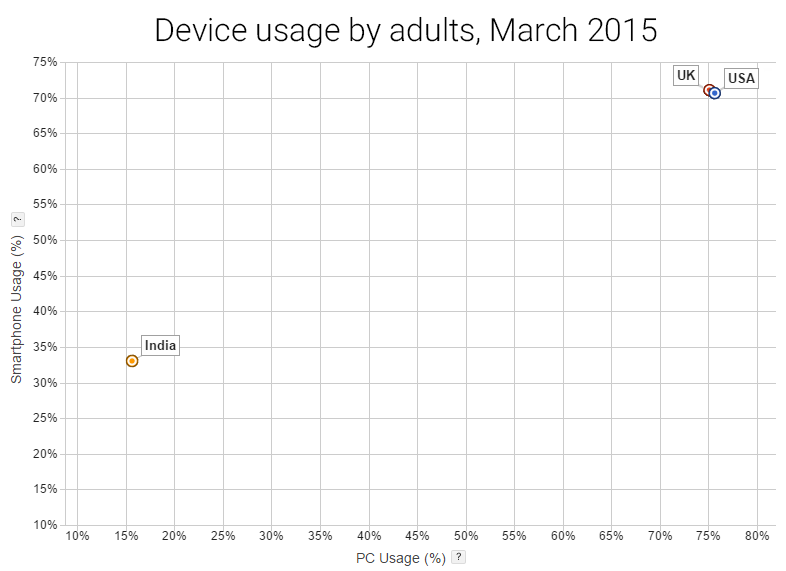
The one-device limitation is also a deal breaker for many in the developed world. I use Hangouts and Facebook Messenger on my phone, tablet, laptop, and desktop. But in India, the smartphone isn’t just the primary computing device, it’s often people’s only computing device. If we go back to the statistics (Google Public Data is an incredible resource, by the way) we’ll see that, for March 2015, the US and UK both average around 3.3 connected devices per adult. In India it’s a different story—the country only averages 0.8 connected devices per adult. To be successful in the US and UK, Allo would need to support multiple devices, but it’s not a big deal in India, where most connected citizens only have one device anyway.
We can explain the lack of tablet support with statistics, too. Fifty-one percent of the UK adult population and 39 percent of the US adult population use a tablet. In India, only 4.8 percent of adults have a tablet. So while tablet support is something to complain about in the US or UK, it’s not a problem for most people in India.
Allo and Duo’s odd setup process can be explained through the India/WhatsApp connection, too. Duo (and Allo) don’t use a Google account for sign up. Instead, you “sign up” with your carrier’s cell phone number. WhatsApp works the same way, making the Duo/WhatsApp companionship easier for WhatsApp users. Also, if you’re just getting on the Internet for the first time via your smartphone, you probably don’t have an e-mail account or a Google account. You definitely have a phone number, though, since that’s how you’re paying for Internet service. Allo and Duo’s SMS-based setup process is simpler than making a Google account.
Allo rollout ramping up in India. Watching servers to ensure they don’t melt, then will expand to other regions…
— Justin Uberti (@juberti) September 21, 2016
Some more evidence Allo and Duo were targeted at India: Allo rolled-out worldwide over the course of a few days, but it launched first in India. Google partnered with Indian OEM Micromax to have Duo pre-installed on its devices. Almost half of the Allo sticker packs are by Indian artists, and many have Indian themes like “I <3 India” and “Modern Parivar.” Google just announced the Google Assistant will soon be learning a second language after English: Hindi.
Allo’s design and marketing don’t line up
Google’s only real mistake with Google Allo and Duo was pushing the apps in developed countries when the apps were clearly not designed around the typical use cases for those countries. Why are these products being pitched to connected users as Google’s flagship communication platform? Why were they touted on stage at Google I/O—an event hosted in the US and streamed worldwide? Why do they get advertised on Google.com and not, say, Google.co.in?
India is a huge market, and Google, as a worldwide company, should absolutely target it. It’s also probably possible to design a product that appeals to users in multiple markets. Google doesn’t seem to have done that, though—it designed two products exclusively around a single-device, limited-connectivity use case, then turned around and promoted those products to highly connected users.
Google could have saved itself a lot of grief and bad press if it had kept its India-centric product in India. Take the India-exclusive YouTube Go, for instance. Judging by this picture, YouTube Go doesn’t support HD video, but no one from a developed country is going to complain about that because YouTube Go isn’t being advertised to them. That’s because of an alternative aimed at highly connected users—it’s called regular YouTube.
For Allo, there is no highly connected alternative. Google’s older instant messaging platform, Hangouts, is being pivoted to an “enterprise” app, and Google is already planning to shut down one of the Hangouts desktop apps. This will leave Allo as Google’s only consumer-facing instant messaging platform, but the app isn’t as versatile or as feature-rich as the one it’s replacing.
Allo doesn’t support Google account logins or multiple devices, and no versions exist for desktops, tablets, or the Web. These things may be added in updates later, but if Google wants to convince all kinds of people all over the world to use Allo, it had better add them fast.

Ron is the Reviews Editor at Ars Technica, where he specializes in Android OS and Google products. He is always on the hunt for a new gadget and loves to rip things apart to see how they work. He loves to tinker and always seems to be working on a new project.