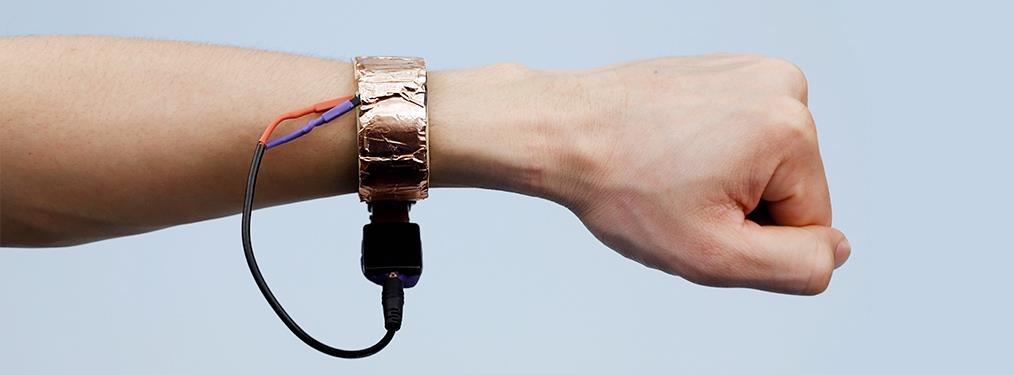
The prototype setup, without the Galaxy Gear.
The prototype setup, without the Galaxy Gear. Credit: Disney Research
It’s a rough-looking device, but it’s also just a proof-of-concept. Disney says the watch works on anything electrical or electromechanical; any large, metallic objects; and “structural members in buildings,” such as doors, furniture, and window frames. It was demoed working on door knobs, a ladder, a stove, refrigerators, laptops, a motorcycle, and even plastic, insulated power tools. The researchers say they have an average overall detection accuracy of 96.1%.
In order to put all of this object-touching recognition to active use, the researchers set the watch up to detect what the wearer was doing and then automatically launch context-based applications. For example, leaving the office at the end of the day and touching the doorknob could launch a reminder to pick up milk on the way home. Touching multiple items in sequence could be tracked, too, and then combined to detect an activity. After touching the refrigerator and then the stove, the watch could figure out that the user is cooking and could start a timer. Disney also set up the watch as authentication for a laptop—the laptop knows a user is touching the touchpad and the watch knows the laptop is being touched, so the system unlocks. It could even detect the changing RPM of a Dremel tool thanks to the changing EM noise.
Smartwatches already use rough activity tracking features today via accelerometers and GPS, but adding object touch detection would open up a whole new world of possibilities. Apps could know a lot more about what you’re doing, which would make them more useful, but “tracking everything you touch, all day” would also open up a whole new batch of privacy issues. Assuming the tech works in the real world, we could see super contextual-awareness being the smartwatch’s much-needed killer app.