
Credit: Intel
Credit: Intel
Credit: Intel
Credit: Intel
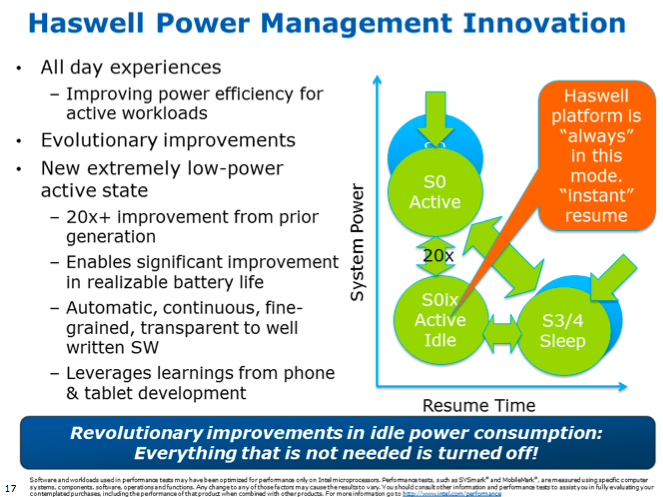
Ivy Bridge-based systems are either active (in the S0 state) or in sleep or Hibernate modes (the S3 and S4 states). The S0ix power state splits the difference, keeping the system active but using only five percent as much power as Sandy Bridge systems do while idling—the benefit over the S3 and S4 states is that going from the S0ix state back to an active state is instantaneous and seamless to the user. Haswell can also switch between these power states more quickly than previous platforms, wasting less power while transitioning.
The desire to save power extends beyond the CPU itself—Intel has also added support for several low-power interfaces normally associated with ARM-toting tablets, including I2C, SDIO, I2S, and UART, along with more traditional SATA, USB, and PCI Express interfaces. All of these improvements, along with system-on-a-chip (SoC) versions of Haswell with a TDP of just 10W (down from the 17W in Ivy Bridge processors), should enable Intel to put Ultrabook-class performance into tablets with similar size, weight, and battery life to today’s ARM-based offerings.
GPU performance: Big increases, if you pick the right chip
In Ivy Bridge, improvements to graphics performance were much more noteworthy than improvements to CPU performance, and that song remains the same with Haswell, which is supposed to be about twice as fast as the Intel HD 4000 in Ivy Bridge depending on the chip you get (which we’ll discuss more in a moment). Intel has achieved this mostly by adding more hardware to the GPU—the actual architecture is similar to Ivy Bridge, which itself was an improved version of the Sandy Bridge graphics chip. Intel’s next next-generation processor, codenamed Broadwell, is slated to introduce a revamped GPU architecture, which should bring even further gains.
The integrated graphics processors in Sandy and Ivy Bridge came in two flavors: the more powerful GT2, which you know as the Intel HD 3000 and HD 4000 graphics processors, and the cut-down GT1, which came in the form of the HD 2000 and HD 2500. The high- and low-end GPUs from each generation are architecturally the same—each supports the same video decoding features, DirectX and OpenGL versions, and number of displays—but the higher-end GPUs have more of Intel’s “execution units” (EUs) on board. The HD 4000 had 16 EUs to the HD 2500’s six.