The 16-terabyte drive (actual capacity 15.36TB) must use between 480 and 500 of Samsung’s new 256Gbit dies. We’re not entirely sure how you squeeze that many dies into a standard 2.5-inch SSD case, but presumably there’s some die or package stacking involved.
At the Flash Memory Summit, as reported by Golem.de, Samsung showed off a server with 48 of these new SSDs, with a total storage capacity of 768 terabytes and performance rated at 2,000,000 IOPS (input/output operations per second). By comparison, the consumer-grade SSD that you have in your PC is probably capable of around 10,000-90,000 IOPS, depending on the workload.
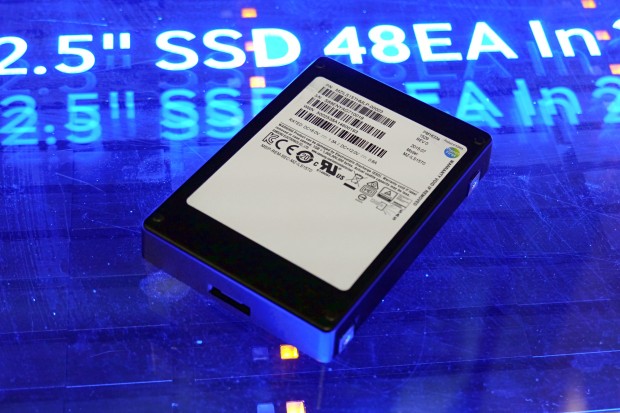
The 16TB Samsung PM1633a SSD Credit: Golem.de
Over the last few years, as NAND manufacturers raced to increase density, we knew that conventional HDDs would eventually be defeated by the seemingly indefatigable march of Moore’s law—but we didn’t think it would happen quite so soon. That isn’t to say that hard drives will be obviated by SSDs any time soon, of course: at least for the foreseeable future, SSDs are an order of magnitude more expensive than HDDs. Today, an enterprise-grade 1TB SSD will cost you about £600 or $1,000; an enterprise-grade helium-filled 8TB hard drive from HGST costs about £400 or $700.
We don’t have a price for Samsung’s 16TB PM1633a, but we can’t imagine that it’ll be cheaper than £5,000. But hey, you would be the owner of the world’s largest drive!