Disassembling the Amazon Dash
bitsofcents.comOne neat thing Amazon are doing with this product, which I hadn't considered as an "internet of things" option, is making each unit of hardware order a single supplier's goods. All the example buttons say "Tide" or "Bounty" or "Gillette" or "Olay" right on the button - all Procter & Gamble. And the other goods pictured [1] are all brand-name goods with fairly big marketing budgets.
In the jargon of the grocery industry, this means the buttons can be "supplier funded" - Procter & Gamble probably pay Amazon a reasonable portion of the cost of the button, as a marketing method.
What if the Dash becomes very popular? I believe we'd see an explosion of companies funding dash buttons which would, in my opinion, be a bad thing for the customer. I don't like the idea of locking myself into a brand for the life of the device.
I'd like to see a configurable button that orders, say, the cheapest paper towels that have at least a 4-star rating. The suppliers probably wouldn't be happy about the competition though.
> I don't like the idea of locking myself into a brand for the life of the device.
You're not the target market. Some people exhibit strong brand loyalty for some stuff. In the UK you'll get people saying that baked beans must be Heinz and no other brand.
I tend to agree with you. I want a button I can push to order the cheapest washing detergent. But that gets complicated. Do I mean actual cheapest price at the till, or do I mean cheapest per wash? Does that mean I want to buy a huge 15 litre tub of industrial detergent?
> that have at least a 4-star rating.
Amazon ratings are already sub-optimal. I could imagine a time when all P&G employees have to buy P&G products from Amazon, and have to give high star ratings, in order to help fix the ratings. Perhaps I'm just overly cynical.
> Some people exhibit strong brand loyalty for some stuff
..but the point is that these people can _choose_ to exhibit such loyalty.
This is well-studied and understood. People can stick with a brand for years, until suddenly they change it for another and completely forgot about the other.
The dash seems like just another convenient lockin
The point of funding Dash buttons is that they're free for the consumer. You're locked in, only so far as you can't be bothered to throw out the button, or just not push it, or instead push the button provided to you for free from a competing brand.
That said, it's almost impossible to imagine that a future where Dash is successful doesn't contain configurable buttons like the ones you describe - they probably just won't be free.
That's a really insightful strategy. Amazon wins by not needing to sink more development time into cheaper hardware by getting P&G to offset costs, while P&G wins by effectively pays a one-time fee per customer per product to ensure a steady stream of sales.
Hadn't thought of that angle at all. Enlightening comment!
$2 a year for a permanent advert within someone's house which also generates sales.
Sounds like a win / win for both P&G and Amazon...
Is it just me that finds the entire concept of the Dash ridiculous?
I mean, what's the idea, having a button for every single product we buy? And we need to set it up first. How is that any better than recurring ordering or just opening the website and ordering it? Are we expected to have an entire wall of dashes at our place?
I guess we'll need to sort them alphabetically or by color, so we don't waste time searching for the button we need.
Sure, but just a few decades ago there were people dismissing all of e-commerce saying "why would I order online when I can just pick up the phone and call in my order?" I'm sure before that there were people saying, Why do I need phone ordering when I can just mail an order form to Sears? I think it's a mistake to bet against a more convenient form of consumerism.
>Sure, but just a few decades ago there were people dismissing all of e-commerce
Were they? From what I recall people were saying, "Why isn't this catalog a webpage yet?"
I'm not sure if buying a bunch of little buttons and plastering them all over my house is necessarily convenient. Convenience is largely counter-intuitive. For example, you'd think everyone would get their groceries delivered at this point, but most of us drive to the grocery store. There's a larger convenience in having all these products at your fingertips, trying different brands, shopping for lower priced items, seeking deals, etc. You lose this flexibility with the Dash. Its also really ugly to have what look like ads plastered all over your home.
I'm surprised we all don't have a home robot with enough computer vision and fuzzy logic to figure out what we're low on and produce a list of items that need to be bought that week. I feel like some kind of robot revolution that was supposed to happen never did, so we're finding weird automation solutions that don't really work. I imagine this is what is was like when computers were rare and you could only use the ones at work because home computers weren't a thing yet. Smith-Corona kept making better and better typewriters but you really just want a word processor and printer.
> "Why isn't this catalog a webpage yet?"
Ah, Google's ill-fated attempt to scan all catalogs and put them online
The problem with Dash is that it doesn't really scale.
It scales as much as is needed, which is basically zero. The rate of growth in the number of products I buy is effectively zero. I use one shaving cream, one soap, one shampoo, one detergent, the same number I used 10, 20, 30 years ago and the same I will likely use for the rest of my life.
Also, I don't need a wall of buttons, a few inside the bathroom cabinet, a few inside the kitchen cabinet, a few at my workbench, in the garage, in my shed, is all I need.
I see Dash more like an experiment, it may not be the final product or disapear completely to become something else.
Even if I find this idea wasteful, I think amazon does the right move with just experimenting.
This isn't the scaling phase. Dash is also an API for automated ordering. And the button is a test to measure the usefulness of such API.Once there's data proving the idea, and an available API, Amazon and it's partners will scale this.
Good point about being an API. When combined with RFID, I can imagine smart fridges / washing machines utilizing this API to automatically order (or suggesting human do a 1-click order) when your Tide is about to run out.
Some form of Dash exist with industrial manufacturing and assembly( some part call it bins) Where the no of items are limited ,where obviously it scales nicely. To think that the Dash is a solution for all the items is not productive. I think Dash may have market for consumer items like diapers,sodas, Ramens kind of stuff, basically which once you consume more frequently.
Writing it off might be premature, at least it is worth a try.
Which part of it do you think doesn't scale?
Each product has its own button
If each button is seen as ad and paid for by the brand shown on it, the costs likely look good from both Amazon's perspective and the brand's perspective.
A button that costs somewhere between $5 and $10 might result in something like $240 worth of sales over its lifetime. (eg. 1 sale per month x $10 sale price x estimated 24 month lifetime)
Seems scalable to me.
I think the concern is that I have, for example, around sixty different spices on my spice rack. Do I stick a button behind each one? My cluttered cabinet with AA batteries, AAA batteries, CFLs, compressed air, WD40, several dozen other items? How about each item in my cluttered fridge?
I think the Amazon Fresh Direct concept mentioned elsewhere by mason55 makes a lot more sense. Stuck to the front of my fridge I want a little scanner--one on my fridge, one by my cabinet, one in my laundry room. Running something across the barcode scanner when it's low/empty is as easy as pressing a button, and doesn't mean I have to put a button on/beside every single item, especially ones that move around my disorganized shelves.
How frequently do you replenish your spices/WD40? If you are a restuarant, then a button would make sense. The dash, in its current form, seems suited to high-turnover products where the sales generated over the devices lifetime can cover the initial cost.
As someone else mentioned though, think of it as "Dash, the physical button" + "Dash, the API". The API is probably the long term goal, the physical button is just a (temporary) drop-dead simple API client that people can use today. Amazon is likely betting on smart-fridges/-pantries/-homes catching up in the future
Edit: in the near-future, I imagine Amazon adding a touchscreen (so it's not product specific) without adding much to BoM. They can also charge manufactures for on-device screen-time (who doesn't like ads that convert to an immediate sale?)
I think the next iteration is (or should be) a Dash button with an e-ink screen built in that can order any item and the screen changes to display the brand and name of the item it's setup to order.
Trying to add a changing ad screen to this would kill the battery life because of the check-ins to fetch the next ad. I also don't see that generating many sales because the customer would still need to change their set order, I think few people would accept Amazon outright changing what the button ordered based on the current ad.
I believe it's not intended to be an actual product for very long. Its a stepping stone to get consumers to the point where they are making purchases in situ, via the Amazon Echo for example. It's a behavior grooming thing, a social test balloon.
> Is it just me that finds the entire concept of the Dash ridiculous?
I mean, what's the idea, having a button for every single product we buy?
In markets with Amazon Fresh they are also trialing a single-device Dash. It operates as a barcode scanner and microphone and adds things to your Dash List on Fresh. Then you can go in and edit them or actually confirm them to your cart.
I have one and it's very, very useful. It hangs from my fridge and whenever I finish something I scan it and when I think of something I need I just speak it into the mic. It made me an instant convert from FreshDiret.
Also a owner of the dash and I'll confirm it's pretty useful. You can also think of it as a registry tool. If you bring it into a store, you can scan a bunch of products and it'll sync up to the cloud when you connect back to wifi.
It's the mindless-consumerism aspect of the idea that I find most disturbing: "press this button to feed yourself with product".
I'm tempted to start a conspiracy theory that these are just phase one of a plan to eventually have us all living in actual Skinner boxes.
How mindful does a task such as "Buy another tube of toothpaste" or "Buy more shampoo" need to be?
I can't speak for Amazon, but I've cancelled every single recurring order I've ever setup.
I once had coffee on recurring order. Then I went on vacation, and I was always one tin ahead. Then I had a business trip, and I was 2 tins ahead, then I was sick for a week and didn't want to eat anything. it was too much.
I once set up a recurring order on wine, at first I drank a bottle every other day. What fun! but then I just wanted a glass with dinner every now and then. Bottles started piling up, and now I have a good $100 of wine that tastes like vinegar.
Recurring orders suck. If you have a huge house to store things if you aren't on a perfect schedule it might work. For normal people, it's not ideal.
we have diapers on recurring delivery (honest company, not amazon), but they send us an email asking us if we still want them or if we want to delay shipment by a week, two weeks, etc. Seems to work fine. Does Amazon not do the same thing?
Amazon offers subscription services for many products (including windshield wipers). You set your schedule, you get an email, and you delay or cancel any time.
I don't think the concept is so ridiculous: it's easier to press a single button that is placed in the area where you'd normally notice the product you're looking for is running out compared to getting out an mobile app or visiting a website. Ease of use is likely to lead to more sales.
Maybe the idea won't work but it sounds worth experimenting with to me.
I don't see this becoming a single button for ever item in the house. I see the Dash button riding the middle ground between objects that you have highly predictable usage patterns or have a proscribed life span like toothbrushes where recurring orders make sense and less predictable items like paper towels where usage is harder to predict.
I think the goal is also to make using the button easier than just opening the webpage and ordering it so that when you notice you're running low you can just press the button instead of doing what most people do and adding it to a grocery list. It's also far easier than figuring out how often to set up the recurring ordering.
Their aim is at the utility closet and bathroom consumables like soaps/detergents, paper towels, and maybe cleaning products. Things that are stored an some particular place in the house where when you're getting low on X you push the button and get more 2-3 days later.
Or have it built into the bottle, perhaps even measuring the current fill level.
Like inkjet cartridges, it can simultaneously add electronics to landfill while increasing your spend on consumables!
Unless that's a refillable bottle that you don't throw away that would add a huge amount of waste and cost to every product.
I especially find the instant delivery order disturbing. Is that even close to necessary in 90% of the use cases? Putting the product in a shopping cart would be more than enough and would allow group shipping.
> I mean, what's the idea, having a button for every single product we buy?
It's a button for every repeatable commodity buy you make. Most applicable use cases are: toilet paper, detergent, cleaning supplies, certain groceries. In other words, it eliminates pretty much all friction to ensuring that you're always stocked with those products. You're right to be skeptical, but even just reducing a small amount of friction to buying means better convenience for the consumer and more money for Amazon.
Or you know, why not a phone application that would order the same thing with a single tap.
I think the idea is that this is eventually built right into the products. The washer with the built-in Amazon button for detergent, etc.
That's an interesting thought. There would be deals by detergent companies to include their button in a washer. Also maids could order the products themselves if they're responsible enough.
I'm thinking more about P&G giving you a free washing machine if you agree to automatic delivery and billing of their detergent.
You can certainly choose other brands to put in the machine, but every 40 cycles another box of Tide Pods will show up on your doorstep.
It's also about the sense of seeming control, even if the result is a perfect weekly subscription.
So basically Amazon is tempting you to place wifi enabled microphones around your house? I sure hope it's only capable of picking up high frequency audio.
doing more listening/processing/data transfer than just the initial setup + occasional button presses would make it drain its single AAA battery quite fast.
"Also on the bottom is the small microphone used for setting up the Dash."
Damn... another microphone in your household capable of recording sounds near that device.
All of those exposed pads on the pcb, as well as the silkscreening near a quartet of pads labeled TX1 make me think this thing is going to be amazingly hackable. The micro in there is no slouch by any means, and a wifi module is always fun. I'm giving it at most a week before interesting things are done with these.
Or one could just (pre)order the $19 Spark Photon and get a working module with code, schematics, and support. Depends how you value your time.
i hate preorders! everything cool is preorder! Why can't the future be here today?
is the spark photon really equiv to the dash? or does it still need other components in addition?
FTA: "At the heart of the Dash is a USI (Avnet) 850101. The 850101 is a combination wireless module (Broadcom BCM43362) and micro controller (ST Microelectronics STM32F205). This makes the Dash capable of connecting to 802.11 b/g/n networks with its 120MHz ARM Cortex-M3 processor. It also happens to be exactly the same chip used inside the $19 Spark Photon."
Avnet USI is just repackaging the chipset on behalf of ST and Broadcom. Honestly, there are other things you can order today if you don't want to wait for this one. You could try adafruit, sparkfun, or even digikey.
I personally recommend the modules from LS Research.
Module: http://www.digikey.com/product-detail/en/450-0064/450-0064-N...
Eval/Breakout board + Module: http://www.digikey.com/product-detail/en/450-0120/450-0120-N...
You'd need to add power, a button, and some code to replicate the Dash. Dash is really a super simple device.
We wanted flying cars, but instead we got one-button branded soap ordering.
Instasoap can't kill each other, tho.
I just want a milkman who comes daily and reads my handwritten note, like we used to have.
Another always on microphone from Amazon in your home. Welcome to 1984!
The microphone is only active when you hold down the button - if it's always on (for whatever reason, accidentally or maliciously), the unit would run out of power in a few hours, it's powered by a single AAA cell.
It doesn't have to be always on, it could be remotely controlled.
It's not powered up, though. That's why it lasts so long on one battery. The button wakes it up.
There's a 32kHz RTC oscillator in the MCU, which can be programmed to periodically wake it up as well.
Without analysing the firmware you wouldn't be able to confirm for sure what it's doing.
I suppose one exercise for those inclined would be to reprogram it to listen (perhaps only during the daytime) and see how long it lasts. You wouldn't need high fidelity so a low sample rate would be enough.
> Without analysing the firmware you wouldn't be able to confirm for sure what it's doing.
It's on your own network, so it's trivial to know when it's communicating and with whom. In principle, it could periodically wake and poll a C&C server to see whether it should start streaming audio or not.
Nothing forces it to be on your network. If there's a neighbor with open wifi, or easily cracked wifi, or wifi Amazon already has the key for, (from an Amazon tablet/phone that's been connected to it before) then it could talk on that instead.
You could measure power draw on the battery and make sure no power is ever drawn except when the button is pressed.
I'm bummed that it's apparently vendor-locked. A configurable Dash would make it applicable to all things Amazon. There are perhaps 100 places in our facility that a '"consumable X needs a refill/attention". We don't need a specific brand, and the brand we use can vary over time as needs and pricing change.
> You will see a list of available options from the product line your Dash Button is associated with. For example, if your Dash Button can be used for Tide detergent, you may see a list of various Tide detergent scents and sizes that you can choose from. Tap the item to select it.[0]
That is disappointing, from the early materials it seemed like the face plate was just branding and you could select anything you wanted. They're probably partnering with the various brands that there are buttons for pay some of the cost of manufacturing the devices. There might be a non brand locked version coming in the future once they've moved past the initial release and rollout. At least I hope so.
[0] http://www.amazon.com/gp/help/customer/display.html?nodeId=2...
Maybe this could help:
http://www.ecinews.eu/index.php?option=com_content&view=arti...
I'm disappointed that it isn't powered by the kinetic energy of the pressing: I heard some Philips Zigbee control devices work that way (but Wifi might be too power hungry for that). And I was expecting them to use the ESP8266 for this: Does anybody know if (at scale) that would have been cheaper?
It doesn't look like the ESP8266 has the necessary I/O to do the audio provisioning trick that the Dash is doing with that hybrid module.
Provisioning these things can be a hassle sometimes. The TI CC3xxx has a really wacky one. A custom provisioning app transmits the SSID and password of the target network by sending encrypted packets to nobody: the CC3xxx sniffs the length of the encypted packets and picks up the necessary information from the string of those length bytes.
The audio thing is a lot more elegant, but needs some filtering and processing to make it happen.
The CC3XXX "SmartConfig" was complete garbage the last time I was evaluating it on a CC3200. It didn't work on 802.11n networks, only b/g. And that was when it worked. I got it only once trying on both an iPhone and Nexus 5, I would hate to have to answer any customers' support questions about using something so flaky.
The audio thing does require an app though to do provisioning, which I suppose isn't a problem for the kinds of people ordering this thing.
My preferred provisioning method is to let the little Dash-like device broadcast some setup or config access point. You connect to it, get an HTML UI to input target AP credentials into, and submit the form. It works from just about any device.
Totally agree about the SmartConfig. Interesting idea, very convoluted method.
Thankfully most devices I've been working on have a touchscreen to provision the SSID/PW, or we just ask the user to put it in a text file and inject it via a thumb drive. It really doesn't have to be this hard.
Agreed, but touchscreens and SD or USB means connectors, which are often a significant part of BOM cost and take up space. If you can do it all from the one-chip/module you have in there it's a big benefit when it comes to making something small and cheap.
Like I said, I've been fortunate to have alternate provisioning means.
I think the audio trick is a pretty elegant hack. Device agnostic and doesn't need a lot of handholding. But it also has an impact on the BOM. You need to add that Cortex M3 + microphone to sniff it out. Otherwise the whole thing could have been run off one chip like the ESP or GainSpan GS2100.
Doing the access point-to-client switcharoo is a good one too but needs a bit more instruction on the customer side, plus a way to whack the device back into setup mode when you need it.
The ESP8266 has peak draws of almost a watt when transmitting, unless Amazon releases a crank-to-order device that doesn't seem particularly plausible. I'm slightly surprised that they didn't use the Espresso solution here to keep their part count down, but it is possible this model is just to gauge market interest.
I'm not sure if the 8266 could be powered kinetically - wifi is particularly power hungry.
You are disappointed a wifi device isn't powered by the force of pressing a single button? High standards...
I'll put in a shameless mention that this is exactly the sort of content my STEM education side project, TakeItApart[1] was meant to centralize. OP, we'd love to see the Dash included on TakeItApart so others can learn from your breakdown.
This annotation of the Dash components is terrific. It would be fun to probe the exposed pads to see if they have left an STM32 SWIM/JTAG header available. It's interesting that they choose to use a AAA battery but did not include a battery door so that users could replace it. Perhaps that is coming? Still, the power optimization is impressive considering how power hungry it can be to do wi-fi RF transmission (on the order of a 1 watt).
To steal someone else's tweet:
AOL in a big media deal, Clinton running for office, stocks at all time highs, new cuecat is here. What's not to love about 2000?
Dash was not an April fools?
No, and it was pretty clear it wasn't at the time tbh.
So clear that amazon did not bother avoiding around april 1st for the product presentation.
I imagine if you build up a collection of these for a variety of products you'll need something to hold them all, perhaps it could be called a DashBoard?
Can anyone recommend any resources on power management on something like this?
My background in electronics is quite basic though I'd love to understand how they managed to build an ARM-based, battery-powered device that is predicted to last for years. I know it's not "always on" but it's fascinating nonetheless and I think building something similar would make for a fun project.
Most microcontrollers have extremely low power sleep states, maintaining interrupts on external inputs often only draws the smallest amounts of power. When you're designing for low power electronics like this you often run into the problem of the self discharge of the battery completely dwarfing any consumption your microcontroller has. I'm reasonably confident they chose a lithium AAA simply because they have very low self discharge, and a AAA over something like a coin cell due to the rather enormous amount of power needed to transmit 802.11.
I get the feeling that this device is pretty tentative for Amazon, they haven't gone to huge lengths to keep the price of the build down. In particular there's also a connector on the bottom right of the PCB that looks a lot like it could be for a small screen or some other peripheral.
The main loop looks something like this: Note that the button is hooked up to an interrupt to wake the processor and return from the Sleep() fn.
main() while true Sleep(); InitialiseNetworkStack(); SendPacketToAmazon();Basically it always sleeps, and wakes only when you press the button - does it job rapidly and goes back to sleep.
Since you rarely press the button , it can live for years.
Can anyone comment as to why they'd go for a cortex M3? @120Mhz it seems like overkill for the function of this device. I know it's pretty cheap but it could have made even cheaper with a less capable micro.
The setup process involves some audio processing which requires slightly more than trivial signal processing and also some RAM usage... Also handling the network stack requires some RAM. The combination of those two requirements and the low cost of the STM32s of that level of capability mean it was probably a sensible choice.
I'm surprised they went with F205, though. There are 32Lxxx chips with similar capabilities and lower power.
The whole thing looks like a quick turn of a reference design and the real low-cost design will follow later on.
I would agree. It looks like a quick&safe design.... If it takes off, a cost-optimised version will appear.
First batch might be a MVP.
Any clue about the software?
Why is it I feel like this is just something that is designed to get me more working hours?
I like going to the store, socializing, finding things to try, being a human. Pushing a button doesn't do it for me.
Why not a 2G cellular modem that sends out SMS? WiFi for location?
Cost of carrier access.
Spark Devices negotiated with Telefonica for $3/1mb/mo global data plans. Maybe the bigger question is... why can't there be cheaper data plans available.
$3 a month? That's really expensive for essentially a dumb button. Why would you bother with a 3G modem if you can just use someone's Wi-Fi? Especially since there's probably no GSM signal in your laundry cupboard,but a wifi router will be nearby.
Depending on which product is being bought with these $3/month could be Amazon's net profit on what gets bought with these things in a month.
I think the first gen. kindle put them off of that.
Why does amazon use a module,instead of certifying their own ? this hopes to be a large volume project , so the savings could be considerate.
To me, the choice to use off the shelf hardware reflects Amazon's dedication to lean values. In this sense, they're doing the absolute minimum (using off-the-shelf hardware instead of spending 2 years spinning their own SoC) to verify that their product (on-demand household commodity ordering) is actually something people want. Makes a lot more sense in terms of turnaround time and money - if the idea proves valuable, they can start expending the effort to reduce costs through SoC development.
As the top commenter pointed out, though, I don't think they would really need to spend the time recouping those margins - since all the brands signed up for this service are big-name brands owned by Proctor and Gamble, it could indicate a relationship wherein P&G helps them absorb some of the costs of the hardware in exchange for what is effectively marketing.
What's also interesting is that the circuit board left on the micro-SMA connector for an external antenna.
The early press releases mention deeper hardware integration with consumer products. I'm guessing they're going to be dropping this board into other things besides the Dash product.
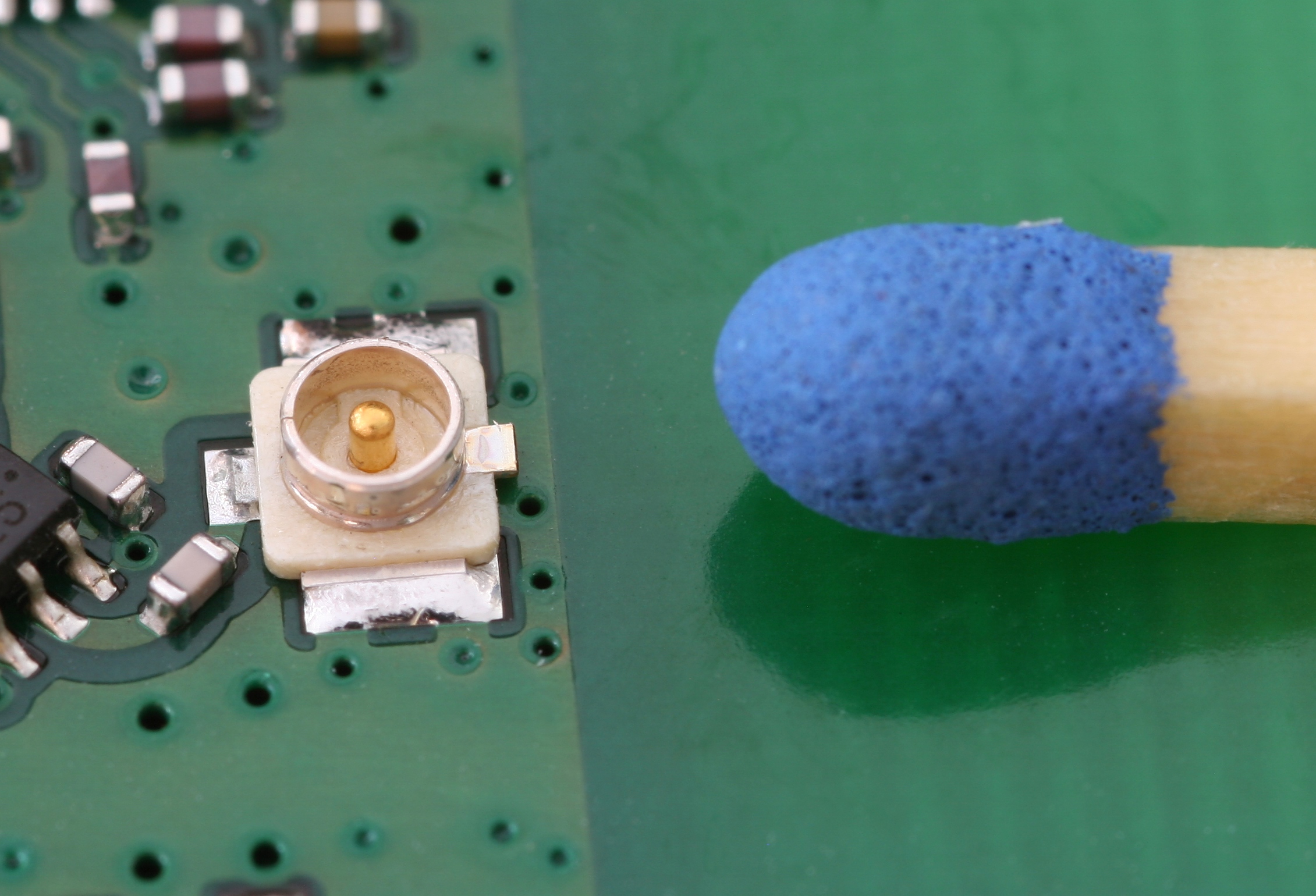
That's actually an RF testpoint, not an SMA connector (by which I think you mean UF.L connector, like this guy: http://upload.wikimedia.org/wikipedia/commons/c/ca/U.FL_conn...). It functions like a switch that is closed when the RF tester connects to it.
If you were to hook one of these up to the connector:
https://www.sparkfun.com/products/11320
Would it not function as an external wifi antenna?
(and yeah you're right about the ufl. thanks for the correction)
In a sense, you're right - it's meant as a quick release testpoint for conducted radio performance on a manufacturing line. Theoretically, you COULD hook up an antenna to it, but you'd have to know some substantive details about the integrated PCB antenna (impedance, center frequency, etc) to get good or even comparable performance out of the external one. Probably not to a male UFL connector, in any case - I'm 99% sure this type of connector is not compatible with UFL.
Mileage may vary, of course, but in my experience this type of connector is more frequently used to get conducted power RF measurements in manufacturing settings.
The article is estimating the price of one of these things as being $5 - I imagine that at least for an initial trial Amazon have decided they can make a decent return on them at that cost without certifying their own components.
Also a key factor may have been the time required to get their own stuff certified vs using off the shelf stuff.
A lot of people prototyping in the IoT space are using the precertified modules.
There's not much more to it: the transmitter is already soldered to a small piece of PCB but has the antenna and necessary tuned discretes on there and ready to go. Doesn't add much to the cost: like BillinghamJ says it's the certification time and cost that's not really worth the trouble if you can just amortize it into the cost of the module.
The cost comes from adding another company to the process - the module maker.
But sure, at this stage it might not be worth it , maybe later.
Hardly a concern anymore. These are just line items on a bill of materials now:
http://www.digikey.com/product-detail/en/450-0103C/450-0103C...
$7.8 is pretty expensive when you can get a bluetooth mcu(in volume, from dialog i think) for $1.
Like we said earlier, you can choose between a raw chip (like the Dialog) and handle the antenna design and all the various governmental certifications and testing yourself ($$$)..or you can buy a precertified module that drops in and you're ready to go.
It depends what you can afford and what each path will save you in the long run.
Irresponsible product design. Unnecessary and throwaway.