Spain pushes for 'Google tax' to restrict linking
boingboing.netThis screencap [1] is from an article from one of the most important newspaper; El Mundo. The article is about how news aggregators arehurting the newspaper industry and that it was high time that the authorities did something. Next to the article there is a widget to share that very same article on Facebook/Twitter/Linked and Meneame[2]. Meneame [3] is the main Spanish news aggreagator, a Digg clone. With this new law the future of all news aggregators in Spain is uncertain.
This is the statement from the creator of Meneame [2], he is considering either closing the site or moving abroad.
The law doesn't only affect linking to newspapers, it also applies to linking to blogs or other sources. You are supposed to pay the tax even when linking to blogs that are not affiliated with the program and that will never receive any money from it.
Under a strict interepretation of this law, HN is illegal in Spain.
[1] https://pbs.twimg.com/media/BtPH52DCMAA3Ppk.png
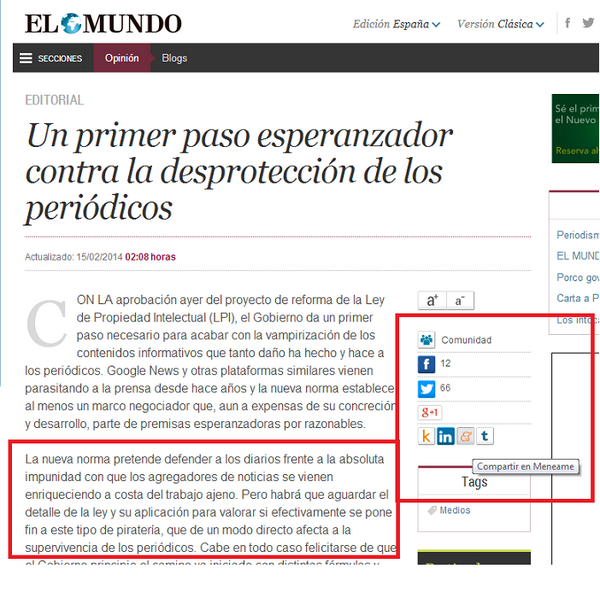
[2] The article and the widget are still there: http://www.elmundo.es/opinion/2014/02/14/52fe8160ca4741d2018...
[4] (Google Translated from Spanish) https://translate.google.com/translate?sl=es&tl=en&js=y&prev...
Imagine this bill multiplied a thousand times (in various forms) and applied to every industry imaginable, and you start to get an idea of what legislation looks like in southern Europe.
This will most likely be damaging to the newspapers in the long run. The result will be a reduced proliferation of links to the newspapers, which will cause a lower visibility.
It is not the first time this has happened. I can't find a link right now (somebody care to add one?), but a few years ago one of the big news outlets managed to secure a legal ruling that they had some rights over how people linked to their site, and demanded that Google comply with their demands or remove all links to their site.
Google removed all links to their site.
After a few days of receiving no search traffic whatsoever, the company who instigated this surrendered unconditionally and asked Google to put things back how they were originally.
The moral of this story is that Google provides a free service that is of immense value to the people at the other end of the link, and demanding that Google pay you for providing this service is both unreasonable and unwise.
Unfortunately, when the government steps in (as they have in Europe multiple times), it ends up not being "unwise" at all for the instigators. Something similar happened with French newspapers:
"Pay us for indexing our sites!"
"We don't want to engage in that transaction on those terms; if you wish, we will stop indexing your sites"
Then the French gov't steps in and effectively legislates that Google is legally obligated to engage in a transaction on the terms of the other party (and pulling out of the transaction is not an option). As I recall, the end result of this extortion was Google paying ~$70 million in what was effectively a protection racket (where the nominal purpose was to set up a fund to help French newspapers enter the digital age).
That was a voluntary settlement - details are here: http://www.theguardian.com/technology/2013/feb/01/google-52m...
The bottom line is that Google would rather do business than not, and £52m is not a painful expense for them here. I'm pretty sure that no European court could rule a company was obliged to engage in a transaction against its will, and would be unable to enforce this. Google have shown with China that they are willing to drop a nation if the terms offered are too onerous. They're not a public utility.
If France would never enforce the transaction, then why would Google pay $70m (and why would France say they would enforce the transaction in the first place)? Obviously it was technically voluntary, but if someone does something voluntarily under threat of bogus legal action, I'm really not seeing the difference from a protection racket.
You'd have to look at the settlement details to find out, but I believe the answer is that the settlement involves a lot of things Google wanted, like high-value adwords placement, and they expect to make a lot more money from that.
If that were the only consequence, this wouldn't be so problematic. But it makes linking to anything something you have to pay for with the author having no way to opt out. So any time you post a link you have to pay a fee, which is collected by a government agency.
The most effective solution for this issue would be to create some form of online coalition of companies against these type of over-reaching copyright taxes (Google, Bing, Wordpress, Twitter, Facebook, etc.)
If the newspapers that lobbied for this tax are delisted and unable to be linked to, their traffic will plummet and they'll be unable monetize their online presences via ad revenue.
In fact it seems that the spanish newspapers have been oposing this tax. They know that the moment google stops linking to them they'll lose a huge quantity of clicks. But the gobernment wanted to do it any way because it's how they plan to reciver part of the taxes generated by google revenue in Spain that it's diverted to Ireland and the offshore google conglomerate. I think it's going to backfire the internet market in Spain, and it's a huge mistake.
Countries all over the world seem to think that forcing international companies to conform to their local requirements makes sense.
Which country DOESN'T do this? I can think of none. The US is one of the worst offenders since they often bypass courts and conduct takedowns without any real oversight (often claiming that they have the right since non-Americans have less rights and the sites are ran from abroad).
Anyway, the way I read your post is that you think international corporations should essentially be above the law. That if you're a nice little local startup that you're subject, but if you're a monster corporation you're not. How does that benefit anyone?
The US is one of the few offenders that CAN do this and get away with it because the market is so important to companies and conforming makes economic sense.
I don't think coldcode was saying that international corporations should be above the law but just that it's impractical to expect an online company to be able to operate in different standards under every different possible jurisdiction.
In a way it makes sense, as most of these multinationals do not reside in the countries where the laws are being made. Maybe if they stop doing business there, or it is more difficult, it will give local companies(which pay taxes and provide more jobs locally) and advantage. Not saying that's definitely true, but it is something to think about.
Just because a company is international doesn't mean it should be exempt from local laws. That would be ridiculous.
How does it not? Operating in more than one country doesn't somehow exempt you from laws.
Agreed, I don't think the global company/local laws mismatch is a difficulty that the government should be responsible for figuring out how to deal with, but something that a company who wants to operate globally needs to figure out.
The real complaint with this recent spate of European laws around the Internet is how incredibly stupid they've been.
Because they don't have to operate in your country. Google can simply decide to no longer run any operations within their borders to avoid the law.
Heck they could potentially even have a subsidiary corporation whose sole purpose is to squat Google.es and redirect to Google.com/es/
That would be a reasonable course of action for Google to take.
It is difficult to determine which parts of the internet are within a particular countries jurisdiction.
Otherwise whose requirements do they follow? The US?
My guess is those most likely to have to pay the tax will simply withdraw services from Spain.
Or just stop hyperlinking things that go to Spanish sites.