Is the shared economy racist?
2drew3.comThis is so depressing and even though sample size is small it rings 100% true. I think it's just a symptom of an inherently racist and unfair world and is not Uber or Airbnb's fault. The same thing happens with names at the resume level and on and on.
That said I think there's a new market here. If the average Airbnb listing is rejecting applicants of color maybe there could be a special "diversity friendly" designation on Airbnb or other sites. Perhaps users could add some flair, something similar to the LGBT pride flag that some business add to their windows, to their profiles to signify they sincerely welcome all applicants. Hopefully this doesn't sound too ignorant.
If mass rejection of specific groups is occurring, there's some money to be made here by sending out the right signals. Just think of the profit made by some gay/lesbian bars in the 1970s and 80s.
"...even though sample size is small it rings 100% true"
I just want to point attention to the (perhaps ironic) fact this sort of reasoning is exactly the same one used by the (allegedly) racist hosts and drivers in the story, i.e. people are much more prone to accept what they are told (mostly in sample size = 1 cases or anecdotal generalizations) if it aligns well with their beliefs (e.g. "another BnB host told me a black guy thrashed his house", "we all know that girls can't code").
A (very) rough characterization of the process, I think, would be:
1. Creation: For this or that reason an a priori belief is formed, e.g. "world is inherently racist" or "blacks are much more probable to be criminals".
2. Filtering: The facts that are reported are filtered using a selection bias (usually, mostly subconsciously) so that facts that strongly agree with the belief are remembered more. (The fact that news items generally report on low-probability, high-standard deviation items, a la man biting the dog, makes this effect even stronger)
3. Update The belief is then updated by the facts with their relative weights determined in (2)
The above (well known and documented, e.g. Blink EDIT: Sorry, wrong reference, see below) process is not a bad thing! AFAIK, it's default brain operation. It takes quite a bit of control and patience to push back the default process at all thee levels.
Note that I'm not arguing that racism, etc. does not exist; however, before jumping to conclusions, like the OP and his/her friend did ("AirBnB doesn't work for black people"), we need to be a bit more careful.
Speaking of irony...
Doesn't Blink posit that a person's extensive experience in an area can lead them to a quick, gut reaction that is, in fact, correct, even before they are able to verify it?
It seems that Andrew's friend probably has had a fair amount of experience with being mistreated due to his skin color. His reaction to being denied a room 3 out of 3 times was perhaps hyperbolic, but certainly applicable to his experience with the service. (Andrew noted his friend's interactions with the driver, so it wasn't all his friend's imagination).
You could use the ideas noted in Blink to look at this scenario from a variety of perspectives, not just confirmation bias.
Actually I meant Thinking Fast and Slow but somehow typed Blink, sorry about that.
There are two different kinds of generalization here, I think:
As you state, "Brandon" probably has had to endure many other forms of racist behavior, e.g. taxis not wanting to pick up black clients, so his generalization to the new domain Uber was perhaps justifiable, but how about generalizing to AirBnb. AirBnB host population may be very different than the general population "Brandon was used to deal with" (I don't have data to back this up, hence the "may be", but I think that is a very high probability hypothesis, esp. in SF) yet he was quick to generalize, although the refusals may have been due to other factors. In other words "Brandon" has reliable data from a different population that he is now attaching to a new population.
The OP and greendata, OTOH, are generalizing to various beliefs based on a single data point of "Brandon".
Exactly correct. Additionally, his friend had previously stated that AirBnB didn't work for him, so this "small sample" we're looking at is just Andrew's experience with the issue at this point in time.
It's always disturbing to me how much commentary in threads of this type on HN is devoted to asserting that the individual who's actually experiencing the problem is misinterpreting it. I love data, but demands for data/citations in situations where the problem is experiential are too often used to dismiss people's real, upsetting experiences with privilege and prejudice.
"... asserting that the individual who's actually experiencing the problem is misinterpreting it"
Note that may main point was about the generalization of the top level comment in this thread, based on this post only, this doesn't mean that the statement in that comment was not correct.
My point was the sample size was small but the "experiment" here is very similar to one seen with taxi cabs and other older services that are very similar to the new online "sharing economy". The discrimination in the former businesses is well documented and studied. I'm not basing my statement of "it rings true" on the data points alone as you are implying but on the large body of similar work.
"it rings 100% true" does not necessarily imply any conclusion. It just means that the initial data on the new sharing economy are inline with other older experiments which study almost the same thing (taxi cabs, cleaning services, etc).
I'm not sure I trust Malcolm Gladwell as a reliable source any more.
It should be easy to grow the sample size. Do you know any black people, and have they used AirBnB or Uber?
What do you call a stereotype when it is backed by statistical data? The a priori belief that is most common is that no stereotypes are true. It's the polite thing to believe. But if you are of a certain analytical mindset, you can be argued out of it with enough data and anecdotal evidence from friends.
An oxymoron :-), i.e. stereotypes are by definition not backed by reliable data (http://www.merriam-webster.com/dictionary/stereotype)
Not to split hairs... but your link defines Stereotype (noun): an often unfair and untrue belief that many people have about all people or things with a particular characteristic
Note the word often which does not mean always.
Often (adverb): many times : on many occasions
Always (adverb): at all times
So a stereotype, by definition, may be true... though often is not.
What do you call an accurate assessment of a group that may be unflattering or unpleasant?
And what if said assessment is correct in 90% of the cases - how do the 10% for whom it fails would feel?
Black people really do commit a lot of crime in America, it's not just a "stereotype". And particularly, young black people, and particularly young black males. Black males between the ages of 14 and 24 commit 27% of all murders, despite being 1% of the population.
It's not scrawny white twitter engineers who are shooting each other in San Francisco
It's not entirely race. I'm certain that e.g. poverty and lack of opportunity play a role as well. Growing up without access to money, good schools, or positive role models can be crippling to success regardless of race.
Poor whites and Hispanics aren't nearly as dangerous as poor (young, male) blacks. There is not another comparable group that manages to commit 27% of murders as 1% of the population. That's a huge ratio.
Keep in mind, most black males will never kill anyone. But black males commit a plurality of murders in the US. And 1 in 3 will spend some time in jail in his life. 1 in 7 American black men are in jail at any moment.
Remember, there are more whites in poverty than total blacks in the United States, and blacks commit 48% of murders.
If you're in an urban environment, don't be a progressive hero and try not to avoid young black males. It can be dangerous[1][2]
[1] http://isteve.blogspot.com/2013/11/yglesias-i-wasnt-victim-o...
[2] http://isteve.blogspot.com/2013/08/all-we-have-to-fear-is-in...
What I'm trying to say is not all racial stereotypes describe a false belief, though it is fashionable to think so.
> What do you call a stereotype when it is backed by statistical data?
An inconvenient truth. Or perhaps the elephant in the room.
The question is, how do you enforce this? What is to stop a host from displaying the "diverse friendly" flare for promotion purposes and then just rejecting minorities anyway.
The only method I can think of would be to monitor when hosts reject minority guests but then there's a risk that you punish hosts who reject a minority guest for some unrelated reason.
I don't think you'd have to monitor it any more than you would monitor a business that puts up the rainbow flag on their window.
I think the key here is to make it voluntary and not push it on people or make it a top-down standard. Its absence should not imply racism. Perhaps the flair could located on another site where users of the shared economy list themselves as "diversity friendly". If you see a listing with the diversity "flair" and one of the reviewers is a person of color, you know that place is worth applying to as a person of color.
That would depend on what it was interpreted to mean by users. I can easily see AirBnB hosts being under pressure to display the flair for fear of being assumed racist otherwise and being boycotted by even white people who don't want to endorse racism. It might also make it easier for a person who feels discriminated against to sue (if they don't display when others are).
After all , you don't tend to see "blacks welcome" signs displayed at hotels, because that is the assumed default.
An easy solution to the problem would be to stop being a racist piece of shit, or else own up to it and accept the social consequences.
Another idea would be to have user ratings and feedback. I'm not sure if these services already do something like this, as I've never used them, but it could give hosts and drivers a means of rating their users so that they have some additional criteria by which to judge whether they want to loan their resources to a particular customer. That won't really solve the problem of new black customers who would have no prior rating, though. Maybe a criminal background check for customers is in order if people are really worried about being robbed or assaulted or some other nonsense. Of course that could cost time and money and could destroy the convenience factor of such services. A real bummer of a problem. I wish people were better.
True but you also don't see "homosexuals welcomed" on many hotels either. There are much more subtle ways of communicating those things.
There's a really simple explanatory mechanism, which is that even if an AirBnB host is bound by the same anti-discrimination provisions of the Civil Rights Act as a Hyatt, which is probably true, holding individual service providers accountable at that level is basically impossible. And to the extent that the "sharing economy" involves more individuals rather than businesses that can be sued, you will see more discrimination.
This issue also strikes to the heart of some of the libertarian ethos around the sharing economy generally and Uber/AirBnB in particular. People are really racist.[1] Just getting the racism to the levels experienced by Andrew's friend experienced involved a century of the federal government beating the states over the head with troops, court orders, etc. The elimination of overt racial discrimination in private businesses is actually a wonderful example of concerted government action addressing a problem that according to free market theories shouldn't even have existed in the first place.
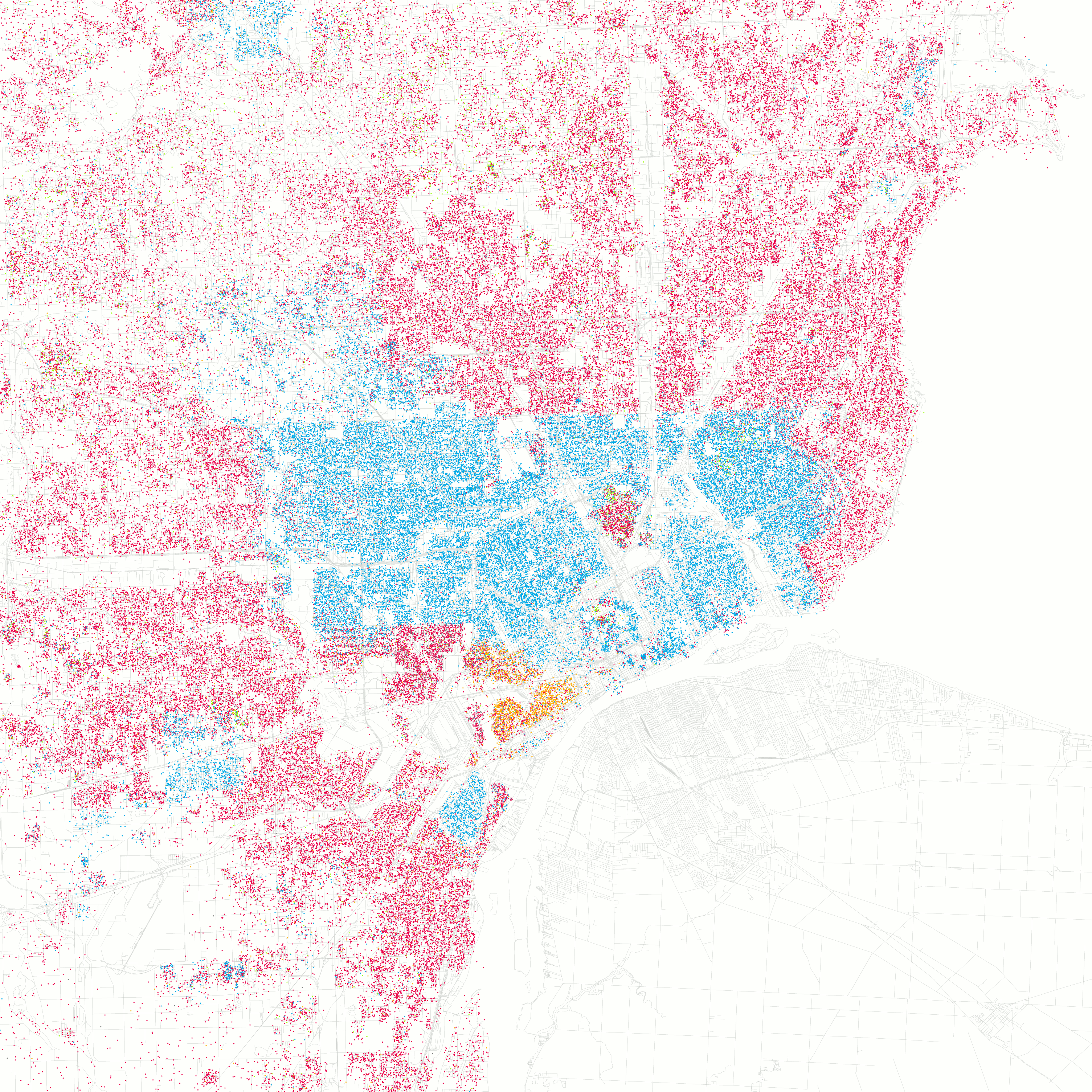
[1] I think Americans are much less racist than almost anyone else. I'm Bengali by ethnicity, and my observation is that people on the subcontinent are racist enough to make a south Georgia redneck blush. But even then sometimes I look around at maps like this: http://upload.wikimedia.org/wikipedia/commons/f/f1/Racial_Di... (race map of Detroit with black areas in blue and white areas in red), and think we'd still have legal segregation if the courts hadn't forced it down peoples' throats.
Impossible? That's nonsense. They could ask users for a standard race descriptor that is never shared with the hosts, and if the hosts seem to predominantly reject certain races of people, the marketplace like AirBnB could kick them out. It's actually pretty simple. It all depends on how eager the marketplaces are to solve this particular problem.
A nice aspect of this is that it could work better than the system being replaced (tracking gets automated and centralized.)
> I think Americans are much less racist than almost anyone else. I'm Bengali by ethnicity, and my observation is that people on the subcontinent are racist enough to make a south Georgia redneck blush.
Not really, it's just in the rest of the world being openly racist is just fine, in the US (and Canada) you have to pick when you can be openly racist and pretend otherwise the rest of the time.
> think we'd still have legal segregation if the courts hadn't forced it down peoples' throats.
We would.
A bit uncharitable. As a minority myself I do think Americans are a lot less racist than almost anyone else, by virtue of the fact that they're aware it exists.
Call it white guilt if you must (though it's really a misnomer), but the fact that Americans are aware of their own racism makes the situation much, much more tolerable than in other places.
Sure, covert racism is still a problem (a big one at that), but at least there is awareness and a substantial degree of introspection. Both of these are absent in more racially homogenous countries, where not only is racism overt, but there is so little public consciousness of it that extreme racism is accepted as a matter of course.
In the US the words "oh good, you're not dating a black girl" will be outright rejected as racist, or at least give people pause and cause discomfort. I've personally experienced the exact same statement tossed around in another country as if it was the most natural thing to say in the world.
Again, it depends on who they're talking to. My father-in-law won't talk much to the black propane truck driver when they deliver, he'll be out there making sure he got all he's charged for, but will complain endlessly about the nigger in the white house when it's the white driver. If you're white he'll tell you straight out that black people are incapable of advanced (like math) thought like a good white person, that's why they're all lazy and poor. He'll also tell you he's not racist.
Because you're white, he assumes you agree with him. In a lot of the US, 'thank god you're not dating a black girl' will only cause discomfort if they think they're in mixed company, not because they think it's wrong. Once the person who they don't know about leaves, so does any discomfort about saying what they really mean.
He doesn't say that shit to me anymore not because it's wrong, but because he's figured out I don't agree with him and look at him like the idiot he is.
> "will only cause discomfort if they think they're in mixed company, not because they think it's wrong"
Yes, and that's a crucial difference. It will give them pause, or cause discomfort, because they know what they've just said is controversial. They know what they've just said is considered inflammatory, even if they themselves don't believe so.
This is, sadly, still a pretty leap beyond racially homogenous countries where all of the above is said without any awareness, because they're not even aware that disagreement exists on their point.
Your father in law no longer says these things to you because he knows you're on the other side. In many countries there is no other side, or the "other side" is so infinitesimally small that it's not in anyone train of thought while they spew their racist crap.
The mere presence of the "other side" gives hope that we might one day be further along than we are now.
You are exaggerating to some point and I am happy to provide some facts and scientific theory. I will address only one part of your argument. You argue that segregation in Detroit means people are more racist and only government regulation keeps them in check.
However, Thomas Schelling, an authoritative economist with published papers in peer-reviewed journals coined a model of segregation, that was named after him.
Shelling segregation model showed that a preference that one's neighbors be of the same color, or even a preference for a mixture "up to some limit", could lead to total segregation, thus arguing that motives, malicious or not, were indistinguishable as to explaining the phenomenon of complete local separation of distinct groups.
That means that segregation may occur even with communities that consist mostly of non-racist individuals or individual with very low level of racism.
Racism is a big problem, but emotional, visceral approach to it doesn't help anyone.
Btw, I learned about this model in Coursera Model Thinking mooc. Highly recommended, very interesting for anyone who is interested in deeper knowledge about the world.
>a preference that one's neighbors be of the same color, or even a preference for a mixture "up to some limit"
A common term for that is racism. Are you saying that segregation can spring from racism? I'm not sure that anyone was confused about that.
Literally the next line is qualifying and clarifying the previous statement:
"That means that segregation may occur even with communities that consist mostly of non-racist individuals or individual with very low level of racism."
I'm not sure that anyone could be confused about that if they aren't emotionally invested in the discussion. And I am not interested in debating things on emotional grounds.
If you reallywant more information on Shelling segregation model, it can be found here: http://www.youtube.com/watch?v=dFl3Cfw12bo. This is a 10 minute lecture from Coursera mooc.
> Literally the next line is qualifying and clarifying the previous statement
Exactly. What I'm reading here is that "a preference that one's neighbors be of the same color, or even a preference for a mixture 'up to some limit'" is not racism, but can lead to total segregation. I can't see where you're reading something different.
It would have been more interesting for you to clarify that for me, rather than psychologically diagnosing me over the internet.
Is merely having a preference for the race of one's neighbors considered racism in this model, or are those people counted as the non-racist portion of the "communities that consist mostly of non-racist individuals"?
What's a "low level of racism"? Is that what racial preferences are categorized as?
Schelling may be clear about some of these things, but you're not. If I'm getting it wrong, it's because you're doing him a disservice, not because of whatever you're projecting onto me.
-----
edit: You weren't doing him a disservice, and my interpretation was not wrong. The model is of groups with different preferences of racial balance, and shows that segregation can happen even when only a minority prefer total segregation. The point: in his model, all actors maintain racial preferences, and a 1:1 ratio is considered the opposite of segregation.
-----
from posts responding to the study on metafilter:
"not that this isn't interesting, but it doesn't take away the 'racist' part - it's not an 'inevitable result of mathematics' unless everyone starts out with a desire for a minimum racial representation. Why would they desire that? Do you seek a neighborhood where 'at least two of my neighbors have brown hair'? Or 'at least two of my neighbors are left-handed'?"
http://www.metafilter.com/52878/Dr-Schellings-neighborhood#1...
or
"It only works when people have a desire to stick to 'their own kind', so racial segregation would only happen if people viewed being around other members of their race as a positive, rather then a neutral.
"You don't see people segregated by hair color, or blood type, or any other genetic trait even when those traits have more effect on the genome? So why would skin color be different, unless there was an underlying sense of 'otherness' caused by skin color.
"Without that underlying sense of otherness, no amount of mathematical mumbo jumbo would cause segregation.
"(by the way, his mathematical models are very naïve, he's basically talking about simple thermodynamics applied to society. If we add 'heat' to cause things to re-randomize slightly and continuously that 'heat' can over come the 'desire' and keep things un-segregated, even if there were a slight desire to keep things segregated)"
http://www.metafilter.com/52878/Dr-Schellings-neighborhood#1...
"The elimination of overt racial discrimination in private businesses is actually a wonderful example of concerted government action addressing a problem that according to free market theories shouldn't even have existed in the first place."
Just to clarify Milton Friedman (A champion of free market economics) readily acknowledges racism. His argument is more along the lines of "in the long term racist businesses will lose business to more accepting and diverse ones."
I like Friedman, but this is one of his more hand-wavey arguments. It ignores the fact that discrimination might be a positive marketing characteristic for a business. If the customers are themselves racist, a business might lose a lot more revenue by serving minority customers than it gains from those customers. Indeed, even if all the business owners are not racist, as long as most of the customers are, they face a collective action problem. The first business to serve minority customers would quickly lose most of its customers to the competing businesses. And that seems to be precisely what was happening in the U.S. until Congress broke the cycle by making such discrimination illegal.
Do you think that many Americans (outside of the hardcore) are racist enough to literally boycott a business that doesn't refuse to do business with blacks?
I think in 1950, enough Americans were racist enough that many they'd simply head to a different neighborhood restaurant if a particular business had an appreciable number of black patrons. Maybe that's generous: in the 1950's the majority of Americans in many states were racist enough to try and ban interracial marriage...
Without the federal crackdown on discrimination in the 1950's and 1960's, housing, employment, public places, education, marriage, etc, would have remained segregated. In the background of that segregation, how long do you think it would have taken to get from "typical American circa 1950" to "typical American circa 2014?" Laws create social norms, and laws banning discrimination allowed a couple of generations of Americans to grow up in an at least somewhat integrated world, which led to the America of today where you can see people boycotting a business for serving blacks as something difficult to believe.
Even the kindest reading of that sort of ideology is saying that rather than solve the problem now, we'll let it solve itself really, really slowly.
It's sort of cute in the abstract, but it ignores the reality of people suffering now.
Individuals don't care about the long term, they care about their personal experience while they are alive.
Just another point against Friendman and his "understanding" of the world.
Right, Lenin or Stalin made everyone equal really fast, what's wrong with you Obama?
This is why you're silly. Because a post critical of Milton Friedman launches you into Leninist/Stalinist diatribe. There are more than 2 sides to an issue.
Yeah, like from Red to Pink is all yours, and I take the truth.
> His argument is more along the lines of "in the long term racist businesses will lose business to more accepting and diverse ones."
This assumes that the business differential exists and is large enough to matter.
I generally point out the lack of non-smoking bars/nightclubs before all the anti-smoking laws went on the books. Everybody agreed that non-smoking venues were a good thing, but non-smoking bars/nightclubs simply did not exist because the business differential was too high (smokers were so much more profitable than non-smokers that even though non-smokers outnumbered them nothing would cater to the non-smokers).
In the case of AirBnB, how much profit will someone give up by not serving <ethnic group>? Not much since most of these places are just getting a little bit of profit for renting out extra space.
Free markets should only reduce irrational discrimination based on race. If discrimination helps your business, it is rational, and will continue.
For example, if 5% of blue people trash your house, and you can't distinguish the 5% from the 95% easily, it may be rational/profitable to discriminate against blue people.
I wonder if you could reasonably sue someone in small claims court for racial discrimination. I've never heard of such a case, but it seems like it's more or less what we're looking for -- a way to bring suit for a penalty that's meaningful in amount to an AirBnB host, without you having to invest tens of thousands of dollars into a sprawling lawsuit.
Very interesting however they could have easily provided some more conclusive proof. The author should have tried booking one of the places that turned Brandon down on the same dates. If he had been offered the place it would haave been more clear racism was in play. I'm not denying racism was in play (although the UberX example seems quite silly - personally I'd be happy to get a driver that didn't talk to me and the one time I've used Uber the driver wasn't very talkative) but I'd like to see the author try my suggestion and follow up the post.
Even if he had done this though, its possible the hosts simply had the rule of thumb "I only rent to people who have rented before and have reviews." The OP has used the service many times and likely had numerous positive reviews, his friend was a first time user. Not a fair comparison.
I should have done this. But I didn't have this experience to prove a point. Truthfully, I was mostly embarrassed that my suggestion wasn't working and immediately kicked into "find my friend an alternate place" mode. This entire post is not proof and completely anecdotal. I'm the first to admit that. But I hope this audience of entrepreneurs will think about issues like this.
Totally understand and I'm glad you wrote it. I'd like to see someone take on the challenge and come back with some proof. It seems from your account that Brandon had just set up a new AirBnb account - is it possible he was rejected because he had no history?
Possible. However, I recommended AirBnB to several Asian and Caucasian friends who never heard of it before (I'm from GA). Few just showed up in SF and booked same day with no problems. Not one bad experience, except this time. Fully acknowledge it's a limited sample. I'd like to see someone take the same challenge. I'd also like AirBnB data scientists to take a tough look.
I kept waiting for him to get on the apps and try to book the same places himself, and when it didn't happen I was kind of disappointed. It's like you say, if he got approved then there was definitely some racism at play. If not, then it was just bad timing. But since he didn't try it, we can only speculate.
That's a great idea - that would have been damning evidence.
This reminds me of a sad old joke.
In the south, whites don't mind if blacks are around, so long as they aren't uppity. In the north, whites don't mind if blacks are uppity, as long as they're not around.
Having spent time among both southern rednecks and northern intellectuals, it rings painfully true.
I don't think any of this is specific to AirBnb or Uber. What is described here is just plain racism, something that's blatant all over America (some might say, it's what defines America), especially in regards towards black people. The black friend in the story knew this and wasn't surprised. It's only surprising to people who think this is something of the past, as if somehow people have improved and this shouldn't exist. The idea that people as a whole change, improve, and become less racist, while romantically appealing, couldn't be further from the truth.
> racism, something that's blatant all over America (some might say, it's what defines America)
A number of replies on this, but some have, I think, understated the issue.
In all honestly, I would say the U.S. is just about the least racist country on earth. If racism is not seen to be a problem elsewhere, then it's largely because of ethnic homogeneity, not lack of racism.
EDIT: It looks like I'm being misinterpreted here. Obviously, there is racism in the U.S. It is a huge problem. We all know this.
But the reason it might seem to be a larger problem than elsewhere is because of our unusually ethnically diverse population, not because of unusually high levels of racism. Also things like our incarceration rate -- the highest in the world, by far.
To a large extent, the political boundaries of the world are drawn along ethnic lines. Where this doesn't happen: former colonies in Africa, much of Eastern Europe after the world wars, etc., etc., you often get people killing each other. Look at the Rwandan genocide, or the mess that Yugoslavia turned into when it stopped being just Yugoslavia, or the decades of troubles between India and Pakistan, or any number of other examples, to see the result.
And then note that these kinds of things are not happening in the U.S. -- not to that extent, anyway.
How can anyone possibly believe this? Not just attacking you but genuinely I find this incomprehensible.
America is a deeply racist society. It's built on the genocide of the Native Americans who are still largely kept in poverty in virtual prison camps we insultingly call reservations, by racist policies.
The legacy of racism against African Americans is still deep and real - have you any experience as a black person in the Southern states? If so then I'll respect your opinion on that topic, but as a White person who came to the US from a different country, and then lived in Texas for a few years, the levels of racism are disgraceful.
The entire hispanic ag-business-driven immigration problem hinges on institutionalized racism.
Then we don't even touch on disparities like over-concentration of poverty in minority communities, incarceration rates, under-representation in positions of power and seniority etc.
> How can anyone possibly believe this?
I don't know much about Europe, but as I look at the conflicts bubbling up in the U.K. and France over Arab immigration, I am inclined to believe the lower prevalence of racism there is more a function of less racial friction in more homogenous societies than actually lower levels of racism in the culture. As far as historical racism, I don't know if we want to compare scorecards with the continent that invented colonization and the African slave trade...
That said, my point of comparison is Asia, specifically the subcontinent. I'm ethnically Bengali (first generation immigrant), and my wife is Oregonian (her family moved there in the wagon trails), of English/Dutch ancestry. If our situations were reversed, there is no way Bengali society would have accepted my wife in the way American society has accepted me. She could move there and live there for the rest of her life and she'd always be "bideshi" (foreigner).
Yes, there is racism in America. No, I have largely not been on the receiving end of it.
But I can see that African Americans often have a tough time here.
I can also see the plight of Koreans in Japan, and Muslims in much of India, and Turks in Germany, and Kurds in Iraq, even though I am not part of any of those groups, either. Racism is everywhere. All of it is disgusting, some of it is horrifying, and much of it is significantly worse than what we see in the U.S.
Those examples are somewhat extreme and don't support the premise that the US is the least racist society anywhere. You also need to separate out complicated ethnic conflicts that are largely geopolitical in nature than racist in a conventional sense.
Also muslims in India isn't racism it's inter-religious conflict which is a fundamentally different thing.
Disclaimer: Not an American.
Name me one country that wasn't founded on war and violence.
The situation with African Americans is still flawed and stratified, but has undeniably improved very significantly. Primarily in that they have equal opportunities on a federal level, although obviously social class and environment still play a big role in feasibility.
I'm not sure exactly what you mean here. There are sentiments against Hispanic immigrants, but the USA also has a very large and legitimate issue with illegal immigration. You can't blame everything on racism.
Incarceration rates are horrible for the entire country, no matter what way you put it. Blacks do have the highest rates, but whites aren't that far behind. It's not just a racial issue. I'd actually say that race is a fairly low concern here, rather the main one should be that the US penal system is fundamentally broken and frequently gamed by private prison corporations.
As for underrepresentation, equal opportunity should not be confused with equal representation. There are obstacles, but lower numbers alone should not be used to make such a conclusion.
>In all honestly, I would say the U.S. is just about the least racist country on earth.
Even given the institutional racism evident in things like incarceration rates and educational outcomes?
Yes.
To clarify, I'm not saying that racism is not a problem in the U.S. Certainly it is.
If other countries don't have huge number of minorities in prison, then it is because (1) they don't have huge numbers of minorities, or (2) they don't have a lot of people in prison.
But in the U.S. we have both the world's highest incarceration rate and an unusually ethnically diverse population. Add to that the racism that everyone has, and we get the kind of problems you mention.
> In all honestly, I would say the U.S. is just about the least racist country on earth.
Based on what?
The data agrees with you. Racism is particularly weak in the anglosphere, you'll experience much more if you venture outside it: http://m.washingtonpost.com/blogs/worldviews/wp/2013/05/15/a...
> plain racism, something that's blatant all over America (some might say, it's what defines America)
Have you ever lived in any continental European country? As someone who has spent about half their life in northern and western Europe and the other half in America, I can tell you with 100% confidence that Europeans are, in general, more xenophobic and racist than Americans.
Having grown up in the UK, lived in many countries around the world, and now been in the US for 15 years I dispute that.
To fight anecdote with anecdote...
Moving from the UK to the US I was shocked by the pernicious levels of institutionalized racism and the undercurrent of subtle racism. It's everywhere.
There's certainly more of a veneer of tolerance here, which covers up a deep seated pathological racism, which is missing in parts of Europe, so when you experience racism in Europe it's more blatant and obvious.
What you do get a lot in Europe is a lot of discomfort with the muslim minorities - whether white, or of color - which is often falsely equated with racism (because racists are often also Islamophobic too). However it's a mistake to conflate the two. With the religious issues it's mostly a stance on the totalitarian nature of the religion and the cultural practices that adherents look to bring, which are often incompatible with accepted norms and values in those countries (particularly regarding the treatment of women).
> What you do get a lot in Europe is a lot of discomfort with the muslim minorities - whether white, or of color - which is often falsely equated with racism (because racists are often also Islamophobic too).
Europe has had at least one genocide over the issue recently. That's a bit more than "discomfort."
If you're referring to the conflict in the former Yugoslavia, a conflict I was actually present for the start of interestingly, then that's a whole different issue and far more complicated.
Wow, I'm glad you explained that. You've defended your point splendidly. Superficially, the continent that had a genocide against one of its ethnic minorities would appear to be more racist and xenophobic. But if it's complicated, well, that changes everything.
Ah yes because Hacker News is the place for a thesis on modern history.
I was being polite: let me be clearer - you are wrong and your comment shows an ignorance of the facts and I suggest you actually read up on said conflicts before spouting nonsense. Better?
Well, no, your comment is equally information-free as the two that proceeded it. "Things are the way I say they are because I say so" remains unpersuasive.
Look, the whole notion of assigning moral value to places based on an arbitrary measure of "racism and xenophobia" is annoying, and if you think that's what's going here maybe you're understandably annoyed. But it feels like you're not even trying to understand what we're actually talking about, and more importantly, it actually IS important that we have measures for social progress if we are to continue to improve. I hope you'd agree.
So, the thing is: it'd be interesting to know what measure you're using such that a place with "institutionalized racism and the undercurrent of subtle racism" (undeniably true! of the US or, one suspects, anywhere else!) is somehow to be regarded as more "racist and xenophobic" than a place where a genocide occurred in one nation against an ethnic minority while its neighbor nations looked on uselessly. If you regard "subtle racism," income inequality, criminal justice problems, social rudeness and so on as a greater problem than that, well... okay, say so. It's obviously ridiculous.
>Moving from the UK to the US I was shocked by the pernicious levels of institutionalized racism and the undercurrent of subtle racism. It's everywhere.
Would you please provide some examples?
Police. Judicial system (all levels). Penal system. That's a good start.
They are, but because they are mostly "comfortable" in their homogenous societies, they don't express as much fear through action as in the US. As the minority gets bigger, fear and negative action rises. I think in the US this was compounded by a lingering fear of a literal slave revolt.
In other words, it's easier to be racist but nice anyways if you don't fear the tiny minority.
The more interesting comparison might be between perception and reality within the U.S.
I would speculate that upper middle class people (who tend to have louder voices) have more egalitarian views than whatever median.
Yes and I don't doubt it, but that still doesn't change the situation in America one bit. I didn't mean to imply that America is more or less racist than any other country, only that it is a defining factor of Americans, something that's hardly news to anyone living here, I should hope.
There is a huge issue with racism in the US but you're wrong to think it's a US problem or that it's worse in the US on average. Spend a few months in Europe, especially the east and south, and you'll quickly change your mind. Also, checkout Japan and China. Those places are in their own way at least as racist as the US is today.
Racism is a universal human problem. Humans naturally divide things into different groups and are almost "programmed" to make snap statistically unsound judgements based on a few data points which may or may not be correct. Humans are also "programmed" to want to eat sugar till they drop. These are issues where we can use our higher minds and education to alleviate if not solve.
>>Racism is a universal human problem.
Totally agree with this. Human beings often denigrate other people, based on relatively minor differences, with a view to elevating themselves. It is utterly childish, and yet people persist in doing it frequently.
People as a whole have been getting less racist. The only problem is that "less racist" still is not as good as many people think it is.
People are also more racist than normal when their assets are on the line (aka paranoia).
There are financial consequences for getting this one wrong.
Research shows that if a neighborhood is "becoming more black" or "becoming more white", that has implications for property valuation. (Yes, this comes from racism, in case you were wondering.)
Who wants to be the guinea pig to wager the value of his house on diversity? (... and it's fine if you do, just be aware that it has implications)
Yes, I suppose one always want to skew towards the richer in these cases, and race happens to be a commonly held indicator of wealth or lack thereof. It's two ugly things mixing together.
There exists a win-win equilibrium for upper class people.
It's an advantage for wealthy, educated blacks to live in mostly white neighborhoods, because it shows that they've "made it" according to the (admittedly racist) standards of success.
And it's an advantage for the white majority in such a neighborhood to have a few blacks around to demonstrate how incredibly non-racist they are.
(Obviously, the underclass (of whatever race) gets left out to dry.)
As a one time wealthy, educated black person, I take offence at this characterization.
I live in mostly white neighborhoods because that's where I and my family wanted to live.
It was not to show that we had "made" it or to give the neighbors the opportunity to demonstrate their lack of racism. I think, far too often, people focus on race and don't realize that class distinctions are frequently better indicators.
On that basis, it seems quite reasonable to choose to live amongst people who are similar to me and not amongst those who aren't.
As it turns out, I'm now in South Africa and it's easier to see my point. Most of my neighbors are black or "colored" but I live near them because it's a nice neighborhood and not becuase of their race.
I don't get the romanticization of the under class. In poor neighborhoods, there are lots of noise, litter, and crime and few good role models. Why would you want that in your neighborhood? To prove how open-minded you are?
Almost nobody wants that. Even liberals who speak on behalf of the poor generally don't want their kids to attend the same schools as "the poor", nor do they want to live in the same neighborhoods as "the poor".
Generally, a poor neighborhood is a good place to be from, to contrast with present circumstances and look at how far you've come. It's not a good place to be.
Property values could be tracking some other changing variable, like crime rates.
The difference is that you can sue Hyatt if you are discriminated against, which keeps people in line. It's very difficult to sue AirBnB for the actions of a host.
You could sue the host. But that violates the rule that you only sue people with money. There are not many but this is one disadvantage of wealth.
It doesn't matter whether the host is rich or not. One of the key ways of proving a discrimination claim is to show a pattern of action, which calls into doubt the host's pretextual reasons for denying service. Much harder to do that with an individual than a business.
This is a tangent to your point, but if I remember correctly you are an attorney so I replied to you thinking you may no more about this, but even if it is racist, I doubt it is illegal.
The fair housing act definitely doesn't protect short term renters staying in someone's home.
"The Fair Housing Act applies to landlords renting or leasing space in their primary residence only if the residence contains living quarters occupied or intended to be occupied by three or more other families living independently of each other, such as an owner-occupied rooming house."
I'm not a civil rights attorney and this is not legal advice, yada yada. You're referring to the exemption in 42 U.S.C. § 3603(b)(2), which says: "Nothing in section 804 of this title (other than subsection (c)) shall apply to . . . rooms or units in dwellings containing living quarters occupied or intended to be occupied by no more than four families living independently of each other, if the owner actually maintains and occupies one of such living quarters as his residence."
I.e. it doesn't apply to my parents renting out their basement apartment. However, many properties on AirBnB do not meet the requirements for this exception because the other does not make the property his residence. Under 42 U.S.C. § 3603(b)(1), a single family house is not excluded from the act (after December 31, 1969), if the rental is achieved through the "use in any manner of the sales or rental facilities or the sales or rental services of any real estate broker, agent, or salesman, or of such facilities or services of any person in the business of selling or renting dwellings . . . ." I don't know if AirBnB falls within that (broad) language (see subsection (c)), but if it does, it would be illegal to discriminate in the renting of a house you own for the purpose of renting it out on AirBnB (which is becoming more common).
In any case, my point is that when you are discriminated against by a hotel, at least you have legal recourse. As you point out, unless an AirBnB host has a property he owns for the purpose of renting out, you don't even have that.
The idea that people as a whole change, improve, and become less racist, while romantically appealing, couldn't be further from the truth.
Well, some things improve. We don't have slavery or Jim Crow laws any more.
I'm not saying the shared economy is racist by design. Nor am I accusing mentioned companies as being racist. But as companies build trust through profiles and links to social networks, they should be wary of the unintended consequence.
OK, but as dublinben points out, one must consider the businesses these services are meant to replace. He mentions taxicabs which are notoriously racist, do you suppose Bed and Breakfast owners might have different answers about vacancy depending on who asks?
If the goal is to observe racism as it functions in our society, cool. If the goal is guilt-driven self-flagellation about the distinction between startups' marketing copy and the reality of the situation, less cool.
I haven't used either of these services, but perhaps it is possible that these apps provide more information about the customer in advance than a traditional B&B or taxi driver would have access to. You can't necessarily tell somebody's race over the phone.
Uber certainly does this - it provides my photo to the driver, and provides me a photo of an African or Arab guy.
since you have the time to clarify, perhaps you should update the post's title. :)
Perhaps you're right. Still, the title isn't accusing either company as racist. AirBnB created artificial trust between strangers to allow them to share homes. That's a HUGE accomplishment. On one hand, AirBnB has to keep investing dollars (marketing/dev/support) at their core user group - perhaps the "Student Universe" segment or the "Business traveler" segment. As they continue to grow, plan for an IPO, take market share from hotels... they need to think about these unintended consequence and work harder towards creating a "open, trusted, diverse community."
This isn't limited to white hosts either. My brother stayed with a black couple during an internship in DC last summer (he's white).
They told him that after several bad experiences they no longer host black guests.
What do you suppose they hoped to convey to your brother with that statement?
It's quite possible that their experience with black guests was negative. But by telling your brother of those negative experiences (which he had no need to know), weren't they, at least in some sense, effectively differentiating themselves from another, negative category of blacks?
> which he had no need to know
They told him this after he was there for a while and got to know them, and he said it came up in normal conversation.
I suppose they could have been trying to differentiate themselves, or, they could have been attempting to bond with him over their (perceived on my brother's part) mutual dislike of lower class black people.
But given the situation, I think it's more likely that they had no ulterior motive. They had a few bad experiences with black guests, and decided to use race as a heuristic for determining suitability as a guest.
This is how nearly all racism starts, it's unfair and we should strive to eliminate it, but people are always going to make generalizations.
There's no racism like the racism of respectable, middle-class blacks against the "thug class" of lower-class blacks. Chris Rock had a routine about it which I will not repeat.
Wait, how can feelings of member of same ethnic group towards each other be classified as racism?
Some people refer to it as "internalized racism".
https://en.wikipedia.org/wiki/Internalized_racism
It's a bit different from having prejudice against a "different" group, but related.
I'm not racist, I've got Black friends but. ...
Was the place run by Uncle Ruckus?
What we are seeing here brings to light an inconvenient truth: you simply cannot legislate away obnoxious social behavior. As long as I remember, Craigslist has prohibited discriminatory advertising to ensure listings comply with the fair housing act. Does this really stop a prejudiced landlord? When it gets down to the level of individuals dealing consensually with individuals, there isn't much that the state can do (unless it's a tyrannical state).
Black comedians have always joked about being passed over by cabs, well before Uber, Lyft etc. In the long run, I think these services actually improve things .. On the curb, all a racist cab driver sees is how someone looks .. but now everyone can develop a reputation that goes well beyond appearances. In addition, by taking care of payment, prejudiced drivers don't have to worry that some groups are less likely to pay at the end of the ride. Eventually, they will realize that the color of one's skin is a terrible predictor of character and (hopefully) become less racist.
So, the "sharing economy" is not itself racist, but due to its peer to peer nature it exposes the lingering prejudices in our Society. But, since prejudice requires a lack of reason or evidence, the sharing economy also provides a way forward. Through AirBnB, for example, we can not only see what someone looks like, but we get information about the content of their character. Granted, it's not perfect (nothing ever will be), but it's a start.
This is pretty clearly an example of individual people being racist, not companies. Traditional taxi drivers are notoriously racist, I'm not surprised their app-summoned alternatives are any different.
Good point. But does it make it easier for racism to happen? If Marriott/Priceline (blindly accepts reservation) is replaced by AirBnB (Chesky's vision), will travel become harder for African Americans?
Did you read the article? That's exactly what the author says. It's a short article, you can probably read it in 2 or 3 minutes...
Whenever there's an article about racism or sexism it's very important to jump in and start posting your opinions without reading any more than the headline.
I can say I've had similar experiences all across California with AirBnB.
That was probably just a case of hipsterphobia.
From my experience YES!
Before I start, I'd like to note that I am a young white, non-handicapped male.
Most of my participation in the shared economy comes from hitchhiking, and I've done a lot of it. Only once has a car stopped that had a black passenger in it. I don't think that black people are racist towards white hitchhikers, but I think there is a deep barrier of trust at issue. Black people do experience racism at so many levels of society, that when it comes to shearing excess resource with some white opportunists.. HELL NO!, I wouldn't do it.
I'm not saying that black drivers are racist towards white hitchhikers. I'm trying to demonstrate that there is a huge racial gap in our societal battery. White people are privilege enough to be able to trust a fellow citizen. Normally, experience tells black people not to.
ps. The same can be said about women, handicapped, and the homeless. But definitely the case of black discrimination is one of the most severe there.
pps. The pattern I described seems to brake with anarchist and charity groups. I've done food-not-bombs, homes-not-jails, occupy, and there blacks, whites, women, etc. participate together in a shared ecosystem. I wonder why?
I think there's an alternative explanation to your anecdotal suggestion black drivers don't pick up white hitch-hikers. Picking up hitch-hikers is inherently risky. Given that in any altercation or conflict the establishment and authorities will pretty much always view the black participant with suspicion and the white participant with favor, as experienced on a regular basis in day-to-day life by said driver, I think caution in not putting themselves in such a situation is warranted.
It is kind of interesting to hear it explained in that way. Because it also sounds like a stereotype. Black driver has experienced, day-to-day, that white people have mistreated him and no longer trusts them and thus will not put himself into that situation by picking up white hitch-hikers. My step mother was a bit racist. It sickened me. But my dad would justify by explaining that she grew up in a bad area and she was often mistreated by her black peers. It still made no sense to me as a young teen. But that is almost exactly what you describe in the black driver not picking up white hitch-hikers. How many experiences like that does one need to have to make it socially acceptable to do that?
I second that
These are businesses built to operate outside established regulations and inevitablely have features of grey and black markets. In some ways this is like complaining about racism among chop shops or the guy selling electronics that fell off the back of a truck. The lack of full accountability is what makes it possible to provide a deal.
This would have been far more convincing if he tried to book the same dates as his friend and was accepted after they said they didn't have anything available on that date. As it is, it's just one of many possible reasons his friend had trouble finding a reservation.
This strikes me as naturally similar to many human marketplaces, such as craigslist roommates, hiring practices, where to go grab a drink -- which have long been reflective of similar biases. In my anecdotal experience, the scales on airbnb/couchsurf/craigslist roommates/similar are even further tipped in a sexist? manner, dramatically favoring females.
There is little surprising or special about the sharing economy resonating these patterns. However, It does provide an excellent venue for study and potentially creative mitigation.
I can believe racism was a factor.
However, there's also a bias against new guests (with no history).
And, there seems to have been a big increase in the percentage of marginal listings that are not-really-available. (Perhaps, far more people are casually listing places without real intent to rent or diligence in checking requests and updating calendar availability. Or perhaps with higher usage, those are the only kinds of listings that are left in the last few days.)
My experience: the first few times I used AirBnb, even as a last-minute booking, availability was accurate, most hosts got back to me right away, booking was quick and easy.
The last few times I've used AirBnb, in New York, Berlin, and Portland, I've had a positive feedback history and there are more listings showing as available than ever. But, many hosts take over a day to respond if at all, and often then tell me the spot isn't available. I've had to send ~10+ inquiries, instead of ~2, to achieve one booking. So a few 'sorrys' in a row, on a booking a few days in advance, doesn't seem that suspicious.
Because the host gets to perform a 'social/internet x-ray' on a prospective guest, you always wonder if the real reason for the 'sorry' is that you're just not to their liking: by race, gender, age, coolness, politics, career, whatever. You never know for sure. That's both a strength and weakness of the AirBnb system: people can meet and host others they're most comfortable or interested in... or express longstanding and unfair prejudicies.
If anything, shouldn't apps that involve ratings and profiles reduce racism, because they allow you to judge the person by their behavior as opposed to just their appearance? Compare Lyft to taxis, for example.
In the case of taxis the driver only sees appearance-based characteristics when they choose whether to pick someone up. In the case of Lyft the user has a long history of ratings which indicate whether they're a good person to drive around.
Doesn't the digital sharing economy actually make bigotry incredibly easy to detect and verify?
All you have to do is try booking the same place on a different dates (assuming you have an account in good standing/positive reviews/etc). If they keep rejecting you, then not only are you sure you have a bigot on your hand, you have a paper trail with enough proof to go after them with a lawyer.
This is something that isn't even possible in other environments (like say, cabs that just conveniently don't see you standing there hailing them). If anything, the digital sharing economy can be a huge help to fighting bigotry.
I'm not sure how these services operate, but I wonder if a difference to traditional hotels is that they get applications, rather than reservations on a first come, first served basis?
If AirBnB landlords receive applications, maybe they just wait for an attractive one (ie a single male landlord could prefer to rent to attractive women).
I'm not trying to defend racism, just wondering how to alleviate the problem. I suppose traditional hotels don't get to look at a profile of the people who book with them. At most they could infer something from their name.
No, at the hotels, you have to wait until you attempt to check in before they discriminate against you.
http://www.gaynz.com/articles/publish/2/article_13302.php
http://www.queerty.com/gay-couple-told-theres-no-room-at-the...
http://www.advocate.com/news/2007/03/30/gay-couple-turned-aw...
Black Utopia Fantasy Story: http://sinfest.net/archive_page.php?comicID=4900
I think the headline is a bit misleading.
Racist would mean that hosts don't want to rent their apartment to people of other races (ie whites only wanting to rent to other whites). Here it seems that hosts are making a judgement call about the renter and using race as a parameter. They appear to have no problem renting to Asians or Indians, just have an issue with one particular ethnicity.
Wouldn't a more accurate headline be - 'Airbnb hosts don't want to rent to black customers' (even if it's highly anecdotal)?
Racial discrimination is when someone is discriminated on the basis of their race. It doesn't matter how friendly the perpetrator is to people of other races.
Right - but you appreciate the difference between someone
a) disliking all races different from one's own b) using one's life experience to form opinions about people and grouping them by - age / race / occupation / ethnicity / etc.
I think that using same word is wrong - as they are completely different phenomena.
I dont think its really that different of a phenomenon. Item a) is a lot extrapolating item b) to everyone who doesn't share your race. Also, its completely possible to be racist against members of your own race, which still qualifies as racist behavior.
Basically, the general definition of racism is more about prejudice against one or more races, rather than about uplifting one specific race above everything else.
Disliking all races different from your own is xenophobic. There is a different word for it. :)
You don't have to be equally racist against all ethnicities to be called racist.
No one limits their usage of "racist" to the scenario you described, so that's not what it means. Your situation is racial supremacy, which is a special kind of racist.
http://dictionary.reference.com/browse/racist
That is what it means, at least according to the dictionary.
White supremacy is an oppressive institution that reaches throughout all of society. Unless it is actively fought against, it will prevail.
>White Supremacy is an oppressive institution that reaches throughout all of society. Unless it is actively fought against, it will prevail.
Or, you know, we could just educate people and get rid of racism in a way that doesn't swap one bad thing for another (like racist policies intended to favor non-whites, which I assume you're referring to).
I'm referring to white supremacy (racism) as a societal institution, not merely the actions and beliefs of individuals.
I wouldn't call policies which lessen the power of the white supremacy 'racist'.
Racism is an insidious cultural disease. It is so insidious that it doesn’t care if you are a white person who likes black people; it’s still going to find a way to infect how you deal with people who don’t look like you. Yes, racism looks like hate, but hate is just one manifestation. Privilege is another. Access is another. Ignorance is another. Apathy is another. And so on. So while I agree with people who say no one is born racist, it remains a powerful system that we’re immediately born into. It’s like being born into air: you take it in as soon as you breathe. It’s not a cold that you can get over. There is no anti-racist certification class. It’s a set of socioeconomic traps and cultural values that are fired up every time we interact with the world. It is a thing you have to keep scooping out of the boat of your life to keep from drowning in it. I know it’s hard work, but it’s the price you pay for owning everything.
- Scott Woods (http://scottwoodsmakeslists.wordpress.com/2014/01/03/5-thing...)
i've never used abnb, how would the host know that brandon was black? do renters have avatars/profile pics?
So unfortunate, and also a reflection of the wider national context. Maybe time to add a few more to this list of "21 Things Black People Can't Do in America":
http://m.motherjones.com/politics/2014/02/21-things-you-cant...
Jesus, that article is so full of shit. It's literally a list of misleading headlines.
Equivalent:
"21 things white people can't do in Germany: Be the nation's leader while having a tootbrush mustache"
"21 things white people can't do in Germany: Be the nation's leader while having a tootbrush mustache"
... can't do any more.
Quite right. Historical baggage and preconceptions make some things rather difficult in certain countries if you look a certain way. In your example, shaving would do the trick. In the well-documented and numerous examples of blacks being routinely harassed, arrested or killed for unfounded suspicions...?
Perhaps the "literally a list of misleading headlines" comment is because if one had the time and thought it would actually be considered, one could probably come up with misleading headlines and links to stories of white people suffering injustice for random things.
Like "Can't divorce an ex Pro Football player [link to story about OJ Simpson killing Nicole]"
Or "Can't drive truck down street [Link to story about Reginald Denny]
I know those are older stories but those are the ones that come to mind with little research.
That's not what's happening in the article at all. They're saying "Black people can't even drink Arizona tea", when in reality it was some guy drinking canned tea and knowingly trespassing so he could get arrested and cash in on the whole "Trayvon Martin had an Arizona tea" thing.
Step 1: Take issue with the sensational language of the original article, which is actually a collection of links to other news stories
Step 2: Take one news story from said article and offer your own made-up explanation that's even more sensational.
Ok then.
a collection of links to other news stories
You seem to be focused a lot on just the links and not the sensational language used as anchor text. Some of those stories are tragic. Others not so much. But if the point of that article was to list 21 times a black person was done wrong, they just as well could have given the actual article headline and not editorialized them. (If MotherJones was HN, those titles would have been moderated back to the original.) But that wasn't the point of the article. The list isn't quite as emotional without things like "can't wear a hoodie" and "can't play music at a gas station"
Just curious if you actually read any of the stories included and if you found any of them surprising or notable.
That is a depressing set of links.
like, you can't be annoying and expect not to hear a comment?
This is sickening, but more so because it shows you that African Americans still receive downright discrimination in the United States. If anything, these sharing apps reveal that crowd managed sharing apps cast spotlight on the problem.
To combat this, they would need to enforce a strict rule that highlights that you cannot refuse someone based on their color, gender, orientation. Of course this only works in an ideal world.
This is so depressing to make AirBnb or Uber responsible for the image of Black people that the Black people worked so long and hard to achieve and maintain.
Right, because blacks are the ones responsible for how they're portrayed in the media.
Right, because if media portrayed Asians as living in slums, not working and dealing drugs, the public would just buy it in a second.
No not in a second, but certainly over time and with the help of confirmation bias. Absolutely.
And if the media portrayed Africa as rich, prosperous, democratic Continent and Asia as a corrupted war zone with 30yrs + longevity rates, we would believe it too, right?
I'm not sure what your point is, other than trolling. I'll leave you to it.
How convenient...
Time was, media portrayal of Asians was full of opium dens and squalid hovels.
Have you never looked at the FBI crime statistics by race? Asians commit almost zero crime in America, and they earn more money on average than whites.
Maybe stereotypes exist because they reflect data?
So Asians are smarter and less crime-prone on average than Whites. I don't understand why you are picking on me, I'm not the one here who has a problem with facts.
So what? Asians and whites are discriminated by government agencies, universities and large corporations. Last time HR manager screamed at me because I insisted my race is 'slavic' not 'white'.