Nokita: A Plan to Raise Billions and buy out Nokia before Microsoft
arcticstartup.comThe name is a bit of a pun: it's a form of the Finnish verb 'nokittaa', which means 'to raise [the bet]'.
Because what Nokia needs right now is a board full of nostalgic nationalists and yet another complete change of strategy and tech.
"Upon the closing of the transaction, Nokia would be restricted from licensing the Nokia brand for use in connection with mobile device sales for 30 months and from using the Nokia brand on Nokia’s own mobile devices until December 31, 2015."
Nokia sold Microsoft its production lines, and licensed its patents. Starting in 2016 Nokia can reenter the cell phone market again. Basically Nokia gutted its legacy capital, and is taking a two year break and reevaluating what direction it should orient itself.
Nokia and Microsoft could not have made a more mutually beneficial deal. Microsoft gets a thriving hardware division NOW, and Nokia gets cash and the ability to reboot itself with no short term risk.
My point is, Nokia DOES need a change of strategy and tech, they will just be taking at least two years to blow bucketloads of cash on R&D, instead of worrying about short term end-consumer sales. Personally I'm kind of excited to see what Nokia comes up with. (Everyone seems to also be forgetting that Microsoft only purchased the mobile device business. Nokia's most profitable sector was its Nokia/Siemens Networks, which it still owns. They also kept their Patents and Mapping software. Microsoft get's a 10 year license with the option to upgrade to a perpetual one. Nokia is going to make a TON of money off one of the worlds largest companies, and Microsoft gets cheap intellectual property. Win/Win.) The sky is their limit.
As a Nokia R&D employee (staying in Nokia), I'm glad other people are starting to get the insane potential of New Nokia (with its retained R&D labs and talent, its mountain of patents, and its newly found mountain of cash--and no longer dividing attention between smartphone improvements and going after "the next big thing")
That said, I'm still emotionally bummed at what happened to Nokia in the last few years, and don't think it was inevitable that this had to happen to Nokia.
Maybe not inevitable but I prefer this path to following google down the android hole. It's hard to be truly innovative when you let someone else hold the reigns.
Content should be first. Search, maps, news, video editing, messaging (basically everything Apple isn't that google, microsoft, and yahoo are.)
With a top tier software services stack, and exclusive content, it's a lot easier to convince people to latch onto your hardware platform.
Can someone explain why Elop did a bad job? No one was buying Nokia phones anymore... they are now.
It's more like the other way around. I used to know lots of people with Nokia phones, both feature phones and smartphones. Now there are only iPhones and Androids, I don't think I've seen a phone with Windows except in a store.
Besides, Nokia had great reputation as a quality brand. Some of their phones were unbreakable. They've lost their reputation since their deal with MS.
They lost their reputation long before they went to MS. Symbian had over 3000 developers yet their interface was very confusing, and full of bugs. The N95 was a decent phone in 2007 besting the iPhone in many ways (fast CPU/GPU, 3.5G, full GPS, good display, 5MP camera with good optics) but it did not have touch. I was fine with it and owned one and loved it.
So Nokia then came out with the N97 and it was clear that they did not have the ability anymore to design software or pick a strategy. Their 'app store' switched from MoSH to Ovi and it just simply did not work. All the while Android and iOS were moving very fast. People were very unhappy with the N97 flagship and the rest of the offerings were not very clear. They had dozens of models. E series was supposed to be the business series and N series for "media". It was confusing marketing. From 2009-2012 they were losing double digit marketshare every year. Even strongholds like India and Asia were starting to view Nokia as a company that lost their direction. So yes people did have fond memories of their unbreakable candybar phones but they also associated Nokia with the old days of phones as they could not produce a modern, coherent UI. (until MeeGo where it was too late)
I'd like to see them continue on the path that the Lumia 1020 set - premium camera smartphone. I think there's a good niche for them there that is very hard for Apple to get into due to asthetics (a Lumia can have a bump on the back for a large fast lens that would be very unusual for an iPhone).
Case in point: The Lumia 1020 is using Nokia's relatively old technology. The Nokia 808 PureView was released in Feb 2012, yet received very little recognition.
All of a sudden, a year later, the Lumia 1020 seems like a "fresh, new" idea. When in fact, Nokia has been marketing this EXACT SAME IDEA for over a year. For better or for worse, the "Windows Phone" brand turns heads. Lumia1020 is sticking with people a lot more than "PureView 808"
I remember the press going crazy for the 808, with one exception: it ran Symbian. That was the only thing the press didn't like, and that fact kept anyone from seriously recommending it. It was a tech demo, it was a great camera attached to a phone that cost Nokia nothing to build (unlike the Lumia 1020). The 1020 was the real-world version of the 808, the version Nokia wanted people to buy.
He canned their best phone (N9) and OS (Meego), only to pursue a clearly inferior business strategy, drive the stock price down, and enable a Microsoft takeover...
I was an owner of a N9 and really enjoyed the OS. Most of the employees that developed Maemo and MeeGo are carrying on at jolla.com. They still have not shipped a phone yet and I have been following them for nearly 2 years now.
As much as I love the close to open source atmosphere and very good UI of the N9, Elop is right. Android turned making phones into a commodity. The only place where money can be made is by providing an ecosystem. Customers demand an ecosystem too. Nokia was losing market share so fast that as Elop said they were on a "burning platform". I am not sure they had the might anymore to create a MeeGo/Maemo ecosystem in time to save them.
I really wish that Nokia would have continued MeeGo development but I understand the decision to can it too. Nokia for many years was offering contradictory statements and making half assed partnerships. So they had to say we are going all in and all of our resources are behind Windows Phone. Developers got burnt several times. Even with Maemo they suddenly partnered with Intel's mobile OS and had to spend a year porting stuff with no apparent gain to customers. So I wish Jolla well, but Nokia did what they had to do.
"Android turned making phones into a commodity. The only place where money can be made is by providing an ecosystem."
I agree with that. Having an ecosystem is the root of value in mobile device companies. Elop was correct to identify an ecosystem as the most important thing. Where it gets controversial is the subsequent MSFT decision, which could be interpreted as saying "Now that we have determined ecosystems are the most valuable thing a company can have, we are torching ours and outsourcing that part of the company to Microsoft"
The more logical thing would have been "now that we have determined ecosystems are the most valuable thing a company can have, we are all-in with Qt and MeeGo."
Of course, it ultimately boils down to whether Elop and Nokia's leadership had more faith in Microsoft than in themselves to build that ecosystem. In terms of execution, neither company had been firing on all cylinders for quite some time...
>best phone (N9) and OS (Meego)
Best phone and OS according to who? The same folks who cheered on the OpenMoko? As Elop said, the market has turned from a battle of devices into a war of ecosystems. Meego would've ended up like BB10 running on QNX(remember how many folks on here salivated about a QNX based mobile OS?), critically appreciated but with no apps and sales.
Nokia recently became the fourth largest OEM in the US market. http://pocketnow.com/2013/11/01/nokia-smartphone-sales I doubt that given Nokia never really had a brand in the US for smartphones, it could've done so without Microsoft's support.
According to everyone who saw it and touched it. I was watching their unveiling of the phone, trading their stock and listening to market opinion, and I remember that very day. Everyone in the market agreed that Meego could have been huge (it was also open-source like Android, and in many ways a better OS), and it was only Elop's allegiance to Microsoft which killed it.
Meego was good enough that Jolla picked it up, and Intel spun it into Tizen. At the time of the N9 unveiling, it was better than Android.
Speaking of ecosystems, fast forward a few years, if Nokia had indeed attempted to push Meego and failed, Android would have been the logical choice. Now they're settling for scraps with Windows Phone, when they were once THE leader worldwide in smartphones...
Edit - by the way, Nokia was the smartphone market share leader as recently as 2011... In fact, it was during Elop's tenure that Nokia lost most of its market share, although they were on the way out for awhile before then. But had Meego had better traction, it could have been very different. Nokia had an ecosystem, and had mindshare...
Another problem is that the final (and truly brilliant) UI of the N9 didn't exist at the time Elop made the decision to kill it. At the time, the Swipe UI was not done, and was actually the 3rd "let's start over" initiative with the MeeGo UI at the time (so you can see why there was skepticism on it).
But man, they really knocked it out of the park. It was (and still is) the best smartphone UI ever made.
> (it was also open-source like Android, and in many ways a better OS).
Open source is not a very big selling point to the masses. WebOS was open source and better than Android at the time, had good reviews, but it flopped miserably.
>Speaking of ecosystems, fast forward a few years, if Nokia had indeed attempted to push Meego and failed, Android would have been the logical choice You're assuming that Nokia would not be dead from all the losses in the meantime. Microsoft was pumping $250M into them per quarter to ease the transition. If Nokia went alone, it may not have survived the big transition to Meego.
>and it was only Elop's allegiance to Microsoft which killed it.
No, it was Nokia's board that hired him in the first place and approved all his big decisions.
You do know that a company's board can fire the CEO at any time right? So Elop's allegiance had nothing to do with anything there. Here's a good read. http://www.businessweek.com/magazine/content/11_24/b42320567...
> You do know that a company's board can fire the CEO at any time right?
Oh really?
> Open source is not a very big selling point to the masses.
No, but it enables other manufacturers to hop on board and create an ecosystem. Nokia had Intel and others in their corner...
> WebOS was open source and better than Android at the time, had good reviews, but it flopped miserably.
It wasn't open source until it had already failed. Plus it never felt as though HP really cared all that much about mobile devices, they were a huge monolithic entity making too much money on desktops, servers, etc...
Contrast this with Nokia, the world leader in phones (including smartphones) for quite some time.
Also, at one point Symbian held 70+ percent of smartphone market share, Nokia obviously did know how to create an ecosystem.
> No, it was Nokia's board that hired him in the first place and approved all his big decisions.
Obviously a mistake on their part. Corporate boards don't always make the best decisions, though in theory they should.
Also, at one point Symbian held 70+ percent of smartphone market share, Nokia obviously did know how to create an ecosystem.
That data point actually proves the exact opposite: Nokia knew how to sell mobile phones, but they had no idea how to create an ecosystem.
Despite Symbian's huge marketshare, the market for 3rd party Symbian apps was in shambles. There had been an initial enthusiasm for Symbian app development in 2002-2004, but that was slowly killed by Symbian's obtuse certification processes and SDKs that kept growing in complexity and crappiness.
When the iPhone was introduced, Nokia was marketing their Symbian phones with the slogan: "This is what computers have become." But almost nobody was doing computer-like things on Symbian phones. The browser sucked, even though it was WebKit-based (Nokia had forked the code and left it to linger). There was no channel for selling apps to ordinary consumers.
A few geeks installed weird stuff like Quake ports on their N95 phones, but the average Symbian user just did phone calls, SMS and occasional photos.
I agree with your points, but as a quibble, webOS was not open source at the time. The decision to open-source webOS didn't come until the end of 2011.
(I should know, I was working there).
4th at 4.1%. Beating Motorola (which was stagnating, even after the Google buy) and ZTE (which didn't have much US brand recognition anyway) wasn't super difficult.
Also, Meego Harmattan (released with the N9) got pretty stellar reviews all round. See for your self:
http://www.theverge.com/2011/10/22/2506376/nokia-n9-review
http://www.engadget.com/2011/10/22/nokia-n9-review/
http://www.gsmarena.com/nokia_n9-review-659.php
Every review lauds the software, and laments the fact that it was doomed by Elop.
BB10 got great reviews too, so did WebOS. That in itself doesn't signify success. The ecosystem is the weakness. No apps = no sales.
N9 had more apps at the time than Windows Phone today. Nokia had a large developer base and the Qt development environment for N9 was really good. There was nothing to stop it gaining market share as it was overall a really decent platform/ecosystem.
Only thing that killed it was Elop who decided to limit sales to just 23 small countries, and left big markets for their WP launch device, which was horrible at the time (Lumia 800). Of course the whole MeeGo strategy was killed earlier which made the device DOA.. And it still sold 10x more than the Lumia 800.
As someone who loves the N9, I still feel compelled to point out that it is simply false that the N9 had more apps at the time than Windows Phone has today.
There were a lot of Qt developers (still are) and I definitely agree that the N9 was set up to not succeed, and that had a negative effect on the ecosystem.
Although even before feb 11, when Nokia was all-in with Symbian+Qt+Meego, developer interest was lagging behind iOS, Android, and even Windows Phone which was vaporware at the time. Here's one from mid-2010: http://www.appcelerator.com/assets/appcelerator-mobile-devel...
The long and short of it: he bet everything on Windows Phone.
I think you can envision a successful strategy that would have included Windows Phone, potentially even as the only platform they offered, but Elop killed off everything else in a very visible way before WP was really ready. When it became the only offering, they alienated existing customers and left them with no obvious migration path.
WP sales have started to recover, but IIRC they're still lagging behind what Symbian was doing at the time Elop took over. Conceptually WP may have been a reasonable long term choice, but there were certainly ways to get there that didn't cost them so many existing customers so quickly.
While both your statement and my response are gross oversimplifications, I would point out that when Elop took over, more people were buying Nokias than they are now.
Q3 2010 (when Elop took over): 110.4 million Nokias sold Q3 2013: 64.4 million Nokias sold
Parsing your statement, if when you said "no one was buying Nokia phones" you means "no one [in developed economies] was buying [Nokia high end smartphones]" you'd then be correct.
Pedantic reply is pedantic :)
[citation needed]
WP started to get some traction recently, nothing earth-shattering but still... http://thenextweb.com/insider/2013/11/04/report-windows-phon...
And how does that compare with Symbian sales before Elop? I have not looked at a comparison, but it would not surprise me if Windows Phone has not yet caught up.
Don't get me wrong, I am not a Symbian fanboy and I think Nokia held onto it for too long, but the notion that "no one was buying Nokia phones" is not the whole story. It probably resonates with the average HN reader, who is relatively young, lives in the US and carries an iPhone or Android device. It probably also accurately represents where the Symbian market was going long term. But it's not the whole story.
"And how does that compare with Symbian sales before Elop? I have not looked at a comparison, but it would not surprise me if Windows Phone has not yet caught up."
I can give you a reference that is close to me. Windows phone is 2nd place in latin america (http://techcrunch.com/2013/08/22/windows-phone-snags-second-...) where the first is Blackberry and nobody used Symbian.
I don't think you understood my point. I was saying I would not be surprised if Symbian in 2011 was selling more units than Windows Phone in 2013.
For example, just from press reports that I can find on Google, Nokia sold 20 million Symbian phones in Q4 2011, and 4.4 million Windows Phones in Q4 2012.
"I was saying I would not be surprised if Symbian in 2011 was selling more units than Windows Phone in 2013."
Yeah that was what I understood. However, I was just giving an example of a Non-US market where that were not true :)
"For example, just from press reports that I can find on Google, Nokia sold 20 million Symbian phones in Q4 2011"
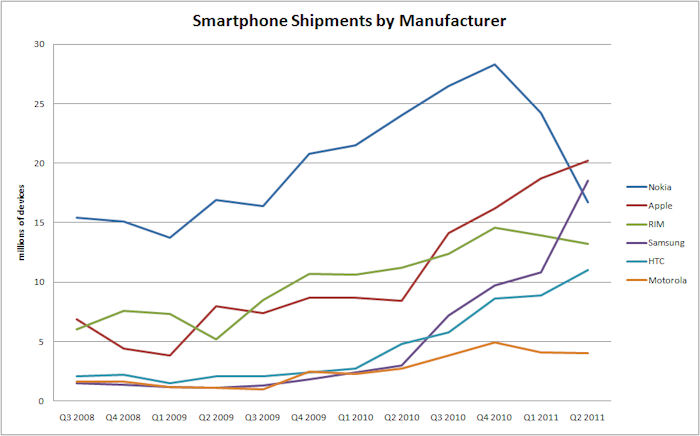
That's true, but you have to also considerate the tendency:
http://www.allaboutsymbian.com/images/news/smartphoneshipmen...
At that moment it looks like Symbian was running out of gas.
> On this last point, they talk about leveraging a non-corporate image, like the Dudesons or Madventures, and throw “the largest events, gigs, and parties of human kind”.
Well that sounds really sustainable.
Compared to manufacturing costs and the revenues at stake, gigs, events and parties are cheap.
I meant more as a company culture.
> Corporate Culture Reboot to 2002
Wow, that would be very useful. Should we reboot Blackberry to it's 2008 culture, Microsoft to 1996, Yahoo to 1999?
How do you reboot a company's culture? The culture is something that is developed over many years, "rebooting" it would take quite a bit of time if it is even possible at all.
> How do you reboot a company's culture?
Management declares it, which causes corrosive cynicism.
Honestly I hope they succeed. Lumia 1020 hardware with Android or Meego would be very enticing.
This will probably not happen.
I think Nokia will help Microsoft to compete with Apple in the field of smartphones, especially with custom-designed hardware and exclusive OS.
I don't know what the new Microsoft wants. What is it that they want to sell? This is important and you can't just say "everything to everyone".
Amazon.com has a focus on retail. They sell stuff and the Kindle (including Kindle Fire) line is just a medium to get it to the customer. If FedEx and others kicked the bucket tomorrow and Amazon felt UPS was too strong as a vendor, they'd probably start their own logistics department. If they felt Comcast was too dominant, they'd probably want to do something about that as well.
Google's focus is arguably its services (which it uses to push ads). Apple is stubbornly a devices (hardware) company.
However, it is unclear what Microsoft's angle is here. Do they want to make money selling software through OEMs? It doesn't seem like they want to push prices of hardware down. They make too much money off of enterprise software to cut that arm off. Online services does not make enough money to let it completely cannibalize the software licensing cash cow yet.
I am glad I don't run Microsoft. I would be lost.
From what I understand Microsoft's goal is to become less of a software company and more of a devices and services company[0]. In that light, the acquisition of the mobile devision of Nokia seems to make sense.
And I guess it's pretty much the same strategy as Apple is following, especially now Apple has made Mavericks and several Mac OS apps free of charge.
[0]: http://www.microsoft.com/investor/reports/ar13/shareholder-l...
I my be mistaken but the first sentence in that article is false. Microsoft has not yet bought Nokia (although they think and act like they have).
"Android and Linux products" - please, no!
Yes, how dare they not make a Plan 9 phone!
Or just wait a couple of years until the block on using the brand on smartphones is removed and sell the name to Xiaomi, Huawei, or Lenovo.
Could work but I think they should remember this isn't an OS thing but an app thing.
BlackBerry and Nokia are still producing very good phones. But they failed to jump the app train. Blackberry may survive since the new OS supports Android apps. Nokia should work on this as well.
There are rumors that Nokia is still working on an Android Lumia.
Those android prototypes are meant to "scare" Microsoft nothing more.
Nokia won't be able to use the Lumia brand after the Microsoft deal is finalized. And they won't have their phone manufacturing department.
So we can safely say and Android Lumia won't happen.
True, but rumors are that they were testing Android on the Lumia series.
But ofcourse rumors are just that: rumors ;)
Probably not this proposal, but there are a couple scenarios that could lead to Nokia being a takeover target:
1. Microsoft's activist shareholders tanking the deal, perhaps by pointing out that buying Nokia's factories and the whole legacy handset business including Series 30 and Asha is pretty crazy.
2. Nokia's board concluding that, now that they are rid of Elop, could reboot Nokia themselves: spin Jolla back in, and start selling Sailfish and Android smartphones.
Nokia doesn't have money any more to develop Android phones on their own. They don't even have money to continue with WP strategy on their own. Elop spent billions of Nokia's money to boot Windows Phone and restructure the operation as a Microsoft division. It was 'all in' with Nokia's money.
> Nokia doesn't have money any more to develop Android phones on their own. They don't even have money to continue with WP strategy on their own.
They actually do. If you were to check their quarterly reports you'd see they have plenty of cash...
Not accurate. They're flush with cash.
End of fiscal 2010, they had $16.4 billion in cash.
Today they have $12 billion in cash. With zero long term liabilities.
They have drastically more money than they would need to remake their business and target Android.
If it didn't work, that might be the last shot they get at it however.
To be fair if I was Nokia and wanted to save myself this microsoft deal would still make sense. It all depends on the contract terms.
Sell the smartphone division, aka Windows Phone division, to Microsoft. You get rid of Elop and still scavenge a portion of the money poured into WP. Then start a new smartphone division leveraging Android. On the employees front most of your best former designers and engineers are still local just working for Jolla or Intel. Buy Jolla for the hardware designer then partner with Intel and get help on the engineering front. Hype the hardware at some consumer electronics conference and try hiring back the few of your best engineers which stayed and were included in the Microsoft deal.
Boom, you now have Daniel's untested and high risk plan for an Android Nokia. Please vote for me as the next Nokia CEO.
This is quite plausible scenario, if that's what they want. The truth is that the smartest engineers have jumped ship a long time ago anyway to the network division or other companies, and rest of them will leave soon.
Most of what Microsoft bought was truly just dead weight and Elop. Also, the deal included just the employees and Nokia brand licensing, not patents or other valuable IP, so it's not comparable to Google/Motorola deal, which was mostly about patents.
The 'new' Nokia will soon release their new strategy, that'll be interesting. They have already released information that they will stay in 'device business' although they can't release phone products until 2016.
Nokia has, at least, the resources to operate its infrastructure division. There have been sorrier messes in the mobile OEM business.
Nokia has Android ready to go on existing devices. Bringing up Android isn't rocket surgery. You would have to ask the Jolla people how much it would cost to put Sailfish on existing devices. I bet their answer would be under $10M.
In other words, claims that Nokia had to "focus" on one OS due to costs were bunk then and they are bunk now. Lots of newcomer OS are hitting the market and the costs to try them are low enough that many OEMs will sell Tizen and Firefox OS devices just to test market acceptance. Nobody will spend so much they bet the farm.
I'm not sure that was bunk in Nokia's case. When they realized that Symbian had to go, they also realized that the vast bulk of the company was organized around that one OS. And if sources are to be believed, most of that deadweight was fiefdoms jealously guarded by entrenched groups, which meant they were not going to be conducive to "pivot" to a new direction. Now they had to shed that humongous deadweight and produce a competitive "modern" smartphone. I think it's entirely possible that in that situation whatever resources you have left, you may well have no choice but to bet the farm.
Nokia may have used Android to force Microsoft into a buyout, but I doubt they were going to seriously pursue it, for one big reason: that would have entailed compulsorily licensing Google Maps, which is a direct competitor to their own mapping division. You may think that doesn't sound so bad, but consider this:
1) It dilutes the billions they paid for Navteq.
2) As the SkyHook lawsuits have shown us(IIRC) Google demands all location data produced by Android devices to improve their own geo services. As such, Nokia would have ended up building devices that end up improving a competing service.
3) Considering the mapping division is one of only three divisions Nokia held on to, it's undoubtedly important to them long term. I am not sure, in their eyes, the pros of having an Android phone out there would have outweighed the cons of improving a competing mapping service.
Re Skyhook: Google has made no such demand on any OEM. Google demanded Moto not replace Google location services with Skyhook. Many Android phones have shipped with, e.g. Verizon's location services and maps.
Based on what has appeared in commerce, you can run, and preload if you are an OEM, any competing service on an Android device. But Google draws the line at denying Google data from their own apps. Seems reasonable.
> you can run, and preload if you are an OEM, any competing service on an Android device. Seems reasonable.
...that's only kind of true. OEM's who are members of the Open Handset Alliance are prohibited from producing devices which run forked versions of Android. This is why Amazon has so much trouble finding manufacturing partners to produce Kindle devices.
So OEMs can load competing services onto Google supported Android devices. They cannot produce devices which run flavors of Android not supported by Google. This seems less reasonable.
This link, which goes into some detail about the Skyhook lawsuit, paints a starkly different picture:
http://www.theverge.com/2011/05/12/google-android-skyhook-la...
Google may have allowed Verizon and AT&T maps because, of course, they are the ultimate gatekeepers. But they still demand data for their own services and forbade SkyHook completely. The article lays it all out.
In light of that, your point agrees with mine: Google did not allow denying their apps with data, which sounds reasonable for Google. But for Nokia that would be selling phones that improved the service of a direct competitor. Google certainly forbade SkyHook from getting any data, so very likely Nokia faced the same problem, which would have meant they'd be giving Google data without being able to use it themselves.
I have read the available Skyhook litigation documents in detail, and I have worked with multiple location services APIs in Android and other mobile devices. I don't want to argue about every point in detail, but Google isn't demanding location data from other location/mapping/location-services stacks. If you really have you own whole location ecosystem, as Nokia does, Google won't go after you because you could make a good case that is, in fact, anti-competitive in an illegal kind of way. So I do not think "But for Nokia that would be selling phones that improved the service of a direct competitor." is correct. The Skyhook case is about changing the way the Android location APIs work, and those are NOT part of AOSP.
Bottom line, though, if you stepped outside of Google's constraints, like replacing the Android location service internals with Skyhook and keeping the data to yourself, Andy Rubin would personally leave a horse's head in your bed. The article says "Skyhook claims Google uses the threat of incompatibility to act anti-competitively." Which is the less nice way of saying if you don't follow Google's rules, whether or not they are spelled out in any contract, they will make it impossible for you to sell Android-based products with Google's ecosystem. Whether that is actually anti-competitive, is, of course, the subject of that litigation.
One thing Andy Rubin knew is that carriers can be dicks, and being a dick to carriers and their OEM partners, to the point of threatening with losing access to Android products is something he did not feel apologetic about. He learned that at Danger.
It's too bad Skyhook ended up in the middle of that. I have my own stories to tell about OEMs afraid to use interesting technologies because of the AFA, and the way Google used it. Some people think Google's behavior is similar to a case where a mainframe software maker got RICO'ed for bundling.
Regarding Asha: I hear Asha is doing crazy well in low-end markets. Not sure how Microsoft can leverage it, but I'm sure they are aware of this.
The low end is being destroyed by "white box" Android phones from China. There is simply no way to compete with them on price since they do not have to develop software and sell nearly at cost. This will be the same with high end phones soon as improvements level off and it becomes commoditized. I think that mobile phone manufacturers will have poor to no margins quite soon. The only place to make money now is through the ecosystem.
Asha WAS doing well is developing world markets. Asha is now a dying business. http://www.google.com/imgres?imgurl=http://allaboutwindowsph...
Microsoft bought itself another Kin.
Hah, even "something that was selling well" is not a description that could be applied to Kin.
What makes you think Microsoft bought Nokia for the Asha business?
I stated the exact opposite

Doesn't finland also now have an enormously successful 'little' slice of the games industry?
Why? Those two are a pretty good match.
It's really weird how people have started to anthropomorphize these corporations and their products...why do this? If you could raise billions you could start a new endeavor?
Nokia isn't an old friend of yours. There's nothing to "save". Raise your billions and hire some of their designers if you like the work that they do.
Nokia's brand premium is worth quite a lot to some people, representing (at the very least) a quicker path to making money since you technically don't need to educate everybody about a new brand.
> There's nothing to "save".
To be fair, there's a lot of intellectual property at stake.
Nokia kept all its intellectual property.
Well if it worked that way someone already would have done that wouldn't they?
1) There's $12 billion in cash in Nokia, representing 42% of their market valuation
2) There's a lot of intellectual property
3) There's a global brand
4) I think it's safe to assume there are a lot of excellent people that still work for Nokia
There's a lot to be "saved." Whether Nokia could be turned around on its own is another matter.