The Raising of Chicago
en.wikipedia.orgChicago didn't fuck around when it came to ambitious 19th century engineering: http://99percentinvisible.org/post/57747785222/episode-86-re... (reversing the Chicago river--this has a lot of great old pictures).
Although, see: http://chicagoist.com/2013/04/19/photos_what_re-reversing_th... (reversing it back temporarily this year to account for flooding).
In school we used to say "aerospace engineers make bombs; civil engineers make targets." But in fact civil engineering is really cool, especially in terms of what they were able to do before modern technology: http://www.colorcoat-online.com/blog/index.php/2011/05/engin....
See also the 1893 World's Fair -
http://en.wikipedia.org/wiki/World%27s_Columbian_Exposition
(One of my favorite books in the last few years is http://en.wikipedia.org/wiki/The_Devil_in_the_White_City)
Amazing book! Hope they finally make it into a movie sometime soon.
wow. never knew of this book but I'm an architect with a good understanding of the pioneering work and complex relationships of Burnham and root, Adler and Sullivan and mckim mead and white. there are cracking stories to be told here. I'm going to have to pick up the book now to see if it is done justice.
It wasn't just infrastructure, it's in the attitude of the city. Someone once told me "in New York they build skyscrapers because they have to, in Chicago they build skyscrapers because they can."
Yes, I've always found that attitude amazing. Illinois is pretty flat. Chicago could grow outward pretty much unimpeded in at least 180 degrees. Yet, it has a dense downtown core full of skyscrapers.
Whaaat. I never realized this sort of thing happened. Elevating cities, reversing rivers. I didn't know civil engineering was so cool. It seems like science fiction, like terraforming, but there it is, happening a hundred years ago.
They also dug (by hand) underneath Lake Michigan 2 miles out, to bring fresh water into the city. Amazing.
That 99percentinvisible article is great reading. OTOH, the site puts some kind of idiotic music player at the bottom of my window. I wouldn't mind so much, except that it covers up the bottom of the FF scroll bar.
Icky design. :-(
North American cities used to be enormously ambitious (see also, for example, Boston's Back Bay). Contrast the fear, trepidation and status-quo obstructionism that characterizes municipal affairs today.
Here's a gif of the land reclaimed by Boston over time:
http://wp.streetwise.co/wp-content/uploads/2011/06/filling_i...
Can you imagine anything of this scale happening today?
Today's Boston can't even build a traffic tunnel. The Big Dig was a disaster-- took decades, costs billions more than planned, and was so shoddy the finished roof fell and killed someone. http://en.wikipedia.org/wiki/Big_Dig
As someone who works in an office building along rose kennedy greenway, I wouldn't say it was totally a disaster. Basically everything along the greenway has been revitalized and it's pretty beautiful to walk around in the summer. There is a lot more activity in the area and lots of new restaurants.
The real problem with the Big Dig is that is was designed and built in ignorance of the law of demand [1] as it applies to lane capacity. The traffic congestion that the Big Dig was supposed to eliminate simply moved outward [2].
They should have eliminated the Big Dig completely and spent the money on increasing rapid transit capacity.
That said, eliminating the elevated highway that cut the North End off from the rest of the city seems to have been a major boon.
[1] http://en.wikipedia.org/wiki/Law_of_demand
[2] http://www.boston.com/news/local/articles/2008/11/16/big_dig...
I can't really speak to traffic because I rarely drive, but I do agree there needs to be more investment in rapid transit. I rely on the red line/walking to get to and from my office. It is the only line I would consider living on.
But I did want to add that it isn't only the north end that was cut off. I doubt the resurgence of the Sea port area/"innovation district" would have happened if it hadn't been for the big dig.
Not to say this is okay, but those huge historic engineering projects usually cost more than just a single life.
Every time I see a cathedral or dom tower ... :)
Not with the EPA. That type of terraforming is verboten in the US. And I would actually agree that it had to have been terrible for the environment.
You can take a cynical view of it if you want to, but you also have to remember the economic aspects in play. At the time the US was experiencing unprecedented growth. There was abundant amount of capital to throw around. That just isn't the case today.
Contrast that to Southern China. Lots of insanely ambitious city projects, driven once again by tons of growth.
It's not about abundant capital - it's actually easier for American cities to leverage the bond market to raise capital now than it was in the 19th century. The bigger issue is labor and regulation. The people working to raise Chicago were frequently immigrants, either from other countries or from farms, working long hours, with little pay, and with questionable safety standards. Thanks to regulation and labor organization, workers on civil engineering projects are much less likely to fall off a building or have one collapse on them, and can afford to live much more comfortably. But that means it's much more expensive and difficult to undertake a large project.
Same goes for regulation. Notice that the whole reason Chicago needed to be raised was so they could drain run-off. So where do they drain it into? The Chicago River and Lake Michigan, which became toxic cesspools until very recently. And those shop owners didn't have much of a say while they were hoisted into the air. Regulation and democratic involvement are really annoying when you want a large capital project to go through, but they're really important to you when that large capital project is something that's being done to you.
There's even more capital these days, it's just locked in securities and traded on exchanges instead of directly invested in enterprises.
It's common knowledge in the financial world that returns are expected to be very low in the near future. With that and the recession both financiers and economists (real economists, not random op-ed writers) are aware that the market and macro situation for government projects is ideal.
But it so happens that government projects today are very often financial disasters, particularly when backed by bonds or tax increases. There's no law of the market that says this should happen either, but it seems to be a feature of ossified political systems.
In times of rapid economic change, the risk of doing nothing is often far worse than a grand project that is merely less than fully successful. Chicago feared it would become a big flat toilet, for many good reasons.
When things work pretty well, it can be more difficult to allocated resources for bigger projects, I suppose.
Singapore does that kind of timing pretty well.
Interesting to note, many economists in no small measure blame the recent financial crisis on the global cpital glut chasing returns. If you create an innovative instruments for financial capital to support physical capital (in this case US housing stock) you too can create a bubble.
You build infrastructure when you expect to grow, because that's when infrastructure creates the most value. Chicago during the late 19th and early 20th century wast he fastest growing city in the world, and was becoming wealthy from its central location in transcontinental trade.
Today, nearly all traditional American cities are on the tail end of a long decline (save a small handful, like New York, San Francisco, and Seattle), or else are the kind of sprawly suburban cities that don't have the same need for the ambitious public works that the traditional, dense, American cities had.
Actually most U.S. cities are in a huge rebound...from better policing and the memory of the 1960s riots is fading. Houston is our new Chicago.
Totally different. "Cities" like Houston grow outward like the suburbs. Houston has almost 3 times the land of Chicago. Population density of Houston 3,623/sq mi, Chicago 11,864.4/sq mi. One is a city, the other a glorified suburb.
Well if any of today's American cities lost 5 to 7% of their population in a single year to some sort of medical epidemic I suspect there'd be a fair bit of civil activity.
The 1885 cholera epidemic is a widely told myth: http://en.wikipedia.org/wiki/Chicago_1885_cholera_epidemic_m...
Well I was going simply off the article. Still, even that entry shows pretty consistent spurts of deaths hitting 3 - 5% of the population so it's pretty consistent with the point of the article (after multiple years of deaths they were force/spurred to act)
I'm particularly struck by the contrast between a great city undergoing a decades-long project to raise everything above the local water level and modern-day insanity such as North Carolina making it illegal to base public policy on scientific reports about sea level rise.
One wonders if those lawmakers, teleported back to 19th-century Chicago, would deny that drainage is a problem and forbid basic public policy on any scientific report linking sewage to disease.
> North American cities used to be enormously ambitious (see also, for example, Boston's Back Bay). Contrast the fear, trepidation and status-quo obstructionism that characterizes municipal affairs today.
North American cities used to suffer with depressing frequency civil engineering disasters that killed dozens of people at a time. It truly would be odd if fear and trepidation regarding the topic is greater now, if that's actually true.
Caution might be greater, since we know more about the topic and more about what we need to be cautious of, but that's all to the good.
Nicely explained in this comic/editorial:
My impression is that project overages have scared cities quite a bit. To use your Boston example, the Big Dig certainly has scared many other municipalities thinking of something like that. The Denver Airport fiasco most certainly scared away people from building new airports for decades.
Moving into speculation... I believe that society values lives a lot more. It would be very hard to cost effectively build another Golden Gate Bridge due to the lives involved. Is this really a bad thing? So instead we build skyscrapers.

I took a tour of Seattle, and the guides discussed Seattle going through a similar transition. Essentially the whole city was raised by one story. But the roads were done first, creating a sort of "waffle-like" city, where crossing the street as a pedestrian meant climbing a ladder, crossing the street, and descending the ladder on the other side. People were sometimes injured or killed by falling down the ladder, someone else falling down the ladder, or things falling onto them from street level.
After the sidewalks were raised to match the streets, the underground sidewalks were kept open for a time, until (predictably) problems started with drugs and prostitution, etc. They were closed in the early 20th century but you can tour them today.
For completeness, here's the article about the raising of Pioneer Square that the parent post was referring to. http://en.wikipedia.org/wiki/Seattle_Underground
Living here in Chicago it's neat to see the vestiges of this still around - like 'vaulted sidewalks', where the current sidewalk sits over 5 feet of air, and then the old sidewalk is down below:
http://gapersblock.com/airbags/archives/city_streets_how_chi...
Pictures or it isn't true!
Here's my grandmother's old neighborhood in the near southwest part of the city (Pilsen):
You can see where the sidewalks enter on the second floor of these flats and the original ground level entrance is now below street level.
We had lots of fun goofing around in the "cave" down on the first floor.
It's very bizarre seeing a street view from a block away from where I live on HN.
Sorry, that's where GMaps put the center of Pilsen. I can update the link if you want... =)
(ObGmapsWeirdThing: My wife and kids were outside on the driveway when the google cameras went by. Now I can see them all the time, staring back at me with their blurred faces...)
It is random. I lived about two blocks away on 18th place.
Hello, half-mile away neighbor.
Here's a thread with a bunch of pictures of Chicago excavations that have exposed vaulted sidewalks http://forum.skyscraperpage.com/showthread.php?t=143407
These are the signs by my wife's office - it's really hard to visualize but at points in the sidewalk there are grates that you can see through down to the old sidewalk below
http://fuzzyco.com/news/archives/uploaded/2005-08-15/vaulted...
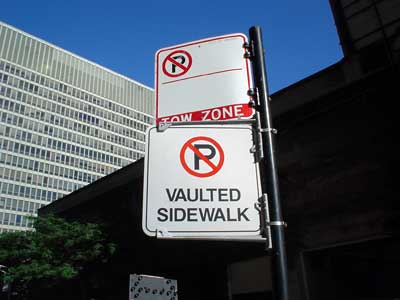
This practice was not unique to the City of Chicago.
The city of Naples was rebuilt at great expense after the a terrible cholera epidemic in 1884 carried off a large number of victims. In response the government funded major effort to raise the city's streets as proscribed by the then current Miasmatic Theory of Disease. The thinking was along of the lines of low lying 'bad air' caused illnesses and thus the raising of the city's infrastructure would improve the general health.
Details: https://en.wikipedia.org/wiki/Miasma_theory_of_disease
Definitely listen to the Freakonomics podcast on Chicago's quintessential role in developing the US as a country and economic giant - well worth the 30min or so, and based on a book by Thomas Dyja: http://freakonomics.com/2013/08/15/the-middle-of-everywhere-...
Chicago was recently used as an example of a city that is so paved over it can't drain properly. http://www.theatlanticcities.com/neighborhoods/2013/05/way-w... I wonder if that's a valid interpretation, given its natural drainage problems?
Curious why that article didn't mention Deep Tunnel. It's our 50-year project to dig massive drainage systems and underground reservoirs to hold the emergency storm runoff. We're..hmm..15 years away from being done!
Interesting! One of the slightly counter-intuitive solutions the city has implemented in recent years are flow restrictors in catch basins that service street storm drains. The rationale is that the sewer system can't handle the combined volume of rainwater from the street and from peoples homes (mainly runoff from gutters or sump pumps), so they opt to let the streets flood instead of people's basements.
Oddly though flooding in the city proper where there building density is high is generally not a problem. This past year when we had very heavy rains, it was the northern suburbs that had real get out your boat type flooding.
Where are the technical details on how this was accomplished? The wikipedia article said what was done, but didn't go into how.
All the references appear to be just newspaper articles or some layman's explanation. Are there any meaty technical discussions of these accomplishments, especially the raising on an entire city block.
This is totally fascinating, but I'm still not sure I get the infrastructural context. Were traditional storm sewers impractical for Chicago at the time specifically because of the city's elevation?
Yep. You need a slope to get water to flow. The city is effectively at lake level. Having a storm sewer doesn't do you much good if the water can't go anywhere.
Another city with similar problems is Berlin, I was there recently and I was puzzled by the crazy pipes all through the centre of the city.
Turns out that the ground water level in Berlin is really high so all construction sites (and there are huge number of these in Berlin) need to pump out the water from excavations which explains the pipes everywhere.
http://robertherrmann.wordpress.com/2012/01/20/the-fancy-tub...
The city _was_ effectively at lake level. Between the raising of Chicago, the Chicago fire (which made sufficient debris to create Grant Park) and additional raising of the street grade, some buildings "ground floors" are three stories above the ground.
The city was too low to dig traditional storm sewers that were angled enough to move waste water by gravity.
Here are a few great Chicago resources. Archive of photos here: http://chicagopast.com/ Video Archives here: http://mediaburn.org/ This is a personal favorite: Chicago Culture "sitting on the front stoop" enjoy! http://mediaburn.org/video/ben-hollis-stoop-talk-1-for-weeke...
People interested in economics, history, Chicago, or the midwest in general should definitely check out "Nature's Metropolis: Chicago and the Great West" by William Cronon.
Galveston underwent a similar transition of two stories after the catastrophic damage of a hurricane in the year 1900, in order that it would never be vulnerable again†
†Unless the city expanded outside the elevated seawall, which it did... for a time. Predictably, another hurricane has corrected this oversight recently.
http://en.wikipedia.org/wiki/Galveston,_Texas#Hurricane_of_1...
So Undertown does exist?
Kinda. While Butcher fictionalizes is, and expands on the truth, there are many tunnels throughout the city, and it's possible to traverse most of the loop underground.
Plus there's good ole Wacker drive...
And it's always exciting when those tunnels flood... http://en.wikipedia.org/wiki/Chicago_flood
While visiting Chicago earlier this year I found that a ton of great bars exist under on the lower level. Definitely worth visiting/seeing.
Hmm... I always thought it was hanging out with that sixth borough
I just saw a great picture of this from 1885: http://calumet412.com/post/58699298036/street-grade-elevatio...
Anyone know why Venice, Italy hasn't undertaken a similar plan?
There have been plans/proposals to refill the aquifer under Venice [1].
The construction of the Modulo Sperimentale Elettromeccanico (or MOSE) that is meant to be raised in times of high water started back in 2003 [2].
Venice is built largely on wood pylons. They are in many cases over a thousand years old.
Nevermind Venice, which is at least still above sea level (barely)---what about New Orleans?
You missed the reversing of the Chicago river...