Solar Energy Saves Europeans $135M a Day
cleantechnica.comThe title is misleading. $135 is not "money saved", it's "money not spent on fossil fuels" (even for that I couldn't find how it was calculated by solarpowereurope, but the number seems plausible).
To the discussion of whether $50B/y is a big figure or not. EU has around 400GW of PV installed. Cost to install per 1kW ranged between $600 and up to $4000 because a big chunk of that capacity was built when prices were much higher. If we consider average price at $1000 this means $400B on capex alone + yearly operational expenses. It can still be profitable (assuming current PV prices can be sustained + installed capacity doesn't grow faster than storage) but it's going to be many years until the investment is recouped and it starts to actually "save money for Europeans".
In any case, of course it's still nice to depend less on imported oil, even if not for money savings.
Over last several years the cost to install 1kW was, ehm, less than €200 if you do it the retail way - 2..4 500W panels from the warehouse next street and a microinverter.
Thanks, China.
In addition to my primary system, I have a toy installation with 6 500W panels and a micro. I paid around 500 euros for that last August and by this time this toy installation generated me 1281 kWh. That's around €400 in terms of retail energy prices. So, I'll break even this August.
So, everything generated after would be exactly the "money saved".
Yes, you are right. The money saved is not just $50B.
1) Add the money saved from fossil fuel subsidies, that don't need to be spent
2) Add ethanol/biodiesel subsidies
3) Add defense spending to protect oil pipelines and fossil fuel assets
4) Add healthcare spending, fossil fuels are linked to nearly every kind of disease (except STIs, mad cow, polio, etc)
5) Add deaths/injuries from fossil fuels and the associated hospitalization costs, lost productive human years. Fossil fuels have the highest deaths/TWH.
6) Add the money saved from demand destruction (Less demand --> cheaper oil)
6a) Immediately, decreasing the price of fuel.
6b) Slows down fossil fuel multibillionaires becoming richer. Oil is profitable at $10/barrel, but with global demand skyrocketing, Oil is extracted from costlier sources (fracking/sands) which need a minimum price. However, the cheapest extraction (Saudi) will profit immensely and with that money buy everything else in the world, extracting wealth via rentier capitalism or stock market, making housing, healthcare, everything else costlier for all of us.
7) Creating the initial demand for solar panels, enabling scale production, making solar panels dirt cheap now and forever.
There are probably more.
For point 6 a UCL study on Wind energy in the UK suggested that over the 13 year period they studied the new wind power had saved 14 billion in electricity costs, because it was cheaper than gas generation.
But it saved consumers 140 Billion by lowering demand for gas and so cutting prices.
So a 10x multiplier.
Cleantechnica is a solar advocacy group and they consistently frame things in misleading ways like this.
I was making a related point in https://news.ycombinator.com/item?id=48462628 Got downvoted as I assume some didn't parse past the first line.
With oil prices and wars, the adoption for renewables and not just solar should accelerate to wean the world off oil.
I've half jokingly said it before, but I think by overall impact Trump and Putin's sheer chaos is doing an order of magnitude more to transition the EU to green energy than anything else that was done deliberately to fight climate change lmao.
People don't give a fuck until gasoline is 2€ per liter.
Taxing/preventing extraction of crude oil upstream would always have been the better solution.
Yeah but then it's your fault, you get voted out in 2 years, and the next government reverts it. Local governments are ever the populists for a reason.
Covid helped a lot with digitalisation and working from home.
But these things don't get momentum in a vacuum. People need to advocate for them beforehand, so that when the time is right, the decision makers will know who to turn to.
Some EU countries, at least Croatia, Hungary, Spain and Greece lowered gas prices to pre Iran war levels. I wish instead EU would lower tariffs on EVs. Xiaomi SU7 would get 45% total duty.
It will happen when we have better weather forecasting models. If it gets randomly cloudy for 5 days this month and 17 days next months screws up planning for factories, farms, datacenters etc.
I always post this https://www.rte-france.com/en/data-publications/eco2mix/powe...
France is notorious for being all-in on nuclear, which they then have to shut down in the summer because the river water they use for cooling gets too hot.
The French seem to have some cool ideas to solve pesky problems. Guillotine for the super rich, nuclear for energy. Though it looks like they stopped doing both.
Batteries, having a mixed grid of renewables, and new advances in nuclear solves this
Batteries help, but they still cost way more than direct solar and wind. We still need way more solar and wind to use directly.
Costing less than the most expensive thing they replace is the interesting threshold.
That's evening peaker gas plants in most places. After batteries push gas out of that market they go on to morning peaks and so on.
A "peaker" or Open Cycle Gas Turbine is much less efficient which is doubly expensive in Europe. Firstly you need more fuel, and the fuel is expensive, but also you're making more pollution and that's expensive too.
The UK for example basically doesn't have "peakers". Right now it's early evening, demand is high as people cook evening meals but haven't yet retired to bed where they stop using electricity, but renewable generation is reduced as the sun approaches the horizon. So there's 8GW of combined cycle gas power plant production, but only about 100MW of "peakers" and it might grow to 200MW or so at absolute peak.
This is the exact scenario they are being used in at scale. The company removes their gas peaker plant infrastructure and replaces them with batteries. Already have the grid interconnect and now can dispatch power on the millisecond level instead of hour level.
batteries are not yet competitive with fossil fuel
This is not true. Batteries are cheaper than peaker power plants using fossil fuel. They also allow the operator to fulfill market demands at the minute level versus the hours previously that it took to turn on a peaker plant.
This is being done at scale in California and Texas.
interesting, so most power in Texas at night comes from batteries?
Fore more than 2 hours capacity, batteries are expensive than most other and cost keeps increasing as more hours of capacity needed. Without gas or coal to burn when 1hr battery capacity runs out, battery storage is expensive.
Are you saying that the cost/MWh of battery storage goes up the more batteries are installed?
To scale battery storage to a level that is capable of bridging, say, 48 hours of "Dunkelflaute" (darkness and no wind) on a regional scale (e.g. the entire Scandinavia) is probably unrealistic. Just the amount of lithium needed would be insane. And there were longer Dunkelflautes in recent history.
New advances in nuclear is what I hope for. First experimental SMRs are being installed in several places of the world, others are in design stage. Looks like a hopeful technology.
> To scale battery storage to a level that is capable of bridging, say, 48 hours of "Dunkelflaute" (darkness and no wind) on a regional scale (e.g. the entire Scandinavia) is probably unrealistic. Just the amount of lithium needed would be insane. And there were longer Dunkelflautes in recent history.
48 hours in Scandinavia is roughly equivalent to turning all their road vehicles electric. And that's even with Norway using the second highest per-capita rate of electricity in the world let alone Scandinavia (second to Iceland, whose electricity is 100% renewables thanks to abundant geothermal): https://www.statista.com/statistics/383633/worldwide-consump...
Given nobody is suggesting an instantaneous transition, this is not at all unrealistic, and I don't know why anyone might consider it to be.
Good luck with new nuclear, but with all the politics in that domain, I don't expect that to work out even if e.g. Helion Energy supplies working shipping-container-sized aneutronic fusion.
Across a large enough area it's always sunny somewhere. And clouds don't interfere as much as you'd think. Add in wind, hydro, nuclear and some gas and you can handle pretty much anything just fine.
That has nothing to do with where factories, mines, farms etc are already located. You have to buy land to connect the power plant to the load and some guy in the middle wont sell. Handle congestion/maintenance of those lines etc. Lots of issues beyond just generation that the grid already is dealung with even though massive solar plants have been built. But main thing is weather forecasting has to get better because even with existing huge plants constant surprises happen.
There's this thing called the power grid, it transports electricity across great distances.
And everything you're talking about is an issue with any kind of production, I don't know why you're bringing it up as if it's unique to solar. If you're building a factory that needs high amounts of stable power then you plan accordingly. Doesn't change the fact that solar is a useful way to generate electricity. I don't think anyone is saying we have to use it exclusively. We can use different solutions for different problems.
Lots of probs with existing grid . Certain routes are already overloaded/congested, building new ones is not as easy because of land acquisition costs compared to the past. Repairing, upgrading and maintaining old routes to handle new loads raises costs of moving electrons to your factory etc. One hurricane or blizzard can shut a route down so redundant routes have to be built. People just under estimate how complex things have become.
you can handle it with solar & gas alone
Yeah more dependency on china! Nothing to backfire, no Chinese influence at all!
China might produce the most panels at volume but this isn't a hardline monopoly like being able to cut off oil pipelines. We can produce panels ourselves if we _need_ to (as a coalition of friendly countries), it will of course be more expensive, but expensive is better than not possible.
Also, the more panels we already have, the less reliant we are. Energy doesn't stop flowing because deliveries of new panels stop during a conflict. You just pause expansion. A very different scenario to fuel reserves running dry in weeks.
> Also, the more panels we already have, the less reliant we are. Energy doesn't stop flowing because deliveries of new panels stop during a conflict. You just pause expansion. A very different scenario to fuel reserves running dry in weeks.
If someone is genuinely worried about China cutting off their power, the fact my very cheap solar inverter came with an app should probably be a consideration here.
I'm not saying the Chinese did put a kill switch into it, but I am saying that we all know what Snowden reported about the US, and given that it really wouldn't be a surprise.
> this isn't a hardline monopoly like being able to cut off oil pipelines
"Solar panels come from China" is a made-up problem. Oil pipelines and oil production equipment already have supply chains rooted in China and no one worries about that.
Unlike the oil dependency system, where there's actual scarcity of the thing you need (oil), there's nothing special about building solar panels that locks you to China. Basically any country could build it, but they need to figure out how to build stuff in general (as opposed to outsourcing like the last three decades)
Solar panels are oil drills, not oil.
Hard to call it influence when the panels, once installed, just work and slowly degrade over the course of years.
There are more immediate ways for China to influence Europe.
Meanwhile the recent oil debacle showed how fragile a system it is to have fossil fuels shipped across the planet.
Really ? One doesnt needs China to produce electricity once its installed.
You don't buy anything else from China? You're sure none of the oil drills or gas turbines in your country are from there?
Is buying the means to produce energy from China worse than buying energy directly from Russia?
This is indeed the risk.
I installed a solar system at my home in Massachusetts for 17k last year (after tax credits), 7.82 kw.
So far it's covered about 70% of my usage and 5.7 Mwh. I don't have a full year of data yet so I expect that number to grow as it includes the summer months. I drive an EV and this includes the car.
Not sure what the actual cost was, but in 2015 my parents got a solar system in California that covers the entire house plus an EV. I remember looking at the time to payoff and I think it took maybe five years, now day to day power and all their driving is essentially free.
What about without subsidies?
Cost will go up ~30%, so roughly 6.5 years instead of 5.0.
Same. I installed 9kw plus BYD batteries this year (finished first week January) for €19K. Completely self sufficient, even surplus which I distribute to the public net and they pay me for. I hope to have complete data by next year but it looks like I can reduce electricity bills by 85% which is for Europe with really high costs/kw a bargain. Expected ROI 10 years.
Curious who you ended up using and if you recommend them.
Great Sky Solar, they're a small local company and I had a great experience with them.
Uh, that's absolutely badass...
As an adult, one of the things that fascinate me is self-sufficiency: the idea that you can buy a solar power system, install it, and use your own power -- without getting a bill in the mail every month, many times feeling like a victim of modern day suburban subjugation.
I'm still a good little obedient peasant, but I hope one day I can rely more on well water/rain catchment system, solar power, and propane.
Getting 70% of your electrical usage from your own solar power system has to be a good feeling.
> one day I can rely more on well water/rain catchment system
There are some fascinating youtube videos on digging your own backyard shallow well (12-40'). This close to the surface, the water is considered non-potable, and you should have yours tested, but you can pump up what you need for backyard garden irrigation. Wells like this can be seasonal, as it is essential a rainwater catchment system using the permeable ground as your reservoir. Still, a neat concept for a relatively low cost.
> There are some fascinating youtube videos on digging your own backyard shallow well (12-40').
What's more fascinating is that you would have to dig your own - here in the backyard of Europe you can call a specialised company, they will arrive with a rig and drill a well for you to basically any depth/diameter you want (for heat pumps you can go to 100m) cheap and fast, so it's basically never worth it doing it yourself.
If you own a home you should genuinely spend time calculating and thinking about it. It's not near as far fetched as you think. You can benefit from the same technical advancements in engineering and manufacturing that have benefited every single industrial sector. It has never been easier. The number of plug and play components out there is unreal.
These days it's very much sun-legos. You decide what you can afford and what you think you need, and then you bolt the stuff together. Anyone who is willing to put time into it is capable.
I 100% believe you! We're planning on doing a custom build for our next home, and I'm going to budget for solar. Like you said, it's gotten so much easier these days and I think that we don't take advantage of this because it requires budgeting/saving and because paying a monthly bill can be so much easier in the short-term. But I'm 100% going to do this.
If you're building a place, consider how you could arrange some of your basement for effective food storage.
This family[0] appears to be 90% agriculturally self-sufficient: they occasionally eat out, but grow most of what they eat. They store a lot of food in their basement, critically, with a DIY ventilation system. If you're building a home from scratch, and you're independently minded, it's the ideal time to build in some food storage and ventilation access in your floor plan.
When I showed this video to a coworker who also eats mostly off her own land, she recommended beginning by experimenting with preserving store-bought produce before planting an ambitious garden that yields more food than you know how to store.
Great, it's a life changing thing being fully independent of external chaos. If you are able to DIY it pays back in less than 5 years.
They dont talk about rebound effect. When energy gets cheap/free people produce more, consume more, waste more.
Cheap energy is what drives innovation.
You'd never have cheap solar if we didn't have cheap coal first.
The problems of today will be solved by more energy consumption (desalinization or carbon capture, for example), not less.
Innovation is "waste" until it creates something new.
>I installed a solar system at my home in Massachusetts for 17k last year (after tax credits), 7.82 kw.
This is the problem still in the US. Even at ~$0.23/kwh delivered in the northeast, you're looking at an ROI of nearly five years. Fine if you can float that kind of cash to feel better about yourself, but the economics just aren't there for most people, especially in cheaper parts of the country where rates are ~$0.12. Even financing you're looking at a monthly payment equal to or greater than an electric bill. Of course if you have the time to amortize it you'll come out ahead, but there's simply no cheap solution that can actually save real money out of pocket in any reasonable amount of time beyond theoretical future savings on paper. It will never be a true solution without massive subsidisation that reduces out of pocket to a 1-2 year horizon.
This perspective is always so myopic to me. I say this as someone who doesn't make much money who's in the middle of a massive solar install (DIY). I made some simulations and a spreadsheet to work out all of the scenarios and I figured out that with a loan I can come out at monthly financing costs nearly exactly my electrical bill every month. That's right, I can have a 12 kWh battery backed 18 kW whole-home installation at no additional monthly cost.
The way that these discussions get contorted online will never make sense to me. The same people who make comments about ROI and it not making financial sense also have new car-loans on vehicles that depreciate catastrophically and are worth nearly nothing in 10 years. After 10 years my solar install will have been paid off for three years, I will get free electricity, and I will have the following benefits along the way:
Additional home value/equity
Backup power in case of grid problems or catastrophe.
Free fuel for my used battery electric vehicle. (compared to ~$200 a month in gas)
As close to zero carbon footprint as you can have in our contemporary world
And that's all assuming electricity prices stay the same. That's not even talking about how hydrocarbons are a very finite resource. Saying there's no "ROI" is looking at the situation like the only variable is your monthly expenses. It's the best decision anyone with a home who has the climate can possibly make. If you value your independence and personal security you'd be crazy to not do it. What would you pay, if you have the kind of money most people on these forums do, to ensure your home operates independent of external inputs? Imagine a new great depression? Or other such event?
>"Saying there's no "ROI" is looking at the situation like the only variable is your monthly expenses."
That's the reality of life for most people outside of our little bubble of six figure earners. If it's a higher monthly price, it's a nonstarter.
>"Additional home value/equity"
I wouldn't be so sure of that. Solar is a massive maintenance liability that a majority of buyers will avoid. Fine if you find the right one willing to pay a premium, but how much more are they going to pay for an old system vs. installing their own?
I'm not a six figure earner, and have never been close. Your mentality is not everyone's mentality. And there are many people, my neighbors and friends, who are willing to pay more for energy security and independence who are not in a bubble of six figure earners.
For your equity comment, it reads like astroturfing. Every single report with real-world data shows that it's positive equity and that homes with installations sell for more than those without. It's not a "vibe" I have, it's a cold hard fact. There's a million things you maintain when you own a house, and free energy is literally the easiest thing to want to maintain. Compare that to siding, or septic, or anything else....
Your comments aren't in good faith at all.
> massive maintenance
What maintenance for solar panels? Please share your videos of oil changes on your solar panels.
As opposed to equipment for fossil fuel which (a) doesn't burn fuel (b) has no moving parts (c) doesn't have thousands of parts and therefore runs free of any maintenance forever?
I wonder where these kind of people come from and what kind of education they have? Even Pakistan seems far more technologically advanced, they've been rapidly deploying solar with no issues.
> Solar is a massive maintenance liability that a majority of buyers will avoid
My parents put up solar in 2005 when it was very expensive. The original panels, inverters, cables are all still there, nothing had to be replaced in the last 21 years. The only maintenance task is a recommended (not mandatory) yearly cleaning that is probably in the 300€ range and takes maybe 1h, but since 5 years they have 2x EVs and 2x Powerwalls and are self-sufficient for 80% of the year, so that cost is negligible. The area where they live also has enough rain that if they skip cleaning for 1 or 2 years, the average total output is still close to the max they can get.
> Solar is a massive maintenance liability that a majority of buyers will avoid.
That's not at all true where I live (Seattle): the cost of a solar system goes almost straight over into home equity. Solar energy is a feature - a real selling point. No idea what maintenance liability you could have in mind; one can have panels cleaned once a year, for maximum output, but they still just work if you don't. Other than that there is literally nothing to maintain.
> Solar is a massive maintenance liability
... Wait, which maintenance is this? You'll probably eventually have to replace the inverter (or, at least, solar panel warranties are normally considerably longer than inverter warranties), but that's probably about it.
(Theoretically you can get a minor efficiency improvement by cleaning them regularly, but it really is minor to the point of "arguably not worth doing at all" in most conditions.)
> Solar is a massive maintenance liability
Can you cite sources please.
I’ve had my system in Canada for 2.5 years, flawless, not one second of maintenance.
Family in Australia have had systems for over 10 years with zero maintenance
Also electricity here is ore approved to increase by a minimum of 5% a year, so a solar install on a house is huge for equity. Most people here spend around $2k to $3k a year on heat. I spend $400.
A 5 year ROI on a system that should last at least 20 years isn't an investment to feel better about yourself. It's a way to save money.
Three years ago, I was paying about $0.12/kWh, now it's about $0.22/kWh and installing a system makes sense.
It's cash up front for a savings later. My roof was due for replacement 'soon' but not immediately, and I didn't model the cost of moving that 3-5 years from the future to the present.
If you can't manage a 5 year planning horizon on a house, I'm not sure that home ownership is a great idea.
I get it if the ROI is 10+ years... too much uncertainty to put a lot of capital in.
Is a 5 year ROI really that crazy? Seems very reasonable considering lifespan of solar is more like 15-20 years (or more).
Mine are guaranteed to output 80% of their rating after 25 years.
In the real world panels that old are putting out 85%
> Fine if you can float that kind of cash to feel better about yourself,
Why do you need to float cash? Thats your assumption.
> you're looking at an ROI of nearly five years. Fine if you can float that kind of cash to feel better about yourself,
Huh? 5 years to ROI, _after which you get free energy for the next 20 years_, seems like a pretty good investment.
> Of course if you have the time to amortize it you'll come out ahead, but there's simply no cheap solution that can actually save real money out of pocket in any reasonable amount of time beyond theoretical future savings on paper.
I, ah, disagree that five years is not a reasonable amount of time.
getting your money back in 5 years is pretty good, or am I missing something?
That's 15% yearly
That 5 years assumes you can provide 100% of your electricity usage via solar, which is a complete fantasy outside the south/southwest US, and would realistically require a >10kw system. But again, it's also the out of pocket money we're talking about. Very few normal people can float that, and opportunity cost is real.
Why do you need to assume 100% generation???
It's all about the all-in cost of the system vs the reduction in utility bill.
If your system runs 20% of your usage, it still has whatever ROI it has.
Building to cover 100% usage isn't a typical goal if you're planning to keep the utility anyway. Most net metering doesn't pay you if you make more than you use, so if you go over, you spent too much on your system.
>Why do you need to assume 100% generation
For the time to payback to be even remotely close to 5 years in that scenario. Otherwise you're easily talking a decade plus.
That makes no sense whatsoever. Thought experiment:
Household #1 uses 7 kWh of electricity per day. They install a solar + battery system that produces 7 kWh per day, covering 100% of their use. This costs them $C, and the reduction in the amount of electricity they use from the grid will save them enough to break even in 5 years.
Household #2 uses 14 kWh of electricity per day. They also install a solar + battery system that produces 7 kWh per day, which covers 50% of their use. This costs them $C, and reduces the amount of electricity they use from the grid by 7 kWh per day, just like household #1. Therefore it should take them 5 years to break even, just like household #1.
Breakeven time is a function of cost and the amount your grid usage goes down. How much electricity from the grid you use if your solar system cannot supply 100% of your usage should be irrelevant to the payback time.
I don't get it... system costs scale pretty closely with number of panels.
If a $X system covers 100% of your use, a $X/2 system probably covers 50% of your use.
Ignoring time value of money, if the $X system saves you $X / 5 per year, the $X / 2 system that generates 50% will save you $X / 10 per year. Both systems would have a 5 year ROI.
Even if your half price system generates only 45%, it only brings the ROI out to 5 years 6 months.
There's are some fixed costs to hook into your panel and whatnot, but as long as your system is within a reasonable range, the math should math pretty well until your system generates more than your usage. Assuming the math maths at all... if system costs are high and utility rates are low, it doesn't math. If you roll a roof replacement into your system cost, then yeah, a small system won't get you the ROI, but I don't think the math works to include roofing in the system cost unless your utility power is very expensive per kWh. If you're in a reasonable cost area, and you need a new roof for your system, you need to wait until it's time for a new roof anyway. Or if you can't afford a new roof and a solar system at the same time and don't want to finance the solar system, you could probably have the roofers put in rails for future panels when the roof is installed so that the roof warranty covers the rails. Then you can add solar when you've rebuilt your reserves.
Identical solar panels in San Diego produce more KWh than they do in Boston. Same cost, quicker payoff.
Well yeah, if you have the option of where to build your system, it makes sense to put a system where the math works best. There are many reasons why San Diegans were building more solar systems than Bostoners, insolation and utility rates are high among them.
But regardless of where you install, if a system with 100% generation has a 5 year ROI, a smaller system should have a similar ROI, because the system cost mostly scales with the system size. Probably not down to a single panel (although the plug and play systems available in some jurisdictions do work for low scale)
>"Ignoring time value of money"
The time value of money is the entire point of what I've said.
And it goes up exponentially when you are just getting by as most of us are. $17k right now is worth incredibly more to me than saving $200/month for the next 20 years.
Time value of money scales with the value too, though. I just wanted to make the math easy. If you the system costs half, and delivers half the savings annually, the ROI is the same. If the system costs half and saves a little less annually, the ROI is a little longer. I'd like to see real numbers where a 100% system gets you a ROI of 5 years and a smaller system gets you a ROI of 10+ years.
> $17k right now is worth incredibly more to me than saving $200/month for the next 20 years.
Would you take a $17k loan today, and pay it back at $200/month for 20 years? That's a 13% loan. Which I guess is a market rate for a personal loan, but those usually have a shorter period. My preferred credit union gives solar loans at 6.25% to 8%.
Would you take a $17k loan, to save $200/month for 20 years, but have to pay $191/month for 10 years to clear the loan? What about if you paid $146/month for 15 years? If not, why not? How about if you paid $331/month for 5 years?
Just installed my plug-and-play panel this week in my small garden. 400W so not enough to power all my appliances. But I'm happy that I'm at least a little hedged against the negative geopolitical developments we're going through.
Can I ask where you are in the world? I wish they were legal here.
My solar panels amaze me every day. It is just crazy that a flat panel, that doesn't have any moving parts, and requires a once a year cleaning (at most), just eliminated my power bill completely.
The amazing bit is the Sun it gets its energy from.
Doesn't make the solar panel(s) any less great to have though.
This equates to about 20 cents per day per person, or about $73/year. It is a move in the right direction for sure, but I'm not sure I'd call this a significant statistic.
If I look at a electricity bills the last year, consumption costs sits around 20-25% of the total (with tax). The remaining 75% is grid connection fees and infrastructure fees that pay for expansion of future transmissions. The argument why those grid and infrastructure fees exist is primarily because of the intermittence problem cause by solar and wind.
This makes calculating the cost saving from solar and wind a bit complex.
Since the EU has been under investing in nuclear, solar + batteries investments is the only way forward. While the EU is making good progress, I still think it should invest a lot more a lot faster.
EDIT: I just found out that my comments show up as dead to everyone else. Can you please change that or let me know what to do? I am not a bot...
My roof mount system is saving me $1000 a year in electricity, plus more in natural gas that I I disconnected, and it was $0 of my own money thanks to a grant and interest free loan.
Electricity is pre approved to increase a minimum of 5% a year (it just went up 16% this year for people out of town), so the savings will only increase.
I’ll pocket something like $35k in 25 years for $0. Best investment ever.
I’m in canada in a tight valley where it snows a boatload.
> it was $0 of my own money thanks to a grant and interest free loan.
Pretty sure it's all tax funded.
Where I am as soon as the government introduced subsidies every single installer jacked their price 2-5x, now they all start right at the threshold at which the subsidies kicks in, amazing... it costs twice as much to the community but "0" to the individual
> Pretty sure it's all tax funded.
That's too simple of a statement. Sure, govt grants are involved in subsidies for installation and the loan interest. But that thing is then generating electricity, which is what saves them the money.
So it's not "all" tax funded. Some of it is the sun's energy, and that was the whole point.
Similarly my friend swaps electric cars every couple of years (Volt -> Bolt -> Equinox) bragging about all the discounts and subsidies he's gotten. Maybe it's still beneficial through the used car market but it doesn't feel like an effective subsidy for the government to be handing out.
it's a way to get infrastructure built up. the tax dollars pay for bootstrapping of the ecosystem. it's actually smart in principle if you think about it, but obviously there's room for abuse and outright fraud.
Exactly. Sadly, it gets overlooked how much subsidies nuclear and even oil+gas have received over the years.
Nuclear energy wouldn't even be a thing without heavy govt subsidies. And it keeps needing subsidies. No nuclear plant is economical without subsidies. (The operators admit this themselves.) In contrast, the solar and wind industry is eventually carrying itself without subsidies. In many parts of the world that's already the case since tech and market have matured.
Not an exaggeration to say that oil and gas is the most subsidized enterprise in human history.
The total cost of the French nuclear program since the beginning was estimated at 228 billion euros at 2012 prices, including both research and construction costs.
By that time Germany cumulatively poured around a trilling euros into the green energy and still had coal power plants and 2x the CO2 per capita compared to France.
As of 2026, in Germany 22.5% of electricity still comes from coal and CO2 per capita is still 1.7x of France.
The hard numbers so far are extremely favorable towards nuclear. Roughly speaking you get 1.7x better results at a 1/4 of the cost.
Using German coal dependence as a baseline statistic to prove that nuclear is more economical than green energy is a remarkable stunt.
What's the stunt? France built reactors for modest cost and phased out coal.
Germany wasted enormous amounts of money on green energy and made very little progress.
Which country is more "green"? Which technology is more "green"?
I'd say you are comparing different things in different eras. When France built the majority of its nuclear plants, 70s-90s, Germany didn't do anything renewable to speak of but sunk billions into the dying coal industry. Unions and other worker movements put lots of pressure on policy makers to keep subsidizing coal long after it was remotely meaningful to do so, mainly to avoid coal workers getting unemployed and whole regions dying out. Would have been cheaper to just give all those workers a sizeable pension and kick-start other tech, nuclear or not.
When Germany started serious bets on wind and solar, after 2000, France didn't really add much nuclear anymore.
So, the comparison you are making just doesn't work well, no matter if one likes nuclear or not.
Well if France could build reactors in the 70s-90s, then Germany could have done it in 2000s, right? It's not an alien technology.
Instead they chose to pour money into wind and solar and ended up with:
* higher CO2 emissions
* higher consumer electricity prices
* all that for much higher implementation cost
The gap is massive. I think it's directly comparable: these are two neighboring EU countries, comparable in size, population and GDP. They made different choices which led to significantly different outcomes.
Where do you live? There should still be price competition on types of inverters, aesthetics, focus on highest ROI, etc.
I live in a heavily subsidized state and quotes ranged from (after subsidies/incentives) 5-6 year ROI to 20-25 year ROI.
> Pretty sure it's all tax funded
Yes. I’m very happy my taxes are spent on things that improve the lives of everyday people rather than endless wars.
Either spend it on productive things, or have zero taxes.
It ALWAYS happens.
This seems highly doubtful. If solar saves money, why does Germany (with a lot of solar) have higher rather than lower energy prices?
Partly because they still use coal, which is heavily taxed under the emissions trading scheme and partly because of the way electricity auctions work in most of Europe, namely every participant sells at the price offered by the highest bidder.
Spain opted out of this system and is now enjoying cheap wholesale electricity, which is fueling an industrial revival.
> Partly because they still use coal, which is heavily taxed under the emissions trading scheme
... and solar is heavily subsidized, which could outweigh this effect. So this doesn't explain the high energy prices.
> partly because of the way electricity auctions work in most of Europe, namely every participant sells at the price offered by the highest bidder.
This doesn't explain why Germany has so high electricity prices.
> This doesn't explain why Germany has so high electricity prices.
It's the main thing which does.
Say you have two energy sources, Alice Electric can deliver at €0.03/kWh but only up to 10% of your demand, while Bob Energy can deliver 200% of your demand but all units will cost €0.5/kWh.
The net result of the electricity auction, as described, is that the consumers pay Alice and Bob €0.5/kWh each, which gives Alice a €0.47/kWh profit margin and therefore lot of money to expand operations if she wants to, but until she can actually supply 100% of demand, it's priced by what Bob charges.
This doesn't explain why energy costs are higher in Germany. You have to replace the words "Alice" and "Bob" with something that is relevant to the topic at hand.
Bob is gas, here, generally. Gas is the supply of last resort pretty much everywhere. Though in Germany in particular, Alice is beginning to be big enough that the dynamic is beginning to break down; this March spot prices started to go zero or even negative at midday.
Bob is the marginal generator: the most expensive power plant that still has to run to satisfy demand in a given hour (or whatever the auction period is, I assume it's per hour).
Bob is not one single concrete thing, it's the abstract concept, anthropomorphised.
Germany's energy is expensive because the marginal generator is so expensive.
The marginal generator is likely so expensive because solar was used to replace cost effective nuclear and coal plants.
No; nuclear and coal can't _really_ be used for peaking. They're too unresponsive. Peaker plants are pretty much always gas these days.
That's nonsense. Solar during overcast days is extremely and at night infinitely expensive by itself. You can't just take some average, you have to take expensive gas or battery backups into account when comparing to a stable energy source like nuclear or coal which doesn't need these backups.
> That's nonsense.
It's one of the industry standard metrics.
> Solar during overcast days is extremely and at night infinitely expensive by itself.
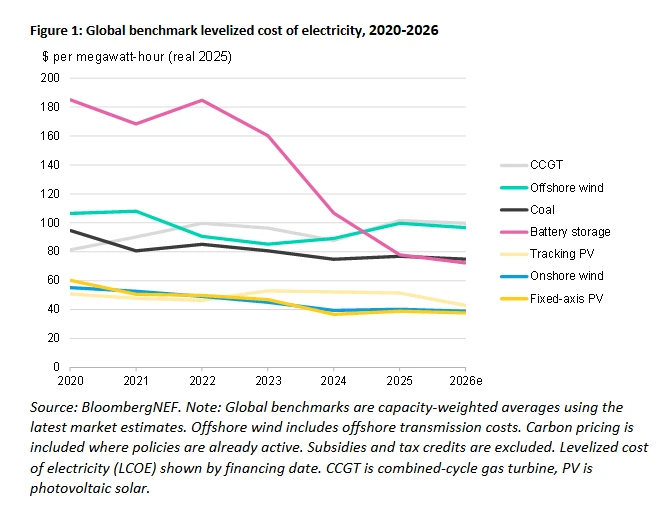
1. Note pink line's name: https://assets.bbhub.io/image/v1/resize?width=auto&type=webp...
(from article: https://about.bnef.com/insights/clean-energy/battery-storage...)
2. Literally everybody knows this. 2006 wants their memes back. Why do people bring this up without realising that demand is lower at night, with shops and factories being closed etc.? Even the duck curve thing is solved with just 1-2 hours of storage.
A quick DDG search says that other nearby countries with higher % of specifically solar (e.g. Luxembourg, Hungary, Netherlands), have lower consumer electricity prices than Germany, ergo solar itself isn't what's causing the high consumer prices in Germany.
And it's not like batteries are even expensive any more, at least not when bought in bulk.
> You can't just take some average,
Sure you can.
Consider a consumer with a constant demand (to make the maths easier, still works if not):
Option 1: use only the thing which works 24/7, but costs €1/kWh
Option 2: use the thing which works 50% of the time and while working costs €0.05/kWh, and the rest of the time go back to option 1.
Option 1 costs €24/day
Option 2 costs (50% * €1/kWh * 24h) + (50% * €0.05/kWh * 24h) = €12.6/day, or €0.525/kWh.
(PV is of course weirder than that, because it's shaped more like "Over the next 35 years it will emit X joules for your initial investment of Y money", so you're pre-paying for something, and also it's immune to any inflation, and there's a long side-discussion about financing here I'll skip as you seem to be refusing to accept even the fundamentals).
> stable energy source like nuclear or coal which doesn't need these backups.
They absolutely do need backups, their downtime is higher than you may expect.
This is, in fact, why even coal rich countries don't only use coal. Why nuclear-happy France doesn't only use nuclear. Etc.
Dismissing the cost benefits of renewables "because they need some kind of backup" is like dismissing the travel benefits of planes because the airspace around them gets closed every night, or like refusing to use a bike ever because sometimes you need to buy a new fridge and that won't fit on a bike trailer.
Or dismissing oil because of the two stupid wars currently going on, and how much they impact oil.
Er... No?
Electricity prices in Germany are lower than last year.
https://www.zeit.de/wirtschaft/energiemonitor-strompreis-gas...
I mean higher than in other countries with less solar energy, like France, which has mostly nuclear.
This seems to be a good question for an the LLM of you choice. I've asked one and after some search:
Wholesale prices:
- Germany ~€0.089/kWh - Factor 2.94 to consumer Price
- France ~€0.061/kWh - Factor 2.92 to consumer price
- Spain. ~€0.065/kWh - Factor 2.82 to consumer price
The reason seems to be that this price is driven by the tech that is used to fill the gaps what demand is high.
And coal/gas make this expensive.
- Germany needs a lot of coal/gas at some times
- France has nuclear so less coal/gas is needed
- Spain just has a lot of renewables and needs way less coal/gas to compensate
So France is better off because of nuclear... But Spain is doing nearly as well with renewables.
The "saves $" value is based on fossil fuels, not nuclear.
"Saving money" in an absolute sense is very different from "saving money compared to fossil fuels". The headline talks about the former.
Did you consider that Germany has solar because of high energy prices?
Do you have any evidence that this is true?
Logic. If energy is already cheap, building out any new power source is unnecessary.
Once you've determined you need new electricity generation, the cheapest source tends to get built. Right now that's solar; that's an objective fact.
That's not how it went through. The Green party in Germany heavily pushed against nuclear energy and coal energy and for solar energy. Now nuclear has been phased out and solar is here. Energy prices have gone up. Possibly because solar is extremely expensive during the night or on overcast days, so expensive gas power plants have to be used during that time. The old nuclear and coal plants would have been cheaper than replacing them with solar and gas.
> Now nuclear has been phased out
You can't really blame solar for phasing out nuclear. That was a political decision. Uranium mostly comes from Russia and China too, so it's not like it was geopolitically "safer" than gas.
> The old nuclear and coal plants would have been cheaper than replacing them with solar and gas.
Gas's share of electricity generation has not meaningfully changed in Germany since 2015. [1] It's ranged from 80 to 95 TWh. Last year it was 82 TWh.
That data also shows coal's share of generation reducing since 2022. If coal is really cheaper than solar and wind, why is Germany using less of it?
> Possibly because solar is extremely expensive during the night or on overcast days
Today gas power plants cover the shortage. As I've already showed you, Germany isn't using meaningfully more gas than it used to even during nuclear's heyday (which was in 2006, when nuclear generated 167 TWh and 74.6TWh came from gas).
Solar and batteries are already cheaper than gas in sunny climes. [2] It's only a matter of time before they're the cheapest source of nighttime power in Germany.
You're operating on information from 3 years ago and haven't changed your mind since then.
1. https://ember-energy.org/data/electricity-data-explorer/?ent...
2. https://ember-energy.org/app/uploads/2025/06/Ember-24-Hour-S...
> You can't really blame solar for phasing out nuclear. That was a political decision.
You can't say solar "saves" Germany money when this is apparently not the case. You can't just selectively count the cases where solar replaced an energy source which happens to be more expensive than solar. Solar saves you money if and only if its implementation, including backups, is less expensive than what was used previously, whatever it was.
> Gas's share of electricity generation has not meaningfully changed in Germany since 2015. [1] It's ranged from 80 to 95 TWh. Last year it was 82 TWh.
What then explains Germany's high electricity prices?
> That data also shows coal's share of generation reducing since 2022. If coal is really cheaper than solar and wind, why is Germany using less of it?
Because the Greens and other environmentalists pushed for using less coal. Just like they pushed heavily against nuclear. And in favor of heavy subsidies for solar. It was a political decision, not an economical one.
> Solar and batteries are already cheaper than gas in sunny climes. [2] It's only a matter of time before they're the cheapest source of nighttime power in Germany.
Even if that report is correct (Ember is a solar energy company so that information could be heavily biased) that doesn't mean they would be cheaper than nuclear and coal would have been during the night in the past, or that switching from nuclear and coal to solar and backups didn't increase, rather than decrease, energy prices.
It's maybe worth to study the composition of energy prices in Germany: https://energiewende.bundeswirtschaftsministerium.de/EWD/Red...
The higher prices are partly artificial: surcharges for offshore wind and special-grid-use surcharge, subsidies for 'co-generation of electricity and heat and to compensate for the burden caused by the Combined Heat and Power Act' , the concession fee, VAT. Except for the offshore wind surcharge, all the others would exist no matter the fuel you use. Together with 43% procurement charges - which would also exist independent of the fuel used, all of these explain your bill. Substituting the renewables with coal or nuclear would only marginally lower your prices.
Maybe if they would cut their $5.9B subsidies for coal, which are also in your bill, prices could go down a little more.
Edit: the numbers for subsidies in fossile fuels were wrong, not 1.9 but 5.9
https://www.diw.de/de/diw_01.c.827737.de/nachrichten/schluss...
> You can't just selectively count the cases where solar replaced an energy source which happens to be more expensive than solar
Wait so you're admitting nuclear actually was more expensive than solar?
> What then explains Germany's high electricity prices?
You've already been given an explanation in this comment thread: https://news.ycombinator.com/item?id=48462996 which you chose not to accept.
> Because the Greens and other environmentalists pushed for using less coal. Just like they pushed heavily against nuclear
I'm supposed to believe the plucky brave environmentalists actually won against money? Please. When has that ever happened?
> Ember is a solar energy company
It's a non-profit think tank, so wrong on both counts.
The price of electricity is set by the marginal cost of the most expensive individual source - if your grid is 80% solar, 20% coal, the price you pay is the price of coal, because the solar providers can increase their prices to just below that of coal. Obviously I'm simplifying somewhat, but that's the general dynamic.
This is "by design" in the sense that it offers big subsidies to more solar generation to come online, but you won't see the biggest price cuts until the last expensive sources are pushed off the grid entirely. Because Germany's marginal source is coal, they pay way more than countries whose marginal source is gas or nuclear.
Germany replaced a lot of its nuclear energy with solar. If this makes energy more expensive, solar is doing the opposite of saving money.
_-_renewable_energy.svg)
And yet all solar gear installed comes from China. Source: I am electrician installing it.
Is anyone else manufacturing it at comparable prices yet?
It's hard to compete with slave wages
It's hard to compete with dark factories.
Going forward, a big factor in (lack of) "made in Europe" isn't high wages. It's that a) much manufacturing capacity was lost because it was offshored decades ago. It takes ages to restore that. And b) "how many jobs does it provide?" has traditionally weighed heavily in policy decisions.
Once robotization kicks in bigtime, it doesn't matter where labor is cheap. It matters where energy or raw materials are cheap. Or supply lines are short.
Like it or not, China is way ahead on that curve.
Where were the shoes that you are currently wearing manufactured?
I mean... so? The immediate alternative is gas, where most of the _fuel_ comes from various dubiously-friendly regimes. At least once the solar panels are in place, China's permission isn't required for them to produce power.
Curious; why is that an issue?
So? Does every country that has oil also manufacture their own drills, rigs, and oil tankers?
Is it good or bad or it doesn't matter for climate?
I'm sorry, that really just comes across as racism.
There's virtually an infinite number ways to assess something like this, and a single figure out of context is meaningless.
What's the deprecation schedule? Which financial "context" is it calculated within? A household may benefit from governmental support and profitable, while the aggregate financial situation may or may not be so. What timeline is it calculated on? A 5-10 year window may be unprofitable, while a larger one may be. An even longer one may change numbers completely...
$135M a day is almost nothing (~$50b/yr) for an area with combined GDP of ~$30T.
Edit: People's general understanding of the scale of economies is genuinely terrifying to witness.
It's not nothing. Plus the fact that it's money not not getting shipped out of Europe to hostile regions is a net win.
Where are the panels sourced from?
Most panels are from China. Panels have a very long lifetime. Over their lifetime they generate way more than their price in oil. Europe is not a huge producer of oil and relies on imports to sustain its usage. Sourcing panels is effectively reducing the amount of money leaving Europe in the long term.
China. With that said, they have so much solar PV capacity that they’re barely breaking even, even when exporting tens of GW of PV panels a month. I argue it’s a net positive the solar PV printers in China are kept in business to maintain their annual output, the world needs as much solar PV as it can produce as fast as possible.
50 billion dollars a year is never "almost nothing".
It's basically nothing for a entire continent, let's be real.
It's enough to fund more than a 10% increase in installed solar capacity in the EU, so if all that energy were to be used to save money, double solar capacity every 7 years - or 10 years if assuming that 3% of all panels are retired annually.
Somewhere between 6-9% of total retail electricity spend. So, not almost nothing.
If we're talking about money not spent, aren't savings almost unlimited just from mechanization? The train, the car, the shopping cart, the dishwasher may be saving us all several economies worth of work on a daily basis
$50b/yr is not going to support the terrorism around the world
Of course we can hope for more, but would you agree it is a good start though?
This capital saved (~$50B/year) can be recycled into more renewables, storage, transmission, and EVs to further drive down future petroleum demand, creating even more savings into the future. Stocks vs flows. Price of clean tech keeps rapidly falling, investment will continue to ramp. Think like a flywheel.