Monero Community Crowdfunding System
ccs.getmonero.orgI'll echo the sentiment that Monero seems like the "best" cryptocurrency in that it has all of the benefits of Bitcoin + actual privacy.
And interestingly, it's one of the least-used least-hyped options. It's as though we didn't actually want privacy in our money system.
I think a hint into this is actually in one of these posted features: https://repo.getmonero.org/monero-project/ccs-proposals/-/me...
One of the reasons for building a proper payments system is "Casino games"...
It seems that many high-quality things (or otherwise aspirational things) take on Esperanto names (disclosure, I am an Esperantist). While Monero is no doubt a cool crypto-currency, it is even cooler that it has inspired some crypto-curious people to learn Esperanto[1] instead!
While I am here, I might as well give you a brief Esperanto lesson. Mono = money, ero = piece/quantum. So, "pano" = bread, "panero" = bread-crumb. Thus, "monero" = coin.
Many previous international currencies (all of them created with Swiss involvement), were also given Esperanto names: Spesmilo (thousand speso's (speso is analogous to "penny")), Stelo (star).
There is even a luxury watch-brand (from Switzerland) called "Movado", which is Esperanto for "Movement" (made back when watches were made with mechanical movements).
And I also learned, from the linked thread (disclosure, I am a participant), that there is a soft-drink called "Mirinda". This is an adjective that means "awe-worthy".
[1]: https://www.reddit.com/r/Esperanto/comments/1sobiko/comment/...
> interestingly, it's one of the least-used least-hyped options. It's as though we didn't actually want privacy in our money system.
There is lots of interest from individuals. But governments all around the world have done their best to suppress it. They indeed do not like privacy and independence. They are the ones who sued and pressured exchanges into delisting Monero.
Its been made very difficult to actually buy it
You can go to an ATM and purchase a coin and use a DEX to convert almost instantly.
wouldn't that defeat the privacy purpose? wouldn't someone be able to see that it was your card in the ATM, when they traced back the monero as exchanged for a coin that was exchanged for your fiat?
ETA: just to be clear - that's a genuine question. I don't know much about monero, so if it really is possible to have untraceable money, that seems like a prudent investment for precaution. I've just always assumed that digital money is inherently traceable, so I always assumed genuine privacy is a mirage. I assume I'm wrong about that, somehow, so I'm curious about the mechanisms of that anonymity.
The DEX will likely leak the fact that you received the monero, but after that there is no more paper trail. So you can spend it as you like.
so would that be a feature of monero-to-monero transactions? I'm still confused as to how it would actually be anonymous? like if I used another coin to exchange for monero, that's obviously traceable. so then I use monero to purchase something else which I then sell for other monero (or I just trade monero directly? if that's possible?). and I'm to believe that there's no way to trace that back and say "okay, monero from wallet X was traded to wallet Y" or whatever other intermediate steps (like"monero was spent on X from wallet A, and then X was resold using monero from wallet B")? like, assuming they don't get in to my wallet, no one would be able to track down a transaction on the chain to a wallet? Or they would be able to track it to a wallet, but they couldn't tie that wallet to me for... some reason?
sorry to ask, but the website seems very light on any actual technical detail about how they are achieving their privacy claims - at least in terms I can parse to make them understandable to me.
The flagged post in reply to you is correct. Each transaction is buried in one time addresses and decoy addresses.
very cool, thanks! And since I can't respond to that poster, I'll say it here: thanks for that detailed answer! That definitely seems like a pretty anonymous system. I'm convinced that monero is a pretty private coin!
Part of the reason is that you can’t buy it on Coinbase.
Because of government pressure. It was delisted by lots of exchanges purely based on government fear of privacy and independence, not any technical or demand reasons.
The CEX that do list it, it is essentially a trap. As soon as you do something with XMR they start freezing your account and demanding all sorts of KYC/AML. That is my experience after playing with it by pulling out a couple hundred $ and doing nothing with it other than putting it back on an exchange.
Monero is far more bloated than Bitcoin, paying a high price for its privacy features, most of which (no visible amount or address) can be had while making even Bitcoin look bloated [1].
[1] https://np.reddit.com/r/grincoin/comments/mu88ow/comment/gv6...
> paying a high price
Monero's transaction fees are less than Bitcoin's:
https://bitinfocharts.com/comparison/transactionfees-btc-xmr...
And Monero's fees decrease with larger block sizes (Monero has dynamic block sizes) whereas Bitcoin has a fixed block size and fees must increase to compete to be included in the block.
I wasn't talking about fees, but about chain size, utxo set size, and code complexity. Fees are always low when blocks are far from full.
> when blocks are far from full.
And when they're not?
But Monero transactions confirm more quickly, the first confirmation usually takes just two or three minutes.
Coinbase doesnt sell it which annoys me, but probably due to legal regulation I am sure. Its a shame too, I think its probably one of the most interesting cryptocurrencies.
Privacy is available in bitcoin as a layer-2 solution such as Lightning. When Trump made the popular and media-broadcast bitcoin transaction during his campaign, he did so over lightning. Privacy alone is thus not a big reason to abandon bitcoin and move over to another chain.
Monero has consistently exceeded the rest of crypto in community, integrity to mission, and use-case. True digital cash.
FCMP++ upgrade will be huge for sender privacy bringing Monero's technical strength in line with ZCash.
The new site[1] looks great as well; it was funded by the CCS.
Very awesome set of replies you’ve left in this thread. So nice to see.
I will be buying some Monero for the first time because of this thread.
I'm glad you gained something! Welcome to Monero!
Drop a Monero address here and I'll send you a tiny amount for your first transaction.
I recommend CakeWallet, which is cross-platform, user friendly, and does a lot of good for the community, but any of the wallets recommended on the official[1] website are fine.
p.s. you or anyone can reach out via my contacts in bio if you have any questions about Monero.
I used the Monero GUI wallet, but it has always historically got flagged as malware by Windows, which I'm sure puts a lot of people off.
Thank you for that offer, that's very kind of you.
My new address is
49jUau1t16ZPtBNFaJ2o5eW79x6Fui14AbqwQyovBe2V6LdwgWrHkniWTV9dj7tAY8SRxsshkmQEwLCBYUvPFEkZBJGZt6n
Where do you recommend trading dollars -> Monero?
KYC[1] methods are the easiest and what I recommend for everyone. I will only go into detail with KYC methods in this post.
A. Determine where you are. Are you in a jurisdiction that has CEXs[2] that allow you to purchase Monero with Fiat? If so, Continue to B; otheriwse, continue to C.
B. If you are in the USA/Country where you can buy Monero directly:
1. Open a Kraken[3] account. You will need to prove your identity through a service like Persona.
2. Send money into Kraken from your bank or credit card.
3. Purchase Monero on Kraken with your deposited funds.
4. 7-day hold and then you will be able to withdraw to your self-custody wallet.
Conclusion: You now own Monero. You have payed minimal fees. The government and entire financial system knows you have purchased Monero.
This may or may not be a concern depending on your threat model[4]. Many people overstate this threat—Monero is the 14th largest Cryptocurrency by market cap, it is not particularly suspicious to purchase it. It does not compromise your future Monero transactions—it is just like withdrawing cash from an ATM, the financial system and government know that you now hold cash, but what it is used for is opaque.
C. If you are not in the USA/are in a jurisdiction where you can't buy Monero directly:
1. Open an account on any KYC CEX, I recommend Kraken. You will need to prove your identity through a service like Persona.
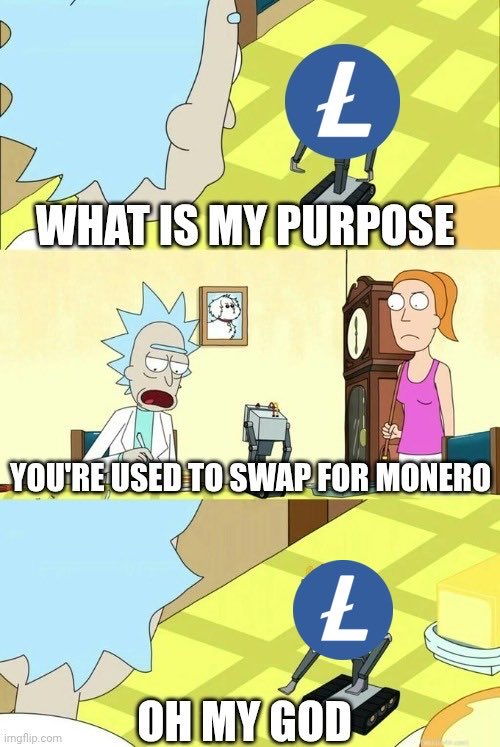
2. Purchase any coin. I recommend Litecoin[5], but Bitcoin or anything works.
3. Create a self-custody wallet for Litecoin, I recommend CakeWallet.
4. Withdraw your Litecoin to CakeWallet.
5. Go to Trocador[6].
6. Create a swap from Litecoin to Monero.
7. Give Trocador one of your Monero addresses to send the converted Monero to.
8. Choose the exchange with the best fees/privacy to your liking (these change throughout the day).
9. Send your Litecoin from CakeWallet to the Litecoin address provided.
10. You will shortly receive Monero to the address you gave Trocador.
Conclusion: You now own Monero. You have payed a small amount of fees. Depending on the pervasiveness and intelligence of blockchain surveillance, the financial system and the government knows that you have purchased Monero, or has the ability to figure out that you have purchased Monero.
All your future transactions are anonymous. Remember, Monero is just patching one hole in making an anonymous transaction. It does not magically make you anonymous if any of these other things are not anonymous: OS, browser, IP address, identities, etc.
[1] Know-your-customer — they say it's to stop crime.
[2] Centralized Exchange
[3] As respected of a CEX as you will get. They support Monero while most other CEXs have removed it.
[4] https://www.privacyguides.org/en/basics/threat-modeling/
[5] Low fee POW (proof of work) crypto. The second crypto to be created after Bitcoin. https://pbs.twimg.com/media/HDyfsemWoAAOLVM.jpg
[6] [https://trocador.app Highly reputable instant exchange aggregator. They do not touch your funds, they just aggregate other instant exchanges and provide a guarantee for no-KYC. Excellent customer support. You will pay about a 1% fee converting your crypto through an instant exchange. Instant exchanges are CEXs, but since they deal only in Crypto and not Fiat, they can afford to easily be no-KYC.
I would actually recommend to just use a hardware wallet. The monero-cli or the Monero GUI-Wallet are sufficient. Just drop your wallet onto an USB stick with LUKS encryption. Get your recovery seed + wallet height written by hand and bury them somewhere in your garden, or your parents garden in safe box.
Drop me your address, and I will also send a little bit your way, to get you hooked!
Cypherpunks write code.
45nQZrXEDSL8UPj7DeJRrcdFkAteCajG4bGGsQP7cmWwiZU63dpfWe9RPpas38BAU4Kwv5NSKBsnacXewQszMhrx7fgTQLe
Your username does not match with the person the offer was made to. Please do not beg for money here.
Monero is what Bitcoin wanted to be
Monero has fixed inflation baked in, so no.
> fixed inflation
It looks like you're referring to the tail emission which solves the problem that Bitcoin has.
Also, it is a small fixed amount of "coins", so the actual inflation rate approaches zero.
I think your comment is what they call "F.U.D."
> which solves the problem that Bitcoin has
Which problem are you talking about? It being deflationary? You might not think it's a good idea, but it's not a problem if it's by design.
Once there are no more block rewards, Bitcoin will only rely on fees to incentivize miners.
So either fees will be expensive, or there won't be miners securing the blockchain.
Gotcha. Well it's by design, as Satoshi believed it not to be a problem. Only time will tell.
> so the actual inflation rate approaches zero.
Now THAT is FUD. Current annual inflation rate is 0.84191433% [0]. That is massive and not "approaches zero". The value of Monero over n-years thus approaches zero over time, for big enough n.
While that is a little under 1%, it is still inflation. The ECB targets on average 2% inflation (while before COVID the ECB targeted maximum of 2% - so actually close to the Monero inflation).
Thank you?
It looks like we have different definitions of "massive".
You also say it does not approach zero, but in the following sentence you do say it approaches zero.
I guess people need to decide if inflationary money is better or worse than deflationary money, and what amount of inflation is appropriate.
Personally, without too much thought: I think a monetary inflation rate should correlate with the population inflation rate, so that it's value remains somewhat constant (I'm open to changing this opinion with more information).
They only fund friends and are quite sketchy so the CCS is not the best thing ever
Even if that was true. Are you saying that EVERYONE that gets funded was there from the start of Monero, 12 years ago, and is part of this secret club? Since that is obviously not true, if "they only fund friends", then I guess people must be able to make new friends.
Would someone please explain to me the pros and cons of this existing?
The US Federal Government specifically calls out Monero as one of the coins that it hates, which means that it must be quite effective at achieving its goals. So the pro is that you know it works. The cons are nothing specific to Monero, just general criticism of cryptocurrencies. Not being a deep crypto user myself, at least, I haven't heard anyone speak of any flaw specific to Monero that isn't shared by a significant portion of the remainder of all of these coins
One admittedly minor issue is that since monero is ASIC resistant, its very attractive to run on compromised computers. Other coins suffer this as well I'm sure, but I don't have any data on this. I guess this is mainly a hunch.
> The US Federal Government specifically calls out Monero as one of the coins that it hates, which means that it must be quite effective at achieving its goals. So the pro is that you know it works.
Official condemnation doesn't work like that. Facebook's cryptocurrency, Libra, was also condemned, and we know it didn't work because it never actually existed.
Do you already know how a regular Cryptocurrency works and want to know about Monero specifically? Or do you not know anything about Crypto?
I am very aware of cryptocurrency, some of the intricacies, and possibly most of the use cases.
I asked an honest question about the pros and cons. Every technology has pros and cons, right?
Monero is the most anonymous of the mainstream cryptocurrencies. That's also the reason why it is increasingly outlawed (at least in the EU).
Which is its biggest weakness. Lightning over Bitcoin is decently anonymous, too. Given that is just a layer-2 technology and can be developed further and evolutes outside of Bitcoin protocol changes, makes it more flexible and has shorter innovation cycles.
And outlawing bitcoin has become basically impossible after the large amount of ETF inflows. Monero is nice technology, but I think the ship has already sailed for Bitcoin (and L2 solutions like lightning).
> decently anonymous
"decently"?
It's either anonymous or not.
And the lightning node operator can see the transactions, so no, it's not anonymous.
Anonymity is not binary 0 or 1. There is a difference in there is a one-in-a-million chance that you made a payment, is not the same as there is a one-in-three chance you did the payment. You can define anonymity to be a one-in-a-billion chance, and all lower odds as "not anonymous". But that is not applicable in the real world.
Isn´t the experiment in El Salvador proof that Bitcoin does not work as a currency? If you think it isn't, then do you have any measurable pass/fail test for it?
El Salvador is the worst example, as they have been bribed by the IMF to get rid of bitcoin. I would also wan't to learn how the situation in El Salvador would be any different if they adopted Monero instead - I think it would be the same outcode.
I am not a bitcoin-as-currency evangelist. I see it more as digital gold, and gold is not a currency today. It will have its role as a store of value and fallback unit of trade that keeps government currencies in check - another pillar in financial checks-and-balances.
> El Salvador is the worst example, as they have been bribed by the IMF to get rid of bitcoin.
So the 'true cryptocurrency' hasn't been tried yet, eh? ;)
That was not my argument at all. First I said, I don't see bitcoin as currency at all. Second, major nation states have always tryed to use their power to force other nations to use their currency (petrodollar, cough). This is nothing specific to crypto, but something also specific to traditional fiat currencies.
Any high-volatile asset such as bitcoin is IMHO not suited as currency. The good news is, with the bitcoin taproot upgrade and latest lightning standards, you can actually issue stablecoins over bitcoin's taproot asset protocol, and send it over the existing lightning network. My bet is on stablecoins-over-lightning as currency, and bitcoin as store of value. One blockchain to rule them all, other chains not need (for financial transactions at least).
Bitcoin takes to long to settle, and whilst its settling will need some sort of escrow service to take the risk out for small retailers and consumers.
Plus the global transaction rate would also stop it really being useful for day to day spending for a country.
You replied to me but did not address lightninng. Lightning settles instantly. And you DO transfer bitcoin.
> And you DO transfer bitcoin.
No, Layer-2 systems only transfer cryptographically signed IOUs between nodes.
Settlement only happens when these IOUs are cashed out, and to cash out you need a transaction in the blockchain layer, so the point about latency still stands.
It is as much an IOU as the US Dollar was pre-1971. That is a pretty good image for Lightning/Bitcoins relationship. Lightning is the dollar with a guarantee that you can convert it to gold anytime you like by presenting it at the central bank. Very few people ever converted their USD to the underlying gold as a settlement transaction. The difference with lightning is, the government can't just rug-pull you and stop exchanging those paper bill IOUs - it is cryptograhpically secured that you can always convert to bitcoin. Since no one would consider exchaging dollars as settling in gold, lightning settlement is not tied to on-chain transactions.
Payment channels are possible on other networks as well. Once again, there is no inherent advantage to Bitcoin here. I know because I worked on one (https://raiden.network/). I also dealt with many of its failure modes:
But more than anything: people do not want to use crypto for payments. It gives them no significant advantage over traditional credit/debit cards, it has no built-in solution for appeals or reversals and it forces them to learn a bunch of stuff to be minimally safe...- insufficient liquidity on intemediate nodes - network partitions - uncooperative nodes - nodes that were liquidity sinks and forced other participants to bear the costs of deposits - insufficient market makers> Payment channels are possible on other networks as well
you are moving the goalpost in the discussion of this thread. User KaierPro said bitcoin would not be suitable because transactions takes to long, to which is responded lightning solves that. Now claiming that other cryptos can have layers-2 is correct, but adds nothing to the discussion or my initial point. Yes other chains have faster settlement times, and can have their respective payment channels - no one argued against that.
> which is responded lightning solves that
Theoretically.
In practice, it has shown that it is only viable if adoption by number of nodes and TVL grew by orders of magnitude, and both are very unlikely to happen because - like I said - spenders have nothing to gain from it and no matter how much of the UX friction is solved, it will never be as easy as paying with credit card.
The only people who want to use Lightning are the ones who are invested in Bitcoin. Everyone else just want simple/safe access to a payment network.
You are just moving the goalpost again, without adding to the discussion. If spenders have nothing to gain because they prefer creditcards, then this argument applies to bitcoin/lightning, monero and all other cryptos all the same. Nothing to do with my initial point which was comparing lightning/bitcoin to monero.
> If spenders have nothing to gain because they prefer creditcards, then this argument applies to bitcoin/lightning, monero and all other cryptos all the same.
Most spenders will prefer credit cards, but there is a non-zero group where absolute privacy is important and monero is the better choice, therefore more valuable to them.
You are the one trying to make some false equivalency by saying that "bitcoin/lightning is good enough for most cases, therefore there is no need for monero".
The problem is that you are starting with the conclusion that you want (i.e, "Bitcoin is the best") and you are working backwards from this conclusion to make all sorts of rationalizations. Try going from the use case first and then let's see where the reasoning takes you. You will see that for pretty much ANY use-case, Bitcoin is not the answer.
It is splitting words. There is a settlement layer in lightning, which is presenting the preimage and unpeeling the onion HLTCs in reverse order. This happens at the latency of the network path, so usually less than a second. Bitcoin settling is usually tied to confirmation in the block, which lasts ~10minutes. Lightning might be IOUs, but ones that are fungible themselves and not tied to a specific debtor. Actual lightning-to-bitcoin cashout would probably not happen for everyday use, or at least not more often than you change bankaccounts in todays terms.
That's intellectually dishonest. It's like saying wire transfers or card payments are only valid after interbank settlements are finalized.
Bitcoin Lightning is cryptographically designed to be valid even if it's not yet settled on the main layer. It provides cryptographically sound mechanisms to overrule anyone that tries to "cheat". There is no mathematical way to cancel or double spend it, just like your dollars are valid when the transaction is committed in your bank's database although the money still technically hasn't left the other bank.
There are plenty of failure modes where you can lose your funds even if your wallet keys are not compromised. Try running a lightning node, make transactions worth more than a few hundred dollars and then leave your node offline for a few days. Or even more simply: ask yourself what happens to your funds if the disk on your lightning node goes bust and you don't have a recent backup.
THis is the issue, until its settled in the chain, then you are down to trusting the 2nd layer.
Anything offchain has a whole bunch of issues that are either naively or deliberately obscured by the fact that it _eventually_ writes to the blockchain. The exchanges that offer instant settlement are circumventing trust by doing the settlement for you. You get speed, but not security that they have done what they have said they have.
Well, to be fair to OP: small business and retailers are also not getting "real" money when they accept payment via credit cards from Visa/MasterCard.
To be honest I think the issue here is not due to speed of settlement, but layer-2 is not an acceptable substitute because it does not allow reversability. For the merchants it's good that they are getting the money right away, but most consumers will not dare to pay anything via layer-2 networks simply because they won't have any recourse in case they want to undo the transaction.
You can implement reverseability with a credit system, such as Visa/Mastercard. It should not be implemented in base layer or layer-2. It is basically an escrow system.
So now you are proposing to build yet-another piece to an already complex system just so we can justify the existence of your beloved blockchain in the first place.
How long it's going to take you to realize that even if we built everything you are asking for, we are STILL going to end up with a system that is not as capital-efficient as the status quo?
This is just untrue. If someone cheats in lightning, and you demonstrate they cheated as you describe, then you get all of the locked BTC as a reward. This is on layer 1. Essentially you can easily prove your nonce was signed more recently.
> they have been bribed by the IMF to get rid of bitcoin
And the US government is being bribed by Silicon Valley to adopt crypto...
> I am not a bitcoin-as-currency evangelist
Then why all the talk about Lighning and the dismissal of Monero?
Because lightning uses Bitcoin's blockchain, which is the most secured (as in energy) and the most common (as in market cap) and probably the most accepted as in regulation. Plus, you can use bitcoins taproot asset protocol to issue stablecoins and send them over lightning. No other blockchain needed - which in my opinion, renders monero obsolete or at least a very niche product.
- Lightning is not fully anonymous. It can still be traced by the participating nodes.
- Ethereum's blockchain consumes less energy, is more decentralized, it's a lot more resistent to any form of attack and it can also host fixed-supply coins.
- Market cap is a meaningless metric, it's at best circular logic and at worst it's just a "one billion flies can't be wrong" argumentum ad populum.
- It baffles me how the Bitcoin enthusiasts talk so much about ideology and freedom, but get completely silent about the fact that most mining operations are done in countries with oppressive regimes, financed or subsidized by dictators with access to cheap fossil fuels.
> Lightning is not fully anonymous. It can still be traced by the participating nodes.
"Fully anonymous" is a strong term. Even cash is not fully anonymous. I would give monero that it is more anonymous than lightning because it is a core design principal. There is a spectrum to anonymity, however. As public enemy number one, such as Snowden or BinLaden, your anonymity requirements are different than a citizen buying illegal erectile dysfunction medication online.
If you consider the new features added in lightning over the past 24 months such as trampoline payments, blinded paths etc. - you will find that lightning is anonymous enough. Plus, you can increase anonymity in the client implementation at the expense of higher transaction fees (longer paths, more trampolines). Lightning's BOLT12 standard, which is currently finalized, will increase anonymity even further.
> Ethereum's blockchain consumes less energy, is more decentralized, it's a lot more resistent to any form of attack and it can also host fixed-supply coins.
Thats is factually untrue. First, ethereum famously had a human-coordinated rollback with a controlled restart organized between devs and node runners over Discord. Second, Ethereum is not decentralzied at all, because that is a core property of proof-of-stake: There is no way at any given time that you can be sure that the majority stake is not already in a single entities (or colluding group) possesion - and would thus have absolute control. It is therefore never guaranteed at any given time, that the network is decentralized.
> Market cap is a meaningless metric, it's at best circular logic and at worst it's just a "one billion flies can't be wrong" argumentum ad populum.
Price is ultimately what determines the value of anything. It is absolutely far from meaningless, as the market cap is also a big factor if a crypto asset can be outlawed or banned. Given how many investors in the west already own bitcoin, there would be a massive outcry if it is suddenly outlawed. I say you could outlaw Monero tomorrow and the mainstream media wouldn't even cover it.
> It baffles me how the Bitcoin enthusiasts talk so much about ideology and freedom, but get completely silent about the fact that most mining operations are done in countries with oppressive regimes, financed or subsidized by dictators with access to cheap fossil fuels.
You mean, such as the United States? Because the US (especially Texas) is one of the biggest miners of bitcoin currently.
> There is a spectrum to anonymity, however.
But you can only make any claims about the properties of a system when looking at the extremes. If Bitcoin's blockchain does not make strong anonymity guarantees as Monero, then Bitcoin by definition can not be the "blockchain to rule them all" that you so desperately want.
>ethereum famously had a human-coordinated rollback with a controlled restart organized between devs and node runners over Discord.
That was achieved through social coordination. No backdoor was exploited, no one had their coins stolen on the original chain. The system worked as intended.
Can you say the same about Bitcoin? Do you think that all these banks and exchanges trading ETFs have secured access to the bitcoins they claim to have? When one of these institutions goes bust, who is going to bail them out?
You keep trying to argue that Bitcoin is more valuable because it is more likely to be supported by the powers-that-be, and that is the strongest indicator that all your evangelism is driven by "Greater Fool" dynamic. Satoshi's idea for crytocurrencies was to have an alternative system that worked despite adversarial governments, yet we keep getting time-and-again evidence that it can only work if it becomes of an instrument for the powerful institutions that caused the problems in the first place.
Bitcoin and its blockchain has no intrinsic value. Unlike Monero, it is not fully anonymous. Unlike Ethereum, it has no utility for decentralized applications. It can not be used as a currency. All Bitcoin has is first-mover advantage and a huge number of people with cognitive dissonance trying to keep the bubble inflated.
> Because the US (especially Texas) is one of the biggest miners of bitcoin currently.
Access to cheap fossil fuels? Check.
Facilitated by the government? Check!
Serving the interests of the elites and the aspirational 14% instead of the general populace? Check!
Maybe I did not state my orinignal question correctly.
What are the pros of Monero, and what are the cons?
Really up to you personally what is a pro and a con. For me this is a starting list. A lot of these are a result of the technical differences as well as I listed the technical differences.
Pros:
1% inflation
no fixed supply (makes it more of a currency than an asset)
privacy by default,
fungibility—every coin is the exact same, no coin history
prevents financial surveillance by corporations,
protects against government abuses,
useful tool for activists, journalists, minorities, useful for domestic abuse survivors,
useful for businesses sending money across borders,
protects against stalkers,
protects against advertisers profiling you,
reduces identity theft,
prevents databreaches of personal info,
pushes forward cryptography,
allows people to purchase drugs (you decide if this is good or bad),
prevents financial censorship,
allows anonymous donations,
low fees,
more decentralized than bitcoin due to RandomX CPU mining,
prevents crypto robbery,
allows you to buy your adult content without anyone knowing.
large developer community iirc 3rd after bitcoin, eth
less volatile than other cryptos
usually most used crypto for payments when accepted at merchants
Cons:
20 minutes to use funds again
hard to aquire
number go up slower
hard to convert back to fiat
hard to convert to fiat
used by "criminals"
lots of nazis like it
used for unethical purposes
All of the pros - minus the inflation - also exist for Bitcoin-over-Lightning. Non of the cons exist for Lightning. Especially no waiting time. In lightning you can spend your received bitcoin after a split-second - no waiting whatsoever.
I had a terrible experience trying out Lightning. Could you tell me where I went wrong? I hit high fees converting to Lightning, and I hit high fees sending Lightning transactions.
The problem with Lightning or Zcash is that it is not private by default. A private currency has to be private by default, with the option to share info on the transaction—that's Monero.
Lightning is centralized, Chainalysis supports Lighning tracing—it does not support Monero tracing.
You could get the same advantages of Lightning on Bitcoin by making a layer-2 solution on Monero. Monero beats lightning at layer one.
Fees are not part of the technological stack, but the economics behind the providers you chose. Just as with the Internet, you can host your own webserver or datacenter at home and run your own AS in your bedroom. But most people chose to pay someone to do that. Right now regulation kills all sorts of crypto (Monero included) and drives up prices because it is mostly startups that provide services around that, and they are crushed by the paperwork.
> no waiting time
apart from waiting for the confirmation, otherwise you're in double spend territory.
what you says applies to bitcoin onchain, but not lightning. Lightning settles instantly.
pro: if the world devolves into an authoritarean hellscape, people will still have a form of undetectable currency until they find a way to get rid of this
con: this improves the chances if the world to devolving into an authoritarean hellscape
Moreso than controllable, trackable money helps the world devolve "into an authoritarean hellscape"?
Monero needs to step up for quantum safety, not by replacing the existing encryption, but by adding a quantum safety encryption layer on top. Google's recent paper on quantum risks to cryptocurrencies had identified Monero as being at risk. This is not tomorrow's problem; it requires initiating action today, so these efforts can bear fruit by the time the quantum hardware is ready, perhaps by 2029.
All coins are aware of quantum safety requirements, yet quantum computers are still far enough in the future that it makes sense to wait, and first see what those post-quantum mitigations should look like.
Burying the head in the sand doesn't work. Quantum-safe algorithm candidates exist. Post-quantum cryptography is a bonafide field with families of algorithms that exist, e.g. lattice/hash/code/multivariate based. If a user has to choose between two cryptocurrencies, one of which is quantum safe and the other isn't, the user will choose the one that is. The ultimate choice of algorithm doesn't have to be finalized right now; that will remain a work in progress for decades, but getting there is not a one-hop journey.
For comparison, XRP already has a roadmap: https://cryptonews.com/news/ripple-post-quantum-readiness-xr...
Because XRP is not decentralized, it will be easy to upgrade. With bitcoin, you have to convinve the node runners to upgrade - which means the taken patchset must be sound and verified in depth beforehand.
None if the crypto currencies will survive the quantum apocalypse because all the people who can pull off the migration have long left.
I wouldn't worry since AI can do research, identify approaches, and implement them. The human of course needs to review every line with a critical eye, and compare the implementations against their academic specifications.