Artemis II is competency porn
lizplank.substack.comI can't believe the comments here.
"I could have done it better, it's not a big deal, oh, they had women and non white people on board, what even is the shareholder value of this mission, oh it was almost done 50 years ago..."
These people went literally to the moon and back. Furthest anyone has ever been. That's an achievement.
I know things suck right now. Even more reasons to appreciate what is possible with technology.
I agree with the premise of this article. This achievement is inspiring and re-assuring that competency brings results. The alternative is way too depressing AND it mostly is our reality right know.
Throughout the years we've heard concerns that we could no longer go back to the moon because of skill atrophy. This is, at a minimum, a great step towards recovering some lost skills while developing new ones.
People are too lost in their political hysteria to appreciate what a amazing achievement that was.
We're in this mix of living in a time of mass hysteria and so many bots on the internet that it's tough to tell if the comments are real. I want to hope most comments I see aren't real people. It's sad if they are.
TBF there’s very little change on what we can do more than what was achieved in the 60s. The current space boom is a re-do with better tooling. We can put better computers in space and that’s what gives us anything more than what we had before. The moon and Mars are PR stuff and would be cool and maybe inspire engineers or scientists but its still slight incremental upgrade to what we had so far since 60s.
Even the photos are not that much better so far, people compare the OG and many like the old stuff better. Obviously its impressive engineering but we have seen it before.
I will be impressed when we have a large city sized space station with a large transparent dome.
> TBF there’s very little change on what we can do more than what was achieved in the 60s.
People could do backflips and write moving poetry and memorize thousands of digits of pi in the 60s too. Such things were impressive then and they're impressive now.
I could understand someone thinking that the Apollo program was more impressive than the Artemis program, but to think that the Artemis missions are not impressive is completely foreign to me.
Doing it the second time is so less impressive that soviets cancelled their whole human moon landing and Americans stopped paying attention on Apollo 13 and cancelled the program after 17.
Obviously it is huge engineering achievement each time, just not as impressive as it was done before.
"Even the photos are not that much better so far"
We have an incredible eclipse photos with multiple planets in the background. If you don't find photos like that incredible to see I'd guess you need to do some soul searching.
They are impressive photos, the earthrise is my background on my phone and the eclipse is my background on my laptop but they are derivatives of what we had before.
Is one picture of a mountain derivative of another? Are two pictures of a specific human being derivative? No, they are individual creations, even if made using the same camera by the same photographer. Each is an individual work of art, the vision of a particular person capturing a unique, unrepeatable moment.
They are not derivatives, because the photographers are different people and the time and place were decades separated from one another. To call them derivative is to belittle the humans experiencing the events.
In the same way that Cassini was a derivative of Galileo, but around Saturn and with a working antenna. Or Perseverence is a derivative of Curiosity, which is a derivative of Opportunity. Or philosophy is just footnotes on Plato. Or classical music is everyone trying to escape from the shadow of Bach. Or fantasy is just a poorer version of Tolkien.
I suppose there's truth to that, but it unfairly and unhelpful minimizes the accomplishment, and it collapses the awe that the article talks about. If you are viewing the photos as essentially the same, you are shortchanging yourself, because Artemis was not a means for producing photos, those are more like artifacts of production. Again, that would collapse the awe of Artemis.
(Also, technically, I don't think that Artemis is a derivative of Apollo, more like a re-implementation from scratch.)
They are not essentially the same, just not as big deal as the first ones.
Armstrong is the only cooler astronaut than Gagarin even though other astronauts technically achieved much more than Gagarin. Even Gene Cernan isn’t as cool as Gagarin despite spending more than 3 days on the surface of the moon and probably doing much more things outside of the earth than anyone. He’s cool in other ways of course.
Must be tough to enjoy any photo if you see it that way. Even if they launched to Mars, are new photos derivatives of the robot and probe cameras?
Those not impressive/'I don't see progress' images were sent across a brand new optical downlink. Far from boring or 1960s stuff and very much expanding our capabilities type stuff. https://www.nasa.gov/goddard/esc/o2o/
'I want the I can feel it exponential curve part of progress without the slow, long, hard work part at the start of the curve like new boring optical space communication capabilities'
Most things we do are slight incremental upgrades until we put in enough to get to the more exponential/experiential progress that people 'think' is what progress has too look like. Look at cars. They were pretty basic shit boxes with sheet metal/slight tire changes forever (basically my whole life) and suddenly they got way way way better to the point a grocery runner station wagon Rav4 can have insane performance specs and good mpg from a fairly affordable 250,000 mile capable boring vehicle. It took boring incremental work/infrastructure to make workable, slightly larger tires/brake rotors/pads/engine tolerances, then now with toxic components, then slightly larger again, then a little less toxic, repeat.
Are you expecting one day 'Bob's Refractory' decides you know what, let's start making city/county sized impact resistant high stress transparent domes light enough to ship to the moon for dirt cheap, that would be cool, why haven't we been doing that yet?
Why not up the ante a bit; I'll be impressed when they bio-engineer special humans who don't need a dome to live there. Come on, it's been 60 years!!
We could drop Elon Musk and Mark Zuckerberg and Sam Altman and Marc Andreessen out there to see if they're smart enough to evolve.
My money's on M2c A8n: he claims to be from France, but I suspect he's actually from Remulak.
"TBF there’s very little change on what we can do more than what was achieved in the 60s."
Dunning-Krueger in effect here. Because you aren't educated, you think it's simple and hasn't changed.
ok
ofc very much the american way, outside of the region maybe its more read like propaganda... not in all regions people are like this, but its not a bad thing i suppose. Good things can also be leveraged for bad things etc. (not by the ppl involved ofc, but by others and their framing of the facts)
it'd be nice if people gave eachother a little space to be :) and look past the politics of things.
maybe then we would not feel the need to go the furthest out into space ever done and we can remain sometime in each other's proximity without feeling the need to develop nuclear weapons.
While it is obvious that the fact that except for the commander, the crew was composed of a woman, a Canadian and an African-Caribbean-American, cannot have happened by chance, I think that for this kind of mission also achieving a diversity target is perfectly fine.
There is no doubt that the members of the crew were at least equally qualified with the possible members of a less diverse crew, even if their provenance must have influenced the final selection.
Perhaps instead of doubting that it was right to choose crew members belonging to historically disadvantaged minorities, like Canadians :-), one should wonder why only the crew members are diverse, but not their chief, which is a more stereotypical American, as chiefs are expected to be in USA.
A conspiracy theorist can argue both ways, either that choosing a diverse crew was done as a favor to those kinds of people, or on the contrary, that choosing a diverse crew was done as a disfavor to them, to show them who is really their boss.
So no matter what choice is done, people can criticize it for more or less imaginary reasons.
> While it is obvious that the fact that except for the commander, the crew was composed of a woman, a Canadian and an African-Caribbean-American, cannot have happened by chance
Why is this obvious?
Musk and his ilk have mesmerized a lot of people.
It’s easier for them to believe in the fantasy superiority of a rocket which hasn’t achieved orbit than the real achievements of NASA and other space agencies.
It’s supercharged by a desire to politicize science to defend their sexist and white supremacist worldview. It pains them to see people they dismiss achieving great things. There are no able minorities. Just unfairness. A fair world to them is white men on top, everyone else below.
What’s funny is how different they are from the people they idolize. Just as SS officers would be disgusted by your average ICE recruit, you average NASA engineer from Apollo would have seen through Musk in an instant.
A rocket that requires tens of fueling trips to make a single moon run would be an anathema to them and they would call it out of the bad engineering it is.
There is so much anger that reality is stronger than prejudice and whatever they say and do women, brown and disabled people will be increasingly prominent, powerful and influential whatever they wish the case was.
> they had women and non white people on board
I thought this was a straw man, because surely wtf is even the point of this comment, but nope, sure enough, ctrl+f and there are comments like that here. Wow.
> "...oh, they had women and non white people on board..."
That is from the article
It’s a 50 year old achievement.
I couldn’t do it personally but as a nation or humanity, we can do better, even if it was hard.
What year did nasa land on the moon again?
Thanks, edited my comment to reflect this reply.
you should not ask why they went to the moon again, but ask about why they went to the moon again NOW.
you will see why the whole ordeal was super polished etc.
not to the detriment of nasa nor astronauts or anyone involved. they are doing science and pretty epic things.
so then maybe you can allow to detach your sentiment from the science and acheivement and place it on the appropriate point. (us leadership and their wars needing to give ppl a bit of dopamine because the populus is getting saturated with bad news).
Also, i kinda doubt as a nation or humanity you would do better. i dont know who you are , but this is saying you will be better than some of the brightest minds working at esa, spacex, nasa and chinese, indian, russian equavalents etc
as humanity ... yeah. good luck getting people to work together more than they already do... do you think no one is trying it??? what is your grand plan? how would you do it better?
you cant just make such claims willynilly..show credentials and proof you can do it.
As a german, seeing you go to the moon under trump feels like celebrating the olympics in the dawn of the german reich, it cannot be taken for what it is. It does not matter what we feel, what we want to feel, we can enjoy it for a second and then swallow it down and not write an article like that.
> under trump feels like celebrating the olympics in the dawn of the german reich
Godwin's law...
> it cannot be taken for what it is. It does not matter what we feel, what we want to feel, we can enjoy it for a second and then swallow it down and not write an article like that.
As an American, I felt extremely proud seeing 4 astronauts (3 Americans, 1 Canadian) come back after 10 days in space and the amount of coordination it takes, regardless of politics.
As an American, I don't understand why we need to waste money to be on the moon. There are better things we could be doing, regardless of politics.
I would check your assumption that the money spent going to the moon is wasted—if for nothing else (and there is a lot else), we have stuff like https://en.wikipedia.org/wiki/NASA_spin-off_technologies
Would you say the same about Dogecoin? It’s current market cap would run NASA for 9 months.
There's no guarantee that money wouldn't just be allocated to the dod.
> I don't understand why
https://www.nasa.gov/humans-in-space/artemis/
tldr: for science and a stepping stone towards a crewed mission to Mars
I was wearing my NASA shirt last Monday when a neighbor quizzed me on the mythical "Crewed Mission to Mars".
I told him that it seemed quite absurd and unattainable, at present or near-future levels of technology. I told him, we could probably send a crew, as long as we didn't expect to get them back!
Going to LEO with the ISS has been an amazing achievement, and we (mankind) have proven that it's a sustainable thing: to maintain a crewed station in orbit, and send regular resupply missions up there. It's been a landmark of cooperation, even while USA-Russian relations are frosty.
Now, getting to the Moon and landing on it is also an achievement. Putting a crewed station in permanent orbit around the Moon, or a permanent crewed Moonbase, would be an important milestone, but we must understand that those goals are orders-of-magnitude harder than what the ISS has done.
Humans going to Mars, on the other hand, is absurd, and would be so performative in the first place. You could, hypothetically, send all your cargo up to Mars first, in advance of the crew, and then the crew could utilize the cargo upon arrival. Perhaps.
But we simply couldn't count on the survival of a return-crew mission to Mars. It's a full 6 months in transit, one-way! Anyone who has ever seen an ISS Expedition get dragged out of their capsule, loaded onto gurneys, and wheeled into the hospital, you will know that a 6-month weightless journey will incapacitate each and every person who goes. I once heard an ISS astronaut describe the things they're "not allowed to do" by NASA after arriving home. They need to re-learn many gravity-bound skills. They aren't even allowed to go jogging! They would hit Mars and be utterly useless as human beings, much less scientists or explorers.
The reality of the mythical Mars mission is that it's a pipe-dream which is sold to us by the military-industrial complex in order to fund their current missions and current science, which achieves achievable things, mostly with robots. And I'm fine with sending robots to Mars and Europa and Uranus. Sending humans is counterproductive.
This happened very much in spite of the current regime, rather than because of it. Cuts to NASA and science in general (unless backed by VC) have been a strong theme of the current presidency. RFK Jr is on the Rogan podcast advocating for injecting of non-FDA-approved peptides for Gods sakes.
In spite? You have yo be kidding. They sure showed him by giving him what he wants including public phone call and progress towards his moon plans that he talked about since 2017.
I can't stop thinking about this article while reading this: https://idlewords.com/2026/03/artemis_ii_is_not_safe_to_fly....
Clearly in retrospect they made the right call to go ahead though. The heat shield held up fine.
Arguably NASA played it extremely safe this time round, high first orbit, no direct TLI, no lunar orbit that you can't come back from if the engines don't fire back up. I think they're very aware of the poor quality of modern manufacturing they're working with, which is why it's all the more impressive that everything went as planned, Outlook aside.
It's still extremely dumb they're throwing away RS-25 engines for this, but no competence survives contact with political management.
Just because the heat shield held up fine does not mean it was the right call. Nobody who knew anything was saying there was a 100% chance of catastrophic heat-shield failure, they weren't even saying there was a 50% chance. They were saying that there was a small chance of failure which was nonetheless unacceptably large.
Quote from the blogpost about it being unsafe: "It’s likely—hopefully very likely—that Artemis II will land safely. But do we really have to wait for astronauts to die to re-learn the same lessons a third time?"
NASA themselves set a safety target of a 1 in 30 chance of crew mortality for the mission. That's an insanely high risk tolerance for something that'd be so public, and would have been so incredibly demoralizing and tragic if the world had to watch this crew die on re-entry.
With everything dark going on in the world right now, a lot of people saw this whole thing as a small glimmer of light and something to just be happy and excited about. Having them burn up and die after inspiring that hope would have been crushing.
Space travel is not safe and never will be, you can always get randomly sideswiped by a piece of debris in LEO and that's that, even if everything goes perfectly. If the astronauts understand the risks involved then I would say it's their call. Living on Earth isn't safe for that matter, driving has a 1 in 100 chance of death throughout your lifetime, so that margin isn't significantly more given that you get to go to the frickin Moon.
I don't really buy the "if they die, it strands human spaceflight for years out of PR reasons" argument since what that argues for and against has the same result: nobody goes space for a while. In the end there will always be someone willing to roll the dice. ESA is already playing it 100% safe, that niche is covered.
There's a difference between quantifiable but unmanageable situational risk and predictable, manageable technical risk.
The heatshield issue is the latter.
$100 billion has been spent on this project. Ablative heatshield coatings have been used since the Atlas ICBM in 1957. Yet they still flew Artemis with significant technical risk on a political grandstanding mission that delivered no significant science.
That NASA’s budget is so influenced by politics is why they can’t take the rapid iteration process of SpaceX - NASA can never fail in public. Any failure (even launch delays, as happened with Challenger) gets blown out of proportion and fuels the risk of further budget cuts, which push them to a “safer”, incremental, but very costly process of refining what is already proven rather than researching the less proven technology.
Exactly this
I didn’t follow the mission much as it occurred, but it’s striking to me how much I understand what the author means. Feels like the first event in many, many years that doesn’t amplify the feeling of being in the absurdist nightmare timeline. Artemis II felt like a 2013 event, not a 2026 event!
I haven’t paid any attention to the mission, and there’s something about the framing of this article that I don’t like, as if it’s talking about a soap opera or reality TV or something. It just rubs me up the wrong way.
I agree. Even though I thought this mission was interesting, to me the article massively overstates everything. NASA and the crew is SO amazingly competent, the world in recent years is SO totally devoid of competency, everyone has been thirsting for the sense of AWE that we are ALL feeling (or should be feeling now, let me list the reasons!), etc.
To me, this was irritating. True competency and things that inspire real awe encapsulate “res ipsa loquitur” — they speak for themselves. Having some internet influencer try to hype me into getting awed, and implying that “we all” are feeling a certain way as she channels our collective zeitgeist is tiresome.
And personally, IMO although the mission was nice, it wasn’t groundbreaking technically or particularly awe-inspiring.
Ironically, I left feeling a tiny bit disappointed: if everyone is truly thinking this mission is the height of awesomeness or competency, we have a low-ish bar.
I bet that when the old-timers with their starched white shirts, pocket protectors, and horn-rimmed glasses that did the 60s missions got together to watch 2026 Artemis they privately had a good laugh about how little state-of-the-art has progressed.
I will still wait for the heat shield analysis. Doing a crewed flight was not what I would have done - I’d use a Falcon Heavy to put one or more dummies through different trajectories to make sure we have enough experimental data to extensively model the shield behaviour, especially in non-nominal entries.
Falcon Heavy cannot carry Orion.
It can carry an Orion capsule to a suborbital trajectory and achieve the same reentry speeds the capsule experiences returning from the Moon. The trick is doing a second burn pointing down. If you don't use an actual Orion but just a mass simulator, you can even do some very off-nominal reentries to test limits.
There is ample delta-v for that.
Can you elaborate more on that?
I don't understand how the coupling between Orion and Falcon Heavy would be done (can't just put it inside the fairing).
I also don't understand how you plan to re-light the engines on the 3 falcon cores for a second burn (required for the delta-v you propose) and the fuel economics.
I also don't understand the trajectory you envision. Even if you could re-light the FH engines and couple Orion to it, I don't understand how you would get the re-entry angle correct.
Regarding the mass simulator, it's not clear by your description how the shields would be tested in that scenario.
Let's not leave it to the reader's imagination. If you're seeing something that I'm not, please, lay out the plan in more detail.
> I don't understand how the coupling between Orion and Falcon Heavy would be done (can't just put it inside the fairing).
A mechanical coupling is not that difficult to design. There needs to be no communication between FH and Orion for this use case. It could be mounted with the shield on top to simplify the mechanism. Separation could be purely mechanical, with springs.
> I also don't understand how you plan to re-light the engines on the 3 falcon cores for a second burn (required for the delta-v you propose) and the fuel economics.
Reignite only the second stage. Instead of putting the payload in orbit, put it on a suborbital trajectory with a high apogee, then boost down to hit the atmosphere at the desired speed and angle.
> I also don't understand the trajectory you envision. Even if you could re-light the FH engines and couple Orion to it, I don't understand how you would get the re-entry angle correct.
You have the delta-v - just use it in the right orientation. An Orion is lighter than the payload to LEO of the FH, so there will be a lot of propellant for the boost up and the boost down.
> Regarding the mass simulator, it's not clear by your description how the shields would be tested in that scenario.
The shield doesn't care what's inside the Orion - it cares about mass. You might need some attitude control (you can use flywheels) and parachutes if you want to recover anything, but all the rest is optional.
> A mechanical coupling is not that difficult to design
[citation needed]
> Reignite only the second stage.
Baby delta-v. Weaker than my Uno Mille with a staircase on top.
> right orientation
Trying to re-orient a low earth orbit into a reentry-from-moon-insertion is like trying to bend the path of a bullet.
Get your shit together, play some Kerbal Space Program at least.
> The shield doesn't care what's inside the Orion - it cares about mass.
[citation needed]
---
Buddy, I don't have time for Elon fantasies.
> Get your shit together, play some Kerbal Space Program at least.
I assumed you had actual knowledge of how orbital mechanics work. Please, continue playing your kideogames.
A Falcon Heavy can deliver more than 20 tons to GEO and an Orion capsule weigths about 10 tons. GTO is usually about 10 km/s at perigee of 200 km, meaning even with a full payload, a FH can place an Orion at an orbit that coasts above most of the atmosphere at about 90% of the speed of a returning Orion - and that on a stable-ish orbit - a suborbital trajectory would allow a higher apogee and a higher return speed. Now assume my mechanical design skills allow me to mount the capsule with less than 10 tons of material - this would mean we still have enough propellant on the second stage to give the ship a sizable boost if we so wanted. As for the maximum thrust, a high apogee suborbital trajectory would allow plenty of time for that - a good couple hours at least. That's way more than the longest burn the Merlin engine is rated for. I could dig up the exact numbers for these parts, but the margins seem more than ample enough.
> Buddy, I don't have time for Elon fantasies.
I'm not impressed by your insults. Bring in the math.
> I'm not impressed by your insults.
It's not an insult. You're overestimating SpaceX capabilities and I'm correcting you. There's no shame in that. I do find strange that you're insisting on it though.
> Bring in the math.
Falcon Heavy never carried anything similar to Orion. It never performed a second-stage "second burn trick" [sic]. There has never been a shield test like you described. Those things were never even hypothesized formally.
You made the claim that it can do those things with insufficient evidence. You need to back that up. I'm not going to fall for a reversal of an onus that you, and you alone, should prove.
All the evidence required is the mass of the object and the total kinetic energy the second stage can add to the object - rockets are like that: they don't care what they are pushing or in which direction - it's possible to get the required speed with a 20 ton payload. The idea was never proposed because of numerous reasons (one of them not thinking it would yield a better understanding of how the Orion heat shield works - they thought it was perfectly fine to test their theory with a crew on board, and I applaud their confidence).
There never was a shield test like this. The only other crewed capsule in operation today has had a few uncrewed flights without incident before taking astronauts on board, under much more forgiving reentry profiles. I sincerely hope the Artemis II shield shows no chipping and is well within the expected behaviors according to their current understanding, but, then, again, Artemis III will carry a new design, with changes informed by the first Artemis flight (and near failure - it was uncomfortably close to burning through the hull). And it will have astronauts on board on its first flight.
Doing a shield study on the lines I proposed would be politically complicated for NASA and would undoubtedly serve as an argument to further cut funding to Orion, as it would show they don't trust their designs, or don't completely understand them. I would also delay the next launch, which is, again, a politically charged thing.
I trust their math, but there are incentives for cutting corners here. Both Challenger and Columbia were lost because people forgot they were experimental vehicles operating under conditions we don't fully understand. They were treated like 737s.
> rockets are like that: they don't care what they are pushing or in which direction
That is just incorrect. Fuel tank design and arrangement, for example, is full of internal mass dynamics.
> would be politically complicated for NASA
Let me repeat this again: Falcon Heavy cannot carry Orion. There is no complication here.
NASA and SpaceX collaborate heavily. NASA doesn't build rockets, they're administrators. If SpaceX could be used, they would have used it (as they did with Dragon and so many other projects).
Stop trying come up with makeshift excuses for the lack of technical background you failed to provide.
> Both Challenger and Columbia were lost because people forgot they were experimental vehicles operating under conditions we don't fully understand.
Irrelevant attempt at misdirection. This has nothing to do with whether Falcon Heavy can or cannot test Artemis shields.
---
You're desperately trying to pivot the discussion from a technical one (in which you demonstrated lack of basic knowledge about several important topics) to a political one (which is murky and easier to navigate into a tarpit).
> Falcon Heavy cannot carry Orion.
Why? Explain your reasoning.
I already did.
https://news.ycombinator.com/item?id=47730179
Initially, I presented it as "please elaborate" questions. A courtesy, to give you the benefit of the doubt.
So far, you were not able to answer them with the same kind of courtesy that I initially offered.
Instead, you doubled-down on answering vaguely, hoping that I would slip at some point to a defensive position in which I would offer math and numbers, which are totally YOUR responsibility to provide, since YOU MADE THE CLAIM.
I don't need to prove that something that never happened is impossible. You need to prove that what never happened is possible (because you said it is). Capisce? It's basic science communication.
I don't need to do anything here. I'm right until you're able to prove otherwise.
It’s painfully obvious you never worked in any position remotely close to the aerospace industry.
Never said I did.
At an enthusiast-level of knowledge (which is the level we're discussing here), I am way far ahead of you on this.
This article was a really uplifing take... Happy to see more about how awesome we can be, when we care.
I'm just glad they made it back alive.. Now let's build a moon base!
Are there any big technological advances from this program?
We validated that Outlook is no good :)
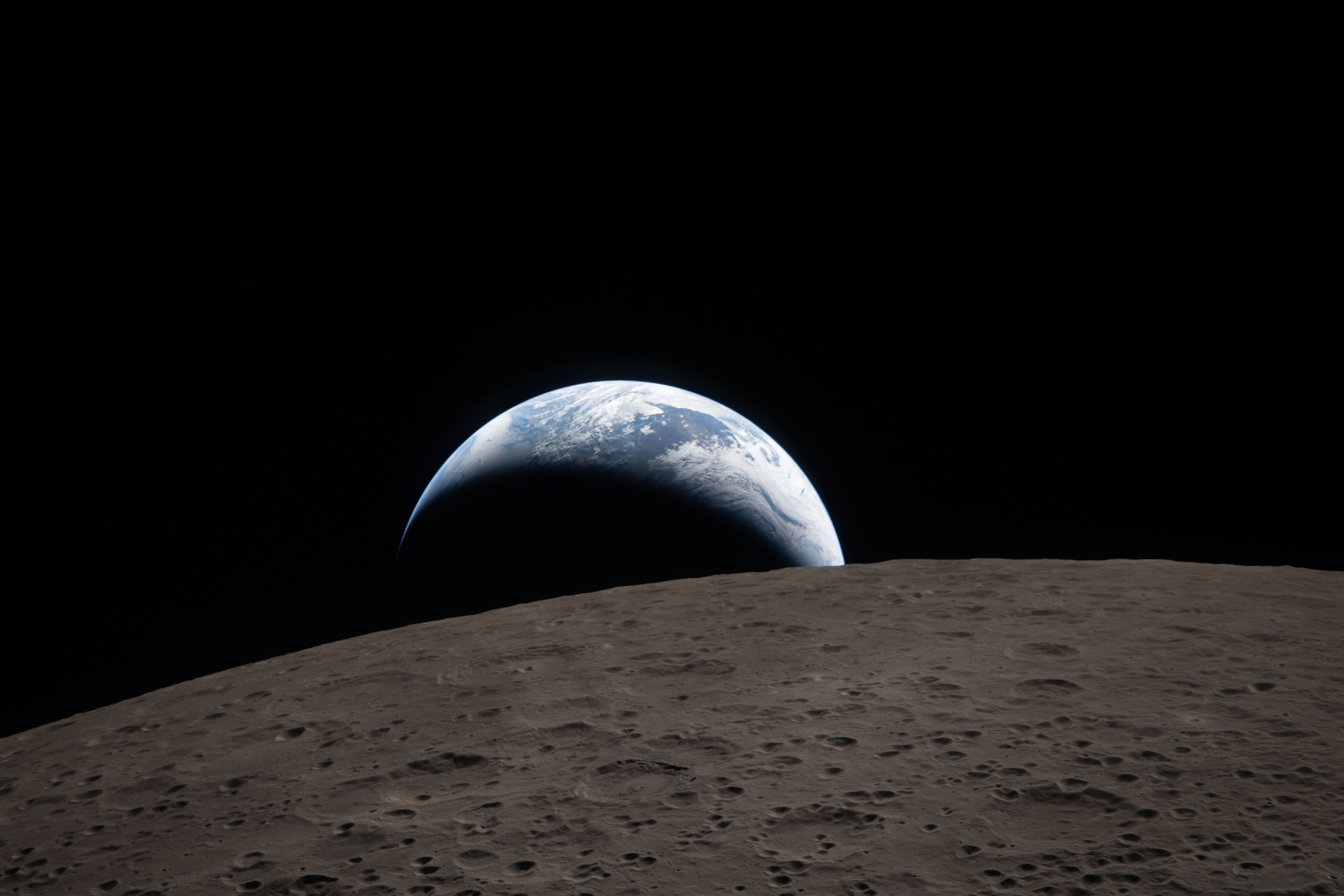
Seriously though, this is mostly a PR and validation win. I enjoyed watching the new Earthrise (Earthset) image - https://www.nasa.gov/wp-content/uploads/2026/04/art002e00928... - camera technology has come a long way since the 70s and seeing the moon this close is Weird to me.
> We validated that Outlook is no good :)
"Help Keep Thunderbird Alive": https://news.ycombinator.com/item?id=47700388
Right now all I can think of is the toilet. Which is not a small thing by the way.
They might have found a way of having two versions of Outlook and at least one of them working.
A lot of it is relearning what was forgotten after the Apollo and shuttle programs. The technologies changed so much it’s a whole new spacecraft that looks like what existed only because that’s the best possible shape.
If I am not careful I wind up with two Outlooks running in my computer. ‘Classic’ is fine, but God forbid I start the other one because when I try to send an email with it is spinner… spinner… spinner… spinner… spinner…
I actually like the new one better, but that's not saying I like either.
I would just love if my workplace let me use the normal Apple apps, but there are regulatory constrains Apple tools don't meet (such as spying on me to prevent data exfil)
Artemis II is basically a test mission for Orion. And while flippantly Orion isn't doing anything that Apollo didn't do first, it definitely does it with a lot more margin, more living space, more safety and redundancy, and an actual toilet instead of gross poop bags you had to manipulate your waste into.
They didn’t even land the rockets for recovery. Regressing :(
Of course they didn’t. The delta-v needed to land the rockets is better expended in pushing the craft further. Reusable rockets isn’t always the best choice.
This is a good point - in the space shuttle era, the SRBs were recovered, refurbished and re-flown. The boosters flown on Artemis 1 and 2 are now lost. There are only enough space shuttle era parts to fly another seven SLS rockets and the current plan to replace them with new hardware is still on-going.
I could not find out exactly why the SRBs of SLS are not worth recovering. If anyone knows why, that would be interesting to find out.
i hate this “____ porn” terminology
Yeah, but they still don’t have a realistic plan to land astronauts there.
Like the space shuttle before it, Artemis proves that nobody can beat the US at spending money on boondoggles.
Lunar missions are inconsequential to problems here on Earth like we can’t afford to build high-speed rail and transit, that we can’t build housing affordable or otherwise, that we already lost the next war to Boeing and Lockheed-Martin, won’t build affordable electric cars, etc.
What we need is affordability porn!