‘Energy independence feels practical’: Europeans building mini solar farms
euronews.comFairly boilerplate article, but the bit that is news is the UK balcony solar permitting. Better longread: https://solarenergyconcepts.co.uk/post/plug-in-solar-uk/
Government press release with a long list of pull quotes: https://www.gov.uk/government/news/government-to-make-plug-i...
(I note that in the alternate universe where Ed Miliband became PM because he didn't eat a bacon sandwich, we could have had this a decade ago. It is embarrassing to be beaten on environmentalist regulatory efficiency by Germany)
British industry and standards bodies think this is an unsafe plan.
Of course they would because it's work being taken away from them but it would be allowing people to plug generators into ring finals with unidirectional breakers. It's not even guaranteed that the circuit is protected by anything newer than fuse wire or an MCB. No guaranteed earth leakage detection. No guaranteed surge protection. Relying on the cheapest inverters to sync frequency accurately. And
I have more faith in German standards and work ethic than our own.
I am not very well versed on this topic but I believe the balcony solar products market one of their safety features as "anti-islanding protection". Personally I wonder what happens if multiple balcony solar systems are connected... can each still tell when the grid is down since the other power source is active?
https://www.digikey.com/en/articles/anti-islanding-and-smart...
Unless there's so much generating capacity available that they can power the entire connected grid, no.
Consider 100 homes on a power line network and the breaker trips. They probably draw 50kW on average, more if it's hot or cold and AC is on. Unless there's enough power generation available to power that entire load, voltage will drop and any halfway reasonable hardware should give up.
Hobestly solving these sorts of problems could be a huge business.
people put few kW worth of micro-inverters and it is fine so I imagine that is figured out problem...
question is whether the ones allowed for sale implement it well and are tested for it
my understanding is that micro-inverters send an "up and running" signal encoded over the DC wiring to the main inverter, and that this is used to detect micro-inverter failure. that is an entirely different problem than the one in the GP comment, i think.
“Rapid shutdown devices” do this. Microinverters have the same “grid is down, turn off” logic as a main inverter
What is the reason about earth leakage? Shouldn't the generator be grounded for the sake of powering those devices which require a proper earthing?
What do you mean by "guaranteed surge protection"? Are you an electrician to write like that?
“Unidirectional breakers” aren’t a thing for AC circuits.
Yes they are. Current alternates direction, but power usually only flows in one direction, from the input terminal (from the bus bar) to the output terminal (that the circuit is wired into).
If the circuit will be supplying power too (e.g. battery storage, an EV and EVSE that supports powering the house from the EV, etc) then you need a bidirectional RCBO.
People with no differential fault protection need not worry about any of this, they'll just be killed when it goes badly wrong.
Source: Am a UK electrician
Example: https://assets.cef.co.uk/downloads/pdg/wylex_nhxs1b32_datash...
EDIT: To say nothing of people with unidirectional electricity meters; plugging these into those setups will get them prosecuted for electricity theft. All SMETS 2 smart meters are bidirectional; you'd best check your meter if it isn't one of those.
I don't follow you regarding unidirectional meters and electricity theft. How does that work?
Between the phasing out of analog meters (the latter half of the last century) and the introduction of smart meters (2010), a lot of electronic prepayment meters produced for the UK market would set a tamper flag if they detected power flowing backwards through them, as a proxy indication of an attempt at electricity theft. These meters will refuse top-ups in this condition, requiring you to contact your energy supplier to sort it out, leaving you without power until you do and then exposing you to scrutiny when they arrive.
Pre-smart non-prepayment electronic meters (for those with old meters, still submitting manual readings, and paying by direct debit) will be fine. Most of these meters, and all smart meters, are inherently bidirectional, because they maintain 4 counts (energy imported and energy exported, in kWh and kVARh) and your energy provider will do all the necessary math to figure out what to actually bill you for (residential customers are not billed for kVARh usage).
The UK government in 2011 announced plans to have 50 million smart meters installed by the end of 2020. In typical overpromise underdeliver government fashion, they didn't even achieve half of that; by then, only 23.6 million had been installed, and of those, 4.5 million had stopped working because they were initially (and stupidly) designed to be tied to a specific energy provider and the customer had changed provider. This even affected me.
Nevertheless they'd still accurately track energy consumption and export even if they'd lost their reporting capability, so you have nothing to fear here. This situation has been rectified at the redesign stage with provider-independent SMETS 2 meters, and all SMETS 1 meters still in service have been hotpatched to bring them into line (restoring their smart functionality regardless of provider).
Even today (well, as of last September), this number is only 40 million, with only 36.7 million of them actually working as designed (reporting readings automatically).
This leaves up to 16 million properties with a meter that may stop working and expose you to a theft investigation when you obtain generation capacity that even momentarily exceeds your usage (for example if you have a dual RCD board and one of the RCDs trips, taking out half of the circuits in your home, but not the one the inverter is plugged into).
Realistically the true figure is probably around a quarter of that; prepayment meters were very popular among the renting population of the time, and those who wanted to track their energy usage carefully and only pay for it with cash as and when needed, and sometimes people had these meters forced upon them by suppliers after the customer had demonstrated poor payment history, but they were far from the norm.
Average home owner buying plug-in solar at a supermarket isn't going to know or care about any of this. They'll just plug it in, and it will work, until one day maybe it doesn't and their supplier opens a theft investigation.
I feel like the meter suddenly "breaking" is the substantially larger inconvenience. Presumably the supplier will raise an eyebrow at the flag, glance over the place, see the solar setup and get on with life. At least one would hope. They must have seen this a time or two by now after all.
Why would power flowing out of my house into the grid be a theft?
The kind of meters we used to install 50 years ago would turn backwards if electricity flowed backwards.
So if you spent a week with the meter connected normally, then you swapped the input and output cables around for a week, the meter would be back at zero. Free electricity!
They used anti-tamper seals to make it more detectable, but there are ways around that sort of thing.
Maybe it looks like you're trying to trick the meter into running backwards?
I assume the scam would be you rewire the breaker so the grid is on the apparent load side. It's not exactly hard to do, just dangerous.
That’s an RCD, not a breaker. Guess the English still insist on using nonstandard terminology, like “lift”, “bonnet”, “torch”, and, apparently, “breaker”. Oh well.
This is not an RCD, it's an RCBO. It combines the functions of an MCB (Miniature Circuit Breaker) and an RCD (Residual Current Device) in one device, as specified by BS EN 61009 (Residual Current Operated Circuit Breakers with Integral Overcurrent Protection).
https://www.bgelectrical.uk/uk/circuit-protection/devices/rc... Right there, both bidirectional and unidirectional breakers.
It would be really interesting to know what's so special about these UK units that they can be "damaged" by being fed from the "wrong" side (as per some other article), considering that the only place where these behave like that is an island north of France.
These are not just circuit breakers/MCBs, they are RCBOs which combine an MCB + RCD in a single unit. RCDs traditionally only measure - and protect - current flow is one direction, so if you are using them for solar you need a bi-directional unit for full protection. The device will not be damaged, it just won't protect you.
However in the case of a UK home, where you may have a single ring circuit connecting all the sockets on the whole floor, what's in the breaker panel isn't going to protect you with plug-in solar anyway. Better hope what you are plugging in meets UK standards and isn't just some Chinese rubbish that claims it does.
Outside the UK, neither RCDs nor RCBOs (type A/AC) are generally distinguished by bidirectionality (all search results about this being .co.uk), since the RCD part of these devices is just a current transformer driving a trip solenoid; there is nothing in it that's powered by the line, nor something which could sense net power flow direction. The situation is different for AFDDs or type B RCDs, since those have active, powered electronics in them which need to be fed from the line side.
After some research the main reason seems to be two-fold:
Answer #1: Many UK RCDs/RCBOs are actually single-pole devices and don't disconnect the neutral. In the simplest case, this means pressing the test button might burn out the test resistor when backfed. I don't imagine this to be a problem in practice, since grid-tie inverters shut down very quickly if the grid disappears under them, especially plug-in inverters. RCDs/RCBOs elsewhere are virtually always disconnecting the neutral, so don't care about this.
Answer #2: It looks like some/many one-module wide UK RCBOs _do have_ electronics in them, even if type A, because they're actively driving the trip solenoid of the MCB part, and if you sketch this out and do it in a very cheap way it's easy to see how you could burn that out if backfed (i.e. powering the trip solenoid during a fault is assumed to disconnect in a very short amount of time, but if backfed for longer than the disconnect time that might be enough to toast the solenoid or the driver).
Notably neither of these has anything to do with the direction of power flow.
> Answer #1: Many UK RCDs/RCBOs are actually single-pole devices and don't disconnect the neutral.
This is not correct; all type AC and type A RCDs used in British consumer units disconnect the neutral as well. Some RCBOs do not disconnect the neutral and this is a problem in some circumstances. The datasheet I linked for Wylex NHXS1 RCBOs explains that these ones do disconnect the neutral.
> Answer #2: It looks like some/many one-module wide UK RCBOs _do have_ electronics in them [...] but if backfed for longer than the disconnect time that might be enough to toast the solenoid or the driver
This is correct. For an example of this construction in an RCBO, see [1]. This illustrates that if the supply is connected to the "To Load" part of the schematic (toward the end of the video), as it would be if the supply is a solar PV inverter with battery storage, then it can continue powering the electronics and be shunted out by the thyristor after it has supposed to have tripped, very quickly burning itself out.
Bidirectional RCBOs are not designed in this manner. They have more complicated circuitry that makes them more expensive to manufacture, but are absolutely required in situations like this if you don't want your protective devices to burn and/or explode when they operate.
> Notably neither of these has anything to do with the direction of power flow.
Yes it does, because if the power is flowing backwards to how they designed it, that is backfeeding it, keeping its circuitry powered after it should have been disconnected.
Not in the US, but in parts of Europe they effectively use AFCI/GFCI breakers for everything.
Those are code in the us now too. (with exceptions for where they don't make sense)
NEC doesn't specify GFCI breakers, it merely requires receptacles in certain areas have GFCI protection, and accepts GFCI breakers as one way to provide that.
The conventional practice in the US is still to use GFCI receptacles rather than breakers.
Right, but the NEC spec arc fault as well (i've only seen this on breakers). recepticals are cheaper and otherwise just as good.
Because NEC 210.12 requires all devices to be protected. Which means if you have a switch or splice before a plug the only way to protect those is with an AFCI breaker. The only exception is a continuous run from the breaker to an outlet in metal conduit or MC cable. Given how much is romex this effectively forces AFCI branch breakers.
I find that receptacles tend to break prematurely if they are wet locations, even if 'protected' with a weatherproof box etc. You also need to know where the receptacle is and make sure it is accessible instead of behind a piece of furniture etc. Then some electricians misunderstand and put receptacles throughout the run (much more expensive than one breaker which is about 2x a receptacle), and in edge cases you need to know the order in which to reset them to get things working again. I much prefer to just have everything in the panel.
Always important to note that "code" does not mean "must meet this standard". Many existing installations will not meet current code and there are varying levels of code (at least in the UK) that mean anything from an electrician can ignore minor faults through to network-notifiable issues.
But that's rather the point here that consumers are the ones who are going to be plugging in these devices, with no appreciation for their circuits and safety devices. The only code that matters is the last version of it adhered to when their home was last wired. In extremes, that can be 40 years or more.
sure, but everything new must meet current code. nobody upgrads when code changes anywhere. Codes from 40 years ago were not bad, though things are always improving.
They are terrible for anything motorized though. The one in my bathroom trips every time I turn off the vent fan.
What tripping curve do your RCDs have? That is not normal if they are the right type, really sounds like something is wrong!
I find it interesting because often the best way to achieve a safe building code is to learn by allowing with basic guard rails and iterating as things happen. This isn’t ideal for the rare individual impacted by the “things happening,” but collectively we refine and iterate. Our current standards weren’t arrived at by navel gazing - we got the codes we have by experience. It’s hard to realize that from the present that you can’t reasonably learn without doing and by constraining without learning prevents growth and learning.
"Things happen" is a interesting way to say "houses burn down and kill everyone inside". And I don't believe that electrical standards were developed with the idea that houses could both consume and generate electricity.
Not to mention that most houses aren't up to current electrical standards, much less fire codes.
Are there lessons on safety that need to be learned here? We already know what the happy path looks like, and we've plenty of lessons on what the unhappy path will look like.
It isn't as if electric charge coming from balcony solar panels is some new magical-seeming type of electricity.
Safety is statistical and depends on human behavior. Unexpected behaviors might appear. For example some places require a power outlet on kitchen islands because with out, people will use cords to the wall which creates tripping hazards.
Also, why do wires have to be fixed to joists every 300 mm? It's not about the electrons.
The situation in germany is essentially the same, but that's why net supply by these is limited to 800 W. I don't think anything changes w.r.t. earth leakage, why would the presence of the solar supply change anything from the RCD and fault point of views, respectively?
If your generator is plugged into their own circuit, it wouldn't change much.
If you plug it into an overloaded ring final (which is not uncommon in the UK - half our house's sockets are on a single ring), you have to rely on the generator being able to detect faults to protect that circuit.
You could also overload that circuit's wiring. If you have a a 16A Ecoflow, plug it into a 32A ring, you could draw 48A before tripping the grid circuit breaker, potentially causing significant heat in the wires. Dinky 3A generators won't do that but I don't think they're the limit our government are talking about.
Not expert but one difference is that in Germany the standard wiring is radial circuits with 16A MCBs while in the UK it's ring wiring with 32A MCBs.
So in the UK we have 2.5mm^2 wires in a ring on a 32A MCBs... Of course a 2.5mm^2 wire is rated ~20A so any issues with the ring (sockets still work since connected from the other branch) can burn the wire before the MCB trips...
Does anyone know the US equivalent terminology for a "ring final" ?
We would call it "a serious code violation." It's prohibited in the NEC and always has been, it's objectively less safe.
From what I understand the UK allowed it because of a severe postwar copper shortage and it persists to this day because it's allowed and a bit cheaper.
> From what I understand the UK allowed it because ...
I'd say "severe post-WWII money shortage". After wartime expansion, the global copper industry could physically meet peacetime demands. But the UK was very close to national bankruptcy. And the Luftwaffe had turned an awful lot of their prewar housing into rubble. So - any cost that could be cut, was.
The "standard" wiring is 1.5mm² on 16A MCBs which are rated to trip at 1.13-1.45x nominal current (so 18-23 A). So this is already mildly improper because you can pull elevated currents continuously and dramatically shorten the life of the insulation.
The rated ampacity of wire for electrical distribution has a significant margin on it.
In the US, Utah has allowed balcony solar since May 2025 and Virginia is expected to allow it starting in January 2027 (awaiting the governor's signature).
There’s 26 active bills! It’s taking off fast. Exciting developments.
He also removed the effective ban on onshore wind construction that was introduced a month after he lost the election, restarting after a decade of lost opportunity.
This Trump-level idiocy that is just never mentioned, even as people blame the gas burned in england on windy days as a cost of wind curtailment, when the curtailment is more a like a third of the cost. Burning gas to power people who chose not to build turbines is the other 2/3rds.
In the alternate world that is tens of billions of gas costs avoided to date and tens of billions more in future.
I always blew my mind that people don't mention this more. The UK is blessed with some of the most plentiful and reliable wind resources on earth, and mediocre solar resources at best.
Banning onshore wind turbines was just insanity. Despite the insanity, the UK has made great steps with offshore wind, but offshore wind is expensive and has all sorts of accompanying headaches. Onshore is super cheap and quick to build per unit power by comparison.
Onshore wind turbines are going to be much more important to the future of UK energy independence than balcony solar.
At the same time they are banning wind turbines leaders (Chinese companies) from opening factories in the UK... [1][2]
[1] https://www.bbc.co.uk/news/articles/c995xjxk97mo
[2] https://www.energyvoice.com/insights/energy-opinion/594763/m...
Once upon a time, Brits could build gensets and reduction gears. In Britain, even.
This factory would have employed (mostly) British staff in Britain.
That seems rather dumb. I wonder why they blocked the Ming Yang thing in Scotland? The UK seems to make quite a lot of dumb energy decisions like blocking UK North Sea gas and then buying North Sea gas from Norway.
There's just not much gas left in the UK North Sea.
> Industry body Offshore Energy UK (OEUK) claims that more oil and gas could be extracted by 2050. However, the ‘High Case’ scenario for future production in a report for OEUK would still mean that 92% of production has already occurred.
...
> Compared to the maximum oil production that occurred in 1999, UK output in 2025 was 77% (over three-quarters) lower.
https://eciu.net/media/press-releases/around-90-of-uk-north-...
China bad. In case of supply chain attack perhaps. It doesn't matter anyway because the Chinese have basically won by moving forward while others were bikeshedding, focusing on diesel emissions cheat devices, closing down nuclear power stations, burning Russian gas on a windy day, not having a proper grid capacity to move electrons South, delivering brexit and so on.
Yes it is rather 'dumb'. Apparently the policy is to reset relations with the EU so perhaps selling out to Siemens is deemed preferable, or perhaps they got the usual friendly phone call from Washington D.C, it is difficult to follow. And that's the point: Where is the plan? Where is strategic thinking?
WHY DO YOU HATE THE COAL BARONS SO MUCH? YOU'RE TAKING MONEY OUT OF THEIR MISTRESSES' MOUTHS
Here's another more mass audience article about these plug-in solar panels: https://www.which.co.uk/news/article/plug-in-solar-to-become...
> I note that in the alternate universe where Ed Miliband became PM because he didn't eat a bacon sandwich, we could have had this a decade ago
I read what is happening in exactly the opposite way. To me it shows that Milliand and the government at large do very little with no strategic thinking and no plan (same as the guys before in fairness but this government was supposed to be soo different...) and, in this case, is only reacting in a panic after almost 2 years in office to the pressure of "doing something" because of the Iran war, while also being told (slight mitigating circumstances for Milliband) that it mustn't cost anything. I always picture scenes from The Thick of It/ In the Loop when I imagine how they come up with 'ideas'.
I find it fascinating how this comment comes up with a whole theory of what happened, along with implications about how the government, and Ed Miliband in particular, think and act, and it’s based entirely on just dreaming up what the facts are, when in reality the facts can be looked up trivially, including the fact that this was in the manifesto, or other facts that are known by anyone who has any knowledge about how govt (especially the UK govt that is designed to be conservative and slow moving) works.
Like you just invented a story and made massive implications based on the invented story, with absolutely no hesitation. And you’re probably in at least the 50th percentile of intelligence.
This is why we’re screwed.
These policies were in their manifesto, they just take some time to enact, even with a majority government.
Democracy fails to work because people expect things to happen overnight.
British governments have a terrible record with all eco schemes (mostly handouts to conmen). I don't expect this to be different
And it is of course home-counties obsessed thinking. They can both afford these toys and also have more sun
I live in Germany, installed a micro solar system in September 2024. Since then, we've been producing 45% of our electricity consumption ourselves. This has saved us 550€, while the initial cost was around 800€. So this September, after 2 years, the system will have paid for itself.
Could you provide more details? 800 Euros sounds very cheap while being able to produce 45% of your electricity needs. Did you mount it on your roof or a balcony or wall? How much power does it produce? Very curious to hear more details or even recommendations (I too live in Germany).
Have a look here:
https://shop-sicatron.de/products/sicatron-910w-balkonkraftw...
You still need attachment material for your balcony.
Keep in mind that this system will input all it's power into your power grid. If you don't use the power it will go directly into the public grid.
Still, really good cost saving measure.
Do you own one of these? If yes, are you happy with the quality?
No I don't own them. Some people here: https://www.mydealz.de/share-deal-from-app/2753917 mention as a downside that you have to connect to the manufacturer cloud to get the live production data from the interverter. Otherwise it is truly "plug everything together and it works".
Crazy thing is, the cost of these systems has gone down even further since then. You can get a 800w plug-in solar set with panels and an inverter for around 200€. Shipping might be 70€ or you can pick it up locally at the dealer. Add another 50-100€ for attachment material and you are good.
So for 250 to 400€ you can get a system that will break even latest after four years, likely earlier.
Several recent HN posts about "time" and these correlate superbly in relation to the now obvious, to nearly all, global energy issues. Those proactive in a reactive world are often mocked and laughed at until as such passage of time is achieved for those only reactive to learn of the proactive's hindsight choices. For those in the United States aware of the 'behind the scenes' energy grid issues this insight reflects that prices will not be dropping for those electrons we all so depressively require daily just like our air and water. Energy grid decentralization is occurring with the actions of each individual and this article supports exactly that because no one alive can survive in our modern world without those electrons. "Necessity is the mother of invention" only now resonates for some while the futurists here that acted long ago acutely understand this growing trend.
> Those proactive in a reactive world are often mocked and laughed at
I'm going to start calling this a Jehovah's Witness complex. Where amplified, mostly imagined mockery of an incredibly dominant view, at least in group, is used as evidence of that view's righteousness and, by extension, rightness.
> prices will not be dropping...Energy grid decentralization is occurring
Cost versus resilience. A low-cost grid has lots of centralised production earning economies of scale. A highly-resilient system doesn't even need a grid, but it's going to be high cost.
The correct answer is in between. Rural electrification should be done entirely decentralised. Meanwhile, trying to run a city (or even most industry) on de-centralised power is a recipe for ruin.
I think the answer may be more complex than that. I mean, I know you are not wrong. My boss only recently made a crack at how pointless solar energy is in the world of cheap gas.
But it is not just cost. It is a level of control the contractor has over it. The solar systems, as currently pushed, are designed to be carefully monitored at all times; if you read the contract ( in IL anyway, but I presume it is common, because my mom had a similar experience ), I have to give the company a way in every time they desire to look at the panels. I can't just take it down, I need to hire them. I can't not sell the house without them ( and the buyer has to take over that contract ).
I like solar tech, but the was it is designed is .. very American in the worst possible way. Yes, there seem to be better options popping up, but that is not where contractor money is at..
edit: Just in case, I got a quote in 2024 so obviously things may have changed on that front ( oddly, BBB may actually help with my particular set of complaints as the contractors will have to spread their bets somewhat ).
> The solar systems, as currently pushed, are designed to be carefully monitored at all times; if you read the contract ( in IL anyway, but I presume it is common, because my mom had a similar experience ), I have to give the company a way in every time they desire to look at the panels.
I did my own install of a ground mount 6.7kW array. I initially declined to connect to the inverter manufacturer's monitoring, because I did not want my system hooked up to the internet.
Then, in the spring of 2024, the inverter failed (it was still under warranty). I was travelling at the time, but that may have made no difference at all. It took me a month to notice that generation had gone to zero.
Once I found out, and replaced the inverter, I chose to connect it not because the system requires it (it absolutely does not!), but so that the manufacturer would alert me in the future if a similar failure happened.
Ideally, I'd like to be able run a monitoring app locally, with no internet connection. For now, I'll take the remote monitoring despite my misgivings about it.
There are inverters with local only monitoring and control. I have one integrated locally with home assistant. You can also add an external current transformer and monitor the production with that independent of the inverter.
Oh? Could you go into any details? I will clearly need to do some research now, but if I can save myself some time, all the better.
Hmm, could you recommend any good references for a personal build? I was debating doing a test run with a shed ( if I mess it up too bad, it won't hurt as much kinda deal ).
Sorry, can't recall anything in particular that I used. I'm a pretty handy person to start with, nothing about the system was complex except for building scaffolding to pre-assemble the metal pipework that formed the frame for the array(s). I used a company (then called Wholesale Solar) to design the system and buy the parts from, which made it all pretty simple.
I did have to take a very challenging exam to get licensed by the state for "home owner solar" - much harder than I expected given the NEC sections and the fact that it was open book.
> solar systems, as currently pushed, are designed to be carefully monitored at all times; if you read the contract
This varies from place to place. I got a quote for solar in Wyoming. It's 100% my deal. Nobody is leasing anything. If I skip inspections and fuck up my roof, that's on me.
> he was it is designed is .. very American in the worst possible way.
Spot on!
If you're buying what someone is 'pushing' you already lost. Solar is not very complicated, particularly if you don't care about grid connectivity. Just buy the pieces for a fraction of the cost and do it yourself without putting money in someone else's pocket for the next 20 years.
That sounds utterly terrible. Don’t buy what they’re pushing.
Here in Canada I did a half DIY install, I own everything, forever. Zero out of pocket, interest free loan. Over 30 years I’ll pocket about $25k
A function state like China on the other hand is just building a grid that works.
Amazing what you can do when you copy how the US electrified in the first place.
Distributed energy production / storage is the key for resiliency in the future.
Every solar farm doesn't need to be China Size - it doesn't even need to be a "farm", just put them on roofs.
And don't let perfect be the enemy of good. Yes there are times when solar doesn't produce energy, but there are also times where it OVERproduces.
Rooftop solar is incredibly popular here in Australia. I think it’s something like 33% of houses have it. We also have a great climate for it.
I have solar on my house and am seeing around 50% self sufficiency overall. Of course with this much saturation, the rate you get paid for feeding back to the grid is quickly dropping to zero. So self use is the game now.
The problem is now shifting to home batteries and storage. Because peak power household use times are in the evening when the sun is not shining.
Conversely prices with rebates have gotten very cheap recently.
I'm getting a 48kwh battery put in with a 3 phase inverter for $6500 AUD in like a week.
> We also have a great climate for it.
Back when solar was much, much more expensive this sort of thing mattered. Now the panels have plunged in price so much, you just deploy more panels (cost of install and other central stuff is the same) and/or accept the longer payback period.
Cold climates do better than one might expect because the colder a solar panel is, the better it works.
>now the panels have plunged in price so much, you just deploy more panels
It's not really, the sun doesen't rise above the horizon for over a month where I live. quadrupling zero output is still zero. The country has massive renewable so by the time solar would generate something, electricity is already super cheap
You're clearly an outlier, 99% of installs will not have that problem.
The issue persists across the nordic countries, I argue that climate matters a lot to the type of power you're looking to generate.
I'm every day more convinced that the only reasonable future of energy production is distributed solar and storage with microgrids at the neighbourhood level or so.
Anything bigger in scale is prone to being shittified to the limit by public entities.
We had this in the 19th century. We moved to a centralised grid because when you don't use it to rent seek it is vastly more efficient.
But now we have storage, distributed production, power meters, etc.
It's relatively easy to set up a grid in which several houses produce, storage and exchange energy with a simplified free market pricing system.
Alas, in most countries it's illegal because you aren't allowed to set up such a network. Energy is one of the big control levers the State has over people.
Again this was done in the 19th century. It is horribly inefficient. The only reason why it seems like a good idea today is because power companies are now rentieers instead of service provides.
How is it inefficient? You have production, storage and consumption right next to each other. You just miss the high voltage lines required to not lose a lot of energy that is produced hundreds of miles away and the transformers and switched that come with it. I would even say that it can be more efficient.
Back in the day having hundreds of nets that are not interconnectable and running everything on coal or gas made things hard to scale. But today interconnections can easily be done through a converter, you don't even have to match demand and production as you have storage and the more productors available, the cheaper and more stable the energy gets.
You also have individuals on the microgrid that actually care about the quality of the microgrid.
So it is a good idea because power companies, or anyone else who has you over a barrel, are not going to change this behavior.
Energy independence is good for individuals, not just countries. Just like privately owned cars are horribly inefficient, independence wins out.
I can tell you've never dealt with an HOA or Strata before. Neighbourhood-level organizations of busybodies are way ahead of everyone else on winning the race to shittification.
Putting them in charge of your electricity won't be all sunshine and rainbows.
I'd rather the county utility manage such a neighborhood level grid; I don't trust my neighbors over the long term to consistently make good decisions regarding such technical matters. But then that's sort of what the major grid operators already do with smaller localized circuits. It's just that it was all built multiple decades ago with centralized unidirectional distribution in mind.
> the county utility
the what now?
Do you not have a utility that covers one or a few counties where you live? Here it's some sort of strange public-private partnership scheme with private investment, strictly capped profits, and a few publicly elected officials at the top. I've also lived in places where the local government owned and managed the entire grid themselves, including directly employing the workers. I've also lived in places where the operation was entirely privatized (IIRC there was some sort of rate cap and a broad SLA in exchange for being granted the natural monopoly).
Here in New Mexico (USA), all power generation and distribution is privatized but theoretically overseen by a Public Regulation Committee. There are some co-operative generation and/or distribution organizations, but these are still private (and very regional in scope). No actual public utilities at all, though many here would like that.
Sure so in that context by county utility I mean the regional provider. In short if it involves hundreds of kilowatts of power and a timescale measured in multiple decades I want a large stable body consisting of professional specialists to manage it. I don't trust an HOA or other gathering of non-expert locals with potentially high turnover with that sort of infrastructure.
Even the battery installation for a large house borders on questionable. That's not a utility closet your average person should be wandering into under any circumstances and it's easy to run up a massive bill in an instant (if you aren't lucky you might simultaneously kill yourself) but at least that's limited to your personal property.
If we just hadn't centralized control of the inverters to a few (chinese) companies... Great read on the risks to our power infrastructure from remote controlled solar inverters: https://berthub.eu/articles/posts/the-gigantic-unregulated-p...
Wild that you're getting downvoted for saying something so obvious. Weird.
Not weird if you’ve been participating in discussions on clean energy since the beginning of this century.
The inevitability of the energy transition has been obvious for so long, and even when it’s done there will be cranks insisting that it’ll never work.
I like the transition to renewables , but there is nothing inevitable about it.
We don't produce solar panels or have the materials to produce them in Europe. So we're just as dependent on imports as before.
It's aluminum, glass, silicon, and some conductive metal. Surely you all have those materials.
And even if you don't make them yourselves, they aren't make and then burn like fossil fuels, they are durable infrastructure, you don't have to replace them often - they have an expected lifespan of >30 years. Buy as many as China will sell you, and once you have more than enough installed, you're good for a long time, regardless of whether they cut you off.
I think being reliant on the fossil fuel supply chain for so long, it's a bit tricky to mindset shift that once these things are installed, you're just good. And they're super fungible, you don't need any precision replacement parts, so you can make your own replacement parts if you want.
> expected lifespan of >30 years
More like <25 years.
> I think being reliant on the fossil fuel supply chain for so long
France isn't. And they are net exporting their (nuclear fission) electricity to their neighbours who shut down nuclear power plants.
Most panels have a 25 year 80% production warranty. Unless they're planning on being out of business, they're not planning on them lasting <25 years. So their useful life is significantly longer than 30 years, unless we come up with massively more efficient panels and the land opportunity cost is high enough that we should swap them out rather than let them just keep pumping out electricity.
Yes, and France currently has a huge problem with keeping their plants online in the summer when it's too warm. And building new plants is outrageously expensive, see Hinkley Point C. Oh, ans you still need to import fission material, so you're dependent again on other countries. Nuclear was good in the 70s, now it's beaten thoroughly by renewables.
The Swedish government is very pro renewables, yet it is initiating large investments in nuclear because they believe it is the only way to ensure enough electricity for the larger and larger need for it in the near future. I’d say they have some good information to base that decision on, since you’re right it’s really expensive, but also it’s the only way to get large amounts of production when the sun ain’t shining (all winter here) and there’s no wind (also happens a lot in the colder months).
Right, a mix of uncorrelated sources is much more resilient than 100% renewables. Of the cleantech industry people I listen to, none of them are advocating for 100% renewables, you need a mix for grid reliability. But renewables can take on much of the load. And overpaneling can help significantly, and makes a lot more sense now that solar is super cheap.
After 25 years, their production has dropped to 80%.
Unlike what you imply, they don't explode and you have to replace them all. They just keep producing, but less.
Panels you buy today come with 20 year warranties.
Those imports have a much longer half life than barrels of oil.
But at the moments they cover only a tiny percentage of our electricity needs, not even talking about storage or the heating needs which usually come from gas.
You objected that switching to solar would still leave the EU dependent on imports. Even if that is true the dependence isn't remotely equivalent.
Your comment makes no sense. If the Middle Eat oil gets cut off, you're suffering within days. If China cuts off solar panels, you have many plenty of time to find an alternative source or ramp up your own production.
If you chase down all inputs into everything you need to generate power you will find you're not truly independent from anyone. But solar panels and various other renewables hardware is much easier to stockpile than oil.
> but there is nothing inevitable about it
The Middle East is not going back to normal any time soon. The Israeli/US attack on Iran is a strategic catastrophe, implemented by two felons advised by ideologues and incompetents. The conditions are right to make oil more expensive for a long time, regardless of the outcome of the war. True peace is very unlikely to never be achieved. For instance: Iran now has a massive incentive to build nukes.
Meanwhile solar panel, wind farm, and battery prices are dropping like a rock and they avoid all of the problems of oil. Only the most ideologically fixated wouldn't invest in and install renewables. Anything that makes huge amounts of money is indeed inevitable.
> inevitability of the energy transition
Huge difference between tranistioning to renewables and going completely de-centralised. Even if we put a limit to the latter at the community level, it's a recipe for de-industrialisation. Centralised power production, even with renewables, has economies of scale, and those economies amplify with volatile demand sources, e.g. residences.
You can decentralize residential power without doing the same for industrial loads. Doing so is a mixed bag. It's somewhat more expensive however it's less prone to failures during natural disasters, failures aren't outside of your ability to fix, and it isn't subject to politics to nearly the same degree.
When you consider the logistics of strengthening the last mile of residential to accommodate EVs in a sparsely populated place like the US (or rather the apparent lack of political will to do so) it starts to look extremely attractive.
A good friend of mine is a solar installer in rural California, and he is booked solid building battery and solar systems sized to charge cars, because depending on PG&E is worse than spending the money to go off-grid.
Yepp. Grid defection is a trend all across the world right now in sunny climates. I live in Germany and can unfortunately not do this, but if I had thr sun hours of California, you can bet I'd build 300kWh of LiFePO4 and as much solar as my roof allows, and cancel all my expensive contracts.
> You can decentralize residential power without doing the same for industrial loads. Doing so is a mixed bag
There is a middle ground: decentralize enough to run essential services. Run the rest through the grid. The big downside to decentralising residential power is that's variable demand–precisely the sort of demand you can net out against other parts of the grid. The sort of variance that makes grids more economic than everyone powering themselves.
(Again, in rural settings, yes–decentralise.)
> The big downside to decentralising residential power is that's variable demand–precisely the sort of demand you can net out against other parts of the grid.
Residential is variable but for the most part not all that amenable to time shifting, at least at present. Isn't a grid most efficient with a constant load, with the next best being something that varies only slowly over time and is highly predictable?
Then there's EVs. I'm under the impression that replacing a notable fraction of the ICE cars on the road with EVs would at present place the grid over capacity most places in the US.
When it comes to unit cost doesn't the ultimate benefit here lie with the consumer's pocketbook? I don't see why residential considerations should make much (or even any) difference to dense commercial or extremely high capacity industrial users. Given that solar plus battery is reasonably affordable for a large chunk of the US population it doesn't really seem like much of a downside when framed as a voluntary expense. I still see people building it out where I'm at (suburbs) despite (AFAIK) the subsidies ending.
> not all that amenable to time shifting
That’s fine. A solar system specced to a house has to meet its max drawdown. A house connected to a grid can effectively pawn off its unused power to another user. That’s the efficiency of a grid.
> doesn't the ultimate benefit here lie with the consumer's pocketbook?
Yes. The NPV of a blended system (solar, maybe battery and grid) almost always beats going all in on one or the other. You spec to your base load and put the uncertainty on the grid. That way you don’t have to overprovision solar and battery. (And you’re good with your essentials if the power goes out.)
This is almost universally true unless you have super-subsidized solar (bonus points for an expensive grid, e.g. California) or stupidly-cheap and reliable grid power (until recently, the Gulf).
That's the same kind of problem solving that thought making self driving Teslas is the solution for infrastructure problems.
I'm fairly certain securing one's household's access to energy independent of rate increases triggered by a combination of aging infrastructure and data center power demand doesn't have a lot in common with tech bros attempts at reinventing trains badly from first principles but I'm open to hear the argument. Care to unpack that?
Im eager to hear rhis one...
_grabbing popcorn_
Easily: it's techbros again forgetting that an expensive asset only wealthy can afford isn't a solution to a mass scale infrastructure problem. And again, just like with Tesla bros, nothing about household solar is independent and requires infrastructure to support it - which, just like with trains, isn't going to get required investment because you're dreaming about individual investment.
Like you say, I want trains - proper infrastructure supported renewables, not Teslas - home individual infra only affordable by wealthy individuals at the cost of shared infrastructure while lowering resilience because it still uses shared infrastructure.
I didn't downvote them, and I don't really disagree with them (that much). But I do disagree with the idea that what they're saying is "something so obvious".
I think the evidence is overwhelming that renewables plus storage will provide the bulk of our energy needs, or at least electricity needs, in the very near future. But I think the idea that it will be some sort of libertarian/individualistic utopia if we're all generating our own power and living off grid is a fallacy. This sort of widespread "off grid" living (beyond a small number of ideologues/enthusiasts) is what you only see essentially in failed states, where communal services are unreliable and the social contract is so frayed that people need to inefficiently generate their own power. One can argue the US and other Western countries are headed that way, but I don't think that's "obvious" or necessarily a good thing.
A much more "obvious" solution IMO is to invest in efficient, grid-scale renewable generation combined with robust storage tiers, as well us long overdue updates to the grid.
And to emphasize, because I'm sure it will get lost in translation, I'm in no way saying people shouldn't be self-sufficient or install rooftop solar if they want to. What I am saying is that widespread rooftop solar as the "of course that's the right answer" endgame of renewables deployment is in no way obvious, inevitable or even desirable.
> A much more "obvious" solution IMO is to invest in efficient, grid-scale renewable generation combined with robust storage tiers, as well us long overdue updates to the grid.
Individual rooftop solar + home batteries _is_ how we're doing this in Australia. You can connect your home setup directly to the wholesale grid and import/export electricity at appropriate times.
Politics of solar, at work
> And don't let perfect be the enemy of good. Yes there are times when solar doesn't produce energy, but there are also times where it OVERproduces.
When solar OVERproduces you have to literally pay someone to consume that energy, most probably wind farms, which could be producing energy instead. So you pay actually twice. When the solar underproduces, you need to bring in alternative sources, but those now have to cover all their fixed costs and generate return on investment over this limited timeframe, which means the actual backup prices hit stratospheric levels.
What's the actual cost of solar with actual net-billing?
Home installations just cut it off. In both of these cases.
I did my own battery backed installation. When I'm underproducing I can shed load (I turn off my AC - almost always that's enough, and it's automated by relay). When I'm overproducing (ex - my battery is full and my load is still not enough to consume input) I just don't let the panels generate more current than I can consume.
Managing grid scale power is different concern, and not particularly relevant to small household generation. Especially not relevant in the 800W category for "balcony solar" (which is much smaller than what I'm working with).
Solar is fucking coming, whether you continue to shove head into the ground or not.
It's just way more affordable. Getting easily more affordable as batteries continue to improve.
I honestly doubt I'll still be connected to a local utility grid for electric 10 years from now, and I live in a region of the US that has considerably cheaper grid power than most areas.
The dilemma here for me is twofold:
(1) while it makes sense to me to distribute generation, because there are not really any significant economies of scale other than purchasing power, it doesn't make sense to distribute storage which, IIUC, has huge economies of scale.
(2) being fully off-grid where I live requires homes that can be heated in winter with heat pumps that require less than mid-winter generation levels. That means, in general, much better construction techniques than most current houses have. At our house, we generate 2x of our needs in the non-heating season, and 0.5x of our need in the heating season - covering that demand with a battery would be ridiculous.
I don't think there's any particular economy of scale to renewables beyond amortising installation costs.
This is a really big component in most western countries, so big installations are always going to be more cost effective, but there's nothing special about storage vs solar or anything else.
I suppose storage is smaller, so you don't have to pay for much land like you would solar (and where homeowners are basically utilising an underused resource so they have a cost advantage in that respect)
My current EV has a 38kW battery.
When it's too worn out for car use (SoH around 60-70%), it's still perfectly enough to run _everything_ in my house for multiple days - except for the electric sauna, and I'm smart enough to turn it on if there are production issues :D
There's a reason why EV's will never be as cheap as the cheapest ICE shitbox. Just the bare metals in the battery are worth thousands when recycled, even more if the battery is still viable.
If you ever are looking to implement that EV battery as house backup, this repo might be useful: https://github.com/dalathegreat/Battery-Emulator
I did mine with it and old leaf 24kwh battery (~60k km). After all the safety margins I get ~15 kwh out of the battery.
Sorry, the consequences are too dire for me to delegate household battery control to a vibe-coded project.
I'm curious what your home insurance provider has to say about your installation.
The value of the metals will depend a lot on the battery chemistry. LFP batteries don't need nickel or cobalt and sodium-ion batteries can also replace the expensive copper foil on the anode with cheaper aluminium foil.
I'm somewhat sceptical that used batteries will ever be worth much other than as scrap given the cost and complexity in testing, installing, and managing a mixed set of used batteries in larger installations.
With new batteries halving in price every 4 years or so the value of the raw materials in old NMC batteries alone should make it economical to sell for scrap and buy new batteries for stationary use cases after 10 years or so!
This is not how curtailment works.
Curtailment is when an energy company has successfully bid on delivering electricity for the next block of time (an hour, for example) but it can’t provide that agreed amount of power because it would overload the grid. There are various reasons why that would happen: faults and unexpected lack of demand, for example. In that case the company is paid for the energy it was contracted to deliver, only for that period of time, even though it did not provide power.
It is wrong to say that overproducers HAVE to be paid. They don’t. They only have to be paid if there was an agreement to buy that power but for whatever reason the grid can’t take it. Normally if there is a generation surplus, the cheapest companies will win the bid to provide power and the others will simply not be paid.
The utility SHOULD ensure there is enough power for the worst case. Which is why they will sometimes pay someone to not generate power.
> When solar OVERproduces you have to literally pay someone to consume that energy, most probably wind farms, which could be producing energy instead.
You don't have to do this with solar, you can just disconnect the panel and have it go a bit hotter. For producers that have a long-ish bringup time, yes, you might need to do this at time.
The situation is slightly complicated by dispatch order, and domestic solar isn't usually dispatchable at all. Grid-scale farms are.
Wind farms don't consume energy, but there is a real issue with how often they have to be "curtailed" (paid to turn off). That is to a great extent due to issues with grid connectivity between Scotland and the rest of the UK, which are (slowly) being worked on.
Wind curtailment is the deliberate reduction of electricity output from wind turbines, despite their capability to generate power under existing wind conditions. This practice is typically implemented by grid operators to maintain the stability of the electrical grid or to address specific operational constraints.
https://www.enlitia.com/resources-blog-post/what-is-wind-cur...
"paid to turn off" Wind energy providers in some countries are compensated for curtailment, this a form of subsidy for renewables. It can be payed directly by the goverment, or it is added to the price of electricity for consumer.
https://www.cleanenergywire.org/news/renewable-curtailment-c...
My understanding is that all inverters sold at this moment, in the EU, need to have demand response and grid curtailment mechanisms by law.
>you have to literally pay someone to consume that energy,
Here's the thing. That's a rule and not a technical problem. Absolutely no reason to do this other than rules and regulations.
Yes, but even more so, it's a good sensible rule!
People don't even bother to argue why it's bad, they've just seen so many headlines telling them it's bad they don't question it.
I'll question it. Why does it exist? Why can't we just shut off the panels or dump excess energy into a metal rod? Why do we need to have a buyer at all?
It's not a buyer, people are paid to take the energy that would otherwise be wasted. And when energy use is shifted it means you need to generate less later, saving money.
The people who pay that cost to the people using the energy are people running energy generators that suffer wear and tear when they ramp down.
Or sometimes it's a subsidy for the use of clean energy being passed on to ensure the clean energy is actually used, not wasted.
All upside, no problems at all.
> are people running energy generators
In Germany's case it's the tax payer, thanks to extremely generous subsidies that are excluded from state aid regulation
Because otherwise the incentive structures for solar-as-baseload, sweeping the actual cost on the consumers, collapse. The system is built on putting equality sign between oversubscribed solar and coal/gas backups during times of undersubscription.
> When solar OVERproduces you have to literally pay someone to consume that energy,
Can't we just throttle the solar panel? In a worst case, you just pull the plug. It's not like a nuclear power plant which needs to be shut down carefully, or am I misunderstanding something?
Yes that's exactly how it works, it's called curtailment.
You can limit amount you feed back into network.
Not sure how is situation with home installations, factory i work for runs 150kw plant for our own consumption and don't bother with selling, but i know that we can set up how much we want/are allowed to feed back.
You don't have to use net metering in residential either. Grid-supported hybrid inverters that won't export power can be installed. Bonus is that they run when the grid is down. It's effectively like having an automatic transfer switch where the grid is the backup generator when your batteries are drained. The profit margin for the pro installers is reduced so they don't promote them, but it is a viable route to save money and avoid hassles with the power company on a self-install.
Cheap home solar installations usually have a disconnect- do they not use those in larger scale installs?
I'm also surprised they aren't using batteries to capture overproduction. They've been clutch in the US, and we're not exactly pushing the envelope of green energy nowadays
Here in Finland electricity prices can drop to under 1c/kWh due to renewables, basically every time it's sunny and/or windy electricity is practically free (the transfer costs are static though).
A few times the price has actually been negative, people got paid for using electricity due to overproduction =)
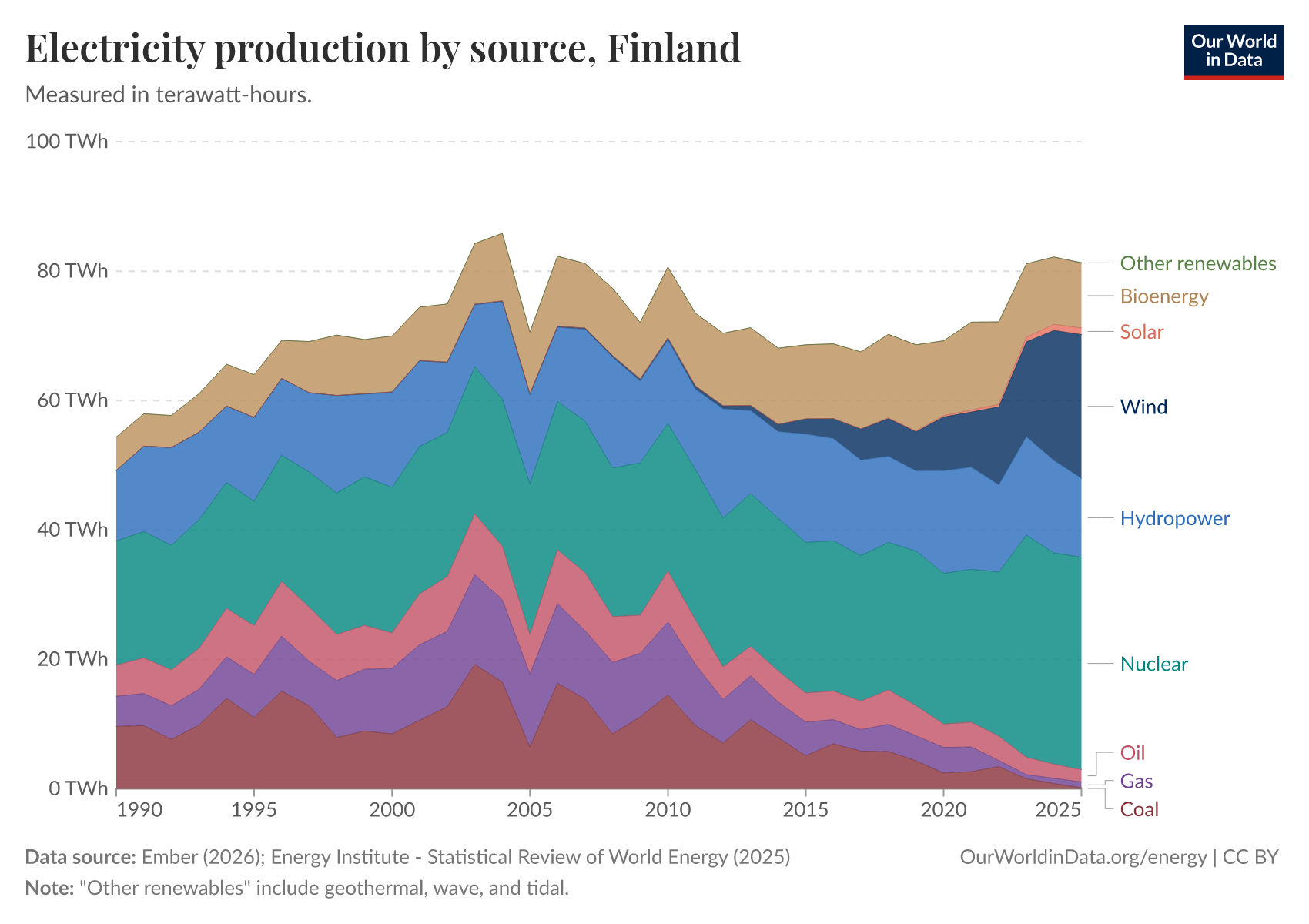
In Finland you produce more electricity from nuclear energy, than from hydropower, wind, or solar.
https://ourworldindata.org/grapher/electricity-prod-source-s...
The amounts for year 2025: Nuclear 32 TWh, Wind 22 TWh, Hydro 12 TWh, Solar 1TWh.
And more from hydropower, wind, and solar, than from nuclear.
There will be connected batteries in every home solving this problem faster than the fossil fuel lobby can come up with a new talking point about why it’ll never work.
I'm not convinced we'll ever see mass deployments of batteries to homes, not because of the fossil fuel lobby but because of the economies of scale from installing grid sized batteries at strategic points in the transmission network.
In California grid scale batteries have capital costs of around $125/kWh to $155/kWh while a home battery might be 20x that including installation.
That's because home battery providers aren't competing on price yet. The market is still small, the risks are high and they need to figure things out.
Once the early adopters run out they will have to start competing on price to make sales. There's no justification for a home battery when they charge 10k for 10kwh as they do now - only early adopters and government subsidies getting it over the line.
IMO home batteries should be a relatively easy install in principle, it's just still in that early expensive phase.
It’s already happening as I write this. An enormous amount of capital and labor are already deployed to find ways to get batteries into people’s homes, and growth is accelerating.
Inverters can be configured with export limits to limit, or entirely halt, energy exports based on market or grid signals. Term of art is "curtailment."
When there's an OVERproduction of energy, that really means there's an UNDER-availability of storage. Battery tech continues it's march towards cheaper prices, and alternatives such as thermal storage are making inroads as well.
It borders on criminal to have abundant energy production be disservice.
I'm no energy markets analyst, so take this with a grain of salt, but I think the next major breakthrough for solar (not the slow, inevitable rollout we're seeing now) will be when somebody figures out an economical way export this periodic overproduction. There is basically never a time when humanity as a whole has an overproduction of free energy, but at present we also don't have a way to make money turning this surplus into a tradable product (like oil, coal, LNG, etc.) because all the electric-powered processes for making such products (ammonia, methane, primary aluminum production, etc) require big hunks of capital equipment that lose money unless they're operated more or less continuously. Battery, thermal, pumped hydro, etc. help here, in that enough of it can theoretically turn off-and-on solar/wind power into a continuous load to power your aluminum smelter or whatever.
Even better though, would be a cheap electrically operated methane plant that you could afford to run intermittently. This, plus a peaker natgas generating plant make, effectively, a battery of infinite size, or you can sell it to any of the many eager buyers of natgas.
Building a small, prefab, plant like this, if possible, would seem to be mainly a problem of scale, and therefore it seems likely that China will get to it pretty soon.
"If you find dollar bills on the ground you need to pay someone to collect it as litter"
Charge batteries, do electrolysis, or a multitude of other uses (I know some companies do that already)
Used 240w modules built in 2010-2012 are worth $60-100 CAD at the moment in small quantities. There will be hundreds of thousands hitting the market (as long as they didn't hit the ground with careless removals) in ~2030+ as microFIT contracts in Ontario expire.
There is no clear path to switching these arrays to Net Metering, as of yet. Prepare for all sorts of unrecycled solar panels and potential loss of renewable capacity that is already installed.
Net metering is really, really smart when the installed base is small relative to the fossil fuel power plant capacity. But it doesn't scale forever. Once it gets up towards 20-40% of the fossil fuel capacity, it goes from an asset to a liability.
Suppose I have a 100MW gas turbine. And suppose there's 1MW of solar installed in my generation network. I don't really care if I sell 80MW at noon and 90MW around dinner time and 50MW through the night, or if instead it's 79MW at noon and 91MW at dinner and 51MW at night. The gas costs about the same irrespective of when I burn it so a bit of a fuel shift doesn't really matter.
But take that 1MW and turn it into 20MW and suddenly we go from 80MW at noon to 60MW at noon, 90MW at dinner to 110MW at dinner and uh oh. You see the problem? Whatever losses I endured at noon I don't get to make up for at dinner because my plant only goes up to 100MW and now we're not just shifting when we burn how much fuel, we're literally having to shift the power generation to a different plant.
Is this example precisely accurate? Absolutely not. But it helps you get a feel for the problem of net metering at scale. The grid can act as a battery for a few % of total generation, but by the time you hit some number, maybe 20% maybe 40% net metering turns from a cool math trick to a real cost on the grid.
Net metering only makes sense as a way to incentivize solar installations. Looking at the economics, it's not something any utility would offer willingly.
It's like if the grocery store let you give them milk for a credit at full price. (Let's ignore the sanitary/health/quality issues that would come up.) You decide to buy a cow and you drink that milk. Sometimes you need more than your cow can give so you buy extra from the store. Sometimes you need less and you sell the extra to the store. Long term, you use as much as your cow produces on average, so you pay the store nothing. But the store has provided a valuable services to you and has incurred expenses in doing so. They have to keep the lights on and maintain a building and pay workers to handle your transactions but they make no money from you. The only way it would work at all is if they made enough money from their non-cow-owning customers to make up for it, and that can only take you so far.
> It's like if the grocery store let you give them milk for a credit at full price.
I know of quite a few places where through net metering you don't get full price, you get the wholesale rate for your production which is significantly less.
Not to be rude, but that's definitionally NOT net metering. Net metering is where you only get changed for your net consumption. If they're looking at your gross consumption and gross production separately, it just can't be net metering. You might still decide to sell solar to the grid for the wholesale price and get a reduction in your bill, but it's not net metering.
Isn't that something other than net metering? Wikipedia calls that one "net purchase and sale."
Sure, I'm mentioning this because the number of places where you feed in at the retail rate is shrinking. It's great to get renewables on people's homes but as you get more of it, it becomes very expensive as fewer people pay for the base load
Could you elaborate on this? Why would people remove a working solar system?
Buildings get torn down. Roof needs a replacement and the owner doesn't feel like it is worthwhile to redo the solar install for panels that only have 5 years of warranty left, or maybe they want to replace them with higher power models with a fresh warranty. There are any number of reasons why someone might need to offload otherwise functional solar panels.
Currently used solar panels are a hot commodity, with many groups selling them by the pallet, because 10 year old solar panels are still efficient enough to easily pay for themselves. Very few installations will care about specifically how many panels they want, they just want a nameplate output per dollar figure.
Old inverters might not have a second life though.
This is literally the only sane usage for hydrogen outside of industrial uses, when you have a massive excess of renewables, use it to turn water into pressurised hydrogen.
And when the prices go up, you run that through a grid scale fuel cell and feed it back to the network.
Storing hydrogen is no small feat. Especially for long duration
Might be cheaper than batteries, and if you can store it for 24h to compensate day/night cycles you're still making money
No you don’t, you could just ground it. Paying them is a choice.
The UK previously didn't allow small plug in solar panels (the kind that you just plug in to a mains socket) due to, I believe, safety reasons. This has changed within the last few days https://energysavingtrust.org.uk/solar-roadmap/
There is a real safety issue with plug-in solar panels and plug-in batteries. Things go wrong if other loads are on the same circuit, which is almost unavoidable with a plug-in system.
Consider a circuit in a home, designed to carry 16A like a common EU/UK circuit, protected by a 16A breaker. Then plug in solar or a battery that delivers just a small 10A. Now in case some other thing on that circuit draws 26A, the breaker doesn't stop it and the circuit is overloaded.
If that same solar was installed as a fixed setup on its own circuit with no other loads on it, it would be safe and protected by the 16A breaker in the switchboard. It's the combination with other loads that causes issues.
So the danger comes when you plug the solar into a wall socket but there are other devices connected to the same fuse of circuit breaker. So...
Instead of the solar having a plug that goes into a wall socket, why not have a plug on it that screws directly into the fusebox ? Then you know that it is the ONLY device on the circuit.
Then a homeowner can’t install it themselves in 5 seconds for free, take it with them when they move, etc.
My understanding is that is why they are limiting to 800w (~4A) at least in the UK's BS 7671 Amendment, which they consider well within the designed safety margins.
Hopefully nobody thinks "I'll save even more if I get two!" and plugs them both into the same circuit.
Perhaps they could somehow detect each other and shut off.
I think that's the reason why the total allowed panel power is only 800W, any more than that and you have to get it properly installed. At least that's ~ the way it is in Austria, it's also pretty easy to check whether you have ~800 or way more hanging on off your balcony.
Ah yes, the good old "let's eat into the safety margins". This is why our motorways no longer have hard shoulders. OK, so cars break down less now. What justification is there for eating into electrical margins? The wiring in people's houses isn't getting any younger. And we still use the ridiculous ring system even in new builds in 2026.
Estimates suggest they could save U.S. consumers billions of dollars a year in electricity costs, while potentially offsetting thousands of megawatts of demand (https://www.sciencedirect.com/science/article/abs/pii/S09601...)
Plus it increases equity because this primarily opens up solar for those in rented accommodation and apartments/flats who otherwise couldn't access it. Personally that feels well worth pursuing if it's deemed safe.
I believe it’s only legal in Utah so far in the US: they legislated it last year, and apparently half the country is expected to pass a copy-paste version in their next sessions
Current state by state status (not my site): https://pluginsolarusa.com
Plugin solar doesn't make much impact anyway even in Germany because of shades/angles and most of the time- no storage. Rooftop is another discussion
My balcony solar produced an average of 5kWh per day in the last month. That is about as much as I consume.
It hasn't changed... yet. The media noise is because the government has announced that they were reviewing current rules with the aim of allowing "balcony solar" by the end of the year.
Related, there's also a boom in at-home battery installations.
https://www.swissinfo.ch/eng/climate-adaptation/switzerland-...
Can anybody explain how these plug-in solar panels work? I am suprised that it's possible to just plug them in to your wall socket.
For instance, isn't it complicated to have their output be in perfect sync with the frequency that comes in via the electricity net? Because to me it seems that if they won't, you will have lower benefits or even a net minus after plugging it in.
> isn't it complicated to have their output be in perfect sync with the frequency
Not especially, given that the inverter has a microprocessor in it. All it has to do is measure the phase of the existing grid.
I don't have references for how it's actually done, but one obvious approach is simply to wait at each zero-crossing for a new half-cycle to cross a voltage threshold before turning on the output. This also implements the requirement to drop out if the grid goes away. It is probably also possible to measure during the "off" side of inverter output PWM, in the same way that variable frequency motor drivers work.
The micro inverter (most of these balcony kits use micro inverters) uses the grid as the reference. Most of these inverters will actually do nothing when the grid goes down. Like, they shut down for safety so you are not back feeding the grid, but even if you had some sort of back feeding isolation going on, they would still do nothing because they don’t have the reference of the grid.
It’s a downside of many grid tied residential systems (even large ones). No grid = no solar.
The Enphase IQ8 series is one of the first mass market micro inverters based systems to have the ability to make its own tiny electric island when the grid goes down. Requires an isolation switch and a relatively power hungry controller to use that feature, though. I looked into them for a balcony solar setup but it would be way overkill to run a full on controller for 800w of solar!
The best way for a small setup is just have a small “solar generator” battery that can take MC4 connectors as input. Prolonged power outage? Unplug the inverter, plug in the battery.
Not a specialist, just from what I heard: There are two things that make it work. First they are not really "independent" like the title says. They sync with the grid frequency. If the grid is down they shut off for safety. The other reason it works is that the grid power inside the home is just what you get as incoming power 〜230V. For example, I think in the US you get 240V or so delivered to your house, but 120V from the plug.
Syncing them with electricity is easy. The hard part is preventing export to the grid which requires either a compatible smart meter that can communicate with your panels or a transformer clamp installed by an electrician. My understanding is some meters measure both directions equally so if you do end up exporting power you can conceivably increase your utility bill.
Why would you want to prevent export?
We just got rooftop solar in Canada. Our meter was old and had to be upgraded to bidirectional.
We were warned if we turned on the system before the meter upgrade the old meter would sum together power coming from the grid and power going into it from our solar and we would be billed for the combined.
So with some old meters you don’t want to put power into the grid.
Why is preventing export hard? Just shut down production when the grid is down, which is how plug-in solar systems work.
The grid doesn't need to be down, your solar just needs to produce more than you're using.
I guess if you can solve phase alignment then another big problem is grid capability?
If everyone plugged one in, could the transmission network reliably deliver the power generated where it's needed? I thought that was a serious long term challenge for utilities wrt solar.
Typically, you have "dumb" panels connected to a mppt-controller/charger/inverter box which is connected to batteries and and electrical plug. This controller tunes voltage/current that is taken from the panels, optionally manages the attached battery and measures and feeds into the grid connection.
Some systems are capable of running in isolation from grid (providing 230V AC on their own), but this is less common and often unnecessary.
My understanding is that plug-in solar inverters do sense what is coming from the grid and phase-sync to it with a PLL, and also adjust voltage accordingly.
Practical...if you ignore hot water. Once you add that into the mix, you either need a lot of space for a large hot water tank, or a very big battery. Peak charges make tankless resistive water heaters very expensive to run.
Heck, I don't even have anywhere to place a heatpump, let alone a hot water tank.
Are they using EU manufactured solar panels? If not, I don't feel like this is real independence.
It's a different kind of dependence. Sure you need China for this particular panel you're buying now but from then on you are no longer dependent on them.
Compare that to oil and gas which has to continually be shipped. And no one says that we won't figure out how to produce these things ourselves one day.
Exactly. This is such a goofy idea, that you can buy something from China and use it in the EU and suddenly you’re “energy independent”. No, you’re China dependent. I guess the argument would be that solar panels last a long time and thus you’ve bought yourselves 20 years or whatever the life span is, of energy independence from China? But you’ll need new batteries sooner than that.
Solar panels are not that difficult to make. It’s just difficult to make them cheaper than China.
With rooftop solar and an EV I’m a lot less dependent on China for the next 30 years than everyone around me is on the Middle East daily for gas to drive and natural gas for heat.
In the US, Distribution costs (the separate charge outside of your energy cost on your utility bill) are also incredibly high and going to keep rising as infrastructure costs mount. In my area, my distribution costs is actually more than my energy cost so the only way I ever think about solar is if I can decouple from the grid completely and get rid of those distribution costs. Got a long lo no ways to go
There's talk about this in Australia too, to keep the power companies viable or to maintain their profit margins I'm not sure but I know to which option my opinion leans.
It's a worse deal for people who have spent the capital to reduce their ongoing expenses, and it's a worse deal for people who have very low electricity usage (likely poorer people and those who are naturally frugal). It's possibly a better deal for heavy electricity users, and I'm not sure that's who should be rewarded. No, I am sure: they shouldn't be rewarded.
For european individuals, yes. For european nations, not in the least. They try to avoid independent consumers and producers of energy with all the regulations they can throw to them.
What nations are you talking about? E.g. in Germany, you can buy up to 7kW of panels, screw them onto your roof, wire them up with controller and battery and feed up to 800W into local grid, no one is gonna stop you or anything (only thing you need to do is register online with the grid operator if you have >2kW of panels).
Legislation is, in fact, specifically made so people (i.e. landlord) actually can't easily stop you from doing this.
Not quite as I understand it. At the low end, a couple of panels, yes. Beyond 960W of panels you will still need an an electrician rather than just the Schuko plug.
It's not clear to me why, for example, 2kW of panels which are also limited to 800W need need the special plug.
Hopefully I'm wrong!
"With a standard Schuko plug, a maximum of 960 watts peak is allowed on the DC side, regulated by DIN VDE V 0126-95. With the Wieland connector, a special feed-in socket, the limit increases to 2,000 watts peak. Anyone wanting to operate a system with up to 7,000 watts of module power will need a permanently installed feed-in socket, thus entering a range that is technically possible but also more complex to implement."
The limits in power you can install, power you can inject to the grid and power you can just directly sell to neighbours through a micro-grid (zeeo, as it's illegal) tell quite the story.
Micro grids are legal outside of Germany like in Belgium
A quick check of OBI (our main home-improvement chain) shows that I can get that 800w "balcony" plug-and-go system for 300-600 EUR depending on the exact panels and inverter I want, and it's all pre-approved. I have fill in a simple, free form online announcing that I've done so or am planning to, and I'm now technically an energy seller - my local utility pays some for power fed back into the network (not nearly the rate they charge for delivering power, but better than a poke in the eye with a sharp stick). If I don't want to accept 0.08 EUR/kWH, I'm free to plug in a battery for any excess. Our base load when I have my work computer and monitor on during the day is somewhere in the neighborhood of 300w, so I think this would work out well for us. I need to get off my bum and do it.
Shockingly unbureaucratic for Germany.
There is, as one could imagine, somewhat more burden for larger systems that require the involvement of someone who is actually an electrician, but I don't want my neighbors to be able to DIY fire hazards.
Yeah, as long as you are basically giving free power to your provider, it's all good.
God forbid you produce more, or try to sell it for market prices or even sell it directly to other individuals through a microgrid.
They are going to start selling solar panels at Lidl, a German-owned grocery store chain https://www.independent.co.uk/extras/indybest/house-garden/l...
It's been the case for several years in Lidl Germany and about a year in France
I saw a video from the UK government with a guy walking down the aisle of a Lidl talking about it! I quickly went to Lidl.es to look as these 800w balcony solar setups are legal here in Spain. Unfortunately they don’t sell the here! Maybe once the UK does it they’ll start.
to answer the first question in the article
"Many consumers want to know how long it will take them to make back the upfront costs of solar"
my answer is that the payback is imediate, right from the first moment watching as energy is generated out of thin air, and the sudden relief from getting off the energy angst missery-go-round, and the sheer borring inertness of solar pv as it does the thing with zero detectable effort, is gratifying and relaxing in a way that money never gives.
I will add that solar pv is increadably robust, and damage tollerant as well, you can drive a claw hammer through a panel, and while it does not improve the performance, the degradation is actualy not that much, and it will continue to function for years
We just got solar panels and a battery installed on our house. I try to be hard-headed about the economics when planning, but I have to say the _experience_ of having done it is exactly as you describe.
The other thing it made me is angry at the political morass that these things seem to be in.
At a technical level I understand the ‘base load’ arguments, but we are throwing away _so much energy_ that’s just there for the taking by not having these everywhere. On most days, our house (in Western North Carolina) gets enough energy from the sun that we net-export to the grid - and we have an EV! There’s just no need for the massive amounts of carbon we are spewing into the air - the energy is just falling onto us!
In the future, providing we’re still around, we’ll look back at a time when we could’ve been getting all our energy needs from just the sun (and wind etc.) and shake our heads in disbelief at those who fought against the idea that we should even think about efficiently using it so viscerally.
I’m in Canada and for 8 months of the year our residential solar net exports to the grid.
Over 30 years we’ll profit ~$25k after spending zero.
It’s crazy how my energy just hits the ground everyday.
Is it immediate? Sure, there is satisfaction that you are using 'free' electricity. But it does have an upfront cost. I calculated that it would take over 11 years to recoup the investment based on our current usage. Given we already get cheap night-time rates to charge the car and run appliances, it is hard to justify.
Like many UK houses, we have gas central heating too. I guess if we had a battery too (more investment) then we could switch to using electric oil-filled radiators, though they would not heat the whole house. And we could install a hot water tank.
I guess for new builds there is a real opportunity, but for an existing household I'm struggling to see how it works - and I want it to!
I don't think it ever makes sense to switch to electric radiators. It might make sense to switch to a heatpump, but you need to avoid being hugely overcharged by the installers and there are flow issues if you have 8mm piping.
This ROI calculator looks reasonable: https://ukcalculator.com/solar-panel-roi-calculator.html - note that it subtracts the install cost for you, so any case where the final figure is positive is profitable. But of course that depends on whether grid prices go up or down in the next decade ...
Well France did move to electric everything (cooking, hot water, heating) in the past thanks to ample nuclear electricity production (and possibly not too harsh winters). Unfortunately they let their nuclear programme decay and are struggling now (EU grid integration does not help)...
I think a big part of the push to install heat pumps now is that it is understood that electricity production is in dire straights, taking into account that the transition to EV requires a lot of electricity.
> hot water, heating
Not really. Urban flats frequently got resistive heating (rather than heat pumps) but when France finally phased out furnace oil it phased in gas heating (again instead of heat pumps).
And EU grid integration was mostly a boon, at least to EDF, with the country able to export its large stable supply and arbitrage between its neighbours.
It largely missed its opportunity and should have ramped up electric use way more aggressively in the 90s. And built up research labs and industrial and practical knowledge in heat pumps and batteries tech.
What "not really"? Electric hot water and electric heating is very common. Almost 40% of homes have electric heating and that's the top heating type [1]...
[1] https://franfinance.com/les-francais-et-le-chauffage-de-leur...
> Almost 40% of homes have electric heating and that's the top heating type
It's 40% of households not homes, and per your link it's 55% of rentals.
That's the urban flats I mentioned, they use inefficient resistive heating because that's cheap to install (no plumbing and no vents, just the electrician adding a circuit per radiator from the box).
Part of the struggle is that renewables have state aid exceptions, enabling massive taxpayer funded subsidisation of the """industry"""
UK also has massive subsidies. I know someone who got a government subsidy, the company didn't complete the job, got paid for the government for the full job, and they calculated the payback was 50+ years.
At this point, I do not understand how anyone can possibly believe that the people advocating for this stuff are thinking in terms of economic (as opposed to political or social) returns. This stuff makes no economic sense and is already bankrupting the country.
Also, there is a legal requirement for new builds to have this now, this is with a massive shortage of housing, with a government that is a government of the "people" but has just put out the same housing targets as the last one and is running 75% behind annually. The scale of subsidies being given to these industries is probably tens of billions, green energy subsidies are now 5x larger than industry profits...this makes no sense, even with sky-high electricity prices (to be clear, it is consumers who are ultimately paying for this...we pay higher prices so that a lawyer somewhere can prattle on about leading a "green revolution" that is lining the pockets of donors).
I can't speak for the UK, but ... I did my own install of a 6.7kW ground-mount array. The materials cost me about US$12k. That meant just 7-10 years until payback. Sure, I saved on labo(u)r costs, often the most expensive part of the work, but the overall point remains ... it absolutely makes sense, at least in the "right" parts of the planet.
It isn't just the "right" parts. Yes, the UK has less sun but ground mount is not happening in the UK because average dwelling size is so mall. So typically installed on roof of much smaller properties which costs significantly more for far less solar panel. Detached homes are also rarer than the US because of the issues with supply of almost all goods/services in the UK so there are more issues with tree cover. And, of course, almost all the marginal demand for solar panel is through government subsidies which adds even more cost.
Guy I spoke about above lives in a part of the UK with less sunlight, there was extensive tree cover around his property, and the job was done incorrectly (but full subsidy paid). As I said, there is wilful corruption and, therefore, it is impossible to engage with this subject on the basis of rational economic thought. Companies receiving the subsidies pretend to be doing work and politicians pretend the companies are saving the environment.
I confess to still not understanding why roof installs cost so much more.
My ground mount array(s) required concrete foundations that were 5' deep and 17" in diameter, and the frame cost $2k in iron piping. There's nothing remotely comparable in a roof install.
I guess people just charge more because "we're on your roof, which is tricky".
Ideally, the problem will solve itself. People will get angry with increased energy prices, and elect politicians who promise to bring them down (The most effective and visible way being home solar subsidies, while reducing gas/coal).
Are you talking about rooftop solar?
For an 800W balcony system your background house usage is likely to be enough to self consume most of it.
You'd wouldn't be able to run even a small oil heater except maybe in peak summer.
It's a good match for working from home as it's a small amount of power spread over daylight hours.
There are a variety of small simple oil heaters in the UK under 800W. You're not going to heat a house with something like that, and obviously you'd be more likely to need one when it isn't sunny, but it seems the 800W balcony solar could run such an oil heater.
Yes it's probably more practical that it's powering your laptop and the coffee maker and that sort of thing.
The mindset shift towards “how many hours of computer usage did that one panel enable” is like the mindset shift from learning calculus, in some ways. Not quite a paradigm shift, but you gain a new appreciation for conservation of use when it’s a difference between choice of $/kW/hr and “wow, the panel powered that for most of the day”.
At the same time, many people will just use a solar calculator or watch or yard lights etc, oblivious to it all.
Show people a solar powered laptop, a solar powered phone, or a solar powered tablet, then they will be impressed.
Remember the craze about solar powered car competitions?
permacompute + solar would make for quite the $100 laptop competition.
It’s already possible for consumers to know that, I worked on the software that powers the tools that tell US consumers this at Genability ca 2015.
As far as I know, they never cracked the European market, so if you’re interested in working on that, I’m currently available for hire! Info in profile :)
>> "Many consumers want to know how long it will take them to make back the upfront costs of solar"
> my answer is that the payback is imediate,
So if I pay $35k for an install, I get a $35k check the first time I connect it to the grid? Pretty sure it doesn't work that way. But it would be a nice subsidy from the government if they were really motivated.
I guess you're saying you start to feel good and validated to have spent the money by seeing _some_ savings every billing period. It's hard to argue with feelings of course, but that's not not the original concern. People want to know how long is it going to take: 1, 5, 10 years or ... never (if panels degrade or break before it will never pay off) to pay off their investment.
From the article:
> According to Solar Power Europe, it takes an average of two to six years to recoup the cost of the system, depending on what you paid for it, its size and where you mount it.
And then it just keeps working for decades. There's degradation, but even after 25 years I believe it's down to maybe 85% output, which is still huge for something with essentially no operating costs.
Panel degradation is very easy and cheap to fix. Our original panels costed about $2,000 each 400W (made sense in our circumstances, recoup in 7 years). After a couple decades we just added 2kW more power for about $300. In another couple of decades you will buy the same for less than $100 probably.
The fun part is that we might never recoup the cost of our gasoline backup generator, as it only worked for about 10 hours in 30 years.
Anyone that worries today about degradation has zero real interest in this stuff, just complains for the sake of complaining.
EU had quite a bit of energy independence with its nuclear fleet at one point.
The EU doesn't operate a nuclear fleet. Individual countries do, which is why you get opposite policy in France and Germany.
… face palm
Sure, because there are quite a lot of natural Uranium sources on EU soil. Care to name them?
The rest of the world, "Let's use technology that helps us improve the environment, our economy, and our grid."
America - "I'mma roll coal and scream about birds and windmills."
A shame local companies where I am from have year long backlogs.
The "balcony solar" system is going to be available in Lidl for no-approval self-install. Limited to 800W.
Depends on your locality. The Fossil fuel industry is lobbying hard against this and is successful in some places.
"Suddenly" is horrific evidence that the government has no idea how to do long-term plans.
Wait until you tell them you can run cars entirely on electricity from a solar farming. I'm sure they will ignore you until the price of diesel reaches four-digit territory. 1000p today? If only we didn't have to pay these incredible prices, what a miracle that would be..
It's not that government has no idea, it's that around the world, too many "leaders" are directly or strongly indirectly being enriched by the fossil fuel industry and their support industries.
So politicians have a choice: do what's right for the people, or gain more power/money for themselves. Not every one of them chooses poorly, but enough do that it is difficult for real progress to be made.
Don't forget the truly staggering amount of voters who seem to be ideologically opposed to energy independence and self delusion to support those bought politicians.
People earnestly and genuinely spout "But the birds" to wind installations. Why are they so intent on taking any possible excuse? Why do they need to have an opinion on something they know nothing about?
i have been looking on this for an year+.. Here some current (online-shops) prices in Bulgaria.. say shop.chepakov.com / kameasolar.com
  - panel 490Wp 2sq.m chinese = ~80E
  - battery 5kwh Li chinese = ~1200E , non-chinese ~2000E+
  - hybrid invertor+charger 4kw = ~800E chinese , ~2000E non-chinese
  - grid and regulations:
  -- day price: 0.15E/kWh, night: 0.09E/kWh
  -- no such thing as spot prices - summer or winter, peak sun or midnight, no difference
  -- can install anything AS LONG AS Nothing goes back into grid - and does not break other city/dwelling rules
The (proven) efficiency one can get is about 50-60% per Wp (if there is sun). So.. it depends how much panels one can install as that is the monie-source, all else is monie-sink :/
Rough Napkin math, electronics with german prices, ~5 hours per day sun on average: 10 panels (1000E) + 2 batteries (2000E) + inverter (1000E) ~~4000E yielding on average 440kwh/month i.e. pay itself in 5-7+ years, mostly for summer loads. While 5 panels + 1 battery + inverter ~2500E -> ~220kwh/month -> 6-8+ years
BUT only IF you can use that much electricity, otherwise it will take much longer to repay. And, batteries have to be replaced probably in 5-7 years, depending on depth-of-discharge.
In most places here everything is electrical. i have convectors, boilers, stove, etc. No A/C. (all other electrics is maybe under 2kw in total). i use like day/night 400/250kWh in summer, 1400/800 kWh in winter. Some people have noisy heat pumps but doubt that changes things much.
If it was a separate house - i would have done it long ago. But it's a block of flats.
So... small Balcony stuff makes no sense (a very expensive UPS?), big balcony stuff (like putting those 5 panels as balcony's shade.. a) probably won't be allowed, b) only a short balcony faces south-ish.
The roof of the building is empty - 250sq.m - and can hold about 75 panels - but dividing that into 15 (or 50+ in higher buildings).. is not pretty. a) Making one single farm and splitting the bill/output seems the only reasonable way but does not work without completely rewiring the building's grid input and measurings; not doable without bunch of permissions/certifications ; while b) making 15 separate 5-panels-packs - is not much economical, plus few kilometers of cables.. And c) If only few people want panels on roof, maybe some form of renting the roof space from others who don't want.. may work for a while but as any renting, may go crazy.
So.. been sitting and thinking.. and recently seems only sitting..
Good job
Are Europeans actually building solar panels, or are they buying them?
If the life cycle is 25 years we crunch to find a new supplier (should it be necessary) won't come as urgently :)
Agreed, but the headline should be "Europeans buying mini solar farms", in my opinion.
Uh Electrification is actually probably not the smartest way to get energy independently at the moment.
I once read an article that in Berlin the sewage system is flushed with fresh water because too many people have installed water saving toilet flushers. So plenty of people bought these water savers and now the price of water has gone up because the water that is directly flushed needs to be paid too.
The 'balcony power stations' are the same thing. They get subsidised, and you even get a fixed kWh price when pushing into the grid.
The problem is that in the end it will become more expensive for everybody because at times you have a surplus driving the whole sale electricity prices into the negative while still paying fixed prices for injection into the grid.
To make this economically viable, you have to have everyone paying spot prices. Everything else is just green ideology driven inefficiency.
Just to make it clear, I think renewables are an important option for the future. But to make them a viable option of the electricity energy mix, supply and demand, storage and grid capacity need to be taken into account.
Last not least, there is plenty of low hanging fruit to drive CO2 emissions down: drive up the truck tolls. Currently you have potatoes farmed in Germany, driven to Poland to get washed, transported to Italy to be converted to french fries and transferred back to Germany into the super markets.
Same goes for home office, during Covid it was possible for many workers to continue with their work. Does an accountant need to drive to an office every day? Nope. How many business trips could be replaced by a video call?
If the CO2 emissions problem is to be solved rather sooner than later, the money has to be spend efficiently as there isn't enough of it.
The price of water has gone up for a multitude of factors. One of them is water savings in general, but not primarily because the sewage system requires regular flushes. The reason is that water gets paid per qubic meter and includes a fresh water and a waster water component. The assumption is that almost all fresh water you use ends up as waste water. Now, the grid has a very substantial fixed-price component that's largely independent from the actual current volume being used. Putting pipes in the ground and maintaining them there is an actual costly endeavour. If water use now drops, and the baseline cost remains stable, then it's entirely expected that the price per volume rises. It's simple math. The same baseline cost needs to be brought in via less volume.
This will also happen to people that use residential gas. As less and less people use residential gas, the maintenance of the gas network gets distributed among less and less customers.
> The 'balcony power stations' are the same thing. They get subsidised, and you even get a fixed kWh price when pushing into the grid.
They are subsidized on purchase, but the price they get when pushing energy into the grid is by default fixed at 0. The network accepts the power, but there's no payment. It's also capped at 800W delivery, meaning that at peak power generation, you'd earn a whopping 5 cent an hour with the current subsidy for full scale solar power. So in practice, the only benefit owners have is that they draw less power from the net which is much more attractive because of the pricing structure. You can, optionally, register your balcony power station as a regular solar power plant, but then you're subject to a whole bunch of rules and regulations (for example you need a suitable elctricity meter etc.). This option is generally not attractive for such small power generations.
Fundamentally, though, the same issue as with the water and gas network exists with all localized (solar) power generation. If more and more people use the grid only as a backup, or for winter energy needs, then the overhead of maintaining the grid will have a larger cost contribution to the total cost of electricity.
As soon as everybody is paying spot prices, balcony power stations are not economically viable anymore. Even today, on a sunny day, spot prices for electricity are either very low or even negative. The more solar power is available, the lower these prices will be. So your balcony power station is replacing electricity you could get for free anyway. At night, when you are not producing electricity, you still need to buy the expensive electricity from fossil plants.
The reason why personal solar installations are profitable is that you can buy electricity for fixed prices from your local power company. You pay the average of the vastly different low (or negative) prices during the day and the extremely expensive prices on windstill nights. Solar allows you to use your own electricity when the average is below spot prices, and get power for much less when the price you pay is cheaper than spot prices. It's like a state-approved scheme to play the market in the name of decarbonization while actually increasing everybody else's prices and possibly even CO2 emissions.
> spot prices for electricity
There are various good websites for showing the UK generation mix, but pricing seems less public. A lot seems to be done on day-ahead, which is pricing for the whole day not minute by minute. Is there a minute-by-minute ticker? Tariff?
(the reason I'm asking is that I'm skeptical as to how true this is for places that aren't California)
You can see spot prices at the top of grid.iamkate.com for example.
It would be nice to have some belated insight into how the bids look. Like maybe a few random hours released from a week ago?
Oh, and it's half hours. You can't buy or sell five minutes of electricity, just half hours, which is why your smart meter also thinks in half hours. 48 periods per day.
Aha - that led me to https://bmrs.elexon.co.uk/system-prices , which shows that for the last week prices have been hovering in 80-180 range, and there was only one period of negative pricing during the day.
Wow, £100 per MWh and 12% is fossil fuels in the mix at 10:48am ... a bit more Solar adoption and maybe that 12% could go away, it's morning after all.
It's windy (41% wind). Solar is not great all day long and all year long in the UK (8% solar at the moment, it is a cloudy day).
This is why smart meters are important to providers, they can more accurately model the spot pricing adjustments which means that you actually use LESS fossil fuels. Also most new meter installs support bi-directional metering
> As soon as everybody is paying spot prices
Which is never, because even then you are still paying some sort of taxes on top of the spot prices and also network fees.
The price of electricity from the network also has to include the price of delivery, while homemade electricity only has to recoup initial investment.
Of course this means given enough home installations (in places with enough sun) the price of electricity from the network will rise, more people will install their own stations, some will even disconnect, rinse and repeat. I read somewhere this exact situation is already playing out already in Pakistan.
To me this illustrates that with renewables (solar and wind) the key is storage. You want to grab all you can during excess production/very low prices periods and then use that for the rest of the day.
You can do exactly that by buying battery packs but (1) they are more expensice pieces of kit than solar panels and (2) capacity and output of DYI/plug in systems is very limited.
A quick check online also says that (in the UK) peak spot prices are usually 7am-10am and 5pm-9pm, which are basically when demand picks up or hasn't dropped yet while solar panels are useless...
> You want to grab all you can during excess production/very low prices periods and then use that for the rest of the day.
Batteries help, but even that is limited in northern countries like the UK. If you look at the data, in July '25, solar produced 2.36 TWh. But in December '25, it was only 0.535 TWh: the output in summer is >4 times the winter output. So either you need to discard 75% of the electricity produced in summer, or you need truly gigantic batteries that store power produced in summer for winter. Both is not economical. Solar is far less efficient in the UK than in, for example, Florida.
In the UK wind contributes more to the grid that solar (not unexpected). Overall the issue with either or both is still that production varies widly over time including within a day.
With solar specifically you have the obvious day/night cycle, which makes storage required to make the most of it.
And exactly as soon as your prediction comes true, it will become obvious for people to buy battery banks that perform temporal arbitrage. Which will then mostly solve the issue.
> They get subsidised, and you even get a fixed kWh price when pushing into the grid
Neither of these is going to be true for the UK balcony scheme (you can't get export generation pricing unless it's an MCS-certified install).
> drive up the truck tolls.
The price of diesel is going to do this anyway very soon.
> I once read an article that in Berlin the sewage system is flushed with fresh water because too many people have installed water saving toilet flushers. So plenty of people bought these water savers and now the price of water has gone up because the water that is directly flushed needs to be paid too.
What is this supposed to mean? You flush less water, therefore water price is more expensive, because flushed water needs to be paid too?
Presumably that the water bill (for tap water) was priced to cover both tap water provisioning and sewage works. But people using (free) rainwater to flush toilets ruined the pricing model, making the tap water price go up.
I honestly don't see the problem, it's probably still worth it (because society still needs to provide less tap water and saves there).
GP is partly right. Most of the cost of sewers is fixed cost: employee salaries, building and maintaining X kilometers of sewers, etc. Some is variable: chemicals, but a small part.
If you, a single person, cut your water usage in half, you pay half as much. But if everybody uses half as much, the system still needs about the same amount of funding. So now you double the per-unit price, and everybody pays the same they were before spending money on water saving features. In this case, even if each person used half as much water, the total water needed isn't cut in half because the sewers need more water to function.
(Also, water isn't "used"; most of it's transported, cleaned, transported, dirtied, cleaned again, transported)
Perhaps that sewers need a certain volume of water flowing in order to function correctly. If that water does not come from toilet flushes, etc then they pump water into them to compensate.
The conclusion that saving water is greenwashing is just wrong.
> This is just made up.
Or not. https://www.welt.de/wirtschaft/article152318777/Wassersparen...
Edit: parent changed his answer, I have included it now.
Thinking of this in terms of markets is the real ideologically driven inefficiency.
You can spend every euro or dollar only once. If you consider CO2 emissions a critical problem, then you should spend every single dollar as efficiently as possible. Obviously independence of fossil fuels has a value too, as the current situation in the middle east shows.
It would make much more sense to import (renewable) electricity from Spain to Germany than strawberries.
No this would not make more sense.
Grids are not set up to move significant percentages of national consumption over longer distances, and expansion is slow, expensive and prone to nimbyism.
Countries already struggle to move electrical energy inside their own borders (e.g. Germany: north=>south), shifting double digit percentages of national consumption across Europe is not gonna happen any time soon. Germany alone plans to spend at least ~€100bn over the next decade on this (internally, not on connecting Spain!).
Much more effective to focus on local generation first than to try and rely on slightly better conditions for solar panels half a continent away.
You shouldn't be spending euros or dollars at all. The economic system is the ideology holding us back.
If money ever starts looking particularly illusory, try thinking in terms of the underlying resources that markets allocate.
That's 'resources' viewed as expansively as possible, everything from the specialized labor-hours of people who know how to do quality control on bulk-manufactured photovoltaics to the ore used to make ball bearings in the factory all the way to the guy in charge of managing a grain elevator that was involved in making the bread for the sandwich one of the janitors had for lunch. The web of collaboration between all these far-flung people who mostly don't know each other, too vast and intricate to fit in any living mind, is how we currently get most of our material stuff.
... And in a conventional market system, the core of how those people coordinate their efforts is money. The price that each person is willing to buy something for or sell it for sends a signal about how much they care about it relative to other things. And markets are one popular way of aggregating that information, helping guide society's cooperative efforts in the direction of what people care about.
There are various allocation systems that don't involve money, both theoretical and historical. Community-based mutual reciprocity with a reputation mechanism to discourage freeloading, for example, can be found all over the place in pre-modern history because it worked – as long as your community was small enough that you can realistically all know each other. Or, back in the 20th century, there were a number of efforts to scale up operations research toward the level of nations, since suddenly we had computers fast enough to handle e.g. non-trivial linear programming. (The successes and failures were both instructive.)
--
Coordination problems are hugely underrated in political discourse. So when I hear people say things like "The economic system is the ideology holding us back", I always have to wonder: how carefully has this person thought about a what a viable alternative would look like?
"I dislike the current system" is only the first and most trivial part of a real reform agenda; the next part has to be "... and here is how to meaningfully change it in a way that doesn't result in disaster, with a detailed discussion of mechanism design and a look at relevant historical prior attempts. [Insert essay or hyperlink here.]"
Sadly a lot of people look at our economic system through an ideological lens - how it allocates resources is, to them, driven by political, cultural and social motivations. The fact that by far its most important purpose is resource allocation is often completely ignored.
Rising petrol prices here in Australia draw criticism against fossil fuel wholesalers - as if they are doing this solely to screw over Australians. The fact that these high prices are caused by an actual lack of resources and that the higher prices are driving a reallocation of resources to those who need them most (ie. most willing to pay for them) is not on the radar for many.
> The fact that these high prices are caused by an actual lack of resources and that the higher prices are driving a reallocation of resources to those who need them most (ie. most willing to pay for them) is not on the radar for many
Careful using words like "need". The resources are allocated to the economically most efficient sectors. Since if you are economically efficient, your profits are higher and can afford to pay more than others.
That's a fair point.
In most cases these are congruent ideas, though. If I have no choice but to drive, but someone can drive or take public transport or work from home, high fuel prices incentivise them to not use it, saving some for myself.
I'm sure there are plenty of people throughout an economy who just don't care, but on average it has substantial impacts, and it's common now for people to totally dismiss that.
Any human system is inherently ideological.
"It’s not only our reality which enslaves us. The tragedy of our predicament when we are within ideology is that when we think that we escape it into our dreams, at that point we are within ideology." - Slavoj Zizek
> The fact that these high prices are caused by an actual lack of resources and that the higher prices are driving a reallocation of resources to those who need them most (ie. most willing to pay for them) is not on the radar for many.
This, for example, is a deeply ideological statement. Do I really need something most just cause I can pay more for it? Does the billionaire need the mansion more than the homeless person needs some living space?
The other replying commenter made a good point that "need" is perhaps not the best description, but I'll stand by it as reasonably close to what I mean.
Yes, there are plenty of people with high incomes who continue commanding resources they may not strictly "need", but across the economy as a whole the effects of these prices is still to allocate resources in an efficient way. The point is this avoids an acute shortage and rationing, which is the alternative to transmitting this information via prices and almost certainly far less economically productive.
So...what should we be spending?
Gold coins? Pesos? Cows? Inferior-quality copper ingots?
It's entirely possible that you have a good point, but if so, it's gonna need a whole hell of a lot more context to elucidate.
I have the curse of having an mom who was a smart CPA.
All this stuff root top solar, plug in solar costs at least twice what utility solar. And only makes sense when you have messed up rate setting schemes that enable arbitrage.
But it's not what you want if you want to get the most GW connected as fast as possible.
Like the requirements that new houses have roof top solar. You could get twice as much if you just invested the money in a conventional solar farm.
> But it's not what you want if you want to get the most GW connected as fast as possible.
I agree with rooftop residential solar. The cost per kW is high, each site is fiddly and requires far more labour and paperwork than the extra cost of adding 4kW of solar panels to a large grid scale one.
But plug-in solar bypasses most of that. The cost to the government to allow someone to buy and install a panel on their balcony is effectively nothing. A single 800W panel is not interesting, but the aggregate effect of 10% of households buying an 800W panel at the local shop is an extra 12% of installed solar capacity.
Admittedly that's less than the annual growth rate right now. But it's also almost free.
US costs for rooftop solar (at build time or retrofit) are misleadingly high.
In the EU build time solar roofs overlaps with utility costs but up to 1.5x , and retrofit is say 2x.
To give context. In the EU adding solar to new homes is cost competitive with running existing(!) nuclear plants. In the US only utility scale is competitive with that.
Retrofit rooftop solar is about the same as new nuclear in the US, retrofit is 25% cheaper than new nuclear in the EU.
> Like the requirements that new houses have roof top solar.
As a CPA child, you should understand that the same money is very different when it comes out of a different account.
(everyone watches two critical numbers, income tax and government deficit, so the #1 priority is to hide capital spending somewhere else, in this case by moving it to buyers of new homes)
While true in general, I suspect that this won't change house prices as (I think) those are more driven by supply-demand imbalances rather than the actual costs, and that the increase in costs will go into someone else's profit margin, which may be some mix of the builders (although they're famously opaque from all the sub-contracting) and the land owners.
Regulations like these make the entire renewable energy sector seem like a crazy scam and greenwashing.
They might not have much of an impact on property values (certainly no more than the plethora of existing building regulations). But we shouldn't be surprised if as a result people vote for a candidate whose campaign promise consists of picking up a grenade launcher and blowing up windmills.
On the one hand, it's been obviously economically a good idea to require this for about a decade, both because PV is cheap and would pay for itself even at full price and also because doing it construction time is cheaper than doing it later.
Even moreso now, because PV is now cheaper per square metre than tiles or fences, even if you don't hook it up to the grid afterwards.
On the other hand, this is the UK so maybe. They did Brexit and somehow Farage hasn't been deported for the consequences.
energy independence - until the gov taxes you for tapping the sun shining over their land.