Spanish track was fractured before high-speed train disaster, report finds
bbc.comWhile these events are statistically very rare, it is worth remembering that there have been two separate events in the past twenty years in Spain where high-speed trains have derailed leading to multiple fatalities [1][2]. In contrast, the Japanese Shinkansen has a spotless record since its introduction in the 1960s [3]. Not a single fatality due to a crash or derailment. And that's in a country with a much larger population and much higher passenger count per year.
What do they do differently?
[1] https://en.wikipedia.org/wiki/Santiago_de_Compostela_derailm...
[2] https://en.wikipedia.org/wiki/2026_Adamuz_train_derailments
I am not sure what conclusion can we draw from, as you said, two very rare incidents over a long period of time.
Reminds me of when Malaysian airlines crashed two planes in a short period of time. It was a good time to get cheap flights from Europe to south east Asia as long as you can withstand relatives thinking you are literally going to die in their third crash.
Bit of an odd comparison, given that one of those flights (MH17) was shot down by a Russian Buk squad. That was not an issue attributable to the carrier in any way, and after the incident the likelihood of it happening again to Malaysia Airlines specifically was negligible.
It could be prevented by simply not flying over an active war zone, something airlines do all the times to prevent the exact same thing from happening.
Or Girkin not ordering the civilian plane full of people to be shot down. It was a civilian plane at 10km altitude with a transponder on. Really doesn't look like a jet on a radar.
And up to that point Russia wasn't known to supply the separatists with an anti air system and the crew to run it.
Doesn’t look like a F14 either but a US warship, rather than some guys in a field, still managed to pull that off and send 290 people to their graves.
But it did look like an F-14. There really was an F-14, just on the ground at an Iranian airbase. And the Vincennes was under armed attack at the time--Iran let a civilian jetliner overfly their own attack. Plenty of blame for them, also.
> But it did look like an F-14
It absolutely did not. The RCS of an F-14 v/s an Airbus A300 is an order of magnitude different (probably 2 or 3 orders).
> There really was an F-14, just on the ground at an Iranian airbase
There was, but that’s a red herring for the root cause. Each ship’s radar independently and correctly identified and tracked the Airbus separate from the Mode 2 targets, but when communicating the track information between ships, the tracks were mixed up.
Source: The US Navy’s own account: https://www.history.navy.mil/content/history/nhhc/about-us/l...
> There was a combat camera team aboard the Vincennes, and the footage depicts considerable confusion and even ill-discipline amongst the crew (cheering, shouting, football game atmosphere) that contributed to one of the most tragic events in U.S. Navy history
The URL you linked to results in a 503 error (Service unavailable) and the Wayback Machine returns "Error code: 403 Forbidden" with "Looks like there’s a problem with this site", for all timestamps I tried, in 2025 or 2024.
I'm outside the US so that's probably the cause. Is such information available elsewhere?
That’s not the point, though.
Don’t fly a commercial passenger jet over an active known war zone. Then you don’t even really have to think about whether the separatists below you know whether your signature looks like a fighter jet or not lol.
Never leave your safety to the vagaries of Russian incompetence or malice, surely.
Russia is active war zone. Russians are flying commercial passenger jets over active war zone and then shooting them. Embraer E190 was the latest victim of Russians. Russia is the problem.
It would seem the air defense systems used could not reliably determine what you imply they should [1][2]. I’m not sure where you’re coming from, or why it would matter what one country was known or not known to do.
[1]: https://www.technologyreview.com/2014/07/18/12951/how-can-a-...
[2]: https://www.washingtonpost.com/news/the-switch/wp/2014/07/18...
> why it would matter what one country was known or not known to do.
It absolutely matters.
Flying over a war zone with known anti aircraft missiles is quite different to flying over a low level conflict that is using small arms only.
There was no war zone at that time.
Those incidents can be prevented by nuking Moscow. It's nor first nor last passenger plane shot by Russians.
Airlines started being more sensitive to this after the 2014 crash
And the other one was, as far as I remember, likely deliberate based on the pilot’s flight simulation data.
That one doesn't reflect well on the airline IMO. There should be systems in place to help employees cope with mental health issues so that they don't end up hijacking their own plane.
imagine thinking the same way after the first crash, just
as long as you can withstand relatives thinking you are literally going to die in their second crash,
and then you die in their second crash.
> And that's in a country with a much larger population and much higher passenger count per year.
These are actually points making the Japanese system easier to maintain. Because of smaller surface area it’s much denser.
earthquakes, tho? Maybe the constant state of necessary vigilance has something to do with it here.
After reading Shogun, Cryptonomicon and watching plenty anime and documents about Japan (including Japanese rail system - still using the "pointing and naming" method I've learned from them) I would risk saying that Japanese do literally everything differently.
A list consisting entirely of fictional works (one by an American who has never lived in Japan even) is not a good basis for claiming to understand a culture.
Seriously, Cryptonomicon is a bizarre thing to put on this list. I like the it a lot, but none of that book takes place in Japan and the closest intersection is Japanese soldiers during World War II, with a brief participation of a single fictional Japanese company in the modern section of the book.
Well I have watched the show adaptation of Shogun, which features authentic Japanese language, and enjoy the occasional Omakase (in Brooklyn), so I’d say I’m pretty qualified to comment on Japanese rail over the past sixty years.
I've managed to draw the Japan flag in middle school one time. Add me to the list of reputable sources.
I’ve read the Wikipedia article about Japan and had a friend living there. Beat that!
Regardless of Cryptonomicon's utility in understanding Japan, the statement that "none of that book takes place in Japan" is not true.
Japanese people are just people. They have a unique culture... Like literally every other identifiable culture on earth.
I love Cryptonomicon but it engaged in that distinctly American brand of orientalism when it got into Japanese soldiers killing themselves and whatnot.
There are probably better sources than those two. What's next, citations from Enoch Root?
Spain basically does not do the required maintenance:
https://www.reuters.com/world/spains-deadly-rail-accidents-p...
From the linked article:
> [The] stretch of track that was renovated last May and inspected on January 7.
The track had been inspected very recently. Maybe the inspection standards are inadequate?
The linked article also shows figures that are quite meaningless without context.
> [The] vast majority [of Spain's high-speed rail budget] went to new infrastructure with only some 16% earmarked for maintenance, renewal and upgrades. That compares with between 34% to 39% spent by France, Germany and Italy,
They simply can't compare those numbers as-is. Of course Spain will be spending less in maintenance as a percentage of the total budget if it's still mainly building new tracks. It's not a useful figure.
> The track had been inspected very recently. Maybe the inspection standards are inadequate?
Spanish officials are very good at deflecting blame and playing politics. Nobody wants to be held accountable for a catastrophe. Also see the 2024 floods in Valencia; a partially preventable tragedy, followed by a whole lot of mud slinging, but zero accountability.
So while inspection standards might be inadequate, I would take anything a senior official says with a pound of salt.
But he is correct. If you have a large enough budget for new construction it can make any maintenance expenditure look tiny. The right figures to compare are normalized by length and age of track, not percentages of the total budget.
> 2024 floods in Valencia; a partially preventable tragedy, followed by a whole lot of mud slinging
sigh
Of course you're right
Yep, plus their network is pretty new anyways. Which generally needs less maintenance than older infrastructure.
Just because something is new, doesn't mean it's full of faults.
Specifically the fractured track was a soldered joint that joined a track from 1989 with a new one from a few weeks ago.
This was a track laid a few weeks ago? I think that's the problem.
Soldered eh? No wonder then that it broke.
English is unusual in that we have both Germanic "weld" and Latinate "solder" and they've acquired different meanings. Spanish (and other Romance languages) use the term "solder" (soldado) for both.
Czech uses "Pájení" (derived from "joining") vs "Svařování" (derived from "boiling".
So, also different with different etymology in a language from a different group (although these things were probably influenced by German)
Interesting. In dutch we use 'solderen' vs 'lassen', in German they use 'schweizen' and 'loten'.
English has a third term like that as well called 'brazing', then there is silver solder (a high temperature version of soldering), in dutch we'd call that 'hardsolderen', whereas what the English call brazing we call oxy-acetyleen lassen (which is more of a process name by virtue of naming the ingredients).
Soldadura autogeno and Soldadura en el arco (sp?) are what I think the modifiers used in Spanish to indicate brazing and (arc) welding.
Schweissen und löten. Has nothing to do with Switzerland (Schweiz) ;)
Ah yes, you are right! I was going by ear, rather than by the written version, in fact I can't recall seeing it written. German is a language that I will happily use but don't ask me to write a letter in it, you'll probably need exponential notation to represent the number of errors.
As an aside: Chinese also uses the same term for both (焊接), and the standard English translation is "welding". This can lead to some confusion when Chinese manufacturers start talking about e.g. "surface-mount welding". :)
Heh, that would be a funny misunderstanding to have as well as the opposite, when you get back something soldered when you expected it to be welded.
They are two very different accidents: The second was insufficient/poor maintenance: Supposedly the train that checks for this had passed 2 months before, and someone will have to wonder whether it's just not passing often enough, or if the inspections are just poor in general.
The first was purely a matter of not upgrading the signaling in a very low speed section: The crash could have happened with regional trains too. Every engineer knew that it was unsafe and one distraction was enough to get someone killed, but Spain is still well in the middle of track expansion, so it's all the horrors of politicking. Unless you have a crash, not upgrading those signals costs nothing, but, say, the very expensive connection to Asturias was worth a lot, so iffy tradeoffs were made.
Hopefully better engineering-driven tradeoffs are made regarding track maintenance, but hey, this is Spain, not a place where we are good at efficient, reliable safety processes: See the failures in Valencia for the DANA, where the chain between the meteorologists seeing a risk that led to recommending evacuation, and the actual order of evacuation was so slow, so we ended up with 229 deaths.
A component here is the highly unfortunate timing of two trains crossing one another as one of the trains derailed. Both trains look like rigid HSRs, and usually when these derails they stay very stable and rarely have fatalities.
Different soil? Different climate/weather patterns.
Japan having to build to earthquake standards, so being more robust overall? Or to specific failure modes, at least.
Doctor Yellow.[1] Full rail inspection every ten days.
Perhaps there are less FSB agents blowing up sections of track with shaped charges in Japan.
Source?
Yeah funny how instantly top comments are about moving the discussion away from the elephant in the room: russian sabotage against a European nation.
Then you mention fsb and get downvoted.
HN is full of russian shills.
Out of all the EU countries Russia would be likely to sabotage (Germany and the UK come immediately to mind), you think the Russians would do this in… Spain which, to my knowledge, doesn’t seem to have much of an opinion on anything and is only in the news when they have heat waves, flash floods, or some public transport mass casualty accident like this one.
But yeah dude, we’re all Russian shills.
If it was a sabotage, we could indeed think with such a perspective. But even then, it sounds hard to believe because I am unaware of any specific grievance or animosity that Russia has towards Spain. If it was Norway, Finland, Sweden, Germany, UK, Poland, some of the Baltics country etc. it would be easier to agree with you. (If it was indeed sabotaged). I am reminded of a politician's speech in my country - "They says that everything wrong in the state is my and my party's fault. Somewhere an accident happens in our state, they say we are to blame. When a natural tragedy happens, and people are hurt or die, they say it is because of us. When someone falls down, they say we are to blame. Brothers and sisters, tomorrow when one of their worker has a child unexpectedly, don't be surprised if they claim that we are responsible for that too!".
Why would they do that though? Like if people start associating "support Ukraine" with "get randomly attacked" then perhaps carrying out attacks could get them to reduce their support. But if the public don't think it's related, then what is the benefit to Russia? Do the Spanish government secretly know and it's a pressure tactic on them?
The recent tactic is to spread distrust to own government by any means necessary - seemingly random failing infrastructure is hardly attributable to some foreign actor, yet it has implications on who gets in the government after next elections, especially europarliament. And as you can observe, most of the "anti-system" parties are pro-russian, openly or by agenda. edit: I'm not saying this accident looks like sabotage. The spread of propaganda after it happened it's a different story.
The mention of FSB is downvoted is because it was near-immediately clear that this was not the cause. It's total amateurs doing wild speculation for who knows what reason - some stupid upvotes on a website or because it makes their life more exciting to feel like they're whistle-blowing some international conspiracy?
This is roughly on par with every celebrity death over the last 4-5 years being followed by idiots commenting "vaxxed?!"
They do seem to come out of the woodwork quickly. Tbf I remember even before the current war, HN had a lot of Russian users - I'm not entirely surprised they would naturally defend their country, even if they aren't oblivious to what is happening.
On other websitrs those are not real users, but bots. Bots that track each mention of a keyword (nowadays can analyse posts too).
I wonder if Dang has any tools to deal with that.
Track maintenance?
Yep.
Which is the secret of preventing 99%+ of sudden mechanical failures of pretty much any type of infrastructure.
Higher passenger count could imply ability to pass higher maintenance budgets?
I think even more important is the seismic activity in Japan asa risk factor here
Are you suggesting this leads to more inspections or better inspections or better build quality or what?
Could weather or some other geographic/similar aspect be a factor?
The geographic aspect of russian agents being in vincinity of the traintracks. Week before supply trains in Germany also derailed, as they do once per month.
Yeah. Japan really has better quality standards here overall.
Now - Japanese mentality is strange to me, but the quality standards and thought process, are convincing.
> Santiago de Compostela derailment
Hey that infrastructure looks perfectly fine and new, ahhh ok... they were going 180kmh where the speed limit was 80kmh..
Which is also exactly how the most deadly rail incident in the past half century in japan happened.
We oftentimes take ridiculous risks to save only 1-5 minutes of our time. Although reading about the Spanish disaster, the driver was rather reckless.
Japan has a culture of perfection.
But every culture has its exceptions. 2 words: Tataka airbags.
I wonder how common it is for train tracks to fracture? And what systems are in place to actually detect this. There was recently a post on a German subreddit where the OP found a fracture in the German rail[0], albeit much smaller.
0. https://old.reddit.com/r/drehscheibe/comments/1qe9ko2/ich_gl...
In November, a bigger missing part of a train track was due to sabotage: https://www.bbc.com/news/articles/cp85g86x0zgo
It happened near Polish-Ukrainian border and officials were vocal about sabotage.
That’s pretty far from Spain
Fractures could happen with ground shifting - perhaps recent flooding could have contributed
> I wonder how common it is for train tracks to fracture?
That entirely depends on which class of tracks we're talking about. And on top of that, remember that Europe is at war with Russia, railway sabotage has been attributed to Russia already in Poland [1] - and if you ask me, I don't believe for a single goddamn second that "cable thieves" were the cause behind the infamous 2022 attack on Germany's railways [2] either.
> And what systems are in place to actually detect this.
In Germany, dedicated railway cars called "RAILab" [3] that can measure track performance at up to 200 km/h perform the bulk of the work. In addition, each piece of infrastructure has something called an "Anlagenverantwortlicher", a person responsible for it - and that person has to walk each piece of infrastructure every two years at the very least, sections that have shown to be problematic get walked sometimes weekly.
[1] https://www.bbc.com/news/articles/c4gknv8nxlzo
[2] https://en.wikipedia.org/wiki/October_2022_German_railway_at...
Nice find. The gap in the Spanish track is massive. I don’t know enough to speculate on technical reasons but it seems quite odd.
The rail fractured into pieces during the derailment. You can see some of those pieces lying around in the photographs.
As the article notes: the initial break left marks on the wheels of several previous trains. The final gap is big enough that no train could possibly make it past it, so it is pretty clear that the gap got larger as the incident progressed.
Rails expand and contract according to the temperature (11mm per degree C per km). They are continuously welded together and installed under tension and heated to a neutral / median temperature for the location. It was around 0C that night in an area that gets up to 47C (and rails might get hotter under the sun) so there was at least 300mm of contraction per kilometre of rail.
> I wonder how common it is for train tracks to fracture?
very
> And what systems are in place to actually detect this.
track circuit detection would pick up most cases I would have thought
An article published in Saturday's edition of the Mexican newspaper La Jornada provides more details about the cause of the crash. The article is in Spanish; here are some of the main points, translated into English:
1. According to the CIAF, the break in the track was "practically undetectable." The fracture on the track was not noticed by the trains that passed over it, or by the technicians responsible for the maintenance of the infrastructure.
2. The damaged train, which belongs to the Italian company Iryo, is heavier than other trains running on the track; the additional weight of the Iryo train may have been a factor, or possibly even one of the causes, of the derailment.
3. The CIAF said that the notches registered in the wheels and the deformation in the rail are "compatible" with the fact that the track was broken before the Iryo train passed over it.
4. Spanish Transportation Minister Óscar Puente rejected criticism of the delay of the rescuers; according to the Minister, rescuers arrived within "18 minutes."
The full article is available here: https://www.jornada.com.mx/2026/01/24/mundo/020n3mun
AFAIK continuously welded tracks (like those used in high speed rail) are also slightly tensioned, so a break in a single point could make it look like a whole section of track is missing, as tension is released.
CWT is laid in such a way that it has net zero stress in a "neutral" temperature, which naturally depends on the climate. Both extreme heat and extreme cold can cause damage, buckling and fracturing/embrittlement respectively, and choosing the neutral temperature is balancing act. But even if completely cut, track cannot shrink longitudinally much at all, it's the job of the sleepers and the ballast to keep it anchored in place. And if the track is laid on a concrete slab rather than ballast, it isn't moving anywhere.
Fun fact: the reason modern concrete or composite sleepers (e.g. [1]) have a slightly concave profile is to better resist lateral forces (i.e. buckling) than traditional straight-profile wooden sleepers.
[1] https://www.romicgroup.com/permanent-way/concrete-railway-sl...
“…not only did Iryo train's front carriages which stayed on the track have "notches" in their wheels, but three earlier trains that went over the track earlier did too.”
This sounds like something a camera mounted on a sample of trains watching a wheel could catch.
It would require a very high speed camera, and a floodlight, which may be impractical.
Japan, Germany, France, China, and the UK check their tracks at high speed. I don't know if Spain does, but there are news articles about them ordering such an inspection train in 2019: https://www.railjournal.com/infrastructure/adif-orders-high-...
https://de.wikipedia.org/wiki/RAILab
https://en.wikipedia.org/wiki/Doctor_Yellow
https://en.wikipedia.org/wiki/SNCF_TGV_Iris_320
As a train wouldn't have the space??
On Spain’s conventional and high-speed rail network, inspection frequency is defined by ADIF rules and EU railway safety standards.
High-speed lines (AVE): Visual and geometry inspections are performed daily to weekly using inspection trains and onboard measurement systems. Ultrasonic rail flaw detection is typically done every 1 to 3 months, depending on traffic and tonnage.
Source: ADIF high-speed maintenance programs and EU interoperability maintenance requirements.
What are the some of the ways that tracks are monitored for fractures like this? It must have been pretty substantial in order to be described as "complete lack of continuity". Makes me think of literally electronic continuity tests -- are those ever used in this context? Or how about cameras mounted on trains using image processing? Or drones?
It seems a shame that a few other trains passed beforehand with this anomaly in place and yet it went undetected.
Measurement trains filled with cameras and LIDAR
For example, in the U.K.:
LIDAR is good, but as another commenter pointed out, Ultrasonic Flaw Detection (USFD) is the gold standard for crack/flaw detection.
You can look at the Wikipedia page on railway defect dectectors [0].
Under "rail break monitors" it mentions both electrical continuity and time-domain reflectometry can be used, and are most frequently used on high-speed tracks.
In addition, there are vast array of other detectors using acoustic sensors, strain gauges, accelerometers, cameras in the visible and infrared spectrum or laser measurement, that potentially could have detected an anomaly (i.e. damage to the wheels of other trains before the incident).
[0]: https://en.wikipedia.org/w/index.php?title=Defect_detector
There are special trains with measurement equipment on board, but yes, it sounds to me like every train should be equipped with some basic sensors for anomaly detection.
The measurement trains drive slowly in the night.
They can go at high speed:
Germany: https://de.wikipedia.org/wiki/RAILab
Japan: https://en.wikipedia.org/wiki/Doctor_Yellow
France: https://en.wikipedia.org/wiki/SNCF_TGV_Iris_320
China: https://en.wikipedia.org/wiki/China_railways_CIT_trains
Indeed!
> Line inspection is carried out at full speed, up to 270 km/h or 168 mph on the Tōkaidō Shinkansen and 285 km/h or 177 mph on the Sanyō Shinkansen
Not necessarily, the measurement train my company develops can go up to 100 km/h and measure certain rail features every 5mm at that speed.
100 km/h is slow compared to passenger train (even non-high-speed ones). Depending on how packed the schedule is, it might not be possible to analyse track during the day without causing backups.
AFAIK, one technique for monitoring cracks uses ultrasonic sensors. They send sound waves through the rails and detect cracks by analyzing reflected waves.
Wheel Impact Load Detector.
It measures vertical forces in kips - (kilo-pounds-force, 1 KIP = 1,000 lbs)
They have these in the USA.
TFA indicates a 40cm gap — huge!
I suppose that counts/was caused by a fracture but almost a half meter of gap in the track is nuts. Like describing a limb that’s totally removed as a bone fracture.
Though conceivably the break was very small and a train impacting the slightly lifted rail just caused a good chunk of it to explode.
The "fracture" being referred to is a weld that somehow failed. The gap you are seeing is because an enormous, heavy train travelling at 200km/h hit that fracture and the rear half of the train derailed, tearing up sleepers and kicking all manner of debris around including ballast and, in this case, parts of newly-fractured (and therefore weakened) track.
> Though conceivably the break was very small and a train impacting the slightly lifted rail just caused a good chunk of it to explode.
The crown (top) of the rail seems to be missing after the gap. The crown-less section then continues ~3 meters before it disappears behind the investigator on the left. IDK what that might indicate.
ref pic: https://ichef.bbci.co.uk/news/1024/cpsprodpb/ecb4/live/53924...
The rail is laying on its side in that picture, so what is visible is the foot not the web.
edit: other angles of the same location here: https://youtu.be/DIQ4SrGSua0?t=1174
> The rail is laying on its side in that picture
Ah, I see it now. The marks from contact with the ties should have clued me in earlier.
Yes, the “fracture” (the problem was actually at a joint) was there for a while. The missing segment of rail was still there when the train arrived - the derailment affected only the last cars.
No, that gap was created after the rail broke and the train derailed as a result.
The crack was in the weld, causing one side to sink and the wheel to hit the start of the next section of rail which was no longer welded to it, causing stress fractures to form in the rail which later caused that 40cm piece to break off.
Next to the weld, if we're being pedantic. The weld itself is stronger than regular rail, but the welding process weakens the rail right next to it.
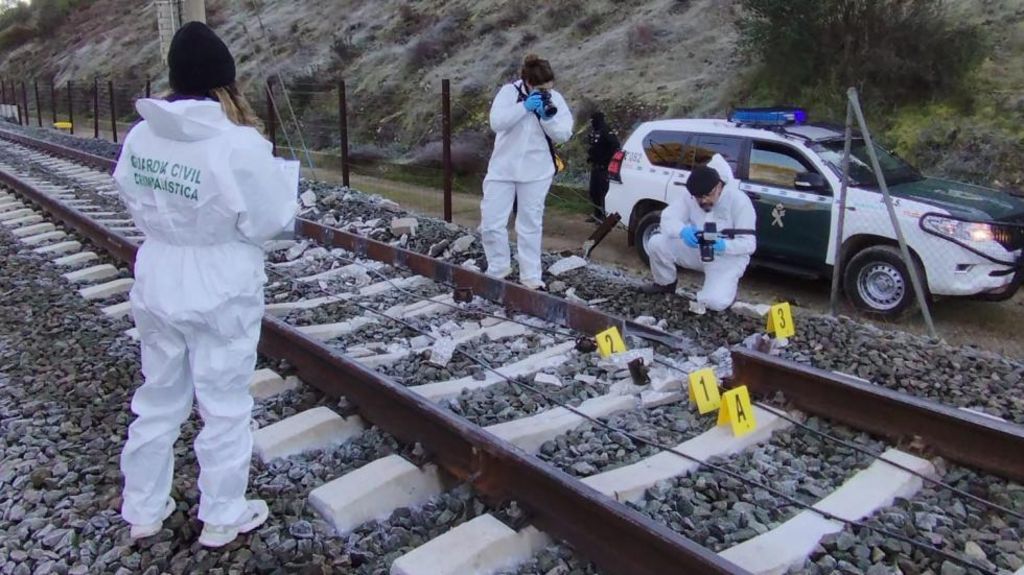
We actually have had 4 train accidents and incidents in a week.
https://people.com/train-collides-with-crane-arm-in-4th-rail...
It's clear some of them are probably caused by neglect in maintenance, others are freak accidents.
It's pretty crazy the statistical probabilities involved for something like this.
5!
An Asturias Circanías train collided with debris from a collapsed tunnel wall on Thursday afternoon in Olloniego. No injured though
Some more info from Spanish media. The track that broke was from 1989 and had not been maintained properly.
No, the claim is that the broken rail was the new one but it happened at the transition from old to new.
Jupp you are right I had not read up on the news today.
Got a link?
And how does it accord with the many statements made early on about the track being renewed recently?
Apparently the weld that broke joined an old segment with a new one installed last year as the tracks are renovated piecemeal.
Still the media in question, "El Mundo", is a mouthpiece for the opposition parties, seeking to create indignation against the government and scoring the head of the Transport Minister in particular.
They also want to make a parallel with the situation of the former President of the Valencian Community, from their party, who had to finally resign one year after being unreachable for hours on a date while hundreds of valencians drowned as his administration waffled aimlessly.
Of course the government is ultimately responsible for the state of the infrastructure, so the Minister well might have to resign after all is said and done, but the innuendo in that piece is pure politicking, not serious journalism.
I have one in Spanish. Seems the latest info is that it broke where the new rails meet the old rail.
https://www.elmundo.es/economia/2026/01/25/697635e8fc6c83c42...
Wow, that's a really big gap. No wonder it derailed
My gut feeling says a lot of fatalities could have been prevented with a physical barrier between both tracks. Shouldn't this be mandatory with high speed trains?
I think the physics of the situation don't make a barrier feasible: a derailed train going >100 mph is going to transfer a lot of energy to any kind of barrier it impacts, which in turn might exacerbate the situation (by spreading debris).
I think these kinds of accidents are largely mitigated by rail defect monitoring. I know rails in the US are equipped with defect detectors for passing trains; I'm surprised that a similar system doesn't exist for the rails themselves. Or more likely, one does exist and the outcome of this tragedy will be a lesson about operational failures.
In principle only, if a barrier could keep a train on its side of the barrier, scraping along the barrier for a long distance instead of smashing headfirst into it, the energy could be dissipated over a long period of time, preventing fatalities. But what kind of barrier can withstand a train?
if they are already doing a poor job maintaining their tracks, what gives you such confidence that they would maintain the barrier properly?
the more you build the more maintenance costs rise.
This collision happened precisely because of unfortunate circumstance that break in the rail and derailment happened just before the switch leading to the opposite track. Without the "help" of the switch, carriages of the first train likely wouldn't have invaded the second track.
The tracks are less than 3m from each other, a derailed car doesn’t need to get very far to be a risk to incoming traffic.
I’d rather they spent the money ensuring no trains ever left their tracks rather than halving the destruction if they do.
There was a switchover which made the derailed cars of the first train move into the track of the second one, you can't have a wall there anyway.
Pure economics. In Minneapolis the railroad demanded a crash wall to separate the light rail trains from their trains. It runs 1 mile and somehow cost nearly $100 million. This is a 5x increase from the original estimate but still $20 million for a 1 mile wall is a heck of a lot of money
Thank about the change in airflow. The train would use more energy because of having to push air that is trapped by the barrier
Also the issues other comments described, including that any fault in the barrier means a new safety hazard
More practical but still probably unnecessary is having the planned “passes” be where the tracks are separated by some distance.
But that requires the trains mostly always being on schedule.
The 20-ton bogie was flung 300m. What do you expect the weight of a whole car to do to such a wall?
You happened to have an opposing train at exactly the point where the train derailed.
That's simply really, really rare bad luck.
Practically anything you can think of is going to be a more effective use of safety resources than trying to contain a derailing high-speed train.
A stupid journalist, opposed to the current government, read a date in YY-MM-DD format as DD-MM-YY
Quite a tragedy.
Spain needs to rethink the way it operates trains. I think Switzerland handles this better, overall, though they probably also don't have as many fast trains because there are so many mountains. But I refer more to the intrinsic quality control and assumption made. If I recall correctly in Spain, there was the other train also coming in. I am sure they could have built the tracks differently. Granted, the issue here is cost, and an attempt to keep the cost down, but if you then accept disasters like that, it seems really awkward to me to want to save money here. And now that we know the track was already damaged, that just adds more validity to questioning whether the quality control systems were overall proper.
I mean maybe something of merit in that, but Spain has nearly 4000km of hitherto excellent and safe high speed rail and Switzerland around 200 km. Who should be giving lessons to whom? ;) Totally different scale of operations
Your comparison is nonsense and using nonsense metric.
Spain having built 20x more HSR than Switzerland in absolute terms, and much more HSR in terms proportional to country size, does actually does give them the right not to be lectured on HSR by a tiny country with a well-known superiority complex - especially when it's a cheap, incoherent shot soon after a tragedy.
I could make a cheap shot about fires in bars...but I won't.