illumos
illumos.orgI still have my OpenSolaris CD from Sun https://files.catbox.moe/f94s9j.png
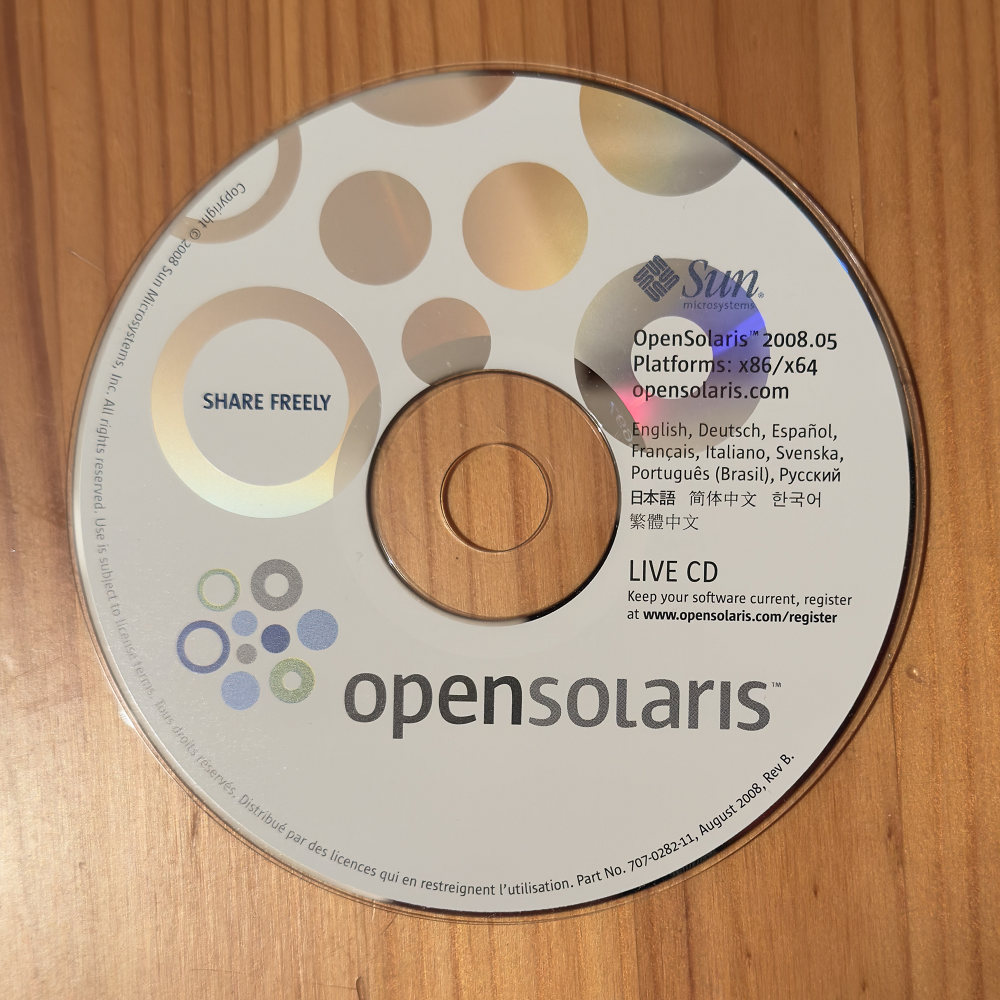
Looking back the 2000s almost feels like an alternate reality
I ran it for a while on my ultra 24 until I just installed linux on it. But it was interesting dipping my toe in the solaris world
Still have a couple original Ubuntu CDs floating around the house after 2 subsequent moves.
It's crazy that we are over 15 years removed from when illumos officially started as a project, shortly after Oracle took over Sun and killed off OpenSolaris.
I was on the group call that made the announcement in 2010 and I'm impressed that illumos is still going strong.
Fun fact, it is the only open-source OS that is proper UNIX (SVR4), not Unix-like, like the BSDs or Linux.
I really enjoy working with illumos on my home server. I run SmartOS[1] and it's zone management is great and the webui they've been working on is pretty cool too.
What does your setup look like? What kinds of workloads are you using it for?
I like Solaris(well, illumos/Tribblix etc) but when I install something I install a version that includes the LX (Linux) zones (container) functionality, so that I can quickly install anything prepackaged for Linux use. Sadly there are some things that take more work to get installed on Solaris.
Blast from the past! I think it was something like 15 years ago when I had an OpenIndiana vm running NexentaStor to control an HP MSA P2000 SAN.
I am not nostalgic for those days.
remember when macOS had time machine but opensolaris really had time machine?
It was the future OS most fails to understand. The ZFS/IPS integration was the first modern step aside of declarative distros. A thing 99% of people still fails to understand refusing the concept of storage system/package system/installer interdependence.
Zones, DTrace was the rest.
I submit that the problem was Solaris 9 just being massively overtaken by desktop Linux in every way - easier to install, faster, simpler to patch, better GUI, more software available. Solaris 10 was too little too late; it already had to compete with mature Linux offerings that had a greater mindshare, and the excellent features like Zones were too far ahead of their time (and lacked the centralized store of downloadable Zone-prepackaged apps that is really the reason for Docker's success).
Purity doesn't matter in practice - especially in a world where OS installations are increasingly ephemeral and ideally immutable.
I always hear DTrace is awesome, but have never used it. And seem to have gotten by just fine... what am I actually missing?
ZFS, on the other hand, was so good that it has outlived Solaris itself and is at the core of e.g. TrueNAS as a commercial product.
Do you have any recommended references to understand that concept and how it plays out in Solaris?
I find myself in the middle of what I imagine are similar design challenges in software packaging, storage, integration, and deployment.
My understanding is that this is part of Oxide's secret sauce.
Is there much traction with this elsewhere? I worked at SunOS and Solaris shops in the past, and remember telling my boss that this new Linux thing was going places and she dismissed it as nonsense.
Oxide uses illumos under the covers That's in no small part due to the composition of the early team--but we have benefitted tremendously from features (ZFS, SMF, FMA, Zones, bhyve, etc.) and observability infrastructure (DTrace, mdb, libproc, etc.) folks on the team have worked on for decades.
About ten years ago I worked on adding support for illumos/opensolaris/openindiana to some stuff and even back then all things solaris seemed basically dead already (despite the open* projects just being a few years old then). Curious to see these come up from time to time, and even more curious to see them still releasing new versions. These always seemed simultaneously ahead and behind the times.