A Year of 3D Printing
brookehatton.comI would encourage people who have never designed physical objects before to try to only print things they have designed themselves as an exercise. For perhaps a year or so.
If you have never designed physical objects before it is really challenging at first. The learning curve is pretty steep and, at least in my case, I discovered that I didn't have a mental language for thinking about functional 3D and mechanical design. You also start to look more closely at the objects around you and think about what went into designing them.
I started doing 3D design about a decade ago, when I got my first 3D printer. At first using free modeling in CAD and then later learning how to do constraint based and parametric designs in Fusion 360. This felt slow and perhaps limiting at first, but when you get used to it, it will save you a lot of time later and allow you to make more useful designs that are much easier to evolve and vary.
I think it took something like 4-5 years before I printed something someone else had designed. Mostly because I used 3D printing to make custom parts for my own projects, but also in an effort to force myself to learn. I know the learning curve was steep, but for some reason I have forgotten how much work it was to learn.
Now there are so many useful designs, designed by people who are a lot better than me available everywhere that I do print a lot of things others have designed. But I think learning to design things yourself is a really good opportunity to learn useful skills.
For instance, I had never anticipated that I, a software engineer, would get paid, by an actual customer, to design parts for their projects. Or even consult on physical design for someone doing product development. I am by no means at the level where I'd put it front and center on a resume, but I can design, and to some degree, manufacture simple mechanical parts.
(Along with 3D printing I've been doing some CNC at a very hobbyist level. I would still say I am very much a beginner when it comes to machining metals, but it is really fun to see that you can make reasonably precise metal parts for real applications (car parts) at home in my garage with not that much effort. This weekend I'll be doing thread milling in aluminum for the first time on a part that requires M3 screws)
I echo this sentiment. So many random annoyances around the house that I've fixed with self designed prints. Its a steep learning curve but you can start simple. First thing I designed was a spacer to go behind silverware organizers to keep them from sliding around. Still in use almost 8 years later. Horrible print quality and all.
Last year I printed a peg leg for a nonstandard luggage wheel that broke off my suitcase and Samsonite won't sent a replacement for, a cleanable coil denitrifier for a saltwater aquarium, custom shadowbox drawer organizers for a toolbox, and during an aquarium emergency printed a metric to US pipe bushing.
I also put the skills to use for woodworking modeling a set of couch doggie stairs and a couple years ago designing the building for my observatory.
It's a really really useful skill
Granted, my modeling skills begin and end with Tinkercad but I've actually created some really useful things for around the house and for hobbies -- a plug for my septic drain field distribution box pipes (one pipe was cut too short and there was no good way to plug it -- I tried lots of options before making one myself), jigs for drilling, pieces for a claw machine I'm refurbishing, cases for Arduino projects, etc.
Also did a luggage wheel/stump. I modified another model someone had made. It was amateur on about every level and rushed with maybe 18 hours before departure but, to my great satisfaction, it did work.
do you print in pla or abs ? how long do pla parts last ? where i live the moisture gets to pla eventually and i cant use it for anything that cant be failproof especially something bearing with a load on it.
I print in a lot of different materials, asa and PLA being primary. Both have proven good enough for me
ASA was surprisingly good, but it does produce a lot of fumes.
I will add that FreeCAD has come a long way in constraint based and parametric part design, and I'm able to use it exclusively running an Arch-based distro.
Deltahedra has extremely impressive tutorials on YouTube. No fluff -- no long intros or filler -- 30-60 minutes of dense content, clearly explained: https://www.youtube.com/@deltahedra3D
I don't do this because I don't have the time to design wargaming terrain, but I've definitely pushed myself to do more designing for household things.
It's a really good feeling to be able to put something together that solves your problem. As I asked my wife, "Is this why people with wood shops are always so smug?"
It's also fun to be able to feel your skills building. I now have opinions on friction fit box lids.
3D printing has been humbling for me.
I can express myself well spatially in code, but that doesn't help much in CAD where you have to figure out what combination of buttons and parameters will do what I want.
I can manage dependencies well in code, but that doesn't help much in CAD. I continually struggle to design parts with geometry that is dependent on the spatial relationships and constraints of how multiple parts connect together.
FWIW, I crashed and burned with pretty much every 3D CAD tool I tried (though I did make it through the tutorial for Dune 3D which was a first), but OpenSCAD has been quite workable, and the development of a Python-enabled version:
has allowed me to extend it to do things which would be quite difficult in other tools:
Have you ever tried https://openscad.org/?
OpenSCAD is very nice but if you combine it with BOSL2 you can do miracles:
Do you by any chance have over a decade of coding and under a year of CAD? You might have forgotten how hard coding was when you had under 200 hours of experience with it.
Cad in general isn’t good at modeling spacial relationships between parts as a graph.
Open SCAD is great, but also give cadquery a shot. It's my personal favorite right now
Since I'm a developer with no experience in 3D design, I just automated my process with freecad and vibe-code my models with GitHub copilot. That gives me instant visual feedback plus 3d model code I can check in into git: https://github.com/micw/freecad-automation
Is this robust enough to run headless? I'm thinking of sticking it in a Celery worker to generate parametric variants, but I'm not sure if the LLM output is reliable enough to run without that visual feedback loop.
The workflow here is:
1. 3D Model code generation
- generate the model via AI, using plain text - review the result (using FreeCad for visual feedback) - iterate until the model is fine - tell the AI which parameters shall be customizable
(see my tablet holder example, there I have parametes for a Huawei MediaPad and also for an old Samsung Galaxy Tab, both using the same model)
2. 3D Model export
This can be done entirely headless and it's very robust. No AI involved, only the python code previously generated by AI.
Currently a generic 3mf file is exported, so It needs to go though a slicer and you need to apply your printer's settings (printer type, nozzle type, all that stuff).
But the generated 3mf is just a ZIP with 3d model and the settings within. So this could also easily be automated.
I print a lot of stuff I design, but I am not very good at it.
But a heck of a lot of what I print doesn't exist, or only exists in disparate parts. So I am forced to RAD a lot of stuff together.
You can get pretty quickly at it with Blender instead of proper CAD. Just do the "donut tutorial", set the correct workspace dimensions and go for it. You can learn basic modelling in a day.
Blender is overwhelming at first glance, but it becomes incredibly intuitive once the UI clicks. Of course modelling for printing in Blender has drawbacks and limitations. It's more fiddly, but unless you are super stupid, you can get pretty far, pretty quickly. And you can do sculpting and organic shapes, which are hard/impossible in CAD. Learning Blender basics is worth it anyway, incredibly useful for thinking and sketching in 3D. Oh, and it's FOSS, runs entirely locally, doesn't spy on you, or appropriates your creations like the "free" Fusion360 and their forced cloud crap.
Once you got annoyed by Blender's limitations for 3D printing, you can learn CAD. But Blender is the best way to get into it IMO. Trust me, you won't regret learning Blender basics, in any case. It's expanding your creative horizon and is fantastic, very pleasant software.
I second Blender. I don't use anything else and don't see why I would want to. I hope to get into geometry nodes in future.
The donut tutorial is .. handwavy relevant to 3D printing.
3D modelling for 3D printing doesn't require materials, colours, lighting, camera placement etc etc. But doing the donut tutorial will get you used to many aspects of blender and realise just how powerful this software is. It's also kind of a Blender right-of-passage.
The Blender documentation is fantastic if you prefer to learn via pages than random video-build-a-thing tutorials.
Blender tends towards using keyboard shortcuts. Learning them can greatly speed things up.
And Blender has a large body of community forums for questions and answers if you want to search(first), post a question, or likely ask your friendly AI what the answer is.
[edit] the bite sized blender basics videos on the blender.org site no longer easy to find. :-(
My favorite model of all time is this digital sundial: https://www.thingiverse.com/thing:1068443 It's generated using code that knows the shapes of numbers and "punches them out" of a template object at different angles corresponding to angles of the sun/time relationships.
It would be impractical to make in any method than additive printing.
I'm a fan of this too, I think it's a very clever design. But I also think it'd be pretty trivial to make in a six axis CNC. Maybe even a 4 axis if you're clever with your mounting.
One of the most useful things that I print is Gridfinity storage boxes and holders. I try to organize as many of my tools and supplies using it. I sometimes do a little leather working for fun and have a drawer full of hardware, all in their own bins. In my garage my sockets, wrenches, etc. all has a Gridfinity holder. I design my own as much as I use pre-made ones. A while ago I even saw a shop that used it to organize most of their small wares. It’s an incredible system.
Another note: PLA has gotten significantly better in the past few years. PLA+ is legitimately better while being as easy to print and the Polymaker HT-PLA and HT-PLA-GF are even better as you can meaningfully anneal them after printing to make them strong and temperature resistant enough for some very functional prints.
Unfortunately, even annealed HT-PLA-GF still creeps quite a bit. I find this to be the main problem using PLA as an engineering filament. For many parts it doesn't matter, of course.
I like having a gridfinity grid on my desk with a number of various sized boxes for at-hand storage of things like paperclips, tacks, pens, etc...
In the garage, I have one that I can slap down anywhere, with a couple boxes that I can load for the screws, nails, washers, nuts, and bolts, etc... used in my current project.
Having the grid makes the boxes sit firmly in place.
I think PLA is a lot stronger than people give it credit for, especially if printed at 100% infill. I finally had a chance to use the PLA-CF that came with my Bambu X1C for a replacement part on my tripod, and it's great.
I think it's cheating to say PLA is stronger and then talk about PLA with carbon fiber added.
PLA-CF is not particularly stronger than PLA. Some properties are improved, mostly geometric stability and appearance, but the carbon fiber acts more like defects in the plastic than strengthening. It’s got very little of the benefits that you’d imagine based upon n experience with regular carbon fiber.
This. CF rarely makes a print stronger, usually just helps make some materials more forgiving to print. Particularly useful for warping prone ones.
The A1 has a relatively small printing plate. How does it work for boxes that are larger ? You print them in pieces and click / glue them together ?
I print wargaming terrain that's bigger than the bed of my P1S from time to time. The clear Gorilla polyurethane glue has worked really well for me.
This is true. So far, everything I have printed has fitted on the plate. However, for larger items you can split them on the slicer and include connectors to join them back up - I'm yet to try this though
I tried this with some longer gridfinity boxes and the result was a bit meh. You have to glue them, but even then they aren't as solid as I'd like. But I only have a handful of boxes that needed to be long so it doesn't matter.
One thing I've started playing with now are gridfinity cases so I can pick a bunch of part boxes out of my drawers, put them in the case and take them to the garage without risk of everything falling out. Then, when I'm done, they go back in the drawer.
I wouldn’t call the A1 build plate small, more like average/typical sized.
And in that sense it means that almost every design made by someone else you find will fit your machine. I rarely if ever find something on Printables or Makerworld that requires a larger machine than the A1.
Then you’ve got the A1 mini being ao popular that many times people will make variants just for the small plate on that machine.
Any reason you are recommending PLA instead of PETG?
I still get worse finish quality with PETG (stringing and globbing) and these PLA+ type materials just end up being as good for me while being easier to print. PLA also prints a bit faster.
This is not my experience. PETG should be utterly problem free, super fast to print and has a much lower fraction of failed prints due to various adhesion issues. The big trick is to make sure the filament is dry, if it is not you will be in for a world of trouble. But properly used prints will last much longer, and are mechanically (much) stronger. On top of all that we can buy PETG in bulk for about a third of the price of PLA.
For functional parts I would not use anything else until there is a really good reason (such as high temperature stability or more strength for a given weight or cross section). I've gone through multiple tons of the stuff now (3500 Kg in total or so) on 85 printers (Bambu's (43), Creality (22) K1s and Prusas (20)), consistency between batches is very good though from brand to brand there can be some notable differences.
If you have stringing and globbing problems with PETG my first guess would be that the filament profile that you are using is subtly off for that particular brand of PETG and/or that the filament wasn't dry.
Calling PETG "utterly problem free" is quite a stretch lol. PLA is pretty objectively much easier to print than PETG, and perhaps than all the popular filament types out there, especially if you are trying to print anything where precision/detail matters. .
PETG is just oozier and stickier by default, so stringiness is almost guaranteed to happen, bridging at a greater risk of failure, etc. It is tougher, so unless you have a printer that can use multiple filaments on the same print, removing supports is more difficult.
Can you reduce these factors by tuning your 3D printer - yes, a bit. But that's not "utterly problem free".
PLA is the plug and play of the 3D printing world right now.
When you print objects with 10's of printers 'tuning your 3D printer' is no longer an option other than to tune it to be 'in spec' You can only tune your designs and the profile for your filament and for a particular model of printer but then all of those have to be close to identical. As soon as you start tweaking your design or filament profile to offset possible issues with the printer you've lost reproducibility.
Incidentally, a lot of the stuff on thingiverse and other similar sites suffers from those kind of issues. They are tuned for PLA on a particular printer without realizing it.
The real question is - did you buy 10s of printers because you needed them for the business, or did you start the business to buy 10s of printers :P
I bought one, to try out some ideas, then it sat on the shelf for about a year, then suddenly there were five and so on.
I have a few shelves that got populated with things in a very similar fashion...
PETG is, for me, always stringy. And I don't want to breath ABS fumes.
Not the person you’re replying to, but I can see the appeal of PLA. It has more color options and prints way easier.
I personally run all PETG because it is ultimately better material post-print, and once you understand how to print with it, it’s not really much harder to deal with.
The day I discovered that I should just run my dryer with the PETG inside while printing was revolutionary. Of course, that requires you own a dryer that allows the filament to print while it’s inside.
I get some the appeal too but once you get a setup dialed in well and safely for ASA/ABS, theres rarely a reason to want to print either PLA or PETG.
Better ratio of weight to strength, far more durable parts for most jobs, and acetone smoothening opens up all sorts of doors to incredibly high quality prints without all the labor of sanding.
I wish I knew how to dial in PETG fully. It prints fine for me but I still get globbing and stringing so the surface finish just isn’t that amazing.
That's definitely still where I see the appeal of PLA, and once I get through the too much bulk PETG that I own I may mix up my future purchases to have more PLA where I don't need load strength and won't have issues with high temperature usage.
I am getting reasonably consistent prints but they aren't perfect.
The long version of my tips for using PETG are:
- A Bambu Lab printer doesn't hurt since it's so nicely calibrated and idiot-proof
- Clean the build plate with dish soap and dry fully. I haven't found any need for glue stick on a textured plate.
- Using a filament that has a profile available from the manufacturer for Bambu lab printers
- Printing with the filament in the dryer with the dryer running during printing
In my case PETG had issues until I realized that on my machine it needs to go slower.
I can print PLA at 100mm/s with .25mm layers...but PETG I don't go much over 65mm/s give the same line width/layer height.
Since getting things dialed in I switched to primarily printing PETG. Although, I have no issue printing PLA, PETG or ABS when needed.
From my experience PLA is just easier to print - prints are less likely to fail and more consistent.
Also due to lower nozzle and bed temperatures, prints start faster so you can check the first layer sooner before you let the printer do its thing.
For some applications, PLA is a little more rigid. It will then fail in a spectacular fashion, but "I need you not to bend" is something PETG doesn't always perform the best for.
any reason to use PETG instead of PLA? PLA is plant based, in theory bio-degradable, while PETG is produced from crude oil.
That is mostly true, PLA is ONLY biodegradable in a facility that can handle that. Your run of the mill recycling center in your city probably can't or won't take your PLA prints.
And then only if it's pure PLA with no additives. Which most PLA has to improve speed of printing or strength or some other property. In practice, I'd wager that 90% of commercially available PLA fillament is not actually biodegradable.
Less creep, slightly better at absorbing shocks without breaking, better failure behaviour (PLA can suddenly shatter leaving sharp edges, PETG tends to deform elastically first).
Note that "deform elastically" is not necessarily a desirable failure state if it happens earlier than shattering.
I still have mixed emotions about 3D printing. I do love the idea of being able to print a part when I need it for something. But I do hate myself at the same time for creating more plastic junk. PLA is not really getting recycled, when it fails someone throws it in the trash and it goes to a landfill. Maybe some really diehard enthusiasts are ensuring all their failed prints and broken parts get properly chemically recycled, but I bet most don’t bother and just bin it.
The way I see it is that a 50g piece of 3D printed PLA could be used to fix a 5kg item that would have otherwise gone to the landfill. I for example have a broken hook for the door tray in my fridge, it's a tiny piece but it being broken rendered the entire 1kg tray useless, it's sitting on top of the fridge waiting for me to buy a 3D printer and fix it.
In the US almost all PLA comes from corn, outside the US I think it mostly comes from sugarcane.
It can be composted in industrial composters, but even if you dont do that it's still pretty green
And that's the best case scenario, I think most people print useless junk to begin with, just look at the top downloads on printables.com, less than 30% are functional prints, most of them are short lived junk, and a lot are AI generated.
While they certainly correlate, downloads don't match print rates. Unless you got a ton of printers you are mostly doing one print at a time and each requires setup and cleanup, or possibly multiple attempts if there are difficult to print features.
It can be multiple hours between prints because good prints take time. But you can spend 30 minutes browsing random peoples designs online and say "cool" and press download on 20 different designs that you only print 1 or 2 of ultimately.
Also some designs look cool but the second you load your model up in a slicer you can see it is too finnicky or too long or expensive to print to be worth the effort.
which is why I tell the shop techs to not print the benchy boat and print something useful instead.
I've kept almost every bit of scrap PLA I've had from printing. You can melt it into silicon molds, grind it up and feed it into a pellet extruder, pass it on to those who recycle it into filament (like https://erikaprintsshop.wordpress.com/), or for the hard-core DIYers, create your own filament recycling operation. (Though more approachable commercial options are starting to come to market (https://crowdfunding.creality.com/)
if you printed what you NEED, how is that junk?
Let's see how much you really care: https://all3dp.com/2/best-diy-filament-extruder-kit-maker/
Seems there is a market for a truly biodegradable print material, if even for doing a prototype before committing to a full plastic print. Or a real recyclable method to take old prints and reuse the material again.
The issue with biodegradable is that it is in direct contrast to something that is durable and long lasting.
I feel the same and that has kept me from buying a printer. That is not to say that I never will but for the time being if I really need a particular part I can always use a printing service.
I find this concern a little odd because most people tend to do very little in their life to make a difference in ways that count way more than a couple kilograms of PLA filament.
Let’s take 1kg of filament, which is enough for multiple print projects depending on the size of the items.
That is approximately the same weight of petrochemical material as 1/3 of a gallon of gas (making a bit of an assumption that the amount of processing per weight of both materials is roughly the same).
Every time you drive 10 miles in a car that gets 30mpg it’s like you are burning an entire roll of filament.
So the average American is using probably 1-4 rolls of filament just to get to work and back. The last time I bought a roll of filament was multiple months ago.
I’m not singling you out, I am really just pointing out that humans are terrible at understanding the quantities of things and what things actually use a lot of material and create a lot of carbon emissions.
This is especially true since cost is so detached from material use, waste, and carbon emissions.
A gallon of gas is an order of magnitude cheaper than the equivalent weight of filament.
Burning a bunch of BTUs of natural gas to make my house 4 degrees warmer and gain a trivial amount of additional comfort wastes a whole bunch of energy but costs me so little that I don’t even know what my gas bill is.
It’s cheaper for me to replace most of my home appliances with brand new ones than hire a repair service.
I can fly to Florida for $50 and burn 15 gallons of jet fuel.
If I put more garbage out in my bin I’m not charged more. I can even put furniture and appliances out there and I am not charged more.
These are all examples of waste and environmental impact where I don’t really see or feel the magnitude of them because our systems don’t show them.
Anyway I know this is kind of a huge tangent of a discussion. But really, 3D printing is the least of your worries.
Can't help but wonder looking through the gifs, am I actually insane that I MUST fillet, chamfer, or chamfer AND fillet basically every single one of those edges[1] with with tangency weight of 1.5 where possible, until the shape takes a generic apple/bauhaus/lego/ikea style? I'm aware that doing so don't necessarily improve load distribution, but I just can't stop rounding those corners.
Am I really the only one?
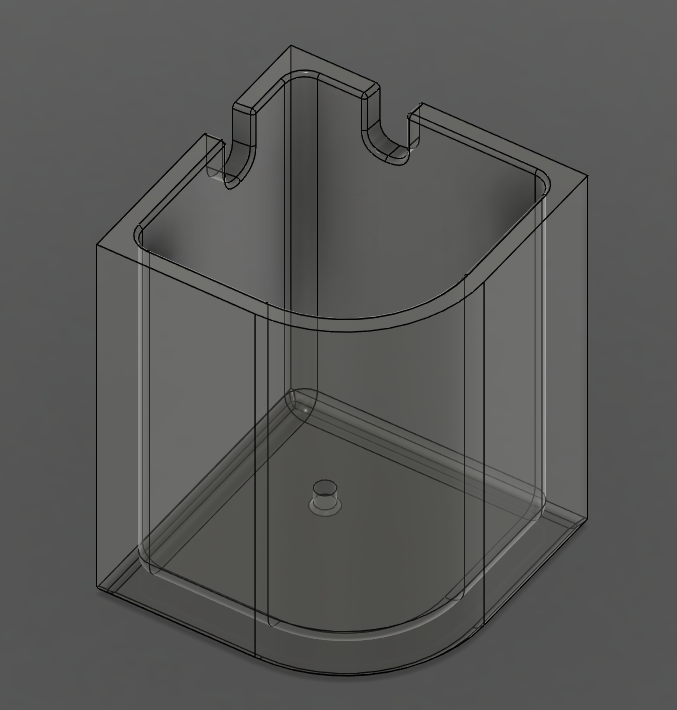
You are not alone. I like to round the edges and corners. I feel that it should help the strength on concave corners at least but honestly have no evidence to back this up.
No idea of your "tangency weight" bit though. I use blender bevel tool.
I'd encourage people doing engineering/functional parts to also try ASA and PC(-CF). Both are pretty easy to print on enclosed printer like Prusa Core One, and they offer unique qualities that are impossible to achieve with PLA or PETG.
Prusament PC Blend is insanely strong and stiff, I saw a 3mm PC bracket bending a high quality metal wood screw into an S-shape without breaking. PC-CF is much easier to print, looks great, and is stiffer still, even if a bit less strong. ASA looks great and is tougher than PC. Both creep less than PLA and PETG. Both shrug off 100C under load.
ASA and ABS really need a good filtration. Like actual filtration, not what the enclosure has. I personally just run a duct to my window and vent outside.
That's largely a myth.
This review [1] cites the absolute highest amount of emitted styrene in the studies they are reviewing to be 113 μg/min. Using [2] for simplicity with styrene's molar mass (104.15 g/mol), we get to a printer creating at most 0.024 ppm of styrene per minute per m3 of unchanged air. For comparison, the "work exposure limit (WEL) for styrene is currently 100 parts per million (ppm) averaged over an 8-hour day" [4].
In other words, as long as you have some air exchange in the room, you'd be orders of magnitude away from the safe work exposure limit on styrene.
It also makes sense, considering that it's a microscopic amount of molten plastic, whereas injection moulding factories work with vats of the stuff.
[1]: https://www.sciencedirect.com/science/article/pii/S135223102...
[2]: https://teesing.com/en/tools/ppm-mg3-converter
There are active studies on chopped CF inhalation/contact hazards, and the SEM images in the above post prove how it occurs.
A lot of plastics contain wide assortments of additives to obtain mechanical properties. Outdoor ventilation is absolutely preferable to filtration or smell reduction filters that does practically nothing about carcinogens.
PLA is comparatively low emission, but a slow cooking PTFE tube in many hot-ends is not something people should be around. ymmv =3
There are different kinds of carbon fibres. It'd be great if it wasn't just Prusa disclosing which type they are using or offering studies on their impact, but in the meantime we can just use CF Prusament to be sure: https://www.reddit.com/r/3Dprinting/s/nQ5zUwnrWZ
Apart from the reply you've already received, most the bad stuff like plastic nanoparticles in the air and many hard to detect VoCs are also rather blatantly an issue with PLA and other filaments.
People focus too much on smell as the only indicator.
Most filters have limited effective life for VOC, and "safe" use is measured in a few hours at most. Venting outdoors into a fern/decorative-plant filled yard is the preferred option for both FDM and Resin printers. Most activated charcoal filters just reduce the smell, and do nothing about the the harmful parts even with HEPA14 filters etc.
Chopped CF filled FDM filaments are mostly a scam, but there are few PETG and ASA viable options:
https://www.youtube.com/watch?v=w7JperqVfXI
https://www.youtube.com/watch?v=m7JAOi4JnBs
https://www.youtube.com/watch?v=vAL_p0yYKIc (Fibre Seeker 3)
One challenge designing a metal-printing process was making it safe for people without prior lab-safety training. Some 3D additive processes are simply just not practical for careless "yolo" consumers. =3
CF filled filaments aren't a scam, they just have different tradeoffs: more rigid, nice surface finish, and less warping (all useful qualities!), but also lower layer adhesion, lower tensile strength, and less toughness. It's not just anecdotal, Igor Gaspar collected a lot of hard data on that.
In the past I've mostly printed intersting/amusing things from places like thingiverse. But this year I had a project I needed an enclosure for, and instead of using something off the shelf I decided to print my own.
Being able to design, print, test, change, print again really made the potential of 3D printing shine for me. I must have went through a couple dozen iterations as the hardware choices solidified and I saw what worked and what didn't (like "oh, I actually can't reach that screw once these two pieces are put together"). It was a really rewarding experience and I'm looking forward to the next project.
Gridfinity seems very useful. I might try it. I spent $100 on FB marketplace 2 years ago for a AnkerMake M5C with bunch of rolls of PLA. I've printed hairdryer rack, containers, Labubus as little gifts for neighborhood kids to paint over. I thought about getting a multi-color 3d printer like Anycubic Kobra S1 combo, but the wasting of plastics is holding me back. Snapmaker U1 is much better but more expensive.
The U1, so far, is looking to be a great printer. No idea on long term, but you will not find another toolchanger at that low of a price.
Flash forge is releasing theirs in the next few weeks.
Good article, but I really really enjoyed the (non-deterministic!) falling objects with physics engine at the top of the page.
What is the latest on metal 3D printing? How long before I can send off models to a shop and they can print it close to the price of the underlying metal?
I imagine metal printing will never be something that happens at home.
> close to the price of the underlying metal
Never? Never for plastics either. It seems like there's always going to be a lot of cost in shaping these materials through carefully controlled very high temperature environments. On the plastic side of things just the filament you feed to a printer is a multiple of the cost of the plastic feedstock that goes into making the filament.
You can send off models and get them 3d printed in metal today reasonably affordably today, reasonable as in "considering the time and expertise that go into making the model making a one off part like this isn't breaking the bank" not "competes with mass manufacturing on cost".
Multiple states are trying to ban 3D printing and CNCs
Reminds me of when Hollywood wanted to ban A2D converters to "plug the analog hole".
Hello, what are you using to render the models in the webpage? and what format did you export the models as to do that? It looks very nice!
Hey! It's using three.js with rapier for physics. The models are being loaded as STLs using the three.js stl loader https://threejs.org/docs/#STLLoader.
https://github.com/Brookke/brookke.github.io/blob/main/src/c...
I have not seen any discussions on the impact on PFA's from these homemade 3D plastic goods.
Is there any reason to believe there would be any? My understanding of PFAS is that they are used in the application of various coating like things (teflon originally, also since then waterproofing applications, paints, makeup, and firefighting foams)... none of which seem particularly related to making thermoplastics and pushing them through a nozzle into various shapes?
All of this was on a Bambu A1 Mini?
These are the types of things I want to print. My Ender 3 was so finicky, I only got a few out before I gave up.
I got a cheap Ender-3 V2 with a few modifications (extruder moved to the sled, CR-touch sensor mounted) which - after redoing the wiring which the previous owner somehow messed up, replacing some mismatched bolts, putting nuts and washers on the bolts underneath the hot plate, putting the springs in their correct locations, removing a metric ton of hot glue, aceton-glueing a few broken ABS details, installing more capable firmware [1] and tightening all bolts - seems to work just fine. Thus far I've only used PETG to print spare parts to repair broken appliances, this started out with some hiccups but works fine after installing the mentioned firmware. It isn't particularly fast, it isn't particularly pretty but it does work for my purpose: create parts to repair and build things. I have no doubt that a more modern printer can make life easier but thus far life hasn't been hard with this Ender: design a model, slice and dice it and send it to the printer which does the rest. I've printed some fairly 'hairy' models which came out fine (i.e. not hairy/thready) even though I'm using PETG. For those with some technical aptitude - in other words for people who are wont to build and repair stuff - these machines are an affordable step into the additive manufacturing world with the promise of 'spare parts at your fingertips'.
I just got a Bambu P1S (they are / were on sale since the P2S came out) and the difference to my Ender 3 is truly night and day. I almost never used the Ender, since it always resulted endless tinkering and even then, the prints never came out well. The Bambu worked flawlessly out of the box.
The P1S is such a good printer.
I picked up a P1S for Black Friday. I’ve been printing non-stop since December, including some stuff I modeled myself. Only failed prints have been because I printed the wrong thing. It’s been flawless with PLA. Haven’t done PETG or ASA yet.
I had an Ender 3 Pro, and it was also very finicky, ~18 months ago I replaced it with a Bambu P1S and that thing is just a (nearly) fire and forget machine. I've been super happy with it. In the 18 months I've had it, I've probably gone through 10-20 rolls of filament, in the 4 years I had the Ender I went through maybe 3-4 (because every time I wanted to print something I knew I'd have to spend an hour fiddling with it). A coworker has the Ender 3 though and his has been reliable, so it seems YMMV.
Ha, another Ender survivor here. I had the Ender 5 Pro for a few years, recently bought a Bambu H2D and it's like going from a bicycle to a car with heated steering wheel. It "just works" (it still has the classic 3D printing problems of edges of the print lifting up etc, but that's not the printer's fault). Vast majority of the time it just works.
Which problems did you have with the Ender apart from the mentioned classic 3D printing problems? As I mentioned in an earlier comment I'm using one of these machines without too much trouble after fixing the mistakes made by a previous owner. I did put more capable firmware on the thing which improved printing speed - especially in the preparation phase - and to a lesser extent quality but even with the stock firmware it performed well enough with PETG and some complex models after dialing in the temperatures, distances and speeds to the somewhat odd filaments I use. I can send code directly to the printer, no SD card needed, I can follow printing progress in a browser and I don't send a single bit of information to the Creality mothership while doing so. The same is probably harder - but maybe not impossible, I haven't looked into this yet - with Bambu printers?
>>Which problems did you have with the Ender apart from the mentioned classic 3D printing problems?
The kind of problems that could only be solved with a rather embarrasing amount of tuning every time I switched filament types or speeds or the temperature in my garage changed etc etc etc. Things that basically meant that every time I wanted to introduce any change I needed to print a new flow tower, new bridging tower, new temperature tower, the bed levelling took a huge amount of effort to install BL touch on it but it still worked....when it wanted to, with parts of the first layer being too close scraping the bed and others being far enough to not stick.
Don't get me wrong - the Ender 5 could print as well as the H2D can, absolutely. But it would need 10 test prints and me pulling my hair out first to get to the same level of quality - which I have done, repeatedly, but I just lost the appetite for the tinkering. With the H2D I click print and the machine calibrates itself so well I actually feel bad for anyone who only ever experienced this and never had to sit down calibrating extruder steps or flow rates manually. (yes, old man yelling at clouds).
>>and I don't send a single bit of information to the Creality mothership while doing so. The same is probably harder - but maybe not impossible, I haven't looked into this yet - with Bambu printers?
Bambu printers, even with the most recent firmware allow Home Assist integration where you can monitor all print parameters remotely. But to be completely honest with you - I did go through a phase where I cared about stuff like this, now I just want it to work and be more like my dishwasher than like my bike, I want to tinker with the bike but my 3D printer should "just" work.
Sounds mostly valid, if I ever get something more 'advanced' I may look back on my time with this machine the same way I look at my early history with (2D) printers - dot matrix, then HP500 inkjet with a sheet feeder and other such luxuries to the current HP and Canon lasers.
Having said that I must say that the firmware update did make quite a bit of difference. I have yet to print out any of those flow/bridging/temperature towers, I did get a few bad starts related to bed adhesion but those are 'common 3D printer problems' not related to the machine. Using some of my daughters' hair spray solved that for the most.
It was indeed. Honestly, it’s been more reliable than any inkjet 2d printer I’ve owned.
gridfinity is really addictive. I have no idea what I want to do with it, but I want to print more.
Awesome. This person got way busier than I did [1] (I think I focus more on creating original designs on the printer). When I first got the Bambu in 2024 I did the whole Gridfinity thing. Very fun.
As their post makes clear (even to me) there are actually a lot of things out there you can 3D print. Something I printed last year (and did not even bother to post) was a center-console "compartment" for a 1995 Mazda Miata I have. I swapped out the trashy aftermarket stereo (a previous owner has installed in the Miata) for one that is close to OEM but then I had an empty "hole" in the center console. So I printed a cubby for it.
I too was like the author. Originally got into 3D printing years ago—found it frustrating. Picking up a Bambu printer a yearish ago made made all the difference in the world for me. Previously I had an Ender and it was, endlessly frustrating (pun intended). The Bambu is so next-level, the software so well integrated and polished, that I finally found that I enjoy, and I am not burdened by, 3D printing.
(The only caveat about the Bambu is that people worry about vendor lock-in. I don't believe Bambu have enshittified that way yet, and people are finding workarounds in case they do, albeit by adding complexity in setting up, printing. The price of the Bambu for someone getting into 3D printing is very attractive.)
[1] https://engineersneedart.com/blog/3dprinting2025/3dprinting2...
Enders are for people that love the tinkering with printers aspect of 3D printing, I would not use them for production. We evaluated a couple but came away unimpressed.
Couldn't agree more.
Knowing you can design a simple part in a few minutes and actually print it immediately afterwards is important. Before I got a reliable printer (bambulab a1) i put off even the smallest projects because I knew it would entail a multi-hour trial and error session with the printer.
I have the same feelings about Bambu. I really like what Prusa is doing for the community and how they drive it forwards - but the Bambu simply works without fuzz. I also came from an Ender and its just so much fun.
Hah, I hope I wasn't the previous owner! Needed an aux jack, and that seemed like the easiest way to add one!
Lovely 3D header animation! Fits incredibly well with the posts content :)
Glad you like it. First time properly delving into three.js - other than the page size I’m really happy with how it turned out
Nice. I mostly print parts for other 3D printers...
At first I assumed it's going to be this guy: https://www.youtube.com/playlist?list=PLGje7toBDzsiIrHIHG-eL...
Omg I love them!
By: motherfucker - Cults3D - I really like the 3D printing community
It really is poor taste. Parents like me might want to spend time 3D printing with children without having to tip toe around an explanation for this username.
I never really heard this word until I was 18 (in the military) and it's occasionally part of my vocabulary if I, say, drop a sturdy wrench on my foot.