Harvard Law paid $27 for a copy of Magna Carta. It's an original
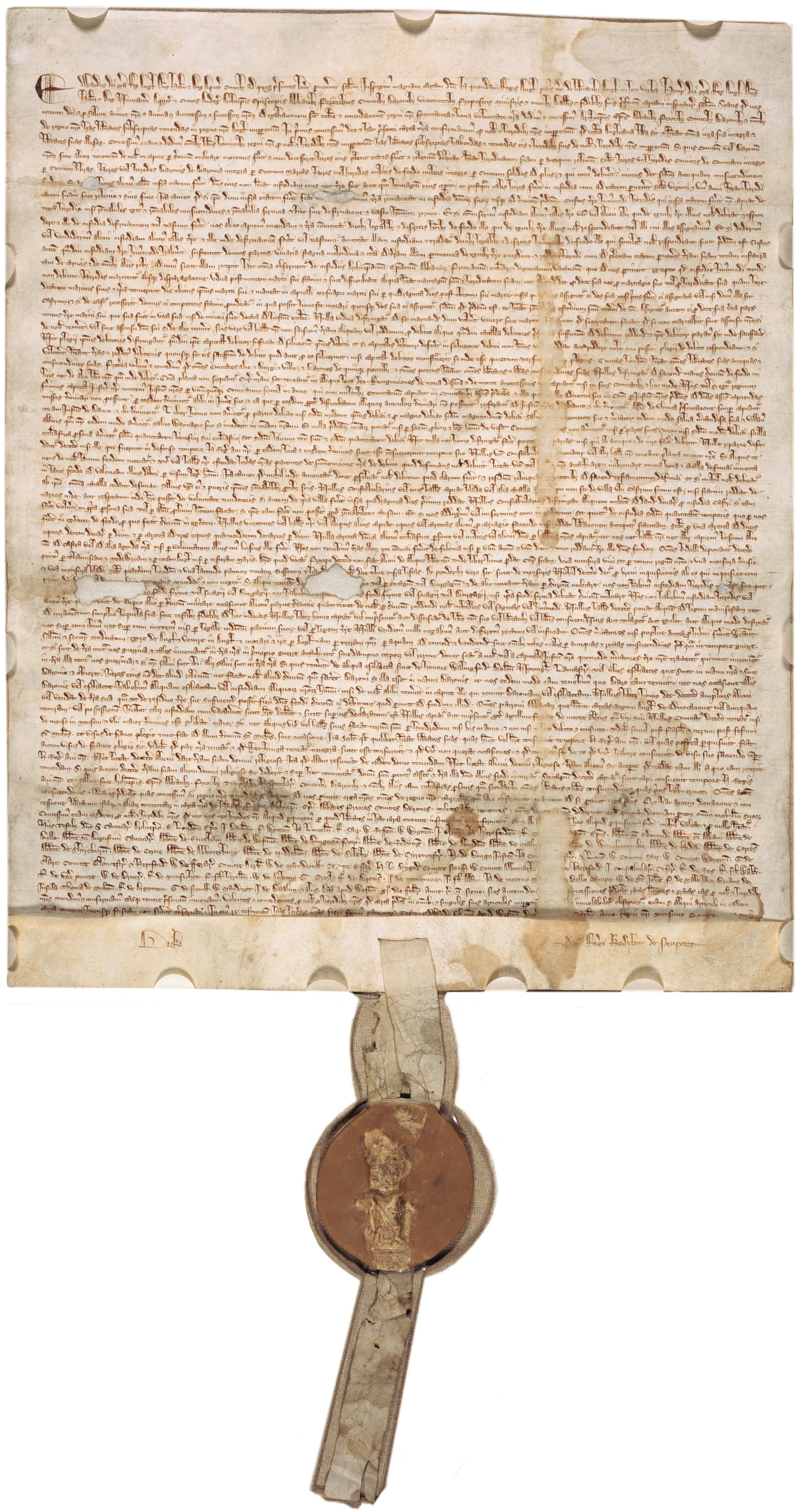
nytimes.comMagna Carta, approximately 1300. Manuscript. HLS MS 172, Harvard Law School Library https://iiif.lib.harvard.edu/manifests/view/drs:49364859$1i
Can't see anything other than a black screen. Using newest Chrome without extension (guest profile): https://i.imgur.com/DgLgUib.png
Works for me on Firefox Mobile w/ Ublock origin: https://i.imgur.com/8UAuXiu.jpeg


The magic of compound interest: buying an original Magna Carta for $27 and selling it for $21 million 80 years later is equivalent to achieving 18.5% compound interest. Roughly the same rate and duration as Warren Buffett's investing career, with a smaller starting value.
The $21 million figure was based on a 2007 sale, which would have been closer to holding it for 59 years -- almost 26% interest compounded annually. If that rate of growth held for another 18 years, we'd be looking at $60 million today.
Unfortunately gains are only real if they're realized — and Harvard will never sell their copy.
Hence why taxing "unrealised capital gains", as was floated during a recent election, is preposterous.
Indeed. However, it might make sense to change the definition of "realized". For example, if you use invested capital as collateral for a loan, we could require that it be valued at its basis cost. If you want to use the current market value of the stocks for loan collateral, then the IRS could recognize that the loan institution "realizes" that the stocks have appreciated in value and that the holder of the stocks agrees on the valuation. Multiple parties realized that the stock has a higher value today than its basis cost and expect it to presumably hold at least roughly that value for the duration of the loan.
Using the market value as collateral is in fact one way of realizing the gains: the investor is using the loan to convert their gains on invested capital into something usable. The capital gains tax would only be triggered when the investor utilizes a price other than their basis cost for their financial instruments.
This would probably not affect very many people: 99% of people don't use their retirement stocks as collateral on loans. It would fix the "Jeff Bezos et al. never pay taxes because they just keep getting bigger and bigger loans to pay off their loans" nonsense.
I don't think anyone in D.C. is currently proposing this, but I think it's a nifty idea. Even if the tax revenue generated is modest, it would boost the average citizens confidence that the system is working and not rigged/broken. And that is probably something worth pursuing these days given how dissatisfied voters have been for the past 9 years or so.
This would also apply to farmers when they take out a loan on their land, which they are also unlikely to ever realize, probably for longer period of time then Bezos, et al. I imagine most of rural America, once they figure this out would be very unhappy.
This might be the larger problem with this, since we probably, culturally at least, want more family owned farms and less corporate monster farms. This would not help the current trend away from family owned farms.
That said, it's an interesting proposition.
You can make a specific exception for loans taken out against the real assets of a business to fund capital improvements of that business. Rules would be similar to when you can deduct business expenses.
The concern is they would find an easy way around it.
You’re talking about behavior which is only taking place as a part of the tax dodge: taking out loans with stock as collateral.
Worst case scenario is the ultra-rich sell their stock bit by bit.
Or they donate it to charitable foundations they themselves manage.
Getting a margin loan with your stocks as collateral is a couple of clicks away in your brokerage.
Actually weird of so few people make use of it.
A home mortgage is a way better deal most of the time, which is what most people do. Better tax treatment, not callable, etc.
My house is already taxed on its current value rather than the value I purchased it for.
There are small edge cases for "the thing I own is worth a gazillion dollars now but I never want to sell it." Those edge cases already exist with the "I grew up in this house and I am emotionally attached to it" situation. It sure seems to me like people having unrealized gains in equities is, you know, vastly more common than finding out that the weird knick-knack that reminds you of your mom is actually a valuable collectable worth millions.
The difference is that land is not produced by anybody and taxing it comes with zero negative effects - it can't dampen production to raise costs, as usual with taxation, because land was produced by nobody. That differs from taxing wealth in things that are produced very differently, because that comes with side effects of discouraging production
Real estate is the edge case, because we don’t usually tax possessions.
Valuable possessions have a tendency to move to areas where ownership is not taxed.
Thus only unmovable assets are taxed simply for possession.
> “My house is already taxed on its current value rather than the value I purchased it for.”
That’s what California’s Prop 13 was supposed to address.
And this is a widely criticized policy that it not the norm across the rest of the country.
That shocked me when I moved to Nassau County, NY--that home owners did not have that protection. Nassau County is allegedly one of the most expensive tax counties in the country. There is definitely a retirement migration of blue collar residents who can't afford the property tax increases on their home when they retire. And in this perverse housing market, what was even 350k 10 years ago is 750k now (I know because I was looking). Forget what retirement age homeowners paid 30+ years ago.
They could use it as collateral for debt.
Then again, Harvard has a 53 billion dollar endowment so it probably wouldn't be necessary.
A good chunk of that is illiquid because it is capital invested in funds that may or may not be priced/valued accurately. And Harvard has $7-8B in outstanding debt. If there’s a severe recession or crisis, it’s not clear that Harvard will sail smoothly through it without some turbulence. Though i’m not implying they would sell some these priceless assets.
with how trump vs Harvard its going, don't put away your millions yet. you might be able to buy it!
And it's still an active legal document
You can see it in the UK legislation portal — the parts which are still in force
$450 when corrected for inflation.
In 1945 they had the gold standard at $35/oz so $27.50 would have been 0.7857 oz of gold currently worth $2540.
Is this a reasonable metric though? No one was buying books in 1945 with gold.
Gold is considered to have relatively consistent value over time.
Median home price in 1940 Boston area was $3,600 or 180oz gold. Today the median home price is 215oz of gold in the same area (or $670,000). In terms of gold, house prices are up 20%. In terms of dollars, 18000%.
A new car still costs around 13oz of gold.
Real inflation of fiat is easy to obscure for political reasons. That’s much harder to do with the market value of gold.
> Gold is considered to have relatively consistent value over time.
Not really. It has fluctuated a lot. You can pick starting and ending points a few years apart and come up with very different results relative to actual inflation.
> A new car still costs around 13oz of gold.
Now take this idea and average it across a large number of different items and you arrive at inflation statistics, which are better than using 1 commodity or 1 purchasable item as a benchmark.
> Now take this idea and average it across a large number of different items and you arrive at inflation statistics
If only it was as simple: you will need to introduce weights between different items, and account to the change of those weights too. Also gold isn't just commodity, it's monetary commodity.
If you use official inflation dollars you get 1$ 1940 ~= 23$ 2025. You can see how magnitude wrong it is for housing or cars in the example above.
Here's food prices from 1940 diner: > A 25-cent platter, 5-cent hotdog, and 10-cent hamburger. Also doesn't really work with official inflation dollars either. And again works much better with gold prices.
Median household income in the 1940’s seems to be something like $2,600. Using your inflation figure that is ~$59800 in today’s dollars.
2024 there seems to be an estimated ~$75,000 median household income.
Housing and cars are also apples and oranges seeing that the average family size and sq footage for even 50’s homes is completely different than today. Today fewer people are living in significantly larger spaces than was normal back then.
Good points.
For houses I think I expect to get better product for same “real” dollars, like with cars or TV. But given somewhat limited supply of houses this can be wrong assumption.
As for income tbh I read it more like real income fell a lot, rather than a proof that inflated dollars reflect reality well. I.e i think if income inequality didn’t grow as much as it did 2024 median household income would have been much higher which would have increased different between inflation figure from real one further.
The key word is relatively. Compared to cash or index investing gold has been far more consistent, while cash has devalued loads even after adjusting for the government indexes, and stocks have gone up loads in real terms assuming you did something passive and reinvested dividends.
The reason it's been fairly constant is that over the long term the cost is driven by the cost of mining it and costs of say getting an acre of land, digging up earth and processing it remains somewhat comparable to the cost of getting an acre of land and building a house.
Cash depreciates because voters say we need more wages and it's easier for governments to print money than make everyone richer in real terms. They can try to generate the illusion of richer in real terms by fiddling the inflation stats, say focusing on a basket of vegetables and not medical costs or beachfront property,
Stocks go up because companies make profits and reinvest.
Using core, required assets actually makes more sense considering recurring purchases tend to change over time.
>Not really. It has fluctuated a lot. You can pick starting and ending points a few years apart and come up with very different results relative to actual inflation.
I think he's talking about really long periods of time. It's true that gold is an extremely volatile investment, whose price can seemingly quadruple or be cut in four at any time. But if you look over periods where the price of gold increased by more than 20x, this becomes a lot less important when you try to estimate things like the average rate of inflation. If you work with a ten-year moving average of the price of gold the problem is also reduced. Gold is the only metal whose sulfide is unstable under standard conditions (101.3/293.15).
In other fields, this is called a "low-pass filter".
Gold was a standard for a reason
Yeah people like shiny rocks. Luckily we switched to a more stable system after the great depression. Although with this major tarrifs war who knows maybe Trump will decide to really collapse us economy and switch to the gold syatem
> A new car still costs around 13oz of gold.
A car or house built in 2025 is very different object than one built in 1945.
Consistent commodities like coal, rice, or silver make better points of comparison, but each give wildly different values for inflation just as gold does. Inflation doesn’t mean anything specific on very long timescales because the underlying economy fundamentally changes.
There’s really nothing suggesting gold is a more fundamental measure of value than silver which was far more commonly traded. IMO the reason people focus on gold today is its more consistent use in video games as a currency rather than say platinum. There’s just never been enough gold to use as a common medium of exchange between individuals, but in virtual worlds that’s a non issue.
Houses built in 1945 are still on the market for comparable prices to those built in 2025
Nope land is comparable, subtract that out and you’ll see a huge difference as you literally can’t legally build a house that shitty in most areas. These things were typically ~750 SF and had terrible insulation via single pane windows etc.
Survivorship bias means most of the lowest quality housing stock either didn’t survive or was significantly upgraded, but that’s irrelevant when talking about what was being built.
Naw. Just look at the plots over the last hundred years. Lately, it's become just as financialized at bitcoin or any of the other "stores of value".
https://www.5yearcharts.com/historical-gold-price-chart-how-...
> A new car still costs around 13oz of gold
But a new car today is vastly different from a 1940s car, so different that it's nonsensical to use it to compare purchasing power of gold.
It's all about utility. So it does not really matter how better or worse cars are over time
What is a 'car'? I don't know what a car is. Sorry. Is it a used Ford Bronco for $2000 or a Ferrari Purasongue for $450,000?
They have basically the same utility. What is a car?
That is a very interesting utility function
If you need to go 50 km away from where you live what functions the car has is irrelevant besides getting you there at the end of the day.
Sure, but modern cars are in fact much, much better at this.
New cars aren't necessarily a lot better than cars built 20 years ago, but compared to anything built before EFI they are vastly more reliable. And then you could also talk about radial tires if you are comparing to the 1940s.
While you are fiddling with your carb and fixing 2 flat tires, I'm cruising along with a misfiring cylinder and a nail causing a slow leak.
Median home prices have risen. Home prices have gotten out of control due to limits on supply that's one of the main factors of inflation. Cars today are very different then cars back then and come with more features. The dollar is what we use for currency and the measurement of inflation is well defined (even if there can be good faith argument of which inflation works better especially when comparing long term) meanwhile gold is just shiny rocks
In 1945, private ownership of gold was illegal. Being contraband, its value was pretty static.
The ban was only lifted once we adopted fiat currency, and it became not particularly useful for trade.
> Gold is considered to have relatively consistent value over time.
Uh... Gold has doubled in the last two years. Fast forward past the trade war and it'll likely crash again. Gold is far, far more volatile than currencies. More even than securities, and frankly even most commodities are more stable.
My grocery bill has doubled over roughly the same time period.
"Groceries" likewise make extremely poor metrics for "consistent value". Also "grocery bill" sounds like you're trying to sneak in an argument about inflation, and not value (gold inflates too!).
Also, too, no it hasn't, not remotely. Don't hyperbolize, it cheapens the discourse. Food CPI is about 1-2% higher than general CPI right now. (Or maybe you moved from CDMX to San Jose or something, likewise not a statement about value).
> In terms of gold, house prices are up 20%
Except that the gold price fluctuated by 50% within the last 30 years: https://goldprice.org/gold-price-history.html
It's a better metric than the estimate of the dollar inflation. Gold standard was in use until 1971
If I were selling books in Europe in 1945, I’d much prefer gold to Reichsmarks.
desilvering of coins was in the 1965 coin act.
So if they paid in dimes/quarters/ half dollars /dollars, they were paying in silver
All cash was convertible to gold at a fixed rate, so more or less they were
In 1945, US GDP per capita was almost $1600. Using your conversion factors, that would be almost $150k today. The actual number is something like $85k. I don't think Americans are that much poorer today than they were 80 years ago.
You’re starting to get into the theories of how they hide true inflation
Poe's law strikes again. Is this supposed to be a parody of goldbugs or do you seriously think Americans were that much richer in 1945? Without a wink we don't know
i’m american, what’s the price in big macs?
Four myocardial infarctions.
1945 is the year 5 AMC (After McDonalds)
How is GDP per capita a useful measure in the presence of almost-trillionaires?
Depending on which city they sleep in, Bezos or Musk make all local citizens multimillionaires. Per capita. Statistically.
Henry Ford had about 200Billiin adjusted for inflation around that time. Not quite as high as a couple of guys today but not that far off
This is very true. One should look at some select percentiles instead, IMHO.
In 1945 US citizens were banned from owning gold so the exchange rate was not really tethered to the common value of the dollar.
Gold is volatile. Two years ago it would have been half that.
If you ever have the chance, you absolutely should visit the libraries and museums on campus. It's a treat.
I especially loved walking around Widener Library and marveling at the murals and that original Guteberg Bible
If you're willing to brave the American customs gulag, Stanford's free Cantor museum has very historically and artistically significant bits. No ID needed there, of all places.
you can see the Gutenberg bible at the Library of Congress in DC. There was no ordeal to enter. There was a very American sign that said no guns allowed inside, but I dont think. there was even a metal detector or ID required.
> Cantor museum has very historically and artistically significant bits
Amen to that. Love Stanford. Cal has a ton of great stuff too.
> the American customs gulag
What does that mean? I've been to Cantor multiple times and nothing seemed out of the ordinary security wise.
I think the poster meant for international travellers to get through the border.
Seems a bit irrelevant but "you do you" to OP I guess.
A large portion of HN would have to cross an international border.
Maybe, but this was a convo during "American" hours and largely in the American context.
Late afternoon PST/EST tends to be when Asian and European HN is sleeping.
Asian HN seems to start up around 10-11pm PST, European HN seems to peak around 3am-7am PST, and "Global" HN seems to be around 7am-10am PST.
You based your comment on the current time around the world? :)
Maybe the person you responded to was up late or early or was referring to people who might be asleep. Do they not exist if they are asleep?
> You based your comment on the current time around the world? :)
Yep! HN's tone has massive shifts depending on the time of usage, and basically turns into entirely different forums.
> Do they not exist if they are asleep?
That's more of a Descartes question than a me question /s
But yea fair.
They appear to be from or in the UK, so they cannot just teleport themselves across borders, at least not yet.
Ah! I assumed they were in the US given the time!
No worries.
I tried going in, but couldn't without a student id.
I am surprised that a Harvard student ID was required. A long time ago, in the US, all university libraries were open the public. It was a requirement to receive federal funding. Perhaps this has changed, or Harvard forgoes federal funding for certain libraries in order to keep them more restricted. (Does anyone know the full story in 2025?)
I found a visitor access page here: https://library.harvard.edu/visitor-access
If you want to see something special, like the Magna Carta, I am sure you can send an email to the special collections supervisor. They would probably be more than happy to grant you one day entry.
Related:
Digitising the Magna Carta: https://hls.harvard.edu/today/magna-carta-making-history-ava...
Collection of manuscript Magna Cartas and early English statutes, ca. 1300-1577: https://listview.lib.harvard.edu/lists/hollis-014294028
Magna Carta, approximately 1300. Manuscript. HLS MS 172, Harvard Law School Library: https://iiif.lib.harvard.edu/manifests/view/drs:49364859$1i
The real issue often is local high schoolers and middle schoolers. Several college librarians told me that they hated to keep them out, but they were loud and not really interested in studying. They were getting away from their parents.
Ah yea, security has gotten much tougher now. There are a couple open-access museums though like the Art Museum, the Near East Museum, the Scientific Instruments one in the Science Building, and a couple others.
All in all, loved the museums and history, but detested Harvard. I would have been a better fit at a more middle class college like Cal, Stanford, or MIT.
Can a student take you in as a +1?
Nope, that's what I tried. This was just over a decade ago.
When I visited London a few years ago I went to the British Library and stumbled into their collection (and it was incredibly impressive). I had no idea they had two original Magna Cartas. If you have a chance to see the document at Harvard, you should! It's really something.
The Harvard document is a copy of Edward I's 1297 Great Charter that is still partly in force today.
There were earlier versions of the Magna Carta; originally authored by Stephen Langton, Archbishop of Canterbury in 1215, rejected, revised and eventually reissued and negotiated (largely by force) by William Marshal, 1st Earl of Pembroke in 1217.
https://www.nationalarchives.gov.uk/education/resources/magn...
Fun fact, there's an inconsistent comma that changes the meaning of clause XXIX.
This comment is the first result when searching "inconsistent comma clause 29 magna carta" on Google. Can you link to a source?
The fourth (and best preserved of all) Magna Cartas is on display in the Chapter House of the cathedral in Salisbury.

Magna Carta reminds me of the "Seven parts" from Alphonse X of Castille, nearly in the same era.
Also, for its day, it was kinda open-minded and progressive, and Alphonse X was a damn nerd as he ordered to compose a book of games like chess and more tabletop games like Nine Men Morris (Libro de los juegos/The Book of Games).
My UK high school sold a 1297 version of Magna Carta to the Australian Government in 1952 for 12500 pounds.
Saw some of the examples on holiday last month when we were in Salisbury. It was really neat to be that close to one of the ones sent out. Before that time, I'd never actually read the Magna Carta, which really was an interesting read.
Reminds me of that time I found a book at my Uni library that was in the rare books collection that I could only read in the reading room and then saw there were many copies on AMZN for 50 cents + shipping.
When a librarian says a book is rare, they don't mean that the information inside is scarce. Rather, they mean that there are few surviving examples of that particular printing or edition of manufacture.
For instance, you can get a first edition copy of Trilby (which was basically the 1890's Twilight Saga) for a few hundred bucks or less as long as you're not picky about the condition.
Next you'll wonder why people make such a big deal about the Mona Lisa when you can buy your own version at the Louvre gift shop for $25.
Was the university exaggerating the value, or did you pick up some valuable books for cheap?
If a work is older than 200 years and worth reading, then original editions are going to be valuable.
But it will also be out of copyright so the cost of getting a “new” copy is basically just the cost of printing.
This was a 1970s paperback by someone who attracted attention for his work on spiritual matters and sold a lot of books but didn't leave an organization behind so you can find his books at used bookstores.
https://www.amazon.com/Discovering-Secrets-Happiness-Intimat...
Not rare at all but some people might say it has some prurient interest (talks about his sexual misadjustment) so maybe they think it has to be limited access or maybe people will steal it or something. (The same library kept Steal this book in a restricted area of the stacks but let me check it out.)
Likely a different edition, or reproduction.
Do you think the librarians didn't know what was on Amazon?
That is just such a Harvard thing to do.
Harvard: Sorry we can’t give you a discount in our outrageous tuition; yes I know how big our endowment is.
Also Harvard: Will you take $27 for this priceless artifact?
Interesting you say that since last year they started waiving tuition and giving room and board aid for those with family income ≤$200,000.
Yeah so if the parents are two mid-level software engineers, then what?
I’ve been pricing out elite institutions for my spawn. They ramp up pretty fast, assuming you can get In all fairness, the “great colleges” have tons of competition. Normal colleges have excellent outcomes.
In terms of research, they earn their reputations. But that means undergraduates can be a second-thought.
Even the wealthy have no compunctions about sending their kids to Bard or Claremont McKenna.
Amazingly, the woman in one photo is not even using gloves to touch this ancient document.
Modern practice recommends using clean, ungloved hands for documents in most circumstances. Gloves reduce dexterity, making tears more likely.
https://ask.loc.gov/preservation/faq/337286
https://blog.nationalarchives.gov.uk/handling-historic-colle...
https://info.gaylord.com/resources/for-the-glove-of-preserva...
This. But anything glossy I would always switch to gloves, even though they are annoying, because otherwise oils get everywhere.
This is the recommended way to handle old books.
> We're often led to believe that wearing gloves is essential when handling precious books. In fact, it poses a serious risk of damaging them.
https://www.nationaltrust.org.uk/our-cause/history-heritage/...
Best practices today are clean hands and no gloves as it lessens chance of tearing paper as you have better dexterity if I recall correctly
Not to mention that vellum isn't damaged by skin oils - it's already animal skin and contains its own oils.
It's not an original so much as an official copy. The copies, dated 1300, were created 85 years after the signing of the original Magna Carta in 1215.
Although I suppose the argument is that if you re-affirm the same text several times, that each one is legitimate.
>First issued in 1215, it put into writing a set of concessions won by rebellious barons from a recalcitrant King John of England — or Bad King John, as he became known in folklore.
>He later revoked the charter, but his son, Henry III, issued amended versions, the last one in 1225, and Henry’s son, Edward I, in turn confirmed the 1225 version in 1297 and again in 1300.
But still, it would be weird to say that a copy of the Constitution produced during the Presidency of Abraham Lincoln and re-affirmed by the govt was "an original" even if it otherwise had pedigree.
Came here to understand exactly this point. It made no sense to me that a document created in 1215 would have a copy made in 1300 that was referred to as an original.
"Original copy?"
"genuine replica"
whatever, umm, "sanctioned forgery" but exactly how is it a "copy", as the Magna Carta was hand written, with 4 signed copys still in existance today. the item under discussion was created 85 years after the magna carta, and presumably, everyone who was involved with the original, was dead so this thing is just old, but has no direct connection, it's even listed as an "amended version" of the actual original document, which means of course that some ancient controversy and disagreement, is lurking for our perusal and picking sides
It may be that Harvard students no longer habeant corpus, but they do habent a corpus of "habeas corpus" corpses.
I haven't Latin'd in forever, but here's an attempt:
Harvardis alumnis corpus non habent sed quidem corpus de "habeas corpus" habent.
(Let's just say "Harvard" is a third declension noun because why not.)
> Let's just say "Harvard" is a third declension noun because why not.
Given Harvard maintains the tradition of Latin addresses (the Latin Salutatory), I’m sure they have an official position on what their name is in Latin. Wikipedia cites this article but not sure if it is online: Hammond, Mason (Summer 1987). "Official Terms in Latin and English for Harvard College or University". Harvard Library bulletin. Vol. XXXV, no. 3. Harvard University. pp. 294–310.
I spent a year as a student at the University of Sydney (Australia). I roughly remember how to say in Latin “University of Sydney Library”, because they stamped it on all their old library books (something like “Bibliotheca Universitatis Sidneiensis”)-I expect old books in Harvard’s library may be stamped in Latin too
when it comes to latin, i must decline to decline for you, but there's this:
sigillum academiae harvardianae in nov ang
https://etc.usf.edu/clipart/55900/55996/55996_harvard_seal.h...
First declension! Never would've guessed. Also smart to dig up a deal to look for Latin inscriptions :)
Pig Latin would be more fitting for the current climate.
orcuspæ atinuslæ
Veritas
Did you mean: Veritas socialis?
it appears 27$ for a copy in any economy is an astronomical amount
It would have looked like an extremely old, handwritten copy.
Copies of the Magna Carta are becoming unaffordable for working-class families.
Working-class families should work just a little bit harder and maybe cut down on avocados and Netflix.
The sad thing is, cutting down on the streamers does make an actual dent in outgo. Each platform is at least $9USD, and subscribing to them all at this point is easily $100/month. Obviously, some are higher than $9, but cutting the cord to save money tends to come out higher than the dreaded cable bill.
Avacodos be damned
Look, we aren’t barbarians here.
Yeah Harvard is doing good stuff. I also love listening to Stephen Kotkin. He uses the Socratic method a lot so he just goes a bit from here to there and lets you make up your own mind. Really great historian if you ask me. Very calming to listen to too IMO.
What’s his connection to Harvard?
Wow you are right. I mixed up Stanford and Harvard. He is at Stanford. Thanks.
Yeah, specifically Hoover Institute which is a conservative subset of Stanford.
Ezra Klein would sneer at the red tape regulations imposed by a limited monarchy because they "know better" than us plebs how to wield absolute power properly. /s
Are we as a society have become that gullible? Seems more like someone's trying to find a somewhat credible excuse to launder the stolen goods.
>>Harvard Law School bought its version from a London legal book dealer, Sweet & Maxwell, which had in turn purchased the manuscript in December 1945 from Sotheby’s, the auctioneers.
>>In the 1945 auction catalog it was listed as a copy and with the wrong date (1327) and was sold for £42 — about a fifth of the average annual income in the United Kingdom at the time — on behalf of Forster Maynard, an Air Vice-Marshal who had served as a fighter pilot in World War I.
>>Air Vice-Marshal Maynard inherited it from the family of Thomas and John Clarkson, who were leading campaigners in Britain against the slave trade from the 1780s onward.
Pretty convoluted path to launder stolen goods.