An eruption has begun north of Grindavík
ruv.isThe lava has reached the edge of the town.
A man was lost in a crack in the town a few days ago, falling into the crack, then into a hole leading to a larger chamber underneath. The chamber had water in it experiencing tidal flow. His body was not recovered. If magma erupts into such cracks it could cause steam explosions (phreatic or phreatomagmatic eruptions).
One house already on fire. That whole neighborhood seems pretty screwed.
This may be a dumb question but near me is a cement factory that (incidentally) makes stackable concrete blocks the size of a car. They stack them multiple stories high and multiple blocks deep, at least while being stored at the factory.
What about lava makes it so we can’t redirect the flow around neighborhoods with these things?
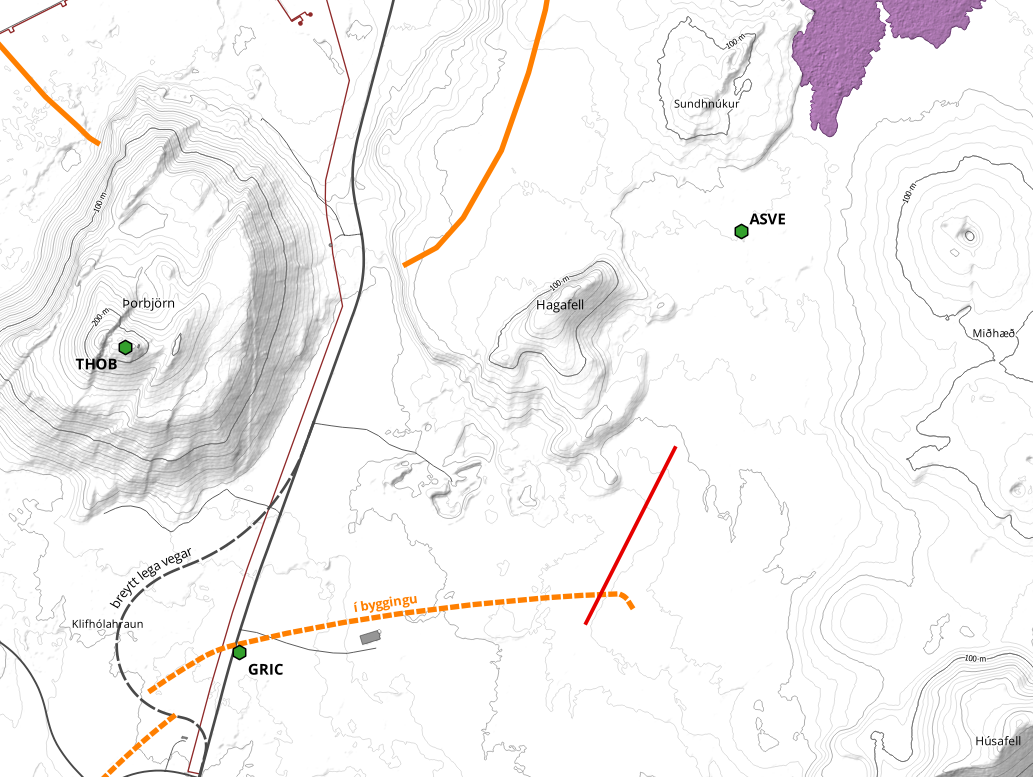
There is a berm that got built around the north of the town but unfortunately the fissures go under the town. The initial eruption came across the barrier so a lot of the lava has been diverted. The second eruption was inside the barrier so not a lot can be done. If you scroll down the linked page there’s a map of the flow and barriers.
There’s footage of them saving the machinery being used to build the barriers.
Look at this webcam feed overlooking Grindavík https://www.youtube.com/live/hvcP4kVVOnk
Go to about 11:58 on the timestamp in the bottom right corner, you will see the lava flowing along the berm (which is doing a good job of protecting a large building) while workers with bulldozers and diggers close the gap in the berm that the road goes through.
The fissure close to the town opens up at about 12:20. The lava flowing behind the berm reaches the road at about 12:50.
fun lil video from a friend here of the evacuation of the heavy earth machinery that almost got swallowed up this morning by the flow.
Thank you
They did exactly that. It worked great, but this new fissure is lava that went under.
See https://imgur.com/a/7WGO9M6 ; yellow are the defensive lines. Red are the fissures. Black is the lava; you can see how well it was redirected.
Working link — https://en.vedur.is/media/uncategorized/Kort_StadsetningGoss...
From https://en.vedur.is/about-imo/news/a-seismic-swarm-started-n...
Sorry, fixed my link. The semicolon broke it. https://imgur.com/a/7WGO9M6
This thread is really the closest I get to lava or lava knowledge so this is very helpful actually.
In this case, I believe it’s that the eruption is getting bigger and lava is seeping out of new & unexpected places in the ground, thwarting the existing redirection barriers. They do have some flow barriers, but the lava is oozing around them. They were hoping it wouldn’t come to this, but at some point, if the eruption gets big enough, lava barriers become pointless.
Lava is molten rock. Concrete blocks are rock.
So is the ground it comes out of and runs over. It doesn’t instantly melt rock it comes into contact with.
Also from the blog:
> Benedikt Halldórsson of the Met Office says houses are not designed to withstand lava flow.
> »... You can expect the walls to give way from the load, and the heat in the lava is such that it burns everything in its path.«
Apart from the heat, since it's molten rock it also has considerable mass, and the lava flow continues pushing from behind.
One weird realization I had is that lava is over three times as dense as water, so if you tired to “swim” in it, you’d basically just sit on top.
it is less about density and more about viscosity, which depends on the type and temperature.
I had an opportunity to interact with lava during a Hawaii eruption, and people could run/walk across red hot and flowing lava, but it would start melting the bottom of your shoes. This lava was definitely on the colder end of the spectrum, with a consistency like bread dough.
On the the other end of the specturm, there are very hot low viscosity lavas similar in consistency to soup. If you tried to step on that, it would be like falling into a pool.
You'd only keep sinking in until you had displaced your mass in lava. Which would happen sooner than in water.
“Sit” might not be the right verb here.
That's not what happened to Gollum
I'm not really sure what you mean by this. But I'm guessing that you really have no clue what would happen.
At least that edge of it.
Imagine owning the house over the road where the lava is heading right now, watching the disaster in slow motion. I guess the lava flow could stop right in front of it?
Edit: Nevermind ...
Iceland has socialised National Catastrophe Insurance. The premiums are very low but if your house is lava'd or avalanched you get a reasonable payout.
Of course it's better if that doesn't happen, but if it does there's solid support for the victims.
This would never happen in the USA. Pure communism
The American equivalent is probably the national flood insurance program.
The annoying thing about that is that it lets people repeatedly keep building in exactly the same spot.
Not without an inconvenience, but it's almost like "every time it floods enough you get a home upgrade".
People can afford beachfront houses often have friends in high places.
That insurance not cheap.
But it is subsidized by one’s fellow taxpayers.
Only sort of. People who live in flood zones are subsidizing all the other people in the flood zones much more than say a homeowner in Colorado.
I don't live in a flood zone. How do I opt out of subsidizing any of these people's flood insurance at all?
You pay taxes, the people in flood zone pay taxes. The same.
Then on top of that, flood zone residents have to pay extra for the flood insurance.
You don't understand what "subsidized" means, do you?
Their flood insurance costs less than it otherwise would because those of us without flood insurance are helping to pay for their flood insurance.
It's fine if you think that's the way things should work, but there's no value in pretending it's not happening.
Hopefully, everyone is safe. But what of the homes? I'm interested to know what generally occurs, in terms of insurance, when homes and property are destroyed by lava flow? Is there insurance coverage for such events? Are the homeowners covered to rebuild/buy new homes elsewhere?
Yeah they evacuated the entire town from what I heard. So there is no danger to any lives. I'm pretty sure the city has accepted that as long as no one dies, that everything else can burn.
It's crazy to think that just one week before all of this started me and my girlfriend were hiking to Gunnuhver hot springs and stayed at pretty much the exact spot over the night where the eruption happened next to Grindavik, mostly because there's nearly absolute darkness ... except for the bright light above Grindavik that looks like an island of light in the middle of nowhere, it was really magical.
Iceland is such a beautiful place.. although I was angry and sad for most part of the trip seeing how tourism changed Iceland over the last 20 years. As recently as 2014 we had to ask the locals in mostly sign language and paper maps how to navigate the Westfjords; there's 5G now in even the last corner of the island.. guess I'll need to resort to Svalbard and Greenland to go truly off-grid in the future :-)
Even if the lava doesn't destroy too many buildings, can the town survive the dual shocks of the ground under all the rest of the buildings being unstable, and uncertainty about whether any further investment in the town will be obliterated by a future eruption? The long term looks bleak to me.
Donate to Icelandic Red Cross here: https://www.raudikrossinn.is/styrkja/stakur-styrkur/
Update from this morning: https://www.youtube.com/watch?v=tsDBgjgEtnU
About an hour drive from Reykjavík, Iceland.
That's not very helpful for people not from Iceland as far as indicating distance. An hour drive doing 60mph is totally different from windy roads along a coast line or through valleys.
Google Maps isn't too useful: "Sorry, we could not calculate driving directions from "Reykjavík, Iceland" to "Grindavik, Iceland"
It’s about 50km from downtown Reykjavik a lot of which is along the main artery route to the international airport.