Electric mountain: Power station that shows the beauty of infrastructure
theguardian.comI had the luck to visit this as a child, before all the tourist side of it was shut down. I remember taking the bus past the giant turbine hall. A few facts I can remember:
1. Carol Vorderman did a lot of the engineering calculations, before she started on Countdown (probably only relevant to the UK lot).
2. They couldn't run powerlines from the facility to the grid as it's an AONB so they had to run them underground at a cost of £1M per mile for however many miles.
Great place along with Sellafield and the wind turbines in Norfolk for a kid to visit.
If you are ever up in Scotland, you can still visit Cruachan - the sister power station at Loch Awe with a very similar design. I took my children there two months ago. They were as amazed as I hoped they would be! Visiting hours here: https://www.visitcruachan.co.uk/
If you are a Harry Potter fan, it's not far from Loch Awe to the famous viaduct at Glenfinnan as well. Details here: https://www.nts.org.uk/visit/places/glenfinnan-monument/high...
If you are a Star Wars fan, Cruachan is the location of The Empire’s base in Andor.
As a Scot, who’s done a lot of hillwalking in the past (and been scared witless by airforce jets suddenly appearing over the brim of a hill) it was amazing to see tie-fighters whooshing across the Scottish landscape.
I visited Cruachan in 2019 by happenstance. It is really cool! I'm going to look for the Star Wars tie in - the architecture certainly does fit the theme. You can watch a Pathe video on Royal Opening of the dam and power station here https://www.britishpathe.com/asset/87792/
I did not know that - thank you, my son watched Andor - I'll get him to show me!
AONB = Area of Outstanding Natural Beauty
Sounds like we did a similar set of school trips, I remember standing in a big loud hall on top of the Sellafield reactor, and down inside electric mountain by the big turbines. I was most sad that they don't do tours at the moment, I wanted to take my daughter there.
You could also visit the Wylfa nuclear plant on Anglesey. Not sure when tours stopped (probably due to security) but you could see the reactor. All closed now.
You may not have heard, but they had a little trouble there at one point, I wouldn't take a kid there.
Are you referring to the Windscale fire of 1957, or something else?
I remember visiting the Sellafield visitor centre as a kid in the 1990s. It was great.
What are you referring to?
I did this at primary school too! We had a picnic next the bottom lake.
Not stated in the article: There are very few places in the world with two large lakes, separated by a lot of height and not much distance.
Wherever that happens, it is probably financially a good idea to build one of these.
But that geography is really rather rare, so the rest of the world will probably have to use gas peaker plants (environment-killing) or battery storage (expensive).
> There are very few places in the world with two large lakes, separated by a lot of height and not much distance.
You only need one large lake (or a place which can be dammed to create one); the other one can be completely artificial, with no water inflow or outflow other than through the pumps/turbines. In fact, I think it might even be possible to make both reservoirs completely artificial, and fill them by pumping water from somewhere else. That makes the necessary geography a lot less rare; you only need the appropriate height difference, and the ability to create artificial reservoirs on both ends.
Yes, but large artificial lakes aren't known for being cheap.
Pumped storage needs big lakes - a swimming pool on the top of a mountain isn't going to cut it.
Keep an eye on Australia, Snowy 2 (whose costs are blowing out) [1], and battery uptake [2]. Based on cost decline curves of lithium scale utility storage, batteries will be cheaper by the time Snowy is commissioned. Battery manufacturing is ramping because every automaker is being forced to electrify, Tesla is preparing to build a second Megafactory factory for battery storage in China [3], and batteries can be installed anywhere.
Batteries can also provide grid support (frequency and voltage support when transmission or generators trip) and can be grid forming now; instead of having to follow the grid, they can drive grid health, including black start [4] when the grid is down. In South Australia, a new battery storage facility has recently come online and is in testing to enable AEMO, the grid operator, to turn down the requirement for ~70MW of constant fossil gas generation for grid services [5].
[1] https://reneweconomy.com.au/snowy-2-much-how-can-a-2-2gw-wat... ("This is the fourth time Snowy 2.0’s cost has been reset – from $2 billion in 2017, to $3.8-$4.5 billion later that year, to $5.1 billion in 2019, to $5.9 billion in 2020, to $12 billion now (2023).")
[2] https://www.energy-storage.news/global-bess-deployments-to-e... ("Global BESS deployments to exceed 400GWh annually by 2030, says Rystad Energy")
[3] https://www.teslarati.com/tesla-china-megafactory-constructi... ("Tesla’s estimated initial production capacity for the China-based Megapack factory is 10,000 units per year or about 40GWh.") [My note: This is equal to their existing capacity in Lathrop, California]
[4] https://www.nrel.gov/grid/black-start.html
[5] https://opennem.org.au/facilities/sa1/?selected=TIB&tech=bat... ("Torrens Island BESS")
Of course, Snowy 2 was a political project for which the planning was totally under-baked. It was a compromise set off by a centrist who was lukewarmly pro-renewable energy, but leading a party that was mostly dead against it and just wanted the Government to pump money into expanding fossil fuel ('coincidently' many of these MPs in the party have direct or indirect investment and interest in coal mining companies, oil and gas industry links, etc.).
There was always much better ways the money could have been spent, like investment into offshore wind, battery banks etc. but to directly invest in renewables and battery storage was and is politically untenable for that party. The Government has changed now to the party that doesn't have the same kind of direct fossil fuel investments, but unfortunatly the massive political donations from the resource industry and oil & gas to our politicians is bipartisan so they talk 'clean energy' while not that much actually changes...
Agreed, lots of inertia and it will take time to course correct.
If you're watching Australia, there's also this further up north: https://qldhydro.com.au/.
The Borumba site will provide 2,000MW generation with 48GWh of storage and works are starting now.
Meanwhile Pioneer-Burdekin is currently scoped as 5,000MW with 120GWh (not a typo) of storage. Assuming it proceeds to that spec it will be the largest pumped hydro station out there.
There are lots of places where such things can be built though. TVA's Raccoon Mountain is an example. https://www.tva.com/energy/our-power-system/hydroelectric/ra...
There is water at the base of a lot of mountains, just knock the top off and build a lake.
There’s really not a lot of point these days. Batteries can be used for load balancing and pump-storage is very inefficient.
We should do all of it at the same time. Diversity and over provisioning is a way to have options and redundancy.
The U.K. needs something like 30 TWh of storage (the National Grid has 50 TWh in their plan).
We’d need thousands of these.
They’re great for load balancing, especially when coupled with compressed air to get them generating within seconds, but we’d have to flood all the glens of Scotland and Wales to make a dent in our needs.
Moss Landing, CA is the worlds largest battery. It is 3.0GWh, and has been operating 2 months.
However, Dinorwig, UK is far larger at 9.1 GWh, and is 40 years old.
For comparison, you could build a replacement for Dinorwig with less than 1 quarter (12 weeks) of Tesla's single Megafactory annual output, and have it installed in less than a year, in any geography (assuming you're ready to run copper and pour slabs; storage enclosures can be installed in parallel, it's trucks, cranes, and human labor bolting them down).
Timelines go down as battery manufacturing scales up. TBMs and mountain cutting are not getting faster or cheaper.
A quarter worth of production from the Megafactory sounds pretty expensive.
I mean somebody should make a giant battery backup, but Dinorwig does have a pretty big advantage in terms of existing-ness.
Existing power stations that are paid off have an advantage considering cost of capital (nuclear and pumped hydro), but that advantage eventually theta decays when maintenance costs exceed new build costs. France is experiencing this now with its aging nuclear fleet [1]. Running the math on Tesla's calculator [2], a quarter worth of annual production (10GWh) runs $3,798,849,522 (~$3.8B). That includes installation (per Tesla). Can new pumped hydro be built cheaper than that? For sure, keep existing low carbon generation or storage in service as long as commercially reasonable.
[1] https://www.world-nuclear-news.org/Articles/EDF-revises-up-c...
For load balancing, these days, there’s really no need for giant monolithic storage projects. Every renewables project can — and should be made to — have storage built in to it. Companies leave it out as it would make there price per MWh higher, and, for some reason, governments let them bid without it.
(Add storage to offshore wind and it suddenly looks similar in cost to nuclear.)
So, no one’s suggesting replacing pump storage with giant battery banks, just spreading batteries and other storage across the grid.
We still have no technology capable of storing TWhs though, and that’s what we need to remove carbon from our power grid.
Dinorwig cost 0.5 billion GBP to produce in 1974 (roughly 1 billion pounds in today's money) and took 10 years to build.
Nobody is arguing Dinorwig should be torn down. However, it took 10 years to build dinorwig. It takes less than a year to build a battery version of Dinorwig with basically 0 geographic requirements. The cost would be roughly comparable for a battery backup (at $200USD/kWh, it'd be $1.8 billion to build a similarly sized plant. or 1.4 billion GBP)
SSE are also hoping to build Coiri Glas in Scotland, which is 30GWh https://www.sse.com/news-and-views/2023/03/britain-s-largest...
Cruachan 2 will take total site capacity to 1GWh https://www.drax.com/about-us/our-projects/cruachan-2/
> SSE’s £100m commitment to further developing Coire Glas comes as the leading low carbon energy infrastructure company awaits the UK Government’s decision on how it intends to financially support the deployment of long-duration electricity storage, as set out in last year’s British Energy Security Strategy.
> This could include the introduction by the UK Government of a ‘revenue stabilisation mechanism’ in the form of an adapted Cap and Floor scheme to support investment in long-duration storage. This would also be alongside broader consideration of how the electricity market, including the Capacity Mechanism and the Flexibility Markets, value the contribution of low carbon flexible assets such as pumped storage.
AKA... They're waiting for a government handout before they begin build. While they can 'buy low, sell high' and make a lot of money, they also want a government guarantee that they will make that much money. Payouts from that guarantee will effectively become an electricity tax.
We need more like 30 TWh of storage to secure the grid without fossil fuels.
Counterexample: https://en.wikipedia.org/wiki/Ludington_Pumped_Storage_Power...
They only started with a single lake and a moderate amount of elevation.
Is there any reason that "lakes" (i.e. big holes) can't be dug where they would be useful for this purpose?
(Update: for those who are downvoting, it was a serious question.)
1. The lower lake still needs to be substantially above sea level and the local water table etc. so that it can actually be drained and so that it doesn't just fill up with local water. You can't do this by the hoover dam, since you'd also have to lower the river another few dozen meters. That's more challenging than it sounds, since you'd have to continue digging all along its path until you reached the place that the river naturally fell to that lower altitude.
2. Reservoirs are very large. The lower reservoir in this article is 7 million cubic meters[1]. The Hoover dam passes 289 million cubic meters of water daily, with around 78.3 million cubic meters of that generating electricity. The largest land vehicle in the world can excavate 700k cubic meters per day[2].
[1]: https://coflein.gov.uk/en/site/423380 [2]: https://en.wikipedia.org/wiki/Overburden_Conveyor_Bridge_F60
3. We do dig them out- the reservoir in the article was substantially enlarged. But it's still rare to find places you can actually do that.
4. The upper reservoir is a totally different question. It would take over 125 years to dig out a hole the size of Lake Mead for the Hoover Dam. It would take almost a million of the bombs used the Sedan nuclear test[3] to dig that hole.
Thanks; I guess if it were that simple, someone would have done it, being as neither pumped storage nor earthmoving are new technology.
If this were the 1950s I'm sure somebody would have tried nukes!
I mean, when all you have is a hammer, and also your entire society is repressing massive post traumatic stress disorder, everything looks like a nail.
Well at least one of these was originally a quarry, so yes. But it would raise the cost a lot, if the excavate wasn't valuable as in this case.
It'll definitely raise the cost, I acknowledge that what I'm talking about isn't going to be a small project. I just wouldn't necessarily assume that it would raise the cost so much as to make this infeasible. To be clear, it's also not like I know anything about civil or power engineering.
I’ve seen a suggestion that you could use two spheres in the sea one deep down, one near the surface.
I don't think so...
You would presumably be pumping air from one sphere to the other.
That air ends up compressing/decompressing, and therefore heating or getting cold. That dramatically lowers efficiency.
And on top of that, a football stadium sized sphere full of compressed air at the bottom of the ocean is going to need hold-down anchors at a scale the world has never seen...
> "The general idea is to have a closed vessel sitting on the seafloor. Surplus energy is then used to pump water out of this vessel, leaving the inside at a near-vacuum. When it’s desired to recover energy from the system, water can be allowed to flow back into the vessel under the pressure generated by the seawater above. As the vessel is filled, the water flowing in turns a turbine, generating electricity in just the same way as a traditional pumped hydro system."
https://hackaday.com/2022/02/02/underwater-tanks-turn-energy...
That's an interesting way to store energy, basically a vacuum chamber that operates in 75 atm water, instead of 1 atm air.
Pump-storage hydro is for load balancing as it can’t store anything on a grid scale and is very inefficient. Sadly, it could never replace gas — the U.K. alone would need thousands.
It is absolutely "grid scale". Did you read the article?
https://en.wikipedia.org/wiki/List_of_pumped-storage_hydroel...
It's grid-scale load balancing, not grid-scale storage. Grid-scale storage is hundreds and thousands of GWh. The UK needs 30-50 TWh to be secure without fossil fuels.
The Kemano generating station in British Columbia was built in the 1950s to supply power to an aluminum smelter. They hollowed out a mountain to drop a river through turbines. It’s an incredible marvel of engineering.
Massachusetts has a pumped storage station in the Berkshires, Bear Swamp. [1] As of a few years ago they had an underground visitor's center with a scale model and lots of info. Not sure whether it's open anymore though.
[1] https://en.wikipedia.org/wiki/Bear_Swamp_Hydroelectric_Power...
I think it was someone on the Volts podcast[1], either David Roberts or a guest, who made the point (I'm paraphrasing) that one of the most helpful things a regular person can do is start to think of solar arrays or windmills as beautiful; if building them isn't "climate but eyesore" but rather a "climate and beauty" proposition, they are much more likely to get built.
When I drive through Oklahoma, Texas, New Mexico, etc. I think windmills are quite beautiful. On the plains they are the only thing to look at and are quite inspiring.
They look like this: https://www.istockphoto.com/photos/oklahoma-wind-energy-turb...
Though not as technologically impressive, there are quite a few rather "simple" little hydroelectric dams tucked back in the Allegheny Mountains of the eastern USA. They are a marvel to see, worth seeking out if you are driving anywhere near them.
Cheoah Dam is on the infamous Tail of the Dragon in TN, and there's a spot where you can pull over and see the whole thing below, it's such an inspiring thing.
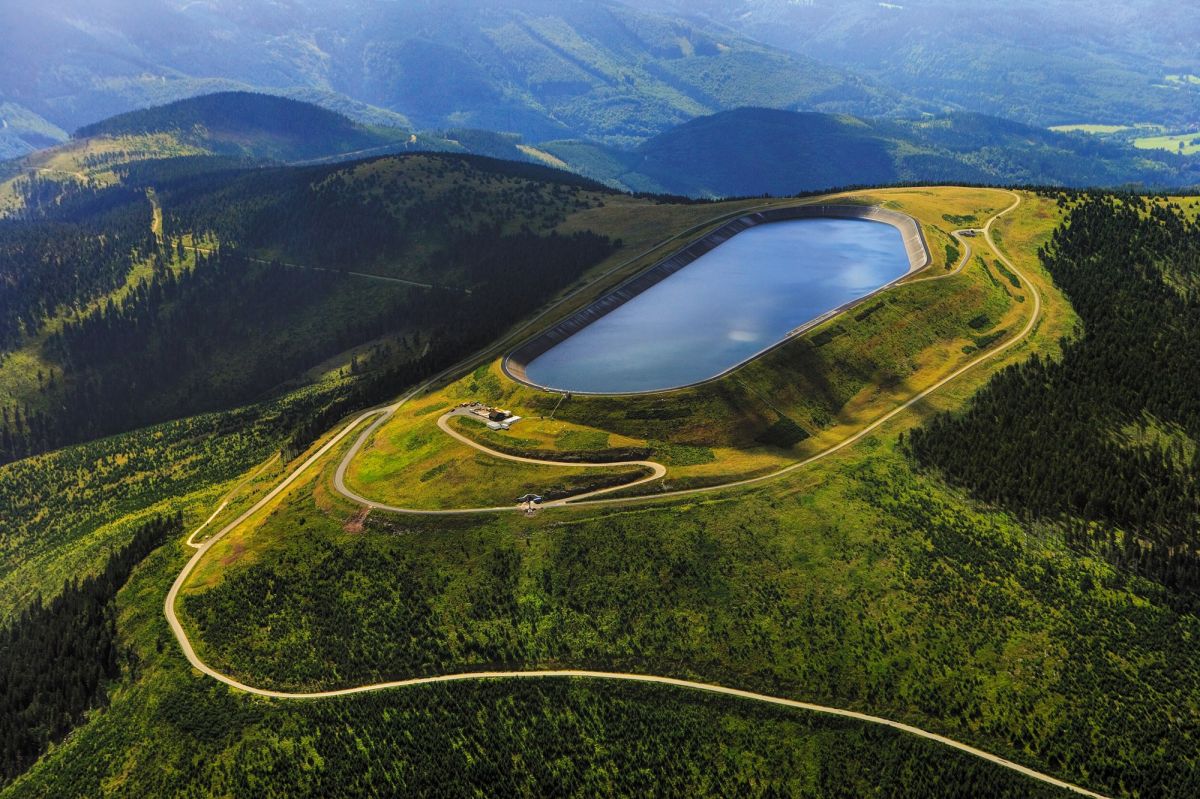
Czech Republic also has a pumped-storage plant in Dlouhé stráně[0]. It's also in a protected landscape and in my opinion looks amazing [1], especially when you descend from Praděd. It's one of the only large scale industrial projects in Czech Republic that is on a world-class level.
[0]https://en.wikipedia.org/wiki/Dlouh%C3%A9_str%C3%A1n%C4%9B_H...
[1]http://turystyka.studentnews.pl/img/wo/3/58/Elektrownia-wodn...
> So, after all those television-watching Britons go to bed, Dinorwig’s generators are run backwards.
> It’s a remarkably efficient process, with about 75% of the energy available for reuse.
Not an (hardware) engineer, so wondering: are turbines typically efficient running both ways? Or would a turbine in this scenario have tradeoffs compared to turbines that are designed for running in one direction only?
The best I can come up with from the comfort of my armchair is that straight gears are typically equally efficient in either rotating direction, but often gears with angled teeth are used when one rotating direction is primary.
The Dinorwig turbines are (like most hydro plants) Francis turbines. The blade still have an angle. Like a PC case fan, the angle is the same direction whether or not the turbine is "braking" or "pumping". But there very likely are tradeoffs in the turbine design to keep both functions relatively efficient.
There are also what are called ternary sets, which are the generator turbine, the torque converter (a massive clutch) and a pump. A good diagram in here: https://voith.com/corp-en/11_06_Broschuere-Pumped-storage_ei.... These are used at another Welsh pumped storage station: Ffestiniog.
Helical gears (the ones with angled teeth) are used not because one direction is better than the other, but because they have a larger contact area and allow larger forces for a given tooth size (module) and lower vibration because multiple teeth mesh at any time rather than one-by-one. The angle can go either way, and, indeed, can go both ways on one gear (a herringbone gear) to nullify the axial loading.
It couldn’t be much worse, right? Otherwise they’d have just installed another turbine facing in the other direction.
I have no idea.
I can easily imagine a turbine being a good chunk of the installation BOM cost and budget constraints saying price recoup in x years that extra parts doesn't balance against. And in this scenario, then no, another turbine facing the other direction would not be an option - though it is only efficient one way.
That’s fair.
You were clearly looking for an answer from somebody who knew something about the field, but I decided (for some reason) to come in with, like, over simplified first principles speculation. I hate it when people do what I did, haha. Sorry!
Incredible place, while at Bangor university I did my dissertation on electric mountain and now spend my weekend hiking round Snowdonia. Lovely part of the world
I went to Aberystwyth and often went out into Snowdonia, particularly Bala. It's definitely one of the prettiest parts of the UK!
I really regret not learning Welsh while I lived in such a Welsh-speaking part of Wales.
I have to say that I really like the Welsh names: Eryri for Snowdonia and Yr Wyddfa for Snowdon itself.
The intro paragraph is about halfway down after a mass of self-indulgence. It should have been first, of course.