A similarity between the CAP theorem and our heart
twitter.comThe funny thing about all that "decentralization" and the fact that the heart doesn't need the central nervous system to work is that the pulmonary system does need it. So on the one hand, it's great, your heart can function on its own, on the other hand, you cannot breathe without a working brain.
Time to finish that refactoring, evolution! One component is over-engineered with respect to the rest of the system.
Evolution: Well, our milleniums-long testing indicates that adding decentralization to pulmonary system is not the highest prority right now, as the blood already provides an oxygen cache - in case of pulmonary failure, we have a couple-minutes window to restart it before any permanent damage occurs. You can add it to the backlog, and we'll get to it when we have time.
That's way too eloquent for evolution. More like: "Hey, let's try this" burp
For one individual, maybe your analogy might be closer to what evolution tries, but I suspect in a large group of individual in a species over a long period, a more eloquent description could be emerged.
No, it's pretty much "hold my beer, I got this" billions of times until something works.
Evolution isn't organized or eloquent. It's messy and random and non-optimized. Evolution results in many individuals who are not fit, any many evolved solutions are quite plainly bad.
Any elegance or beauty in evolution is a construct humans apply to an incredibly abstract and obtuse concept because that's just what we do to things that are difficult to grok.
Evolution is simply random mutations from various mechanisms, but the only guiding force is that of survival. Some random changes make some individuals more fit to survive, which makes the species more fit in time. There really isn't anything more to it. It's all just random chance averaged over a very, very long time.
A very large number of random decisions needn't always yet surprisingly often results in high-level emergent elegant/predictable phenomena... that's like, the entire point of statistics.
> Evolution is simply random mutations from various mechanisms, but the only guiding force is that of survival.
Much like enterprise software development.
It's only a matter of time before the conglomeration of ancient software slowly having complexity bolted on becomes self-aware and helps plot the overthrow of the lunar government
Indeed, although I believe the main value of the automaticity of the heart isn't about being able to survive brain failure, but about being a real-time system with no dependencies. Unavailability of just ~3 seconds can lead to loss of consciousness. We can afford to stop breathing for a bit if the nervous system is overwhelmed, but the heart can't afford that.
It is interesting that we always think about things that would be favorable for humans, but there are plenty of mammals out there which can hold their breath for minutes, almost hours. Think about whales or dolphins. It would not make much sense for them when the lungs start breathing by themselves. On the other hand, the heartbeat of some mammals slows down when they are under water to spare oxygen.
Since the breathing regulation centre is located in the medulla oblongata region of the brain stem, one can miss a surprisingly large amount of brain before one’s breathing stops.
Of course, if the event that causes one to miss part of one’s brain also induces swelling of the remainder all bets are off.
Would that mean that if we had decentralized pulmonary control, we wouldn't be able to hold our breath?
Not necessarily. The heart is autonomous but is nevertheless connected to the central nervous system and can be controlled by the brain to some extent. It could be the same for the pulmonary system. By the way, you can hold your breath for some time, and some people with extreme willpower can do it until passing out, but you can't do it until dying, there are reflexes hard-wired deep into the brain preventing that.
Basically, yes. Nice catch, that completely slipped my mind.
So decentralized pulmonary system would be a huge drowning hazard.
Bah, that's what you landlubbers get for trying to use gaseous oxygen.
yeah, but then you'll want the central nervous system to be able to fiddle with the state anyway in order to do things like holding your breath while swimming, at which point the autonomous system is redundant and you may as well just have the brain manage the breathing state directly.
I'm not a cardiologist (so take my comment with a pinch of salt). But I was an avid runner (running average 10km a week for 2 years) but a few years later, I developed a form of Ventricular Tachycardia called RVOT.
I went for a battery of tests similar to the OP. The results shows my heart is structurally OK. The doctor diagnosed that I had RVOT and recommended I do ablation. He says that this is a very very common procedure.
I did the procedure. However, the symptoms started coming back again.
After reading this article, I wonder if I should have just left my heart as is.
Glad you mentioned this. I'm a avid biker and endurance runner. I'm diagnosed with PVC a few years ago. I went through two rounds of ablation, both failed. Now I take Flecanaide to keep the rhythm but I want seek second opinion now, thanks to this tweet.
Maybe this helps: some anti depressants (like Zoloft) modify neurotransmitters, like serotonin. In my case at least, having a lot of unused serotonin laying around caused arrhythmia. Most doctors have never heard of the side effect (I'm not sure if it's even listed), but in my case stopping / starting Zoloft behaved as reliably as a light switch on my arrhythmia, albeit with cause and effect delayed by a few weeks.
The sad thing is I took Zoloft for years, mostly because my doctor said it's not wise to stop. In my case it was bad advice, as arrhythmia is a self perpetuating condition that gets worse if you let it linger. I use Zoloft to get past a high stress few years in my life (running my own business). Once that was over I should have stopped taking it immediately.
My next door neighbor was a moderately healthy dude in his 60s. Went in for an ablation, had complications, died two weeks later. All cardiac procedures are risky.
10k a week is avid running?
It probably puts you in the 95th+ percentile in distance run per week
Thats only because 99% of people dont do any running at all. 10K is a warmup for runners.
Came for the CAP theorem, stayed for the cardiology 101 course, lol. His approach to diagnosing himself is really admirable. Working with doctors but never fully trusting them w.r.t. completeness is unfortunately the way to go in these busy times, where doctors just assume the most likely diagnosis and move on. Luckily, we have almost the same information available as the doctors with studies and such that we can dig deeper ourselves.
I can't really blame them. The essence of it is "if you see hooves think horses not zebras".
The human body is usualy one resilient bastard, so the ol' "tylenol and come back if it gets worse" is a good tactic for 95% of the cases.
But detecting those 5% cases probably takes A LOT of dedicated bandwidth from the whole medical process, so unless there is some clear manifestation that it's not horses but something else, I think it is reasonable that some will not investigate further.
Science / health aside, I think this is the longest Twitter post I've read posted as a single tweet (instead of a thread). I knew that Twitter had relaxed some length limits but I didn't realize it was possible to post a (checks in text editor) 10,000 character or 1,800 word article in a single tweet these days.
I believe this is only available to paying members with a blue check.
EDIT: "this" meaning posting
Blue check is not enough, I believe, this post is not just long, it has multiple images inserted in the middle of the text. Like a full length blog post. I think this comes with a "creator profile" while also is why the button says "Subscribe" at the top.
I'm not a paying member and I still see the entire thing
> I believe this is only available to paying members with a blue check.
> I'm not a paying member and I still see the entire thing
They meant paying members can post lengthly tweets.
Ohhhhh lol my bad
https://nitter.net/dvassallo/status/1716585205400756514 (original twitter URL requires JS to be enabled, nitter doesnt)
If you have PVCs and find yourself worried, remember that the author is an endurance runner.
Coffee and anxiety also cause PVCs, which are really harmless.
I showed this text to a friend who works in internal medicine (so not a cardiologist but probably much closer than most commenters).
Basic comment was that the person confuses and misunderstands many things. According to my friend, the range marked as "missed beat" contains a premature heart beat [1].
Some more comments:
- Premature hear beats happen in us quite frequently
- CT scans are a rather invasive diagnostic method and such be avoided
So unless some more competent doctor comments otherwise, I take this as a nice story that resonates well in our layperson's minds. Not more.
CAP shows up in lots of places, my favourite is arrow's impossibility theorem.
Share more?
Sorry don't have much time to explain, but in economics and other social sciences there are many situations where there needs to be made a tradeoff between three things, so called trilemmas. I already gave the example of voting in a democracy with arrows impossibility theorem but also it shows up at the central bank when they need to set the exchange rate and needs to to decide between savers, investors and the government tax revenue. This things are always difficult to explain with lots of trade of scenarios just like CAP. I suggest you google trilemma and economy and read more if you are interested.
Gotcha, I was wondering if there was a deeper or more concrete connection between these particular trilemmas. It'd be interesting if there was seeing as how both are related to coordination, though I'm not so sure there is one.
Yes, coordination is a common theme among them. Another way of looking at it is that these systems all have a partial ordering but no full ordering, like a game of rock paper scissors. This is something that shows up all around us, space time itself can have different ordering of events based on the observer so it is embedded in the very causal geometry we live in. I've tried in the past to have a more rigorous explanation for this all but I lack the time and honestly the intellect.
One more thing, I suspect you can also find these in proof/axiom systems.
PVCs are curious because many people have them and don't even realise.
But for those who do notice, they sometimes become super aware of every beat.
Feeling a PVC can make some people anxious, which boosts adrenaline, potentially leading to more PVCs.
It's like a feedback loop where a "missed beat" gets linked with that adrenaline jolt.
Most of the time, PVCs are no big deal. So, the best "fix" might just be learning to shrug them off, which often makes them happen less or go away (obviously after getting a green light from a cardiologist).
This is an absolutely fascinating read.
I'm surprised an extra 30 mins per day of running for 6 weeks had enough of an impact to change the structure of the heart noticeably.
Author here. I've been taking running seriously for 22 months, so maybe the past 6 weeks were just the last straw to trigger this arrhythmia. I also had covid at the end of July (very mild symptoms), which made me think there could be a link, but the tests seem to exclude any lingering inflammation or infection.
> the heart is designed for max availability over consistency, so when in doubt, it triggers a beat.
This is a great line, thanks! Going to share this with my distributed database reading group
I really enjoyed your article. I also get the occasional "missed beat"/palpitation. Mine only occur 0-3 times a day and have never been seen on a EKG. Nevertheless it was enough to trigger panic attacks in me and send me to the hospital with heart attack symptoms. Since then I've finally started taking medication for anxiety and no longer stay up all night thinking my hearts going to stop in my sleep so that's nice.
During that time though, nothing I read and nobody explained to me what keeps the heart beating despite all manner of possible failures. 10/10 was definitely worth the read.
The symptoms of a heart attack and a panic attack are annoyingly similar. Whereas people qualified to diagnose and treat one are generally nowhere near the people qualified for the other.
I get these missed beats occasionally, like a few times a year. Of course, they’re stress related for me. When I first got them, I also thought it was a heart attack and ended up in the hospital where they also ran a bunch of tests on me.
The wonderfully comical thing about mine is they’re stress related. So the first one happened, made me a little stressed because I thought something was wrong, which caused more of them, which made me even more worried, etc.
Can I ask what medicine are you taking right now? I have exactly the same problem as you, the thought that my healthy heart is going to stop any moment is crazy
Sorry if this is too much prying into your health, but what was the personal/medical verdict on whether to continue the running? You say that the symptoms disappear after a while without exercise, but if it’s benign will you keep it up?
I'm going to take it easy for a few weeks, just out of abundance of caution; just in case there's something else that got missed.
I'm not into any competitions or races. I run for health purposes only, so I'm okay losing some fitness. If the symptoms disappear, I'll certainly ramp up again. If they don't, I'll play it by ear :)
My understanding is that 35-50% of endurance athletes have what I have (including symptoms), and they continue to train without any harmful effects.
Thank you for sharing this! I'm into endurance cycling and had similar issues. I'm diagnosed with PVC as well and rely on medication to keep it from happening. I nearly fainted while driving a car, so it is not without "harmful effect".
In my case, the PVC disappears during exercise and comes back when I take a rest after exercising. I just wonder if you had any comparisons between rest vs. elevated heart rate scenarios. Now I'm super curious how elevated heart rate might change the clock rates for those nodes.
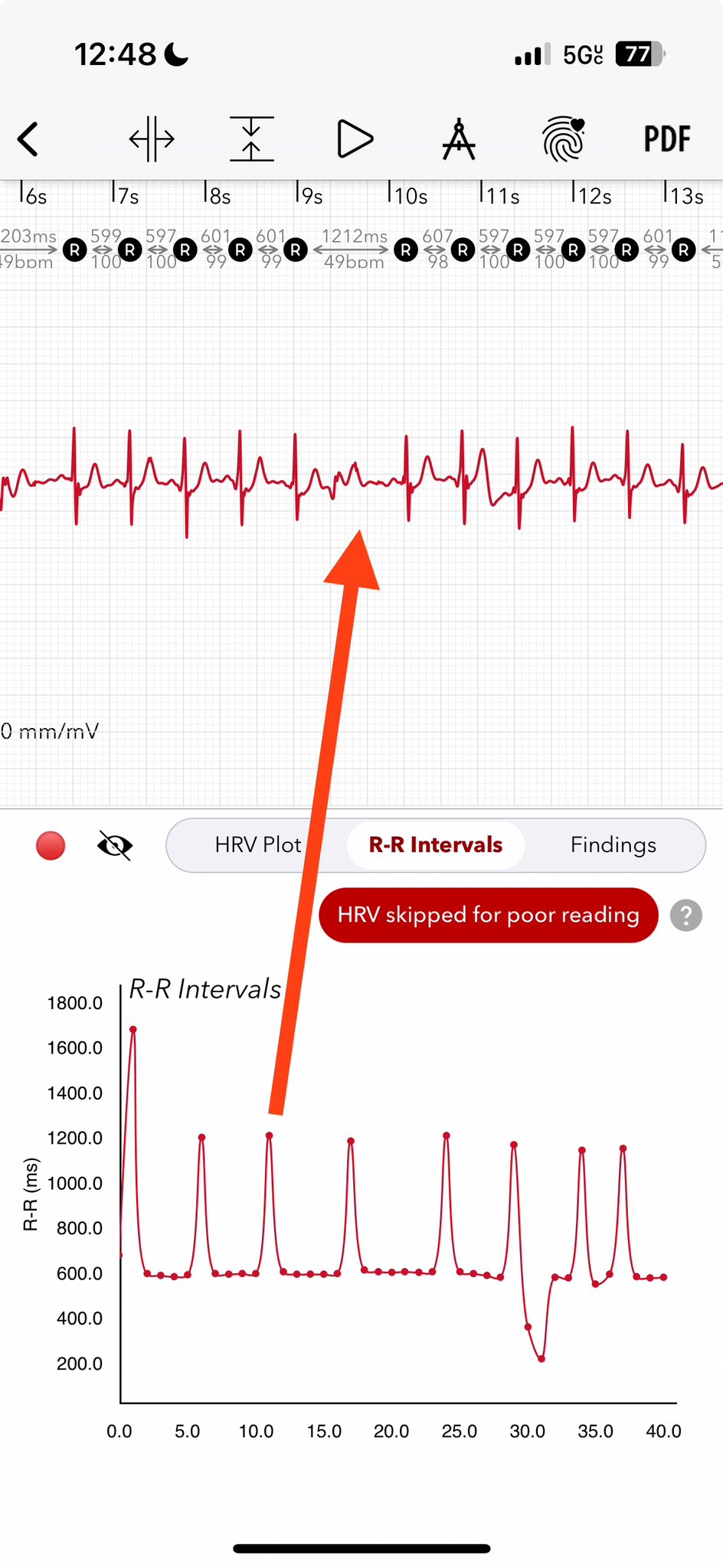
Mine is exactly like yours. During exercise it disappears. Then after about 5 minutes post-exercise, the symptoms become even more regular. I'd get 4-5 normal beats, and then a skipped beat. I managed to capture an ECG post-workout and it shows very clearly the regular PVCs: https://dvassallo.s3.us-west-2.amazonaws.com/twitter/F7yWouK...
From what I've read, when we're exercising (or sick or stressed) the heart rate gets overridden by the SNS (part of the autonomic nervous system). The SA node can only maintain resting heart rate, and once there's extra demands from the body, the SNS takes over (controlled by the brain, but involuntary).
It seems to be a good sign that PVCs disappear during exercise based on the studies I found.
I have the same problem. In my case PVCs at rest typically arose the next day after the workout. The only solution for me was to quit exercising for 1 month completely and letting the heart calm down at a max pulse rate of 100 during the day. It seems that the heart then shrinks a bit in size and the PVCs disappear. Then I started to work out slowly again and they didnt appear any more.
Could you share how you cope with all these findings and experiences, psychologically? I have anxiety that my heart is going to stop any moment (even after stress test came back ok), hope you can share your coping mechanism is any, thanks
Where did you get those numbers 35-50%?
Crazy thought, could it be due to running specifically? Is there something about running, maybe the up and down motion that could be jarring to the heart? I wonder if there's less prevalence in say, rowers or cyclists .
To provide some anecdata. I started running again a few years ago (I'm late 30s now but used to run competitively when I was younger). Before I started, my Oura ring tracked resting heart rate while sleeping at an average of 55 bpm. After 2 years of doing an average of 60km a week (mostly aerobic work), my resting heart rate averages at 39 bpm. I guess the difference is because the heart chambers are now larger - the structure of the heart has significantly changed.
Only after a couple of weeks of running about 20km, did I start seeing my resting heart rate drop to the high 40s. After that, it gradually lowered over the next 18 months or so.
Furthermore, an article about a study back in 2008 [1]:
> At the end of the 90-day study period, both groups had significant overall increases in the size of their hearts. For endurance athletes, the left and right ventricles — the chambers that send blood into the aorta and to the lungs, respectively — expanded. In contrast, the heart muscle of the strength athletes tended to thicken, a phenomenon that appeared to be confined to the left ventricle. The most significant functional differences related to the relaxation of the heart muscle between beats — which increased in the endurance athletes but decreased in strength athletes, while still remaining within normal ranges.
> “We were quite surprised by both the magnitude of changes over a relatively short period and by how great the differences were between the two groups of athletes,” Baggish says. “The functional differences raise questions about the potential impact of long-term training, which should be followed up in future studies.”
[1] https://news.harvard.edu/gazette/story/2008/04/exercise-chan...
amazing article! best read in 2023.