1400 year old gold foil figures found in Norwegian pagan temple
sciencenorway.noI sometimes work with gold foil. Specifically I used to repare old picture frames with gesso and gold leaf. There is a myth that the value of gold carries over into the value of gold leaf. In Asia, you can buy sake with gold leaf flecks suspended in it, and it is cheap enough to sell in corner shops. One ounce of gold can be beaten out into a sheet of gold leaf approximately the size of a football pitch. The major problem with the stuff is how difficult it is to handle. Effectively the only way to move it is using the static electricity of big fluffy brushes.
I recall gold flake vodka sold in random shops in Budapest years ago too, but it was considered a premium product.
Gold leaf is stupid cheap, but it still carries a "valuable" aura.
When Gualtiero Marchesi, the most influential Italian chef of last century, used gold leaf with saffron risotto he made it to play with colors and presentation, but most likely he also aimed at making it feel more "precious".
We're all creatures of irrationality.
Yes it's ridiculously thin, under 0.5µm. Platted jewelry isn't too far either, sometimes just 1 or 2µm
That being said I doubt they had the technology back then, it might be thin but not µm thin
What technology? The main technology needed to work gold leaf is a smelter to pour the initial shape, and after that you don't need any weird materials or machines, it is just skilled and careful hammering. Going thinner doesn't require a different technology, it requires a more skilled goldbeater, even noways sub-µm gold leaf is routinely done with traditional methods.
They wouldn't have had electroplating, but yeah you don't need that if you're okay with just spending a lot of time and care on it instead.
Why do think they weren't able to get it that thin? What "technology" are you referring to? Here's Wikipedia's summary:
"5,000 years ago, Egyptian artisans recognized the extraordinary durability and malleability of gold and became the first goldbeaters and gilders. They pounded gold using a round stone to create the thinnest leaf possible. Except for the introduction of a cast-iron hammer and a few other innovations, the tools and techniques have remained virtually unchanged for thousands of years."
It comes on parchment paper and it’s easy to transfer. They sell it to you in Thailand to put on Buddha statues for good luck.
I put it on desserts and on to of cocktails. Just make sure you're using 24K.
It's cheaper to mix some lead in and your guests will never know the difference!
Well, not for a few decades anyway and they'll never trace it back to you...
The drink Goldwasser has small sparkling flakes of 24k gold.
Goldschläger (https://en.wikipedia.org/wiki/Goldschläger) is another.
I once had the opportunity to help a local archeological dig in Sweden - a very time team feeling -, and we found one of these figures. The metal detectorist had missed it but we got it in the sieve. And the elating feeling was identical to finding a bead or comb piece or just a bit of pot. It was a great feeling each and every time we found anything! :)
Would warmly recommend joining local archeological and historical societies wherever you are.
Well that’s cool. Especially considering the gold was buried on purpose as part of the construction of a long vanished building - imagine being an architect or a priest, tossing a gold figure into the post hole and wonder what the world would look like once it was finally unearthed again. A millennium and a half later. Wild.
> Now, with these three that we found under the actual structure of the wall, it's clear that they were intentionally placed there before the wall's construction,
> One of the reasons archaeologists believe this was a temple, besides the gold foil figures, is the absence of other finds that would be natural if people lived there, like cooking pots and whetstones.
> In Norway, findings of gold foil figures are rare. The 35 from the temple in Vingrom represent the largest collection we have found in this country.
> On the Danish island of Bornholm, over 2,500 gold foil figures were found in a field. Were there not so many gold foil figures in Norway at that time, or have we just not found them? “There must be more of them here,” Stene believes. But most archaeological excavations today are commissioned. “We dig when new roads and buildings are going to be built, this limits what we can investigate. It’s about being lucky and getting the opportunity. A lot of coincidences are involved here. They are so small, but they shine when you find them. There are probably more out there,” she says.
Oh. Coincidences. I bet coincidentally, Kathrine Stene will find them.
Something that has always bothered me is what is line between archaeology and grave robbing? Whose burial rituals do we respect and whose do we get to regard as a source of information about ancient history?
I'm always amused when I see things like "this pyramid was cleaned out by tomb robbers long ago". How do we know they're not cleared out by archeologists? The Pyramid of Giza was already thousands of years old before the New Kingdom (which is still technically Ancient Egypt).
The Robbers' Tunnel in the Great Pyramid sounded well like a state funded archeological dig. Just that back in the day, humans didn't take care to not damage historical artifacts.
Presumably archeologists would have documented and cared for whatever they earthed, while robbers would have just kept/used/sold them
Isn't that the key differentiation, taking care not to damage artifacts?
Plenty of actual thieves just keep the artifacts for themselves, without damaging anything. British museums get a lot of hate for taking home artifacts from other countries.
An old caliphate might be the equivalent of the UK today, a seemingly invincible power, but after a few hundred years, it collapses and its treasures are looted by some other victor.
Maybe another example might be something like the True Cross or other religious relics. They may not be damaged, but it ain't archeology.
About 250 years
Just as a professional follow-on to the joke, a lot of the places I've worked defined it between 50-100 years. Archeologists also have obligations to publish their findings, follow ethics guidelines, work with landowner/government/descendent approval, and attempt to avoid unnecessary excavations entirely.
Only 250 years? I can trace back my ancestors to the 1500s, and I know where they are buried. I have books of stories of many of them. They are real people to me. I’d hate to think of them being dug up to date someone’s curiosity. They are my family.
I had not heard about the Merovingian period in Norway, in Sweden this period is called the Vendel period, and I looked it up, it is called differently. Apparently archeological material in Norway from this era often has a French connection.
The similar find on Bornholm, mentioned in the article, is really something.
https://lejremuseum.dk/wp-content/uploads/sites/13/2021/02/0...
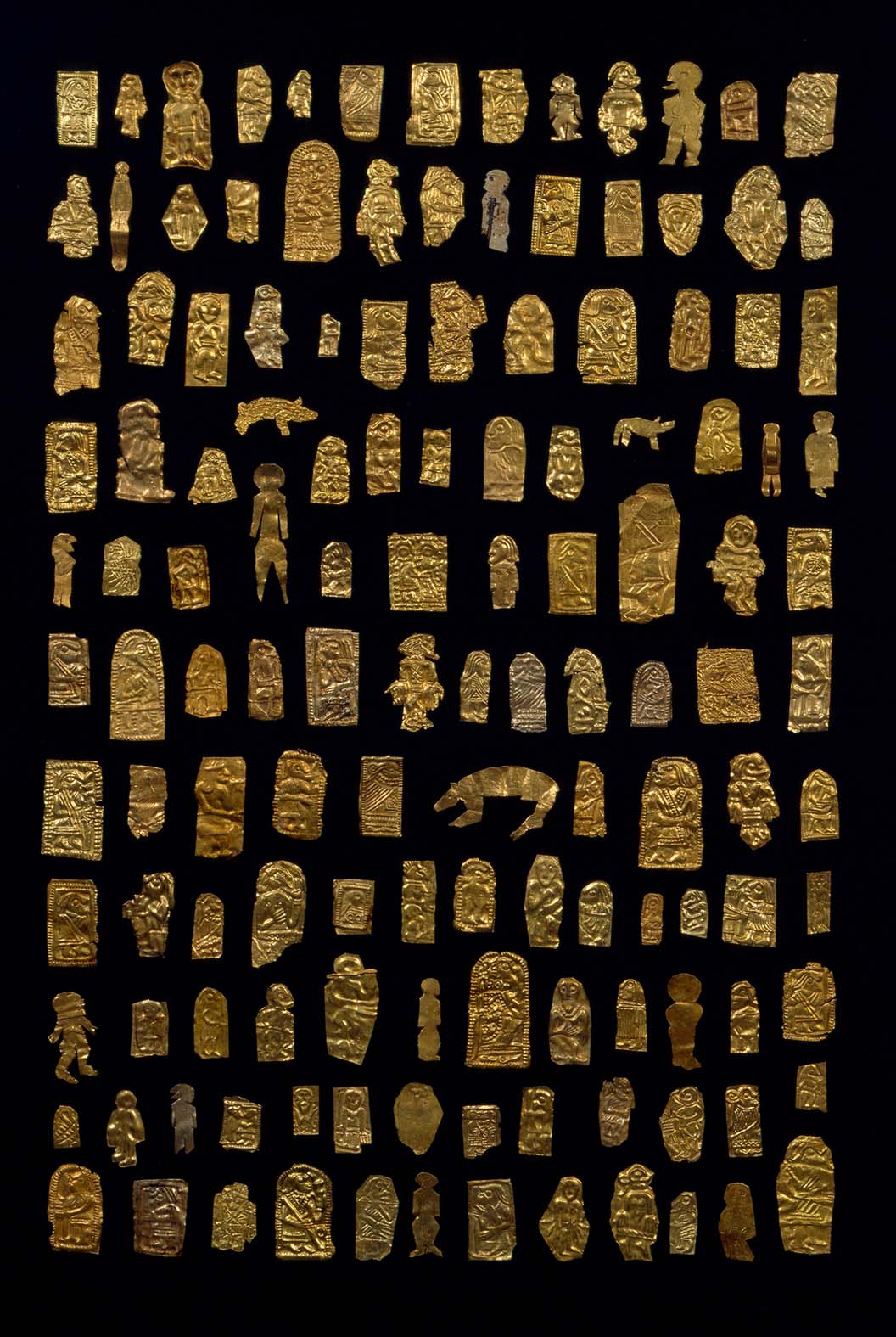
They're on display on the museum here in Rønne on Bornholm:
https://bornholmsmuseum.dk/en/visit/bornholm-museum/permanen...
“Because it’s relatively small, we believe the structure served a solely ritualistic function,”
Ritualistic trope comment preventer:
"One of the reasons archaeologists believe this was a temple, besides the gold foil figures, is the absence of other finds that would be natural if people lived there, like cooking pots and whetstones. "
Other things I found interesting:
"Throughout the autumn and winter, C14 dating will finally determine if it is true that the temple has stood here since around the year 600 – and right up to the 11th century"
600 year old temple out of wood. That would be something.
Then: one of the foils found appears to be intentional crumbled. Which makes sense when it was meant to be a offering to the gods. Or this one was negated, whatever it meant. Since they always show a men and a women(on this site), they might have symbolized marriage (of rich people) and were placed on a special place for good luck and the one crumbled was a marriage not working out. But:
"In Norway, findings of gold foil figures are rare. The 35 from the temple in Vingrom represent the largest collection we have found in this country.
In a similar temple in Uppåkra in Sweden, archaeologists found 100 gold foil figures.
On the Danish island of Bornholm, over 2,500 gold foil figures were found in a field.
Were there not so many gold foil figures in Norway at that time, or have we just not found them?"
"There are also other regional differences: In Denmark, there are more individual figures, whereas in Norway and Sweden, it is mostly couples that are depicted."
So alltogether not much is know about this old custom.
But I think it is interesting and I like the simple art they are showing.
> 600 year old temple out of wood. That would be something.
It’s the year 600, that would be 1400 years old. Japan has a bunch of those still standing, the oldest being 1300 years: https://en.m.wikipedia.org/wiki/Hōryū-ji
I’ve only been to the Todaji temple in person, which is “just” 300 years old after reconstruction, but it’s a mind-boggling experience to see the scale of these buildings and the work/engineering that went into them. Absolutely worth a visit if you ever have the chance.
"since around the year 600 – and right up to the 11th century." so not 1400 years, as it's not still standing.
But, yes, it's not old for a wooden building that's being maintained.
Norway has plenty of stave churches older than 600 years, so a temple surviving 600 years would not be that surprising. With maintenance, wooden buildings can survive pretty much indefinitely, though in part because you can often replace part by part as needed.
Too late to edit, but Wikipedia has a list of stave churches with links to individual pages and pictures of the ones still standing:
Stave churches probably look a lot like the pagan temples they replaced too... which in turn might well have been attempts to imitate the churches they'd seen abroad in local materials. Christianity had already been around for hundreds of years when the last temples were built, after all, so there was plenty of time for influence.
Isn't Norway more devoid of gold mines?
I believe they rather famously travelled abroad to acquire their gold.
There is some gold in Norway, there have been some small gold mines, and you can find alluvial gold. Although you'd think it would be a lot more effective to import it, they did make use of bog iron, so who knows.
Ok, but the photos look very suspicious. 1400 year gold right from the ground shouldn't shine like that. Compare to the coins here for example
https://www.smithsonianmag.com/smart-news/ancient-welsh-gold...
Gold is a noble metal - pure gold doesn't tarnish like that in your photos.
"Gold staters" vary in gold content a great deal:
andThe Durotriges issued a series of rapidly debased coins through this period probably starting around 50BC with a largely silver (80%) stater (British B) with a fairly small percentage of gold.
https://en.wikipedia.org/wiki/Celtic_currency_of_BritainVerica's stater series weighed between 5.27g and 5.29g while the gold content varied between 42% and 44.5% The gold content appears to have remained stable over time with no sign of debasement.Pure gold nuggets unearthed after many thousands of years under ground "look like gold" when given a good rinse to get the dirt off - they don't look tarnished like the "gold staters" in you photo.
I believe the non-tarnishing lroperties of gold is why it has achieved it’s status in the sorld.
I have seen “guldgubber” come out of the ground and they do look like this for real.
TIL that Norway had a Merovingian period
Foilen comes from the French word meaning ‘to trample’ because gold is one of the few materials that can be continuously crushed by hand until it is 100nm thick.
Ancient Egyptians were known to do this around 5000 BC or so.
Cool to think of the journey of this technology to the northern kingdoms over many generations.
What proves this wasn't placed there by archeologists (I'm not accusing this particular discovery, just trying to elicit reflexion on the topic of faked archeology).
https://en.wikipedia.org/wiki/Japanese_Paleolithic_hoax
> The Japanese Paleolithic hoax (旧石器捏造事件, Kyū Sekki Netsuzō Jiken) consisted of a number of lower and middle paleolithic finds in Japan discovered by amateur archaeologist Shinichi Fujimura, which were later all discovered to have been faked. The incident became one of the biggest scandals in archaeological circles in Japan after the story was published by the Mainichi Shimbun on November 5, 2000.
> Hearing the rumour of fraud, journalists from Mainichi newspaper installed hidden cameras at a dig site where Fujimura was working and caught him planting artifacts. The newspaper later confronted Fujimura with the video, and he was forced to confess his fraud.
> It was also reported[by whom?] that prior to discovery of the hoax, Japan's paleolithic period was thought to have started earlier than anywhere else in Asia at around 700,000 BCE.
> It is clear that a number of the artifacts found by Fujimura are rather unnatural and do not make archaeological sense, such as those exhumed from pyroclastic flow strata, but nonetheless majority archaeological groups as well as local and government organisations which substantially benefited from his find ignored these inconsistencies.
Now let's focus on the discoverer of the tomb of Tutankhamun, Howard Carter. I will bring an alternate story, by merely quoting Wikipedia's page about this man:
https://en.wikipedia.org/wiki/Howard_Carter
> Howard Carter was born in Kensington on 9 May 1874,[1] the youngest child (of eleven) of artist and illustrator Samuel John Carter and Martha Joyce Carter (née Sands). His father helped train and develop his artistic talents.[2]
> he showed talent as an artist. The nearby mansion of the Amherst family, Didlington Hall, contained a sizable collection of Egyptian antiques, which sparked Carter's interest in that subject. Lady Amherst was impressed by his artistic skills, and in 1891 she prompted the Egypt Exploration Fund (EEF) to send Carter to assist an Amherst family friend, Percy Newberry, in the excavation and recording of Middle Kingdom tombs at Beni Hasan.
> Although only 17, Carter was innovative in improving the methods of copying tomb decoration.
> In 1899, Carter was appointed Inspector of Monuments for Upper Egypt in the Egyptian Antiquities Service (EAS).[8] Based at Luxor, he oversaw a number of excavations and restorations at nearby Thebes
> In 1907, he began work for Lord Carnarvon, who employed him to supervise the excavation of nobles' tombs in Deir el-Bahri, near Thebes.
> In 1914, Lord Carnarvon received the concession to dig in the Valley of the Kings.[17] Carter led the work, undertaking a systematic search for any tombs missed by previous expeditions, in particular that of the Pharaoh Tutankhamun. However, excavations were soon interrupted by the First World War
> By 1922, Lord Carnarvon had become dissatisfied with the lack of results after several years of finding little. After considering withdrawing his funding, Carnarvon agreed, after a discussion with Carter, that he would fund one more season of work in the Valley of the Kings.[18]
> Carter returned to the Valley of Kings, and investigated a line of huts that he had abandoned a few seasons earlier. The crew cleared the huts and rock debris beneath
> Carter returned to the Valley of Kings, and investigated a line of huts that he had abandoned a few seasons earlier. The crew cleared the huts and rock debris beneath. On 4 November 1922, their young water boy accidentally stumbled on a stone that turned out to be the top of a flight of steps cut into the bedrock
> In spite of evidence of break-ins in ancient times, the tomb was virtually intact, and would ultimately be found to contain over 5,000 items.
> Towards the end of February 1923, a rift between Lord Carnarvon and Carter, probably caused by a disagreement on how to manage the supervising Egyptian authorities, temporarily halted the excavation. Work recommenced in early March after Lord Carnarvon apologised to Carter.[35] Later that month Lord Carnarvon contracted blood poisoning while staying in Luxor near the tomb site
> Harold Plenderleith, a former associate of Carter's at the British Museum, was quoted as saying that he knew "something about Carter that was not fit to disclose"
TL;DR
Carter had the skills necessary to fake the artifacts he discovered, which is what he did in the huts he had set up above the tomb's emplacement, as the funds that were allotted to the expedition were drying up. He attributed the discovery of to their young water boy accidentally stumbling on a stone to give the discovery the touch of innocence.
https://en.wikipedia.org/wiki/Discovery_of_the_tomb_of_Tutan...
> The unexpectedly rich burial consisted of more than five thousand objects
It just sounds too good to be true.
The same reflexion can be applied to:
https://www.ucl.ac.uk/news/2021/feb/research-stonehenge-firs...
> Professor Mike Parker Pearson (UCL Institute of Archaeology) discusses his research which has found a dismantled stone circle in west Wales which was moved to Salisbury Plain and rebuilt as Stonehenge.
The same pattern of a last successful dig can be noticed:
> Yet after having no luck with other circular monuments in the area, we returned to Waun Mawn for a final speculative dig. To everyone’s delight, our dig supervisor Dave Shaw discovered two empty stoneholes, one on each end of the arc of stones, where missing stones had once stood.
In the days of Howard Carter essentially nothing .. and one can argue that there was no archeology then, as we understand it today, just glorified upmarket treasure hunting that destroyed invaluable layers in order to wrench gold trinkets from their settings.
Today there is procedure, as dull as that sounds, that makes it very difficult to plant evidence and get away with it (as evidenced by your linked story).
The majority of significant digs are proposed and planned some months, years even, in advance. The sites are photographed, scanned with geophysical instruments, and the stakeholders are many - land councils, archeological councils, the actual teams with feet on the ground, etc.
As trenches are dug photographs are taken, when 'something' pokes up a bit it's immediately photographed up close and measurements are taken before being carefully removed.
To stage a find would generally take more than one person and they'd have to operate in a sea of oversight.
I wouldn't claim that this is impossible, I would say that's its very hard to pull off and even harder to keep a secret for many years without someone being suspicious.
Significant artifacts get a great deal of scrutiny .. so one would have to be created that had no trace of modern tools, materials, post atomic age isotopes, etc.
> To stage a find would generally take more than one person and they'd have to operate in a sea of oversight.
And yet the japanese hoax happened. I've seen whole teams of people engage into online vote cheating in my workplace. And knowing the game is rigged is the best incentive to cheat, along with career-advancement stakes.
As for faking carbon-dating, you only need a nuclear reactor. ChatGPT brings up the following:
> The Vinland Map came to light in the 1960s, but its authenticity has been a subject of intense debate ever since. One controversial aspect of the map was a Carbon-14 dating conducted in the early 2000s, suggesting that the parchment dated back to the 15th century. However, scientists also found a modern form of ink known as an anatase titanium dioxide on the map. This particular type of ink was developed in the 20th century, causing some speculation that the map could be a forgery.
By your own comment it didn't "happen" so much as it was "attempted"
> As for faking carbon-dating, you only need a nuclear reactor.Hearing the rumour of fraud, journalists from Mainichi newspaper installed hidden cameras at a dig site where Fujimura was working and caught him planting artifacts."Only" .. and I think you'll find it's a lot more complicated that just that - chat with some of the scientists at a US National lab (or physicist in a nuclear field) and you'll find there's entire spectrums of isotopes that fingerprint materials pre & post Atomic age - and there's more than just carbon dating.
> Vinland Map
another example of inks and cabon not matching - as I stated in my comment it's difficult to fake artifacts.
I remember the time before that particular Japanese hoax was exposed by the Mainichi newspaper. That guy wasn't alone in claims about extremely early finds in Japan, he was part of a section of society which believed that the Japanese people were unique and different from everybody else. But the time frames they assumed made zero sense and long before that particular fraud was exposed this wasn't taken seriously anywhere else outside Japan.
> Carter had the skills necessary to fake the artifacts he discovered
Are we suggesting that he used 1.2 tons of gold to make over 5000 items, which he buried and left for a while so he could dig them up later?
"What proves this wasn't placed there by archeologists"
Carbon dating?
(in this case the dating is still in process and of course they date the material of the soil directly around the find)
You obviously can't carbon date the gold itself (because there's no carbon). But okay, sure, you can date the soil around the find. But how could that disprove a claim that archaeologists placed the gold figurines in the soil? You'd need a perfectly recorded chain of history of the dig.
"You'd need a perfectly recorded chain of history of the dig."
Yeah, but how do you perfectly proof in the first place, that it is really you asking those questions and not a implanted computerchip in your brain, or that you ain't living in a matrix? (Or me)
The philosophical answer is, you cannot.
But you can indeed donate to research, that they can hire more people, to check integrity in various ways, because generally, they are very low on funds. So yes, making fraud is an easy way to get reputation - but exposing fraud is as well, so personally I do trust them in this case until proofen otherwise. Because I see no indication of fraud here, do you?
Proper archeology carefully excavates a site and observes and documents the soil of the dig as they go through the various layers. You can tell from analyzing the soil layers if they have been recently disturbed.
Do you have links to more writing about howard carter ? It's quite interesting to me, those artefacts are still on display and are very famous
Unrelated, is the word pagan used in the headline, appropriate in this day and age? It is an umbrella term that is used to refer to non Abrahamic religions with a derogatory slant like 'heathen'. This is similar to using Mythology as a term for any non Abrahamic religious references.
In Norway at least they don't have these connotations. We long had a "Norwegian Heathen Society", who a few years ago abandoned the name because it had long since become so uncontroversial it didn't serve a purpose any more.
Originally the point was to annoy christians - Norway had a state church and laws against blasphemy and they regularly tried, but consistently failed, to get charged for it (last time those laws had much of an effect was when Life of Brian was originally refused a rating out of concern it broke the law).
As a Norwegian, I wouldn't hesitate to call myself a heathen.
Thanks good to know.
I'm generalizing, but most Norwegians wouldn't find pagan or heathen derogatory.
During the 90s, it was embraced as a common denomer for the anti-religious movement.
For some reason this reminds me of the 1987 reboot of Dragnet, starring Dan Ackroyd, in which a satanic crime ring called PAGAN ("People Against Goodness And Normalcy") were planning on sacrificing a virgin. IIRC it was secretly run by the local archibishop.
But honestly, at this point, we've had 30 years of largely positive press for neopagans; I don't see how the word could be considered pejorative.
What alternative word would you prefer to be used? The Norse didn't have a name for their religion before encountering Christianity.
I guess one could use the name of the population (Norse? Danes?) or the specific deity or something associated with it.
E.g. we refer to Greek or Roman temples rather than Pagan ones. We also say Apollo's Temple, or Solomon's temple. I guess "pagan" is a fallback for lack of more precise names.
(I didn't notice it in the title at all until GP's comment, I just realized now this is an interesting oddity)
Today, the Swedish word for their belief is asatro, where as is male deity from the era in question and tro is belief. (Female deity of same era is asynja)
Is it really refering specifically to a male deity? I thought it refers in short in general to the Æsir, one of the principal pantheons, with male and female gods
It is what it said when I looked it up in the Swedish Academy's thesaurus. But perhaps it can differ.
Asatro in many places has a strong negative connotation due to partially being coopted by racists. I've encountered more purported believers in Asatro who are neo-Nazi than not. They may well be a small minority for what I know, but they are vocal, and so it's a term that's tricky.
That is a form of historical appropriation that we should not just blindly accept. The word originates in the 1820s and the word as is much older. I for one will use it in its original meaning and encourage others to do as well.
I get that sentiment, though I feel it's a bit of a losing battle, because it also means you may often need to contextualize what you mean if you want to avoid misunderstandings
I have not felt that, now I don't use the word asatro often but for example in this thread I believe the room for misunderstanding is minuscule.