Arch Linux turns 10
archlinux.orgI love Arch. Best distribution by far in my opinion. Sadly, I had huge problems one week ago when I did a full system upgrade (took me 2 days to fix everything that was corrupted and lost lots of money because of it) but then it was my fault. (Never use --force with a system upgrade!) To be fair, there should be a warning when you try to execute the command as it's probably not what a user would want to do.
I have a bunch of painful stories about using Arch but the best one happened most recently.
I had some outdated package that I wanted to update so I asked in the #arch irc room how to just update that one package. I was told upgrading a single package is generally a bad idea and its better to just update the entire system. I have had a server running Gentoo for ~5 years and I frequently upgrade single packages at a time so I saw no problem with this but ok, I'm not an Arch expert so I followed the #arch people's advice.
I invoked the upgrade command and I see it wants to upgrade the linux kernel to 3.2 and a bunch of other stuff. After the upgrade completes I rebooted the machine (or it rebooted itself, I forget). It wasn't able to boot up. I put in a rescue cd but I couldn't figure out what was wrong.
This is exactly why I don't do 'emerge world' in gentoo anymore. It has backfired on me more than 50% of the time (when I used to do it). I simply do not trust these bleeding edge distro people to get everything working all the time and I am annoyed at the zealots who constantly advise to just upgrade as if nothing could possibly go wrong.
Good points here. I currently run Arch but would be interested in seeing sort of a LTS style Arch that would only update packages with security updates and other stable packages. I guess that would require a lot of maintenance though.
> I frequently upgrade single packages at a time so I saw no problem with this but ok, I'm not an Arch expert so I followed the #arch people's advice.
Imagine your window manager relies on libX as a dependency. You update CoolNewApp, which relies on an updated version is libX. So it installs that from your repos and CoolNewApp works great. However, your WM needs an update to be compatible with the newer version of libX, and that update wasn't installed, so the next time you go to login, bam, broken system.
I imagine the GP means "upgrade single package, including dependencies". This is very common, at least on Gentoo.
This is exactly the kind of things that pacman should take care of. Simply "upgrade everything" is not a good practice, it will break for some people, enough to have them annoyed.
Definitely a valid opinion, but the way I see it when you use Arch you inherently don the hat of one of those 'bleeding edge distro people,' and it's up to you to keep everything working. It's simply the price I pay to have the most up-to-date software and some of the best performance I've ever seen.
More hegemonic distro's like Debian trade some of that speed and freshness for a more hands-off experience. Nothing wrong with either!
I think having to use an option like '--force' is considered warning enough. Which is, I think, perfectly reasonable. Of course, I don't know your exact scenario, but that's how things seem to work.
Yeah, well the thing is I never had to use it before. But a package required it, so with a quick google-fu it said to include --force. What wasn't clear is that you had to do a --force for only that package.. while I simply added it to my already crafted command. (I.e. ctrl-p --force <enter>). Let's say I've learned that one the hard way ;)
You should be using Pacmatic. The --force thing was a news feed item, and Pacmatic would have shown you the official news before you could have done damage.
I didn't know about this (on and off, but current and likely more consistent in the future arch user). From me, and anyone in my position, thank you.
Thanks, that's interesting!
This is why I'll never jump on the "GUIs are for stupid people" bandwagon.
This issue is completely orthogonal to whether or not a GUI was in use. The text UI could just have easily asked for confirmation, and a graphical UI could easily allow the user to shoot themselves in the foot.
Even though I agree with your statement, do you truly believe that if a GUI had presented the options Yes/No/Cancel/Force or whatever, that less people would have suffered from issues like this? I probably would have used that --force flag on a non production system and a GUI would even make that decision more easy for me...
Well, the thing is that it complained about only one particular file which I didn't care and knew it was safe to --force on it. So, basically, you type:
And it tells you, "Can't alter file bar.conf".foo -abcAfter a google search you read, "bar.conf needs the --force switch to be altered".
So you're like, fine..
* Everything crash *foo -abc --forceNext reboot,
"Press <enter> to get in the shell"
Me pressing enter.. and even the keyboard isn't working.
That's what happened.
This has nothing to do with a GUI vs. command-line interface. You're confusing the decision of what information to present with how to present it.
The more I use Arch, the more I do things on the command line. That means a lot less software to maintain. I think if you run tons of different software, you are asking for things to break.
I happily run dwm, and a handful of CLI tools. This minimalistic setup is enough for me - and seems to cut down on things breaking.
I think using the 'cutting-edge' distros (Gentoo, Arch) in general pushes one to use more CLI tools rather than GUIs. At least that was the case with me.
> This minimalistic setup is enough for me
I think that's a poor choice of words ;). It implicates that a GUI, or 'less minimalistic' setup is something 'more', something better. I think it's just something different, for differenet needs. Being very careful, maybe using less GUIs and handful of CLIs is an evolution (in certain areas). You can do more (stuff) with less (commands). But "great power, comes with great responsibility" = you can easily shoot yourself in a foot, and so it is not for everyone.
Arch rules. It is literally just what I wanted from a Linux distro: the dead simplicity and austere Unix-ness of Slackware combined with the up-to-the-minute-ness and easy source package integration of Gentoo. A true gem and reminder of what Linux is and can be, when Ubuntu makes it seem like we've lost our way...
Ubuntu is the best distro around... for what it's purpose is.
Ubuntu isn't around to cater to power users, the whole idea behind it is shipping a distro thats so easy your grandma can install and use it.
I've been happily using Arch for the past 3 years, but installed the latest Ubuntu a week and a half ago. I happily used Ubuntu before I used Arch, but my experience with Ubuntu over the past week and a half was pretty bad. I think its really Unity that I hate, not Ubuntu itself - Unity is slow as hell, really buggy and the user experience has been pretty bad... can't wait to reinstall Arch in a few days.
Honestly, I'm not sure Ubuntu even excels at that anymore.
When I switched my parents over to Linux, I installed Mint, not Ubuntu. This was well before the Unity debacle, but even besides that, I'm glad I did. Mint looked familiar to them (coming from Windows), and while it may be heavily bloated from a software perspective (the stuff that makes Arch users cringe, since they ship everything by default to maximize configuration-free compatibility), it feels very lightweight from a user perspective - like what Windows might be like if they stripped out all of the stuff that people really don't care about.
No need to bash Ubuntu just because it lost the coolness/freshness factor. It's still a great distribution, and the only one I know which serves excellent font rendering out of the box.
I love Arch as much as the next guy, but their default font experience is awful. The biggest headache of using it was constantly fighting/maintaining patched cairo/freetype from AUR (because they'd occasionally conflict with a newer version of some other package). And on top of that you'd have a ton of other packages with baked-in broken fonts like Firefox, xulrunner and Open Office.
When it comes to fonts and text rendering, all users firmly belong into two groups: the 1st group would post a screenshot of their screen where the 'd' and 'p' are rendered with double line thickness at the tip of their curves, and then claim "my fonts are fine". The 2nd group would consider that unusable.
What Ubuntu excelled at (and still does) is to bring Linux to the 2nd group of people, which is a lot larger than the 1st one. All Canonical's questionable achievements like Unity, upstart and Bazaar have been easily eclipsed by them noticing and taking care of the elephant in the room: readability of text on user's screen. They fixed it by patching freetype, providing sensible defaults for fontconfig and by developing an excellent set of default fonts.
Sorry for the long rant, this is Arch birthday after all. Arch rocks! Long live Arch! :)
For folks who want Ubuntu’s font rendering on Debian, there is a simple hack you can try:
Get Ubuntu’s /etc/fonts directory, remove or rename your own /etc/fonts, and put Ubuntu’s in its place.
I’ve been using this hack in Debian Sid, I have applied it to several machines, and it always gets the job done.
Apologies for veering off topic.
I install iceweasel from http://mozilla.debian.net/. As part of the dependencies for this iceweasel, the patched fontconfig comes through with the nicer font smoothing.
Check out the Infinality patches: http://www.infinality.net/
I've used these successfully on Debian, Arch and FreeBSD, and always had great results.
I have had the best font experience on arch, out of gentoo, debian, Ubuntu, fedora, centos, and FreeBSD. It wasn't straight out of the box, but it was easier to make happen than on any of the others.
That means you belong to the 1st group, i.e. people who prefer pixelated/rough text look from the 90s. No offense, but this "looks fine to me" attitude is what has been historically handicapping the Linux desktop.
Below are two examples of "looks fine":
Case #1. Thin non-antialiased fonts sirca Windows 95:
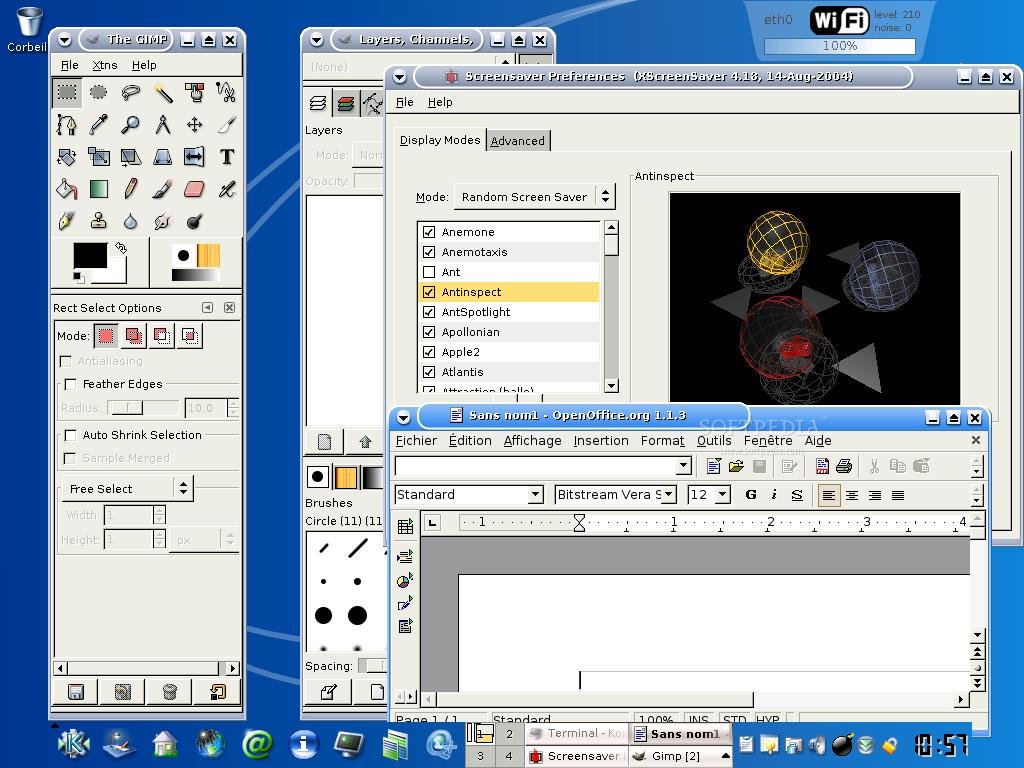
http://i1-linux.softpedia-static.com/screenshots/Arch-Linux_...
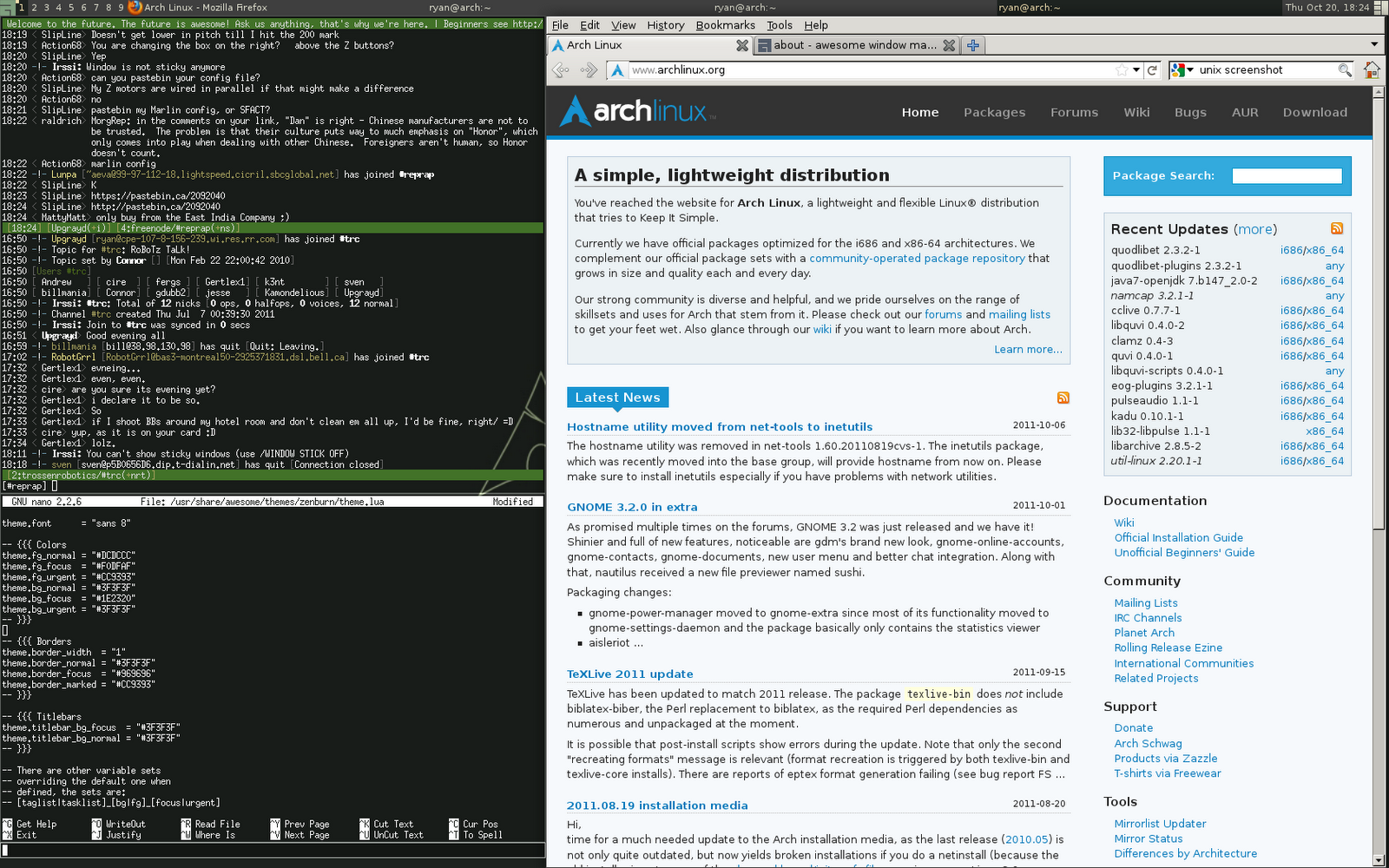
Case #2. Default Arch anti-aliasing with poor quality:
http://1.bp.blogspot.com/-JZ2dKqaJUYw/TqCuVyI3WDI/AAAAAAAAAj...
Just look at "archlinux" rendering in the URL.
And this is how Ubuntu looks by default:
http://www.documentingreality.com/forum/attachments/f111/334...
Notice the excellent typeface they developed themselves, consistent and high-quality anti-aliasing, etc. This looks gorgeous on a modern high-DPI screen. Group #1 thinks this "looks blurry" and Arch works fine for them.
Simply put, It is technically impossible for Arch to provide you with the best font experience because their freetype is compiled with, hm... parts of code removed. The parts that are responsible for hinting, bytecode interpretation and subpixel rendering. And the way they ship Open Office and Firefox (well, last time I checked) makes their fonts non-configurable at all, since they ignore system/global version of freetype.
You could not be more wrong.
I have probably worked more for my fonts than for anything else about my system, on any linux distro I've tried (on OSX, the rendering's fine but the actual font choices kind of blow...there I have other problems that consume much more of my time than the fonts).
On arch, I install the infinality patched freetype stuff from the AUR, set some preferences in .Xresources, install the fonts I like, and I'm good to go. On any other distro, installing patched freetype and overriding the distro-maintained font configuration invariably leads down the path of madness. I don't run the software you mention, but I have never seen an incompatibility issue.
You mention ubuntu. Honestly, its defaults are fine. That is, as long as you never try to use a different font, or install software that ignores the default, or try to use an alternative program like rxvt-unicode instead of gnome-terminal, or visit a web page that specifies its own font, or have a lowish dpi screen. Ubuntu's great if you stay inside the garden. I just barely don't, but it's enough to piss me off.
Also, I happen to not use openoffice or firefox, so I haven't run into the problems you describe. But I expect that they would look great on my system, because the only version of freetype I have installed has patches that do what I like.
EDIT: here's my screenshot with a 'd' and a 'p'. looks fine to me: http://imgur.com/UZJ17
> I install the infinality patched freetype stuff from the AUR
I proved my point right there. That's what I've been doing too and maintaining AUR-sourced patched core packages like that has been problematic: every once in a while you'll get a part of Gnome or something else demanding a higher version of freetype (which your patched version doesn't provide) and it either halts your update or forces you to get plain vanilla freetype.
And you haven't addressed the case of packages that don't use system cairo/freetype. BTW the rendering on your screenshot is excellent. Also I feel that this discussion is somewhat misplaced. :)
> Also I feel that this discussion is somewhat misplaced.
Yeah, probably. :)
Arch linux by default does not even have X installed by default. So while I install X, gnome, and nvidia drivers, the installation of the fonts of choice is the least of my concerns.
P.S. I am not bashing arch linux, I am just pointing out that the default Arch linux does not even have a ui and you can not compare this to Ubuntu.
Hm, interesting. I think all those examples look terrible. First thing I do on a new ubuntu install is this: http://ubuntuforums.org/showthread.php?t=208396 The result looks exactly as it does on my Windows 7 install (cleartype disabled, it makes my eyes bleed).
Looks fine in KDE4. Definitely not as crappy as the screenshots you've posted
Yes , because grandma just loves it when she does a system update and her entire desktop suddenly changes to something else or it decides to replace the Java distribution from under her so half of her stuff doesn't work any more.
If you want to get and keep non technical users consistency in terms of metaphors and the software itself is #1 thing.

Congratulations to all those past and present involved with Arch. Over the past few years Arch has become my favourite personal distro due to how much control it gives me over my system without being _too_ complicated.
Here is to another amazing 10 years for Arch as well as everyone working on other Linux distros. You are all pretty damn amazing in my opinion. Thank you for all you do and please don't stop =D
> Congratulations to all those past and present involved with Arch
Thanks! I still feel good about being listed on the fellows page as a past developer. :)
Happy birthday! And...
A question for people using arch: If I install arch correctly and study the basics, will I need to spend time maintaining it? I like the idea of having a distro I can customize and play with to really learn how linux works, but when I want to stop messing about and get work done, it would be nice for it to be as stable as OSX. Unrealistic?
Unlike Debian, Arch Linux has what they call a "rolling release schedule," which means that the only choices you have are (1) refrain from using Pacman at all to update your software, which of course leaves security vulnerabilities unpatched and (2) opening yourself up to major changes to major subsystems, like Gnome, any time you use pacman to update your system.
In contrast, on Debian, major changes to e.g. Gnome are mostly limited to when a new version of Debian comes out, and you get a lot of leeway as to when to upgrade to the new version, and in particular, sometimes you have the option of subscribing to just the security patches for your version of Debian -- an option that Arch Linux just does not offer at all.
And I got the impression that updates of Arch Linux broke things that required my manual intervention to fix more than updates of Debian did.
Still it is a very compelling distribution because of its "elegance".
I probably spend just as much time maintaining my OS X box as I did maintaining my Arch Linux box: e.g., when I upgraded from Leopard to Snow Leopard and from Snow Leopard to Lion, I had to install a bunch of stuff (a dict client, Gnu coreutils, Carbon Emacs, even wget IIRC) to get a comfortable environment, and the installation took a lot more time than it would have on a Linux distro. E.g., the upgrade to OS X 10.7.3 changed the behavior of sleep mode such that simply bumping the mouse wakes the system, which eliminates most of the value I used to get from putting the system to sleep, so now I have to ask on some forum for a way to revert to the OS X 10.7.2 behavior of waking only on key press or mouse button click.
> And I got the impression that updates of Arch broke things that required my manual intervention to fix more than updates of Debian did.
Maybe it looks more 'frequent' but when it does so it's in a much, much more limited scope each time. It's more like small, discrete steps vs a whole batch at once.
> you have the option of subscribing to just the security patches for your version of Debian -- an option that Arch Linux just does not offer at all.
That's because Arch subscribes to the opinion that upstream knows best, and puts emphasis on as much vanilla as possible (which contributes to its overall simplicity, leanness and elegance). Hence security update means version bump from upstream. Contrast with Debian which actively back ports security patches to the pinned version in each release.
> E.g., the upgrade to OS X 10.7.3 changed the behavior of sleep mode such that simply bumping the mouse wakes the system, which eliminates most of the value I used to get from putting the system to sleep, so now I have to ask on some forum for a way to revert to the OS X 10.7.2 behavior of waking only on key press or mouse button click.
Ironically (although I did not notice that particular behavior myself) this would restore the pre-Lion behavior.
I've been using Arch for about five years, and I can tell you that things break more frequently than with any other distro I've used for a suffiently long amount of time. Things break more frequently when you're tinkering with things, but sometimes even on routine updates. If you want something more stable, use Debian Testing or Slackware. That being said, Arch is great. Try it!
> things break more frequently
Yes it might be more frequent, yet each time it is of a more limited scope since it concerns a single, maybe two packages. Following the news and maybe the forums helps a lot. Example regarding the scope: I upgraded some machines Ubuntu 11.04 to 11.10, and so much breakage occurred that the machines required such an extend of work that they simply were declared unrecoverable and reinstalled from scratch.
> use Debian Testing
In the months following a release, Debian testing essentially == Sid, and breakage is infamous.
Yes, following the news is incredibly useful for preventing breakage on updates, and the forums are especially useful for repairing breakage since other people will often have had the same issue on a big update. Probably half the time something "breaks" on a `pacman -Syu' for me, it's just a quick fix that was the result of me neglecting to read the front page news.
Rolling-release distros and low-maintenance updates are pretty orthogonal concepts. That said, once you get it set up, it's only the major, breaking changes that require real work to maintain, and these are posted regularly on archlinux.com.
I update once a week, keep configs up to date with "yaourt -C" (yaourt is available in the AUR), and read archlinux.com prior to updates to avoid issues.
One caveat is that you need your /boot mounted if you keep it separate, or else anything that depends on linux-headers (like filesystem drivers :/) will break if there's a kernel update.
If you want stability along with the tweakability, go with Debian.
For me it is (unrealistic). Every update is fear that something will break. Vim, kmail, even gtk themes. You don't know the day or the hour.
At least that's how it is for me. I know many people who have no problems with updates breaking stuff in Arch; maybe it's the fact that I'm using a full-blown KDE instead of a mere xmonad or such. But I wouldn't recommend Arch to anyone who expects stuff to work.
IMO, minimalism is as much a defensive strategy as it is an aesthetic for Arch users.
Now that I have arch working for my needs, I spend hardly any time maintaining it.
The only issues come up when some sort of breaking change is released, and in that case there is always an article right on the arch homepage for steps to migrate to the new package.
and I suppose if your needs are limited cause you only need common services (emacs, firefox, tmux) those incidents will be pretty unusual?
Very unusual. The one time I had a fair amount of issues to resolve was when Arch switched to python 3 as the default, instead of 2. Fortunately, this is not something they do lightly or frequently.
I had the same concerns, but after a solid year on Arch only, I can say that things rarely break and if they do I learn something in the process.
Yes, sometimes, like every few months or so, there is some maintenance to do, but only after manually initiating system updates. Never once have I come across a maintenance issue that didn't have a quick solution already discussed on the Arch forums or wiki.
I find that almost every time something breaks it's really because I haven't been careful enough. What you need to do is watch out for any messages during updating (especially during kernel updates) and make sure to just use sudo carefully etc.
I also want to add that while people always seem to talk about Arch breaking, it has hardly broken more for me that Windows of Ubuntu have in the same period of time. The advantage is that when Arch breaks, you fix it because you just tend to really learn how your system works when you use Arch, while in Windows and Ubuntu, I'd just reinstall usually.
I use Arch as my only OS, for day-to-day use, and it's perfectly stable when I'm not actively experimenting etc.
In my own experience with Arch, things offered through AUR (while convenient) seem to cause more problems than that which is in core, extra, community, multilib, etc... In other words, things which pacman handles.
So using AUR introduces a bit of maintenance overhead in the sense that I spend more time reading the comments, checking the number of votes for an item, researching the dependencies that arise, etc. But I'm also happy AUR is there to supplement what is in the supported repos. That said, I've definitely had some MAJOR problems that I've had to work through using AUR packages.
I would say that your statement about putting in the time up front to learn how the system works in order to do relatively less system administration in the long run applies more to Gentoo than to Arch. I was a Gentoo user for several years before switching to Arch, and once you get all your configuration files set up on Gentoo, the system is rock solid. The only drawback is that you're compiling nearly everything from source based on your specific system configuration through make.conf and such, updates can take a while. However, the internal consistency and dependency resolution of emerge seems far, far better than pacman in my experience.
To me at this point Arch is as stable as OSX, and possibly even more so. I go weeks without reboots and my computer never slows down. I do updates almost every day, and most of the time have no problems. And I really appreciate the rolling-release paradigm. In fact, I'd be willing to bet that possibly sometime in the future, OSX could potentially go that route as well. It already seems like they're headed there in some ways.
I've been using Arch to 'get shit done' for about two years now. Apart from the occasional package upgrade to update everything to its latest versions, you don't have to do anything you don't want to.
I have seen arch break pretty spectacularly, but only on systems where i did some, to put it delicately, unadvisable things (put /tmp, /var/tmp on tmpfs, put /usr on unionfs over squashfs, etc). Where I have avoided breaking standard practice, I have never had a single problem. I also see it to arch's credit that I was able to do such horrific things to it with such ease (and fairly good documentation).
>I also see it to arch's credit that I was able to do such horrific things to it with such ease (and fairly good documentation).
This is the key differentiator between Arch and other distros (particularly, Debian): Arch wins when the user wants to modify the system in ways not intended by the maintainers of the distro. In contrast, Debian wins against Arch when the user never does anything that the maintainers of the distro did not anticipate that users would do. (Debian wins here because changes have gone through vastly more real-world testing and bug-fixing before hitting Debian stable than they have gone through before hitting the machine of the Arch user. Note that there is no stable version of Arch Linux.)
I have been using Archlinux for over 2 years. During this period I have installed it on all the machines I _own_ (3 laptops, 1 work desktop). The biggest problem I had was when I had /usr on its own partition. This behavior was not recommended and an update broke it. However this was easy to fix and took < 20 minutes to resolve.
Also, try to use pacman as much as possible.
If I never broke anything...I would not know much about Linux! I think part of maintaining a distro like Arch is dealing with things breaking. The good news is that you learn about how something works and usually can figure out a solution. The Arch community is awesome and is very responsive when things don't work.
What I don't like about Arch is that it doesn't provide debug symbol packages, which makes it useless for providing crash bug reports for programs written in compiled languages unless the user is willing to recompile them. IMHO general-purpose distros have moral (or at least pragmatic) imperative to support the development of the software that they ship, and making sure users can file decent bug reports easily is an important part of that.
Meanwhile, other distros have gotten to the point of automatically installing the right debug symbol packages right from the crash reporter built into app suites like KDE's to generate useful backtraces.
After experimenting with countless distros over the years, Arch is by far my favorite. It combines the customizability of Gentoo with the simplicity of Slackware. Long live Arch!
It's a couple days too late to wish Arch happy birthday, but if you're very quick, you can still wish Albert Einstein happy birthday. He'd be 133 today. Unfortunately there's no real location of his corpse that you can visit as he was cremated, but last I heard, his eyes are kept in a safe deposit box somewhere in New York, there's a couple slides of his brain at the Mütter Museum in Philadelphia, and the majority of his brain is somewhere in Princeton.
If you can, try and track down the documentary Einstein's Brain by Kevin Hull[1], an amusing yarn about a Japanese professor's trip across the US in search of the great man's grey matter.
3 machines running on Arch Linux and no major issues up to now.
It's just perfect for me. I love how easy it is to quickly build a new package (not that I need to write PKGBUILDS myself often, most things are available in the AUR)
Happy Birthday!
1.5 years on Arch here and I pretty much refuse to use any other distro on my laptop. Great work.
I'm not sure exactly when I moved over to Arch from Crux, I'm sure the distribution was at least a few months old by then, but it's been a great distribution as long as I've known it.
It does suffer the occasional dip into making things more complicated than they need to be, some element of the distribution straying towards the "SysV" darkside and away from the "BSD" ideal, or an upstream's configuration system just getting too insane to work around any longer, but everything always works back to some sense of balance after a few years. And it does feel like upstreams come around to the Arch way of thinking more often that the other way around.
I do wish it was a bit easier to automatically build or just download pre-made packages with some of the more popular compile flag variants, ports- or portage-style, but not so much that it casts a shadow on all the other benefits of Arch.
Still, it would be nice to be able to install a console vim with python and ruby interpreter support without having to install gnome too, or being able to install java on a headless server without having to stick half of X11 on there, or not having to install Apache because you want to change nginx's modules. It's always possible to change the PKGBUILD and recompile, but it seems like just changing one enable/disable switch to ./configure should be easier than it often is (vim is especially a pain to keep a custom PKGBUILD of, the ABS PKGBUILD seems to undergo massive revisions every few months).
But really the distribution is just great, the best out there. It lets you use pure Linux and avoid all the hoop jumping other distributions make you do in order to keep their package managers happy, while still giving you all the benefits you want from a distribution like automatic pre-compiled upgrades. And that's enough to make it the best balance of a distribution out there for me.
I've been using debian based systems (including ubuntu) for over a decade now, and I can't think of more than a handful of times time I've had to jump through hoops to keep apt and dpkg happy. You may not always have the latest version of the software, but the productivity compared to compile.everything or rpm-based systems is significant. Almost everytime I need a piece of software, it's one command away.
It is hard to see what your comment has to do with Arch Linux since it is neither a compile.everything nor an rpm-based system.
But yeah, for users willing to adapt themselves to a system, as opposed to adapting the system to their desires, the debian-based distros are probably the best Linux distros.
My comment was in response to "avoid all the hoop jumping other distributions make you do in order to keep their package managers happy, while still giving you all the benefits". Personally, I believe those hoops to be a myth.
Arch has the fewest deviations from "regular" linux of any distribution I've tried, probably because keeping everything as close as possible to vanilla is one of the core principles of the distribution. It still has all the convenience of the one command software install or upgrade, but it doesn't place itself between you and the software once it is installed like so many other distributions do. It's great if vanilla linux is what you've grown up using, it's probably a moot point if you don't default to trying to do things the standard, vanilla way.
I have had other distributions autogenerate and overwrite hand-modified /etc files, and not just system-level ones but even daemon config files! It was something like the distribution required you to edit a distribution-unique "local changes" file for the daemon, not the daemon's actual config file, all so the package manager could incorporate parameters out of some sort of "friendly" config database into a new autoregenerated config file.
Many distributions require that you run a custom command just to do something as stupidly simple as create the /etc/localtime symlink, sometimes even dropping you into a GUI (to create a symlink! Arch is guilty of autocreating this symlink too, but at least it's controlled by a single ASCII line in the distribution's one main distribution-specific config file, rc.conf). Or some distributions have "SysV"-type init systems but require you to use a custom command to handle creating and deleting the symlinks for starting and stopping daemons. Again, usually to allow a package manager to alter those same files without having to figure out what a human has done to them. Those are the sort of "hoops" I'm thinking of.
My complaint's not that those systems exist for people to use, especially if it makes things easier for them, it's just that everyone is forced to use them. Those custom commands/the package manager integration is usually pretty delicate and almost always breaks completely if you try to do things the standard way, without going through them, or if they don't break they stay resilient by silently erasing your changes.
I'm sure there are great advantages to be had by committing fully to a given distribution's custom systems. People managing large or many systems probably find a lot of problems solved by the distributions' custom methods of doing things and the tight integration of those methods with their package managers (but I'm just running a laptop). I'm sure they're also just fine if you first learn how to do a specific configuration change on that distribution, and then don't even need to care what the real output of your manipulations of the distribution's configuration system is.
But if you already know the form of the change you want to happen, the exact line in a config file that you want changed or the exact flag passed to a daemon on startup, it's incredibly frustrating. You have to wade through all of a distribution's weird changes to a piece of software and its added config system layers just to figure out how to mangle your change in such a way that the distribution will unmangle it back into the exact form you could have just edited into the program's config file by hand in 3 seconds.
It's been a long time since I've tried Debian, I don't know what it's like in its modern form, how much you are required to actually cooperate with the distribution's unique systems or if you can ignore them without breaking anything. But the presence of debconf, alternatives, and update-rc.d all sound very discouraging.
Arch is what I have been running (since around 2006). I love the simplicity. When things do break, there is an amazing community waiting to provide support. The Arch community rules! I think Arch is quickly becoming what Gentoo was...(hopefully I dont start a war!).
What do you think gentoo was? When I used it (2005-7ish), I think it was a toy for brat haxxors. At the time, I was a brat haxxor, so it worked well.
During a certain period the Gentoo wiki was one of the best resources for configuration and debugging, even if you used another distro. The downfall might be coincide with the Big Wiki Loss [0].
[0] http://eddiedu.wordpress.com/2008/11/03/gentoo-wiki-gentoo-p...
Like others, I also love Arch and have been using it since 2007. Although I started with Slackware, I find myself using Arch as my primary Linux distribution these days because I feel it is the best of Slackware, Crux, FreeBSD and maybe Gentoo to an extent. As power users, I'm sure we can all appreciate Arch for what it has become. I look forward to using Arch in the coming years.
Happy Birthday Arch Linux!!
I'm using Arch on the desktop lately and liking the bleeding edge updates and simplicity however I'm still loving Gentoo more on the servers, the portage system forces you to build everything just according to your needs where by default with Arch I'm getting pre-compiled stuff.
Anyone running Arch on servers, how does it compare to Gentoo in your opinion?
How would you compare Arch to Mint? Which one would you recommend for people wanting to get deeper into Linux?
I think they are in quite the opposite ends of Linux desktop distro spectrum. Mint attempts to provide nice out-of-the-box experience and Arch is "tweak everything". Mint being based (more or less directly) on Debian includes far more distro-specific patches than Arch which has fairly vanilla packages (afaik).
As for my recommendation, imho you should learn the system you are going to use. If you want to learn Debian, use Debian (or Mint, or some other close Debian derivate). If you want to learn Arch, then use Arch. Every major distro can be poked and prodded, tweaked to no end, and you can look what happens under the hood.
Arch will give you a deeper view than Mint, including having to make choices for yourself, about every component you wish to use.
It's the community that really makes Arch a great distro in my opinion. Because of them we have an excellent well-moderated forum with technically competent and helpful members, an outstanding wiki and a huge amount of software available in the AUR.
Happy birthday, my beautiful Arch! I've only been a devotee since October, 2010, and I don't know how I got along without it. While others are fighting with old. outdated bugs, I get to fight only the newest, shiniest bugs.
Just tried out Arch a week back now, and I was quite happy with it. Here's to 10 more years!
wow, 10 years. I've been using it for a couple of years now.
But I do occasionally find it hard/difficult (from a mental POV), and I fall back on Fedora. I'll be a true *nix guy when I can stop doing that. :)
10 years and still simple and awesome. Thank you guys. Really.
Arch has the best documentation.